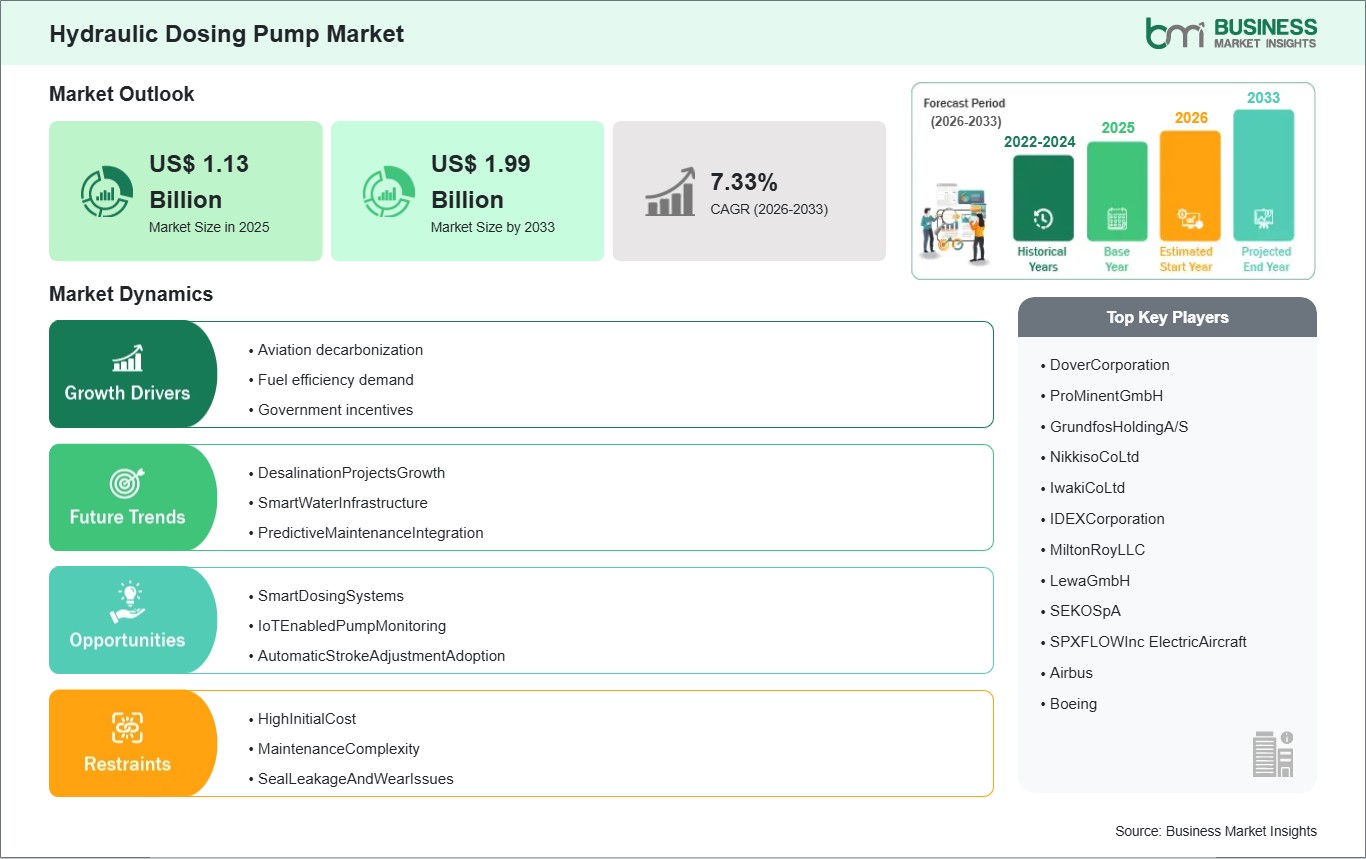
The Hydraulic Dosing Pump Market size is expected to reach US$ 1.99 Billion by 2033 from US$ 1.13 Billion in 2025.The market is estimated to record a CAGR of 7.33% from 2026 to 2033.
The Hydraulic Dosing Pump Market refers to precision fluid handling systems designed to inject controlled volumes of chemicals or fluids into process streams under high-pressure conditions. These pumps are widely used in applications requiring accurate dosing, including water and wastewater treatment, oil and gas operations, chemical processing, and food and beverage manufacturing. Hydraulic dosing pumps operate using hydraulic drive mechanisms that enable high discharge pressures, precise flow control, and consistent performance even in demanding industrial environments. They are typically available in configurations such as plunger/piston pumps and diaphragm pumps, with variations in stroke adjustment methods (manual and automatic) and discharge-pressure ranges from low-pressure systems up to ultra-high-pressure applications exceeding 500 bar. The market is increasingly driven by the need for reliable chemical injection systems that ensure process efficiency, regulatory compliance, and operational safety across critical industries.
The market is witnessing steady expansion due to rising global demand for efficient water treatment infrastructure, increasing industrialization, and stringent environmental regulations governing wastewater discharge and chemical handling. The oil and gas industry remains a key demand center, where hydraulic dosing pumps are essential for corrosion inhibition, chemical injection, and enhanced oil recovery processes. Similarly, the growing focus on clean water access and industrial effluent treatment is accelerating adoption in municipal and industrial water treatment plants. Technological advancements such as automatic stroke adjustment, smart control systems, and integration with digital monitoring platforms are further enhancing pump efficiency, accuracy, and remote operability. Additionally, the shift toward energy-efficient and low-maintenance pumping systems is supporting product innovation and replacement demand across mature markets.
However, the market faces several restraints that may limit its growth trajectory. High initial capital investment and maintenance costs associated with high-pressure hydraulic dosing systems can deter adoption, particularly among small and medium-scale industries. Operational challenges such as seal wear, leakage risks in diaphragm systems, and sensitivity to fluid compatibility can impact long-term reliability and increase downtime. Furthermore, complex system integration requirements with existing industrial process control infrastructure may pose technical barriers during installation and commissioning. Variability in raw material costs and the need for skilled operators to manage precision dosing systems also add to total cost of ownership. In addition, competition from alternative dosing technologies such as peristaltic and solenoid pumps presents a degree of substitution risk in low- to medium-pressure applications.
Despite these challenges, the long-term outlook for the Hydraulic Dosing Pump Market remains positive, supported by increasing investments in water infrastructure, expanding industrial processing capacity, and rising environmental compliance requirements worldwide. Opportunities are emerging through the adoption of automation, IoT-enabled monitoring systems, and predictive maintenance technologies that enhance operational efficiency and reduce lifecycle costs. The growing emphasis on sustainable industrial operations and chemical optimization is further driving demand for high-precision dosing solutions. As industries continue to prioritize process reliability, safety, and regulatory adherence, hydraulic dosing pumps are expected to remain a critical component of global fluid management systems.

The Hydraulic Dosing Pump market is segmented based on pump type, stroke-adjustment method, discharge-pressure range, and end-use industry, reflecting the growing demand for precise, high-pressure chemical dosing solutions across water treatment, oil and gas, and industrial processing applications.
The Hydraulic Dosing Pump market is being driven by the increasing need for accurate, reliable, and high-pressure chemical injection across critical industrial processes such as water and wastewater treatment, oil and gas operations, chemical manufacturing, and food and beverage production. Growing global concerns regarding water scarcity and environmental pollution are significantly accelerating investments in advanced treatment infrastructure, where hydraulic dosing pumps play a key role in ensuring precise chemical dosing for disinfection, pH control, and effluent treatment.
In the oil and gas sector, rising exploration activities and stringent operational safety requirements are fueling demand for high-pressure dosing systems used in corrosion inhibition, scale prevention, and enhanced oil recovery processes. Similarly, the expansion of industrial manufacturing and tightening environmental regulations are pushing industries to adopt efficient chemical handling systems that minimize waste and improve process control. Technological advancements such as automatic stroke adjustment, smart flow control systems, and improved diaphragm and plunger pump designs are further enhancing dosing accuracy, operational reliability, and energy efficiency. Collectively, these factors are driving steady adoption of hydraulic dosing pumps across both developed and emerging economies, supported by the global push toward sustainable industrial operations and regulatory compliance.
Opportunities in the Hydraulic Dosing Pump market are expanding through the increasing integration of automation technologies, IoT-enabled monitoring systems, and intelligent process control platforms. The adoption of automatic stroke adjustment systems and digitally controlled dosing units is enabling real-time flow optimization, predictive maintenance, and reduced operational downtime, significantly improving system efficiency and lifecycle performance.
The growth of Industry 4.0 and smart manufacturing ecosystems is creating strong opportunities for connected dosing solutions that can seamlessly integrate with plant control systems and SCADA platforms. Additionally, the rising adoption of remote monitoring and cloud-based analytics is enabling operators to track pump performance, chemical usage, and system health in real time, improving operational transparency and cost efficiency.
Expanding investments in water infrastructure development, desalination projects, and wastewater recycling initiatives are further strengthening long-term demand for advanced dosing technologies. Moreover, increasing focus on energy-efficient and low-maintenance pumping solutions is driving innovation in pump design and materials, including improved sealing systems and corrosion-resistant components. The growing emphasis on sustainable industrial operations and process optimization is also creating new avenues for advanced hydraulic dosing systems in emerging markets. Collectively, the convergence of automation, digitalization, and sustainability trends is positioning the Hydraulic Dosing Pump market for strong and sustained long-term growth..
The Hydraulic Dosing Pump Market is projected to grow from US$ 1.13 Billion in 2025 to US$ 1.99 Billion by 2033 , registering a CAGR of 7.33% from 2026 to 2033.
By pump type, plunger/piston pumps account for a significant share of the Hydraulic Dosing Pump market due to their ability to deliver high-pressure, precise, and consistent chemical dosing in demanding industrial applications such as oil and gas, water treatment, and chemical processing. Diaphragm pumps continue to grow steadily as they offer leak-free operation, high reliability, and strong resistance to corrosive and hazardous fluids, making them suitable for sensitive and safety-critical environments. Other pump types also contribute to niche applications where customized flow rates and specialized process requirements are needed.
By stroke-adjustment method, manual stroke systems hold a notable share due to their cost-effectiveness and widespread use in basic dosing applications across small and medium-scale industries. However, automatic stroke adjustment systems are witnessing rapid growth, driven by increasing demand for precision dosing, real-time flow control, and integration with automated industrial systems. Their ability to optimize chemical usage, reduce wastage, and enhance process efficiency is accelerating adoption across large-scale industrial operations.
By discharge-pressure range, the 100 to 500 bar segment dominates the market as it is widely used in critical applications such as chemical injection, oil and gas processing, and industrial water treatment where controlled high-pressure dosing is required. The up to 100 bar segment maintains steady demand in low-pressure applications such as basic water treatment and light industrial processes. Meanwhile, the above 500 bar segment is expanding in specialized high-pressure environments including refinery operations and heavy industrial processing where extreme operating conditions are present.
By end-use industry, water and wastewater treatment accounts for a significant share due to increasing global investments in clean water infrastructure, strict environmental regulations, and rising demand for efficient chemical dosing in treatment processes. The oil and gas sector also holds a strong position, driven by the need for corrosion control, scale inhibition, and enhanced oil recovery operations. The food and beverage industry is growing steadily, supported by requirements for hygienic and precise fluid dosing in processing applications. Other end-use industries, including chemical manufacturing and power generation, continue to contribute to overall market expansion through diverse industrial dosing requirements.
| Report Attribute | Details |
|---|---|
| Market size in 2025 | US$ 1.13 Billion |
| Market Size by 2033 | US$ 1.99 Billion |
| Global CAGR (2026 - 2033) | 7.33% |
| Historical Data | 2022-2024 |
| Forecast period | 2026-2033 |
| Segments Covered | By By Aircraft Type
|
|
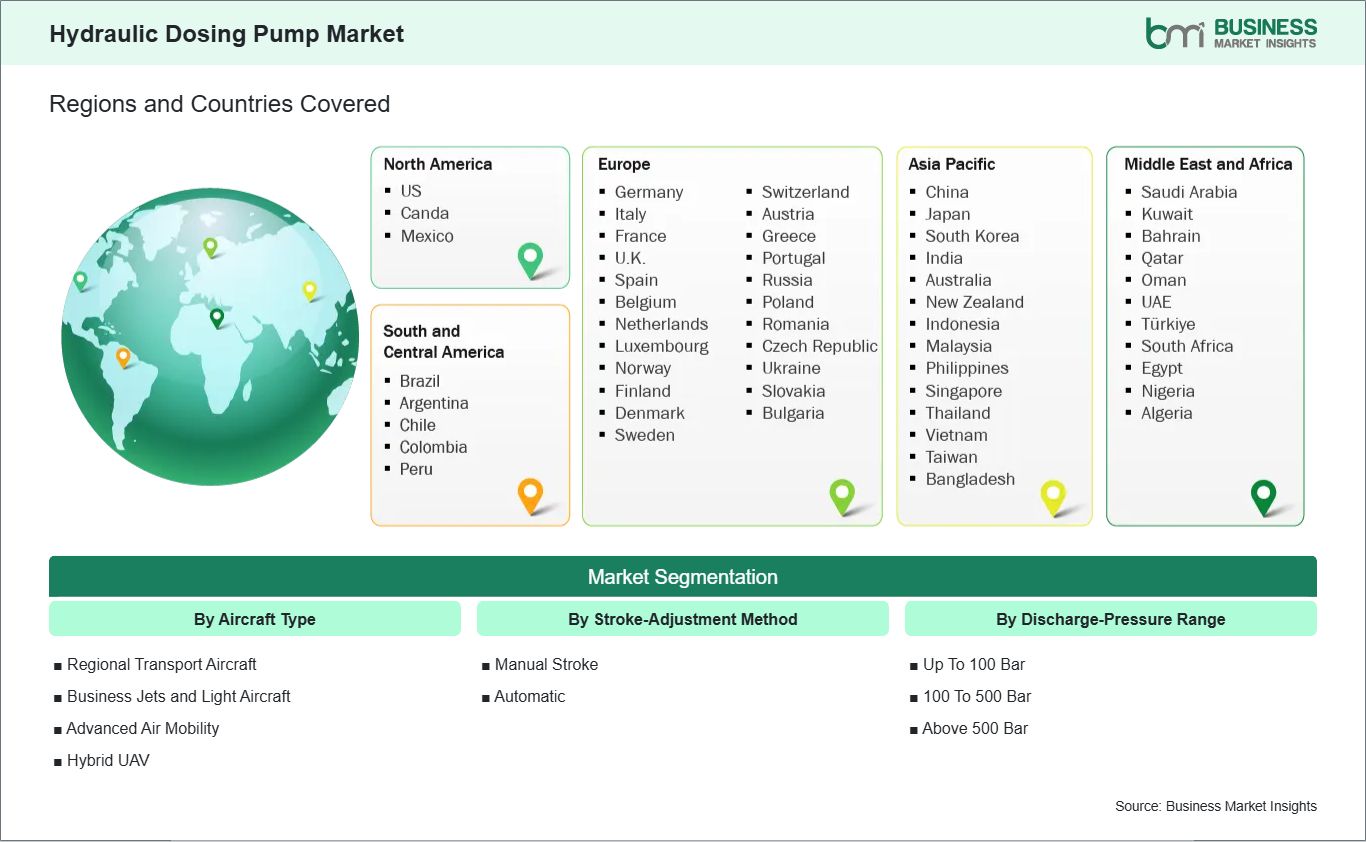
Regions and Countries Covered
| |
| North America | US, Canada, Mexico |
| Europe | Germany, Italy, France, U.K., Spain, Belgium, Netherlands, Luxembourg, Norway, Finland, Denmark, Sweden, Switzerland, Austria, Greece, Portugal, Russia, Poland, Romania, Czech Republic, Ukraine, Slovakia, Bulgaria |
| Asia-Pacific | China, Japan, South Korea, India, Australia, New Zealand, Indonesia, Malaysia, Philippines, Singapore, Thailand, Vietnam, Taiwan, Bangladesh |
| South and Central America | Brazil, Argentina, Chile, Colombia, Peru |
| Middle East and Africa | Saudi Arabia, United Arab Emirates, Kuwait, Bahrain, Qatar, Oman, Turkiye, South Africa, Egypt, Nigeria, Algeria |
| Market leaders and key company profiles |
|
The "Hydraulic Dosing Pump Market Size and Forecast (2022–2033)" report provides a detailed analysis of the market covering below areas:
The Hydraulic Dosing Pump Market shows distinct regional growth patterns driven by increasing investments in water treatment infrastructure, stringent environmental regulations, expansion of industrial manufacturing, and rising demand for precise chemical dosing solutions across process industries.
North America, being a technologically advanced and highly regulated industrial region, holds a strong position in the market due to the presence of well-established water treatment systems, oil and gas operations, and chemical processing industries. The United States and Canada are witnessing strong adoption of hydraulic dosing pumps in municipal water treatment plants, wastewater management facilities, and refinery operations. The region is also characterized by a high focus on environmental compliance and operational efficiency, driving demand for automated and digitally controlled dosing systems. Increasing investments in upgrading aging water infrastructure, along with the adoption of smart monitoring and IoT-enabled pump control systems, are further supporting market growth. Additionally, stringent EPA regulations and sustainability initiatives are pushing industries toward more precise and efficient chemical dosing technologies.
Asia Pacific is emerging as the fastest-growing region in the Hydraulic Dosing Pump Market, driven by rapid industrialization, urbanization, and large-scale infrastructure development. Countries such as China, India, Japan, and South Korea are heavily investing in water and wastewater treatment facilities to address rising pollution levels and water scarcity concerns. The expansion of the oil and gas, chemical, power generation, and food processing industries is significantly boosting demand for high-performance dosing systems. Strong manufacturing capabilities and cost-effective production of industrial equipment are enabling widespread adoption across both large-scale and small-scale industries. Furthermore, government initiatives focused on clean water access, environmental protection, and industrial modernization are accelerating deployment. The increasing shift toward automation and smart industrial systems is also enhancing the integration of advanced hydraulic dosing pumps in the region.
Europe represents a mature yet steadily growing market, supported by strict environmental regulations, strong emphasis on sustainability, and advanced industrial infrastructure. Countries such as Germany, the United Kingdom, France, and Italy are key contributors, with widespread adoption in chemical processing plants, water treatment facilities, and industrial manufacturing sectors. The region’s focus on energy efficiency, emission reduction, and circular economy practices is encouraging the use of advanced dosing technologies with improved accuracy and reduced chemical wastage.
Middle East & Africa is witnessing growing demand driven by increasing investments in desalination plants, oil and gas exploration activities, and industrial expansion. Gulf countries such as Saudi Arabia and the UAE are major adopters, particularly in water treatment and refinery applications where high-pressure dosing systems are essential.
South and Central America is gradually expanding, supported by rising investments in municipal water treatment, mining, and industrial sectors in countries like Brazil and Mexico. Growing awareness regarding water quality and environmental compliance is further supporting market penetration.
Overall, regional growth in the Hydraulic Dosing Pump Market is being shaped by a combination of infrastructure development, environmental regulations, industrial expansion, and increasing adoption of automated and energy-efficient dosing solutions across global markets..

The Hydraulic Dosing Pump market is evaluated by gathering qualitative and quantitative data post primary and secondary research, which includes important corporate publications, association data, and databases. A few of the key developments in the Hydraulic Dosing Pump market are:
The Hydraulic Dosing Pump Market is valued at US$ 1.13 Billion in 2025, it is projected to reach US$ 1.99 Billion by 2033.
As per our report Hydraulic Dosing Pump Market, the market size is valued at US$ 1.13 Billion in 2025, projecting it to reach US$ 1.99 Billion by 2033. This translates to a CAGR of approximately 7.33% during the forecast period.
The Hydraulic Dosing Pump Market report typically cover these key segments-
The historic period, base year, and forecast period can vary slightly depending on the specific market research report. However, for the Hydraulic Dosing Pump Market report:
The Hydraulic Dosing Pump Market is populated by several key players, each contributing to its growth and innovation. Some of the major players include:
The Hydraulic Dosing Pump Market report is valuable for diverse stakeholders, including:
Essentially, anyone involved in or considering involvement in the Hydraulic Dosing Pump Market value chain can benefit from the information contained in a comprehensive market report.
Please tell us your area of interest
(Market Segments/ Regions and Countries/ Companies)