Market Summary
Executive Summary and Global Market Analysis
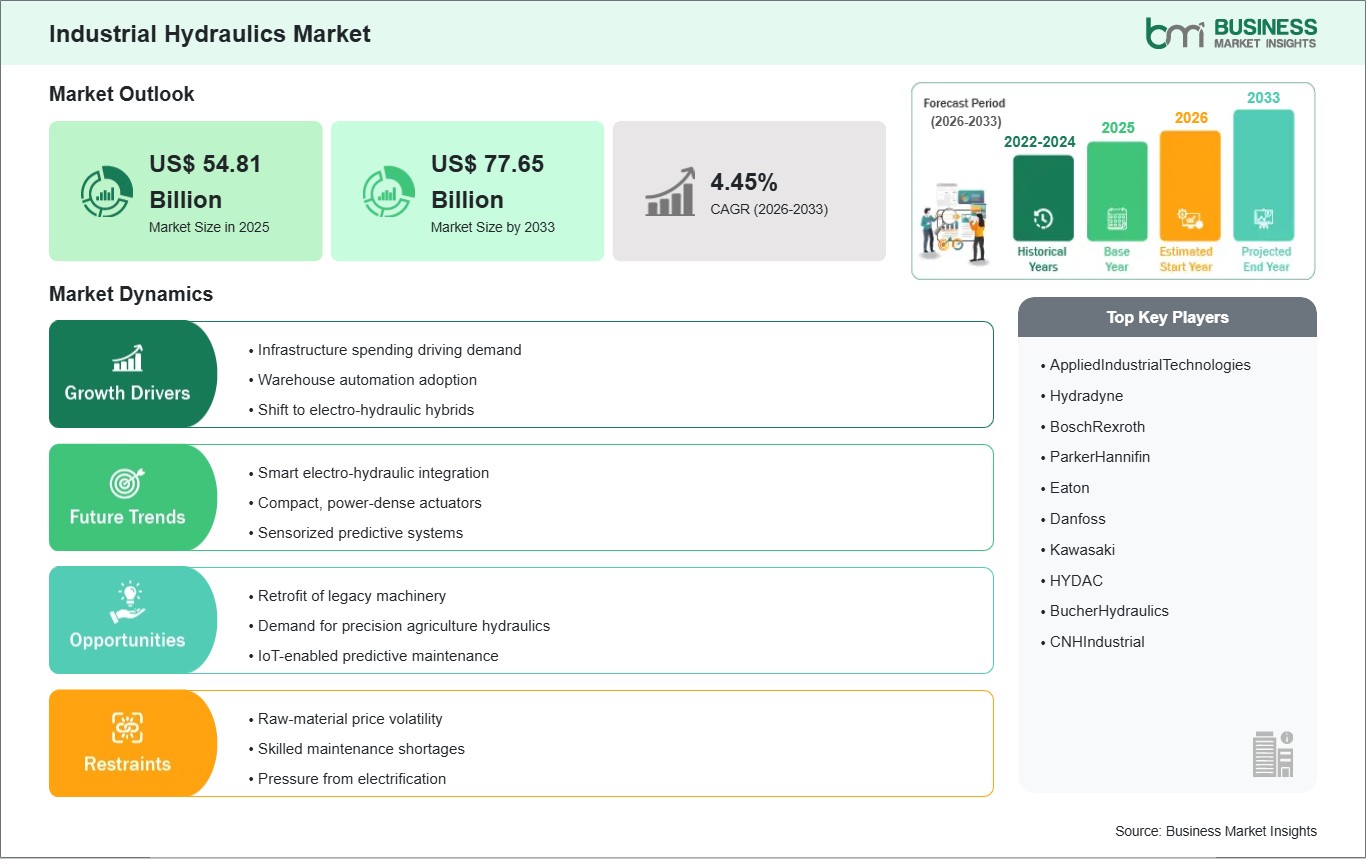
Industrial hydraulic systems convert fluid pressure into controlled mechanical force for heavy-duty industrial and mobile operations. These systems assist in lifting, pressing, steering, motion control, and load handling across construction equipment, manufacturing machinery, mining systems, and aerospace platforms. Hydraulic components are crucial for applications that require high power density, operational precision, and consistent mechanical performance in tough environments. Modernizing infrastructure, mechanizing agriculture, and investing in automation-focused manufacturing continue to boost equipment use in various industries. Industrial operators are increasingly focusing on machinery that can maintain stability, reduce energy waste, and support continuous-duty cycles. Hydraulic technologies are important where electric alternatives struggle with torque limitations or durability issues in extreme conditions. Demand trends vary significantly across equipment types and end-user industries. Pumps, cylinders, and valves are widely used due to their key role in hydraulic power transmission and control operations. The construction and material handling sectors are major application areas, as large machinery needs reliable force generation and motion regulation under changing operational loads. The industry is increasingly focusing on intelligent hydraulics, electro-hydraulic integration, compact system designs, and digital monitoring capabilities. Manufacturers are adding sensor-enabled diagnostics, predictive maintenance tools, and energy-efficient hydraulic circuits to improve responsiveness and maintenance schedules. Integration with industrial automation systems also enhances operational transparency in connected manufacturing environments. Competition in the sector centers on product reliability, custom engineering, after-sales services, and innovation tailored to specific applications. Companies continue to enhance hydraulic efficiency, compact designs, and control accuracy to meet changing industrial performance needs. Strategic investments in digital hydraulics and electrified hydraulic solutions are shaping future product development priorities in global industrial markets.
Segment Analysis
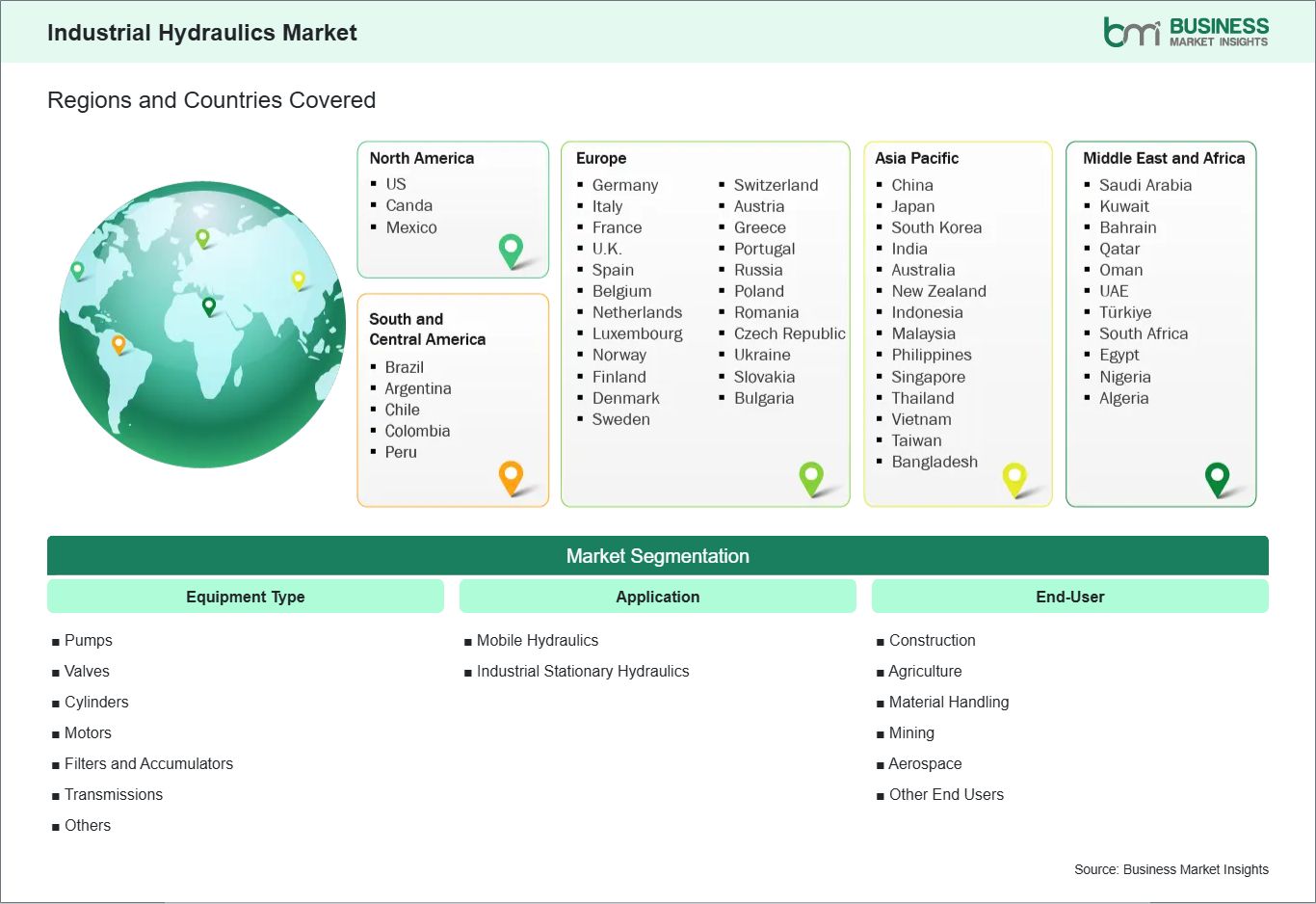
Industrial Hydraulics Market Segmentation
Industrial hydraulics systems support multiple industrial environments through application-specific pressure and motion control technologies.
By Equipment Type
- Pumps – Enable consistent fluid transfer across high-pressure industrial machinery systems.
- Valves – Regulate hydraulic flow accuracy during complex operational processes.
- Cylinders – Deliver controlled linear force for lifting and pressing applications.
- Motors – Provide rotational movement within heavy-duty industrial equipment assemblies.
- Filters and Accumulators – Maintain fluid cleanliness and stabilize hydraulic pressure conditions.
- Transmissions – Support torque conversion across mobile and stationary equipment platforms.
- Others – Address specialized operational requirements across customized hydraulic systems.
By Application
- Mobile Hydraulics – Widely utilized in off-road and construction machinery environments.
- Industrial Stationary Hydraulics – Common across manufacturing plants and automated processing facilities.
By End-User
- Construction – Requires durable hydraulic systems for excavation and lifting operations.
- Agriculture – Supports mechanized farming equipment with high-force operational capabilities.
- Material Handling – Enhances movement precision within warehouse and logistics environments.
- Mining – Operates reliably under abrasive and high-load working conditions.
- Aerospace – Enables controlled actuation in aircraft manufacturing and maintenance systems.
- Other End Users – Includes marine, energy, and industrial processing applications.
Market Forces
Industrial Hydraulics Market Drivers and Opportunities
Expansion of Industrial Automation Infrastructure
Manufacturing facilities are increasingly using automated machines that need precise motion control and consistent efficiency. Hydraulic systems are well-suited for high-force industrial tasks where durability and accuracy must work together under tough production conditions. Industrial operators are replacing traditional machines with new hydraulic systems that can support synchronized manufacturing, automated material handling, and connected production settings. The ongoing move towards smart manufacturing environments is driving the demand for digitally integrated hydraulic equipment. Industries want systems that can reduce downtime while enhancing machine responsiveness and maintenance visibility. Hydraulic technologies with smart diagnostics and pressure-monitoring features fit well with changing industrial automation models and promote long-term efficiency in production-heavy sectors.
Advancements in Electro-Hydraulic and Energy-Efficient Systems
Electro-hydraulic systems are becoming more popular as industries aim for better efficiency and machine control. Manufacturers are increasingly creating compact hydraulic solutions that include sensors, digital controllers, and predictive maintenance features. These innovations improve equipment responsiveness and help save energy in both mobile and stationary industrial applications that need reliable performance. Future opportunities are tied to electrification trends, sustainability efforts, and connected industrial systems. Hydraulic manufacturers are focusing on developing low-emission equipment designs and smart fluid power technologies. Increasing use in construction modernization, precision agriculture, and industrial automation is likely to create long-term opportunities for advanced hydraulic systems and digitally connected components.
Size and Share Analysis
Industrial Hydraulics Market Size and Share Analysis
The Industrial Hydraulics Market is projected to grow from US$ 54.81 Billion in 2025 to US$ 77.65 Billion by 2033 , registering a CAGR of 4.45% from 2026 to 2033. Market expansion shows the continued use of hydraulic technologies in construction machinery, industrial automation systems, agricultural equipment, and material handling operations. Ongoing investments in energy-efficient hydraulic solutions and smart control systems support long-term growth in the industry. Pumps and valves hold a significant market share because they are crucial for fluid control and power transmission.
Cylinders and motors also see strong demand as heavy industrial equipment relies on consistent force generation and reliable operation. Equipment manufacturers are focusing more on compact system integration and digitally monitored hydraulic assemblies. Mobile hydraulics is a key application area due to widespread use in construction, mining, and agricultural machinery. Industrial stationary hydraulics keep growing in manufacturing plants adopting automated production systems. Material handling and aerospace applications also aid market growth with their specialized hydraulic motion-control needs and precision-driven operations.
Report Coverage
Industrial Hydraulics Market Report Coverage and Deliverables
The "Industrial Hydraulics Market Size and Forecast (2022-2033)" report provides a detailed analysis of the market covering below areas:
- Market size and forecast at global, regional, and country levels for all market segments covered under the scope
- Market trends, as well as drivers, restraints, and opportunities
- Market analysis covering key trends, global and regional framework, major players, regulations, and recent developments
- Industry landscape and competition analysis covering market concentration, heat map analysis, prominent players, and recent developments for the Industrial Hydraulics market
- Detailed company profiles, including SWOT analysis
Geographic Insights
Industrial Hydraulics Market Geographic Insights
The industrial hydraulics market exhibits varied regional adoption patterns. These patterns are influenced by the maturity of industrial automation, infrastructure development priorities, equipment manufacturing abilities, and mechanization trends in major economies. Demand characteristics differ significantly between developed industrial regions and emerging economies. In many cases, machinery modernization and construction activity are reshaping how hydraulic equipment is used. North America has a highly developed hydraulic equipment ecosystem. It is supported by manufacturing industries that rely heavily on automation and large-scale construction projects. Operators in the region focus on system durability, energy efficiency, and integrating predictive maintenance into hydraulic machinery. The modernization of aerospace manufacturing, material handling infrastructure, and mining equipment also plays a role in the ongoing use of advanced hydraulic systems in various industrial settings. In the Asia Pacific, there is strong use of industrial hydraulics due to growing manufacturing capacity, agricultural mechanization, and large infrastructure programs. Industrial growth in China, India, Japan, and Southeast Asian countries continues to encourage the use of hydraulic machinery in construction, mining, and factory automation. Regional manufacturers are increasingly adopting compact and digitally monitored hydraulic systems to enhance productivity and improve equipment efficiency. Europe shows steady market activity thanks to industrial engineering expertise, initiatives for manufacturing modernization, and innovations focused on sustainability. There is a strong demand for energy-efficient hydraulic systems and electro-hydraulic technologies in industrial automation and heavy machinery applications. Emerging markets in the Middle East, Africa, and South and Central America are gradually increasing their use of hydraulic equipment, driven by mining investments, infrastructure projects, and the growth of industrial processing operations.
Industry Activity
Recent Developments
The Industrial Hydraulics market is evaluated by gathering qualitative and quantitative data post primary and secondary research, which includes important corporate publications, association data, and databases. A few of the key developments in the Industrial Hydraulics market are:
- In April 2026, Wipro Hydraulics and Indeco Ind Spa entered into a definitive agreement for Wipro to acquire Indeco Ind Spa. This landmark partnership comes at a symbolic moment, as both companies celebrate 50 years of engineering excellence and market leadership. The union brings together two leaders in their respective fields: Indeco, a global benchmark in hydraulic attachments, and Wipro Hydraulics, one of the world’s largest independent manufacturers of hydraulic cylinders.
- In January 2026, Bosch Rexroth and HydraForce established a new leadership structure for its Compact Hydraulics Business Unit. The new framework integrates strategic appointments in key roles, creating a complete and future-oriented team capable of responding with agility to market changes.
Trust & Transparency
Research Methodology
The market analysis combines proprietary research with secondary data from government agencies, company disclosures, regulatory filings, industry databases and expert interviews. Market estimates are validated through data triangulation, cross-market benchmarking and analyst
review.
View Full Research Methodology
Key Sources Referred:
World Bank – Global Trade Indicators
World Trade Organization (WTO)
International Monetary Fund (IMF)
International Trade Administration (ITA)
Company Websites
Company Annual Reports
Company Investor Presentations