Market Summary
Executive Summary and Global Market Analysis
Mechanical components designed to join or secure objects through threaded or non-threaded techniques form the foundation of industrial fasteners. These components ensure structural integrity across machinery, infrastructure, and transportation systems. Their material composition and structural configuration determine performance under varying loads and environmental conditions, positioning them as essential assembly elements in engineered products. Expanding industrial production and infrastructure investments are strengthening consumption across end-use sectors. The automotive and construction industries increasingly rely on precision-engineered fastening solutions to ensure safety and durability. Manufacturing automation further accelerates adoption, as consistent fastening quality becomes critical in high-volume production environments.
Segment-wise dynamics reveal distinct usage patterns across materials and product forms. Metal fasteners dominate due to superior tensile strength, while plastic variants address corrosion-sensitive applications. Externally threaded designs, including bolts and screws, maintain widespread preference for heavy-duty applications, whereas internally threaded options support modular assembly configurations. Technological advancements are reshaping product design and manufacturing processes. High-performance coatings, corrosion-resistant alloys, and automated fastening systems are improving durability and efficiency. Smart fastening technologies incorporating torque monitoring and digital tracking are gradually being integrated into advanced industrial operations.
Segment Analysis
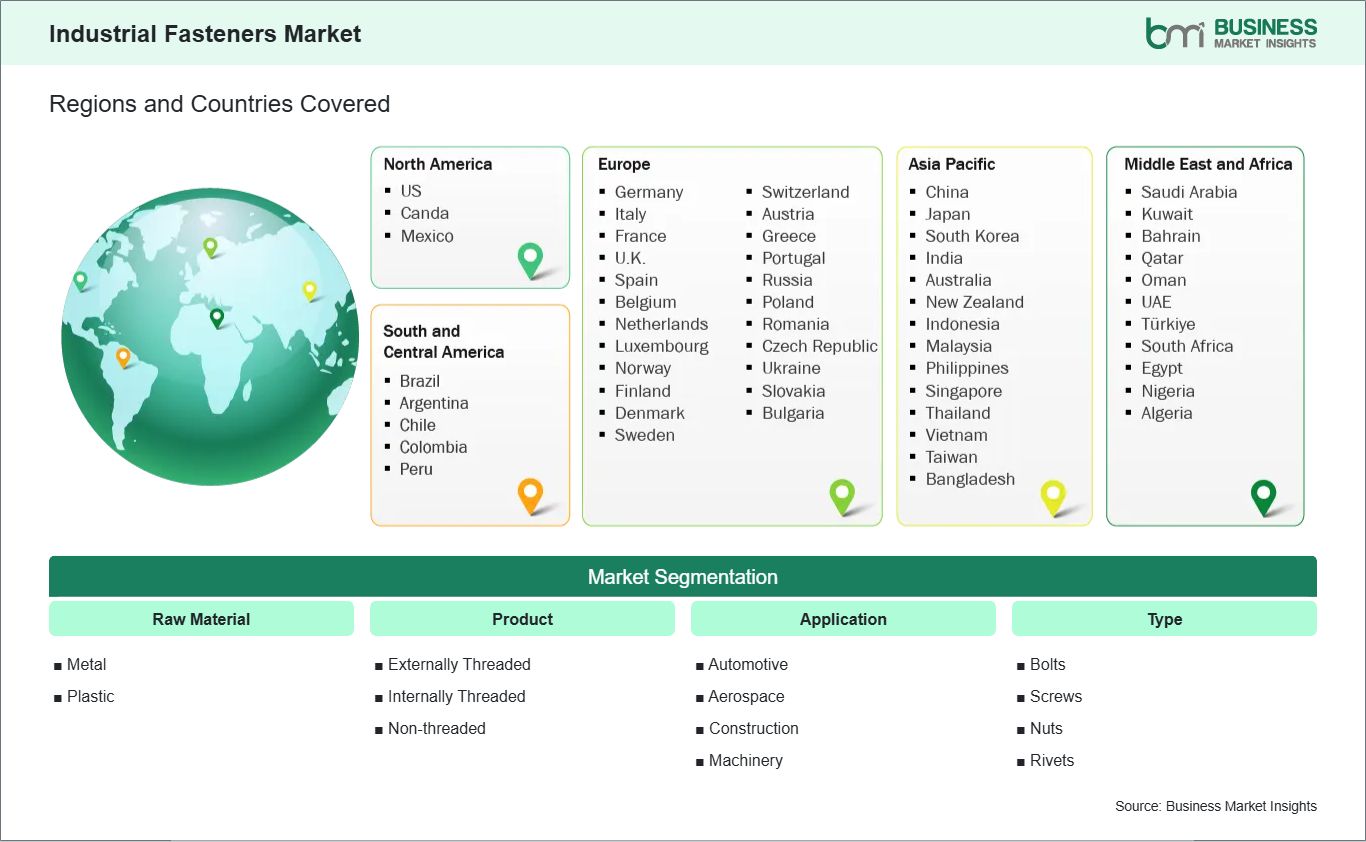
Industrial Fasteners Market Segmentation
The market includes segment-level insights reflect diverse application needs and material preferences across industries.
By Raw Material
- Metal – High strength supports structural and load-bearing applications
- Plastic – Lightweight composition suits corrosion-sensitive environments
By Product
- Externally Threaded – Ensures strong fastening in heavy-duty assemblies
- Internally Threaded – Facilitates secure coupling in modular systems
- Non-threaded – Enables permanent fixing through deformation-based joining.
By Application
- Automotive – Precision assembly essential for safety-critical components
- Aerospace – Demands high-performance materials under extreme conditions
- Construction – Large-scale usage in structural and architectural projects
- Machinery – Supports operational stability in mechanical equipment.
By Type
- Bolts – Widely applied for rigid mechanical connections
- Screws – Offers versatility in multiple material interfaces
- Nuts – Complements threaded assemblies for load distribution
- Rivets – Provides permanent fastening in structural frameworks.
Market Forces
Industrial Fasteners Market Drivers and Opportunities
Expansion of Industrial Manufacturing and Infrastructure
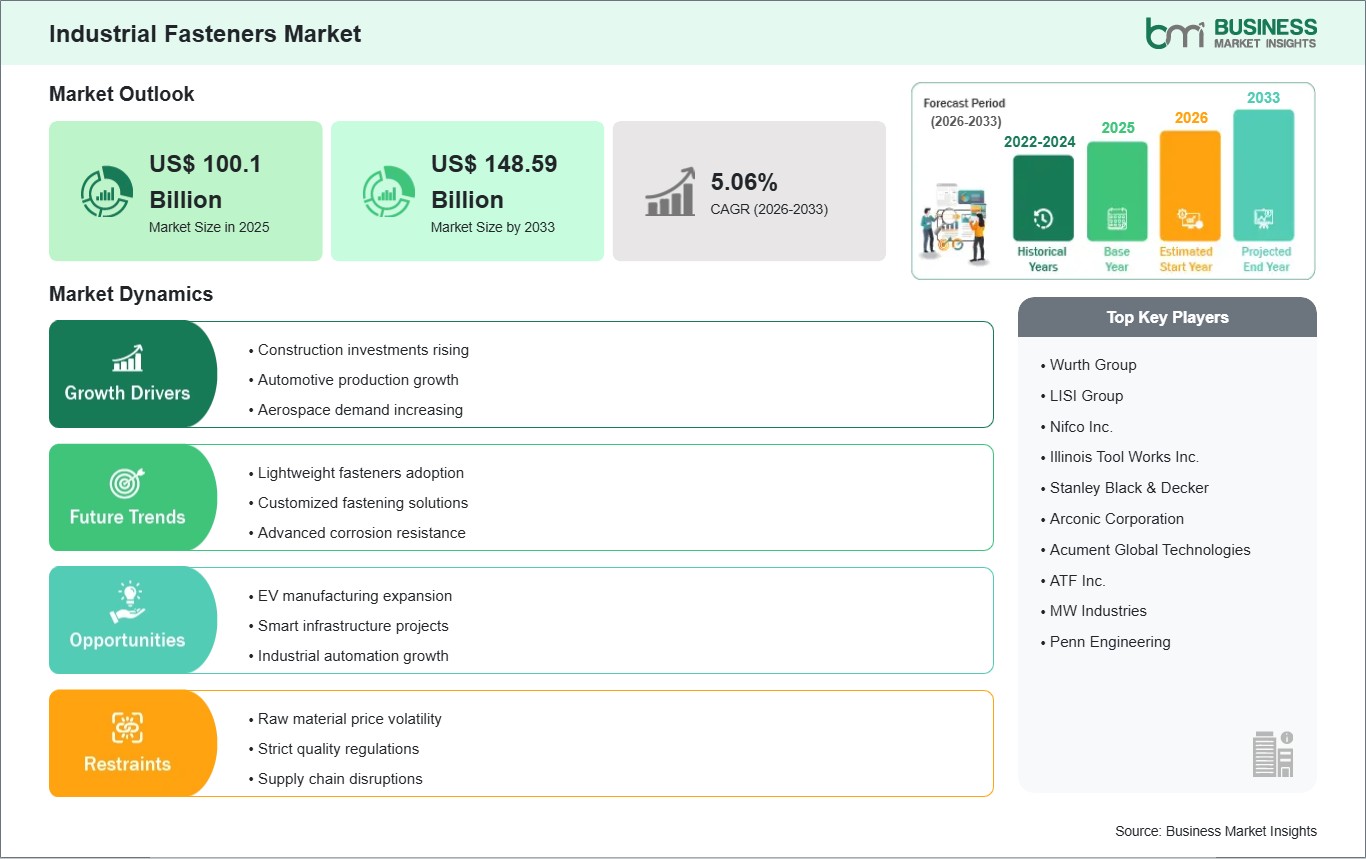
Rising industrialization is increasing the requirement for durable assembly components across sectors. Growing production of vehicles, machinery, and infrastructure components necessitates consistent fastening solutions. The need for high-strength joints drives continuous utilization across both standardized and customized applications. Manufacturing facilities prioritize reliability, leading to steady consumption across assembly operations.
This momentum translates into stable demand across mature and emerging economies. Infrastructure modernization projects further elevate usage intensity, particularly in construction and transportation sectors. The integration of fasteners into automation-driven production systems enhances relevance, ensuring continued industry alignment with industrial expansion trends.
Advancements in Smart and High-Performance Fastening Solutions
Technological progress is introducing innovative fastening systems with enhanced performance attributes. Developments in coatings, materials engineering, and precision manufacturing improve longevity and resistance characteristics. Smart fastening solutions incorporating sensors enable monitoring of torque and load conditions, particularly in advanced industries such as aerospace and automotive manufacturing.
Future growth prospects are tied to digital integration and material innovation. Expanding use of lightweight composites and specialized alloys will elevate demand for tailored fastening systems. As industries shift toward predictive maintenance and automation, advanced fasteners will support operational efficiency and safety improvements.
Size and Share Analysis
Industrial Fasteners Market Size and Share Analysis
The Industrial Fasteners Market is projected to grow from US$ 100.1 Billion in 2025 to US$ 148.59 Billion by 2033 , registering a CAGR of 5.06% from 2026 to 2033. Growth patterns indicate consistent utilization across manufacturing and infrastructure development cycles. The moderate pace suggests stable demand supported by replacement needs and ongoing industrial projects.
Material and product segmentation highlights the dominance of metal-based fasteners due to strength and reliability advantages. Externally threaded products maintain leadership, offering versatility across heavy-duty industrial contexts. Non-threaded variants occupy specialized roles where permanent fastening is required.
Application trends indicate strong consumption across construction and automotive sectors. Infrastructure development and vehicle manufacturing continue to anchor demand. Machinery and aerospace applications contribute through specialized, high-specification fastening requirements, strengthening overall market distribution.
Report Coverage
Industrial Fasteners Market Report Coverage and Deliverables
The "Industrial Fasteners Market Size and Forecast (2022–2033)" report provides a detailed analysis of the market covering below areas:
- Market size and forecast at global, regional, and country levels for all the key market segments covered under the scope
- Market trends, as well as market dynamics such as drivers, restraints, and key opportunities
- Market analysis covering key market trends, global and regional framework, major players, regulations, and recent market developments
- Industry landscape and competition analysis covering market concentration, heat map analysis, prominent players, and recent developments for the market
- Detailed company profiles, including SWOT analysis
Geographic Insights
Industrial Fasteners Market Geographic Insights
The Industrial Fasteners market shows diverse regional adoption patterns influenced by industrial output levels, regulatory frameworks, and manufacturing maturity. Global demand reflects a balanced mix of replacement cycles and new installations. Regions with strong automotive and infrastructure sectors contribute significantly to overall consumption patterns, shaping product innovation and supply chain strategies.
North America exhibits stable demand supported by advanced manufacturing ecosystems and strong aerospace activity. Emphasis on quality standards and engineered components enhances requirements for high-performance fasteners. Industrial automation and maintenance-driven replacement contribute to sustained utilization across established industries.
Asia Pacific demonstrates dynamic expansion driven by industrial production growth and infrastructure development. Rapid urbanization and extensive manufacturing operations generate substantial requirements for both standard and specialized fastening solutions. Regional manufacturers continue to scale production capabilities, strengthening local supply chains and enhancing product availability.
Europe maintains a technologically advanced market environment characterized by precision manufacturing and regulatory compliance. Demand aligns with automotive innovation and machinery production. Emerging markets in the Middle East, Africa, and South America show increasing adoption, supported by construction expansion and industrial diversification initiatives.
Industry Activity
Recent Developments
The Industrial Fasteners market is evaluated by gathering qualitative and quantitative data post primary and secondary research, which includes important corporate publications, association data, and databases. A few of the key developments in the Industrial Fasteners market are:
- In March 2026, STANLEY Engineered Fastening highlighted its strategic expansion of fastening solutions designed for automotive electrification, aimed directly at assisting OEMs and Tier-1 suppliers in overcoming the complex structural and production challenges of manufacturing electric vehicle (EV) batteries and lightweight assemblies.
- In September 2024, Hilti expanded its heavy-duty portfolio with innovations like the HDE 500-22 battery dispenser and HUS4 screw systems. Designed to reduce mortar waste and eliminate guesswork, these solutions feature smart dosing wheels and LED indicators for optimal anchor and post-installed rebar installations.
Trust & Transparency
Research Methodology
The market analysis combines proprietary research with secondary data from government agencies, company disclosures, regulatory filings, industry databases and expert interviews. Market estimates are validated through data triangulation, cross-market benchmarking and analyst
review.
View Full Research Methodology
Key Sources Referred:
Government industrial production data National building and environmental policy documents Industry white papers on thermal management technologies Trade association publications Company website Company annual reports Company investor presentations