
Industrial Furnace Market Outlook: Size, Share, Trends, Growth Analysis, Competitive Landscape & Forecast, 2026-2033

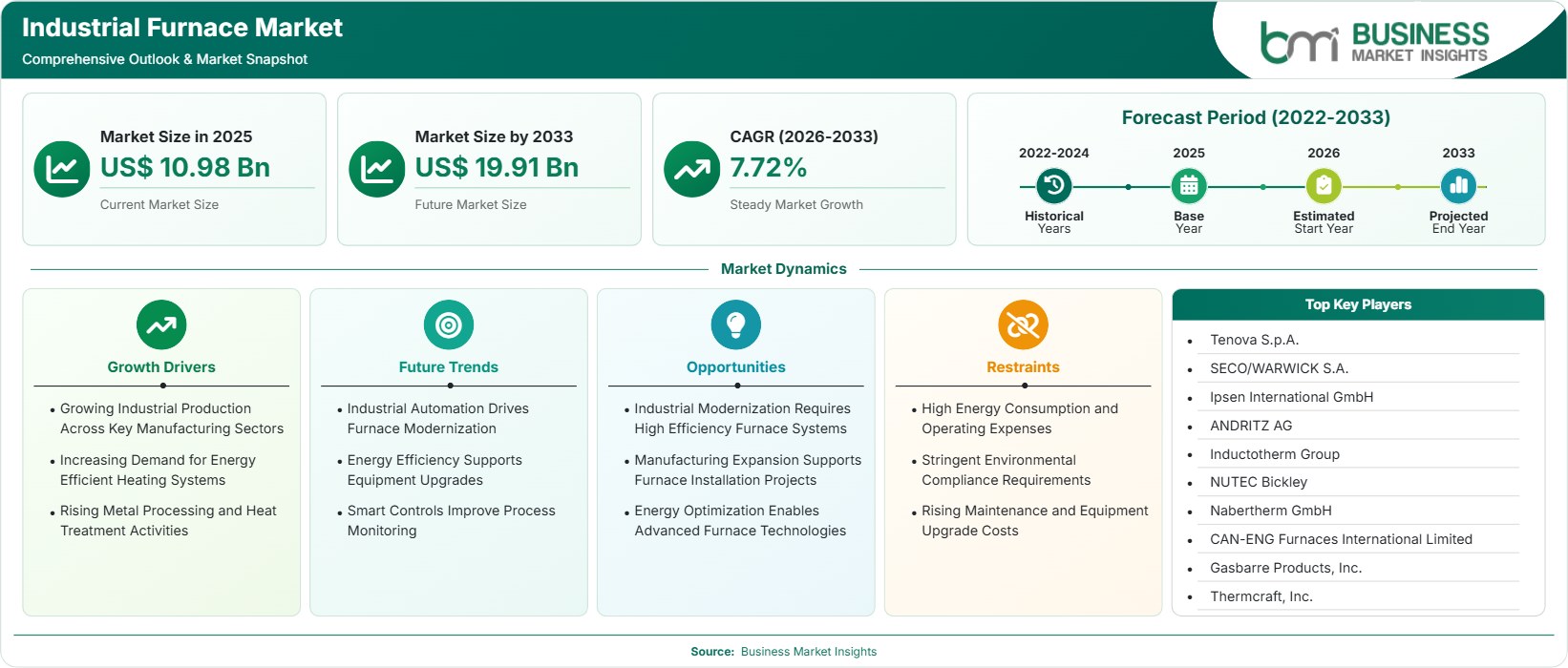
The Industrial Furnace Market size was valued at US$ 10.98 Billion in 2025 and is projected to reach US$ 19.91 Billion by 2033, growing at a CAGR of 7.72% during 2026–2033. Growth is supported by steel decarbonization investments, industrial electrification, heat-treatment demand, digital furnace controls, energy-efficiency mandates, advanced materials production, and expanding manufacturing capacity across Asia-Pacific and emerging industrial economies.

Report Coverage
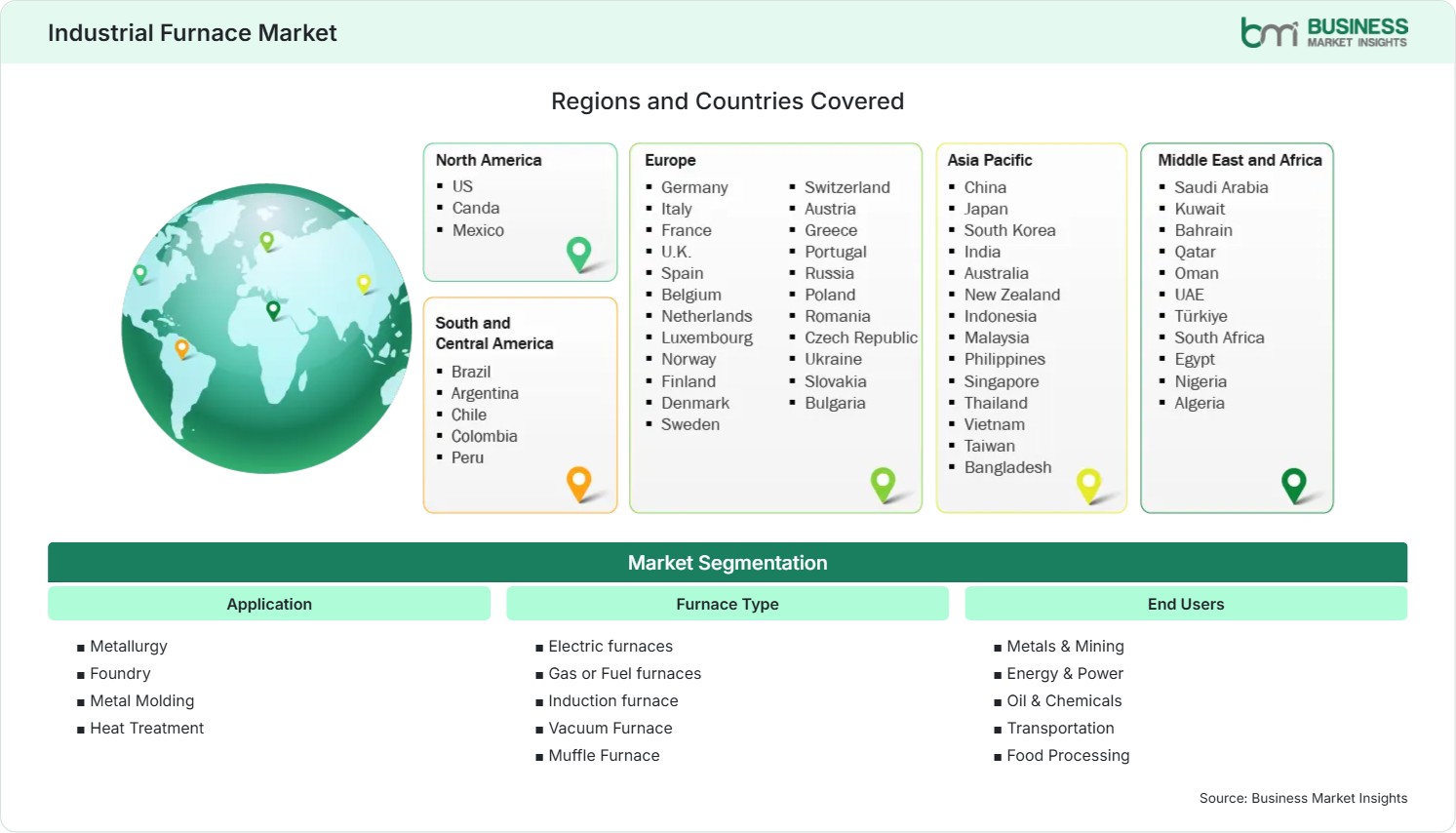
  • Application: Metallurgy, Foundry, Metal Molding, Heat Treatment
  • Furnace Type: Electric furnaces, Gas or Fuel furnaces, Induction furnace, Vacuum Furnace, Muffle Furnace
  • End Users: Metals & Mining, Energy & Power, Oil & Chemicals, Transportation, Food Processing
US$ 10.98 Bn Market size in 2025
US$ 19.91 Bn Market Size by 2033
7.72% CAGR, 2026 - 2033
2026-2033 Forecast Period

AI Overview

Industrial Furnace Market Summary

  • North America Region: Holds a 29%–32% share in 2025, growing at a CAGR of 6.8%–7.2% during 2026–2033. Growth is driven by metallurgy modernization, aerospace manufacturing, efficient heating systems adoption, and furnace retrofits supporting lower emissions and productivity improvements. The U.S. benefits from reshoring, advanced manufacturing expansion, and aerospace investments, recording a CAGR of 6.9%–7.3%.
  • Fastest Growing Region: Asia Pacific holds a 38%–42% share in 2025 and expands at a CAGR of 8.6%–9.2% through 2033. Investments in steelmaking, automotive production, industrial infrastructure, and energy-efficient manufacturing systems continue stimulating equipment demand.
  • Leading Segment: Metals & Mining accounts for a 41%–45% share in 2025 and grows at a CAGR of 7.4%–7.9%. Capacity expansion, secondary steel production, specialty alloys, and modernization of thermal processing facilities support sustained equipment procurement.
  • High Growth Segment: Vacuum Furnace represents a 14%–18% share in 2025 and advances at a CAGR of 9.0%–9.6%. Aerospace alloys, medical components, precision heat treatment, and contamination-free processing requirements strengthen adoption.
  • Key Market Opportunity: Deployment of smart electric and hybrid furnace systems integrated with predictive maintenance, AI-based temperature optimization, and emissions monitoring enables manufacturers to reduce energy intensity while improving throughput.
  • Major Market Players: Tenova S.p.A., SECO/WARWICK S.A., Ipsen International GmbH, ANDRITZ AG, Inductotherm Group, NUTEC Bickley, Nabertherm GmbH, CAN-ENG Furnaces International Limited, Gasbarre Products, Inc., and Thermcraft, Inc.
Strategic Insights

Industrial Furnace Market: Strategic Insights

Industrial Furnace Market Strategic Framework
FREE PDF
Request your free sample
Request free sample
Stakeholder View

Key Takeaways

  • The value chain spans refractory suppliers, heating element manufacturers, automation providers, controls vendors, engineering contractors, and aftermarket service specialists, creating recurring revenue opportunities beyond equipment sales.
  • Vacuum processing, specialty metallurgy, and aerospace heat-treatment applications offer stronger upside than conventional industrial heating due to higher margins and stricter process requirements.
  • Digitalization is shifting competitive differentiation toward remote monitoring, condition-based maintenance, AI-assisted process controls, and energy optimization capabilities.
  • India, Indonesia, Vietnam, and Gulf industrial hubs present compelling investment potential due to manufacturing expansion and increasing metals-processing capacity.
  • Strategic acquisitions continue targeting niche thermal-processing technologies, automation capabilities, and regional service networks to strengthen global customer reach.
  • Carbon reduction initiatives are accelerating replacement demand as end users seek electric and hybrid furnace solutions that align with sustainability objectives.
Geographic Outlook

Industrial Furnace Market Regional Highlights

North America Industrial Furnace Market

North America accounts for 29%–32% of global demand in 2025 and is expected to register a CAGR of 6.8%–7.2% through 2033. The region benefits from strong aerospace, automotive, and industrial manufacturing activity. Industrial Furnace Market share remains supported by replacement investments, digital modernization programs, and energy-efficiency upgrades. Steel recycling growth and advanced materials production continue supporting adoption of electric and vacuum technologies.

  • Aerospace suppliers increasingly deploy precision thermal processing systems to meet stringent metallurgical performance requirements while enhancing productivity and traceability.
  • Furnace modernization projects emphasize automation integration, emissions reduction, and predictive maintenance functionality.
  • Steel recycling facilities expand electric heating investments to improve operational efficiency and sustainability.
  • Reshoring initiatives stimulate demand for advanced manufacturing equipment across diversified industries.

US Industrial Furnace Market

The United States represents 76%–80% of North American revenue and records a CAGR of 6.9%–7.3% through 2033. Strong activity in aerospace, defense manufacturing, automotive production, and metal processing underpins demand. Investments in plant modernization and industrial digitalization are expanding adoption of intelligent heating systems while improving thermal process control and energy performance.

  • Defense and aerospace programs sustain demand for vacuum heat treatment capabilities.
  • Industrial digitalization encourages use of connected furnace monitoring platforms.
  • Automotive lightweighting trends increase processing requirements for advanced alloys.
  • Energy-efficiency mandates support replacement of aging thermal equipment.

Europe Industrial Furnace Market

Europe accounts for 23%–26% of global revenue in 2025 and is forecast to expand at a CAGR of 6.5%–7.0%. Germany remains the leading market, while Eastern Europe shows faster expansion nearing 7.3%–7.8%. Decarbonization initiatives, energy-management programs, and advanced industrial manufacturing continue driving investment. Industrial Furnace Market share remains supported by high technology adoption and strong metallurgical expertise.

  • Low-carbon steelmaking investments create demand for energy-efficient thermal technologies.
  • Germany leads equipment deployment owing to its advanced industrial base.
  • Poland and the Czech Republic exhibit elevated modernization spending trends.
  • Smart-factory integration supports digital furnace adoption across multiple industries.

Asia Pacific Industrial Furnace Market

Asia Pacific holds 38%–42% of global demand in 2025 and records the fastest CAGR of 8.6%–9.2% during the forecast period. China remains the largest market, while India demonstrates the strongest expansion at approximately 9.4%–10.0%. Industrialization, infrastructure development, and expanding metals production support Industrial Furnace Market growth throughout the region.

  • China maintains leadership through substantial steel and industrial production capacity.
  • India benefits from manufacturing expansion and infrastructure investment programs.
  • Southeast Asian economies increase procurement of energy-efficient processing equipment.
  • Automotive and electronics production stimulate demand for advanced thermal systems.
  • Regional governments support industrial upgrading and emissions reduction initiatives.

Rest of World Industrial Furnace Market

The Rest of World region accounts for 8%–11% of market revenue and is projected to grow at a CAGR of 7.4%–8.0%. South & Central America benefit from mining and metals investments, while Middle East & Africa growth is supported by industrial diversification and petrochemical expansion. Brazil leads regional demand, while Saudi Arabia shows one of the highest growth trajectories.

  • Mining developments encourage thermal-processing equipment deployment.
  • Gulf industrial diversification programs stimulate manufacturing investments.
  • Petrochemical and refining applications support furnace procurement activities.
  • Brazil remains the largest regional market by installed industrial capacity.
  • Saudi Arabia records strong industrial infrastructure development momentum.
Global Market Geography
FREE PDF
Request your free sample
Request free sample
Segment Analysis

Industrial Furnace Market Segmentation

Application

The application segment represents the core Industrial Furnace Market scope, led by metallurgical production and heat-treatment processes. The segment accounts for 47%–51% share in 2025 and is expected to grow at a CAGR of 7.5%–8.0% as advanced manufacturing requirements increase.

  • Metallurgy: Dominates adoption due to steel, aluminum, and alloy production requirements requiring precise temperature control and scalable thermal processing capabilities.
  • Foundry: Supports casting quality improvement through controlled heating processes and increasing demand from automotive and machinery manufacturing.
  • Metal Molding: Benefits from industrial production expansion and greater requirements for consistency, productivity, and defect reduction.
  • Heat Treatment: Growth reflects demand for improved material properties across aerospace, automotive, and industrial machinery applications.

Furnace Type

Furnace type demand is shifting toward efficient and specialized systems. This segment contributes a 33%–37% share in 2025 and advances at a CAGR of 7.8%–8.3%. Industrial Furnace Market trends indicate rising adoption of electric and vacuum technologies.

  • Electric furnaces: Gain traction due to decarbonization goals, efficiency improvements, and compatibility with renewable electricity.
  • Gas or Fuel furnaces: Remain important where fuel availability and high-temperature processing requirements favor conventional technologies.
  • Induction furnace: Widely adopted for rapid heating, metallurgical quality, and operational flexibility.
  • Vacuum Furnace: Expands rapidly through aerospace, medical, and specialty alloy processing applications.
  • Muffle Furnace: Maintains relevance in laboratories, research facilities, and controlled industrial heating environments.

End Users

End-user demand remains concentrated in heavy industry. The segment accounts for 41%–45% market participation in 2025 and is forecast to grow at a CAGR of 7.4%–7.9%. The Industrial Furnace Market size expansion closely follows industrial output and metals production.

  • Metals & Mining: Largest user category supported by steelmaking, alloy production, and mineral processing requirements.
  • Energy & Power: Uses thermal systems in component manufacturing and specialized material processing applications.
  • Oil & Chemicals: Demand originates from refining, petrochemical operations, and process heating requirements.
  • Transportation: Adoption benefits from automotive, railway, aviation, and marine manufacturing growth.
  • Food Processing: Utilized in selected high-temperature processing and specialized manufacturing applications.
Market Forces

Industrial Furnace Market Dynamics

Key Market Drivers

Steel Industry Modernization and Capacity Expansion

Global steelmakers are investing heavily in modernization projects, electric arc furnace installations, and advanced heat-treatment facilities. Growing requirements for high-strength steels, specialty alloys, and efficient production processes are increasing procurement of sophisticated thermal-processing equipment. International Energy Agency decarbonization pathways encourage lower-emission steel production technologies, supporting investment in efficient furnace systems. New manufacturing capacity across Asia and the Middle East further strengthens demand. These developments provide a strong foundation for long-term equipment replacement cycles, productivity improvements, and operational optimization across metallurgical industries.

Industrial Automation and Smart Manufacturing Adoption

Manufacturers increasingly require real-time process visibility, predictive maintenance, and automated temperature management. Integration of Industrial Internet of Things platforms, AI-enabled controls, remote diagnostics, and advanced sensors improves operational reliability while reducing downtime. As quality requirements become stricter across aerospace, automotive, and electronics sectors, furnace suppliers are embedding digital capabilities into new installations. The transition toward data-driven manufacturing supports higher-value equipment demand and creates recurring software and service opportunities throughout the equipment lifecycle.

Energy Efficiency and Emissions Reduction Priorities

There is increasing pressure on industrial facilities to reduce their energy use and greenhouse gas emissions. Energy-efficient burners, electrical heating systems, insulation developments, and waste heat recovery are key factors in purchasing decisions. There is greater alignment between capital investment and sustainable practices among both governments and industrial users. It makes the use of replacement technologies easier and upgrades of old systems quicker. Environmental compliance regulations drive the ongoing demand for thermal processing technologies that deliver both efficiency and sustainability.

Key Market Opportunities

Expansion of Vacuum Processing Technologies

Vacuum furnace technologies are gaining widespread acceptance across aerospace applications, medical device manufacturing, tooling, and the specialized materials industry. There is a need for contamination-free heating, precise temperature control, and material excellence in these industries to meet strict standards. Current vacuum furnaces offer higher efficiency, consistency, and reliability, along with fewer oxidation and material defects. Companies that incorporate automation and monitoring of digital processes, maintenance predictions, and high-performing furnaces are likely to benefit from profitable growth opportunities in the future. Vacuum furnace technologies have been identified as one of the most lucrative areas of the industrial furnace market forecasts.

Electrification of Industrial Heating

Adoption of electric heating is a potential avenue for growth for industrial manufacturers and suppliers. Increased use of renewable energy resources, carbon-reduction goals, and environmental regulations are driving companies to replace their old fuel-powered heating systems. Electric ovens offer better energy efficiency, lower greenhouse gas emissions, improved process control, and high-quality products. With companies focusing on their modernization and sustainability programs, demand for electric heating systems is expected to grow, creating replacement and upgrade opportunities across diverse industrial sectors worldwide.

Emerging Manufacturing Hubs in Developing Economies

The process of rapid industrialization in India, Southeast Asia, the Middle East, and selected African countries is generating substantial demand for industrial equipment and technology. There is a concerted effort by various governments to promote manufacturing industries through the creation of infrastructure, industrial policies, and foreign investment. The growth in the automobile, steel, engineering, energy, and heavy industrial manufacturing sectors is generating increasing demand for thermal treatment processes and their associated services. There is an opportunity for organizations to grow their market share, build strong customer relationships, and compete effectively in these fast-growing, high-potential markets.

Market Restraints and Challenges

High Capital Investment Requirements

High initial investment in advanced thermal processing technologies is required, along with high installation costs and additional infrastructure investments. High capital investments in advanced thermal processing technologies include costs for equipment purchase, building alterations, installation, and staff training. Due to the economic instability during the period, the high cost of investing in advanced technology prevents manufacturers from modernizing. Slow market adoption is caused by the lengthy procurement and approval process before purchasing new machinery. Despite advantages such as cost reduction, efficiency, and improved productivity, high costs and a lack of funding sources remain the main issues for industries operating in developing countries.

Energy Price Volatility and Operating Cost Pressure

Industrial heating processes require extensive use of electricity, natural gas, and other energy sources, making them highly sensitive to energy price fluctuations. Fluctuations in energy prices can increase operational costs, affect consumer purchasing decisions, and delay capital investment projects. In times of economic and energy market uncertainty, consumers focus more on controlling costs and increasing efficiency than on expanding their facilities. Consequently, the demand for industrial heaters is uneven, requiring manufacturers to produce equipment that is energy-efficient and delivers tangible gains in performance and ROI.

Company Analysis

Competitive Landscape

Industrial Furnace Market analysis indicates competition is centered on technology capability, thermal efficiency, automation integration, and aftermarket support.

Company Name

Overview

Products and Services relevant to this market

Tenova S.p.A.

Global metals technology provider serving steel and industrial processing sectors.

Electric furnaces, heat-treatment systems, metallurgy technologies, modernization services.

SECO/WARWICK S.A.

International specialist in thermal processing and metallurgical solutions.

Vacuum furnaces, atmosphere furnaces, aluminum processing systems, services.

Ipsen International GmbH

Leading heat-treatment equipment manufacturer with worldwide installation base.

Vacuum furnaces, atmosphere furnaces, controls, lifecycle support services.

ANDRITZ AG

Industrial engineering group serving metals and manufacturing industries.

Thermal processing equipment, automation systems, modernization solutions.

Inductotherm Group

Major supplier of induction technologies and metal-processing equipment.

Induction furnaces, melting systems, thermal processing solutions.

NUTEC Bickley

Industrial heating and combustion technology specialist.

Process furnaces, kilns, combustion systems, engineering services.

Nabertherm GmbH

Producer of industrial and laboratory furnace technologies.

Heat-treatment furnaces, laboratory furnaces, thermal processing equipment.

CAN-ENG Furnaces International Limited

Designer of industrial heat-treatment systems for manufacturing.

Atmosphere furnaces, washers, quench systems, automation packages.

Gasbarre Products, Inc.

Manufacturer serving heat treatment and thermal-processing applications.

Furnace systems, powder metallurgy equipment, aftermarket support.

Thermcraft, Inc.

Supplier of customized thermal-processing equipment and components.

Laboratory furnaces, industrial ovens, heating systems, engineering services.

Trust & Transparency

Research Methodology

The market analysis combines proprietary research with secondary data from government agencies, company disclosures, regulatory filings, industry databases and expert interviews. Market estimates are validated through data triangulation, cross-market benchmarking and analyst review.

View Full Research Methodology

Questions Answered

Frequently Asked Questions

What does the Industrial Furnace Market Report typically evaluate?

A Market Report assesses market size, technology developments, competitive positioning, regional demand patterns, investment trends, and forecast growth opportunities.

Which region offers the strongest expansion potential?

Asia Pacific presents the strongest growth outlook due to industrialization, infrastructure development, and continuing investments in metals production capacity.

What is the fastest-growing furnace technology?

Vacuum furnace technology is among the fastest-growing categories owing to its use in aerospace, medical, and advanced materials processing.

How is electrification changing furnace purchasing decisions?

Manufacturers increasingly prefer electric systems because of emissions reduction targets, efficiency benefits, and improved compatibility with renewable power sources.

What industries generate the highest demand for industrial furnaces?

Metals and mining, automotive, aerospace, energy, chemicals, and heavy manufacturing constitute the largest demand centers due to extensive thermal-processing requirements.

Access the Full Industrial Furnace Market Report

Get segment-level forecasts, regional estimates, competitive benchmarking, company profiles and downloadable Excel datasets.

Access the full Industrial Furnace Market Report
350 pages PDF & Excel | 2026-09-04