
Industrial Services Market Outlook: Size, Share, Trends, Growth Analysis, Competitive Landscape & Forecast, 2026-2033

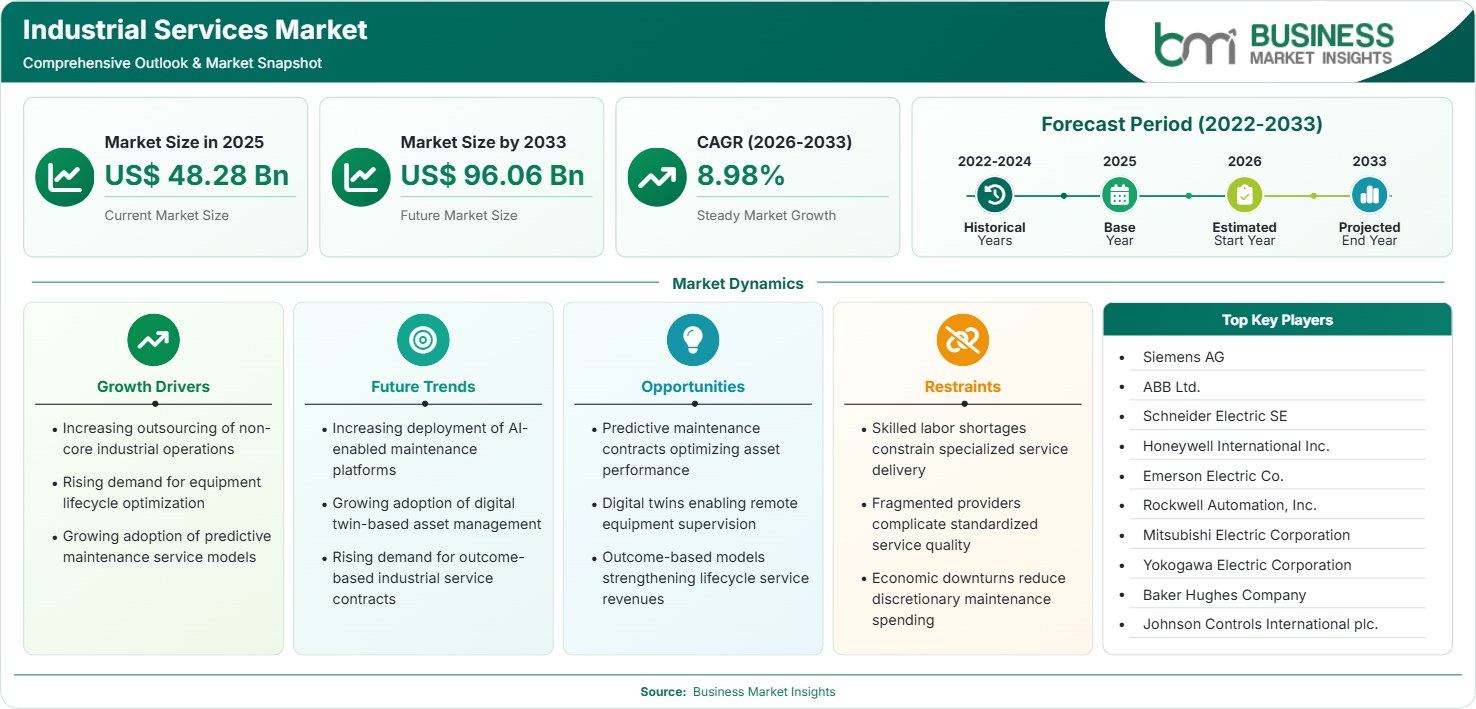
The Industrial Services Market size was valued at US$ 48.28 Billion in 2025 and is projected to reach US$ 96.06 Billion by 2033, growing at a CAGR of 8.98% during 2026–2033. Rising industrial automation adoption, increasing asset lifecycle management requirements, predictive maintenance implementation, energy-efficiency initiatives, and industrial digitalization investments are creating substantial growth opportunities across manufacturing, infrastructure, and energy sectors.

Report Coverage
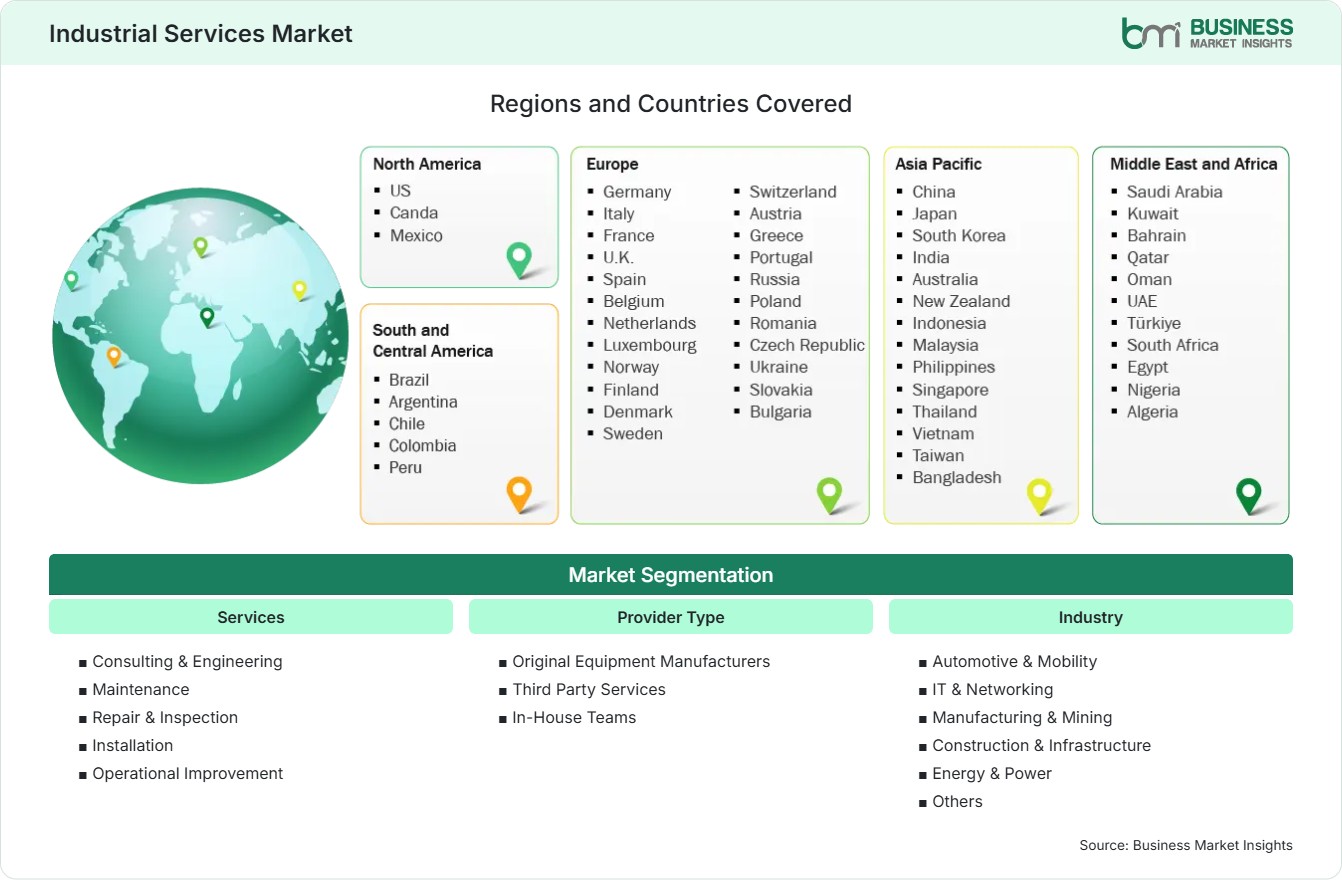
  • Services: Consulting & Engineering, Maintenance, Repair & Inspection, Installation, Operational Improvement
  • Provider Type: Original Equipment Manufacturers, Third Party Services, In-House Teams
  • Industry: Automotive & Mobility, IT & Networking, Manufacturing & Mining, Construction & Infrastructure, Energy & Power, Others
US$ 48.28 Bn Market size in 2025
US$ 96.06 Bn Market Size by 2033
8.98% CAGR, 2026 - 2033
2026-2033 Forecast Period

AI Overview

Industrial Services Market Summary

  • North America Region: North America holds a market share of 34%–37% in 2025, growing with a CAGR of 8.0%–8.6% during 2026–2033 influenced by industrial automation investments, aging infrastructure modernization, predictive maintenance adoption, digital twin deployment, workforce optimization programs, regulatory compliance requirements, energy efficiency targets, and smart manufacturing transformation initiatives across industries. The U.S. remains the regional revenue leader, supported by advanced manufacturing investments and service digitization, recording a CAGR of 8.1%–8.7%.
  • Fastest Growing Region: Asia Pacific accounts for 27%–30% share in 2025 and advances at a CAGR of 10.4%–11.0% during 2026–2033 driven by rapid industrialization, expanding manufacturing capacity, infrastructure upgrades, mining investments, industrial automation deployment, renewable energy expansion, digital transformation programs, and increasing outsourcing of specialized operational services.
  • Leading Segment: Maintenance, Repair & Inspection commands 38%–42% share in 2025 and grows at a CAGR of 8.6%–9.2% during 2026–2033 supported by aging industrial assets, safety compliance requirements, predictive analytics implementation, downtime reduction priorities, asset reliability improvement programs, plant productivity goals, and increasing service contracts across asset-intensive industries.
  • High Growth Segment: Operational Improvement represents 14%–18% share in 2025 and expands at a CAGR of 10.5%–11.3% during 2026–2033 because enterprises increasingly pursue process optimization, sustainability targets, digital integration, industrial analytics deployment, energy management enhancements, workforce productivity initiatives, and operational excellence transformation programs.
  • Key Market Opportunity: Increasing integration of artificial intelligence, digital twins, advanced analytics, remote monitoring platforms, and performance-based service contracts enables scalable asset optimization, efficiency gains, operational resilience improvements, and long-term recurring revenue generation.
  • Major Market Players: Siemens AG, ABB Ltd., Schneider Electric SE, Honeywell International Inc., Emerson Electric Co., Rockwell Automation, Inc., Mitsubishi Electric Corporation, Yokogawa Electric Corporation, Baker Hughes Company, and Johnson Controls International plc.
Strategic Insights

Industrial Services Market: Strategic Insights

Industrial Services Market Strategic Framework
FREE PDF
Request your free sample
Request free sample
Stakeholder View

Key Takeaways

  • The value chain is moving from individual maintenance activities to integrated service ecosystems, which combine engineering, installation, monitoring, inspection, and operational optimization via digitally connected platforms.
  • The sectors that require extensive maintenance, such as manufacturing, mining, utilities, and transportation, still offer the best revenue prospects, since they depend on keeping assets running and complying with regulations.
  • Diagnostics based on artificial intelligence, predictive maintenance systems, connectivity through industrial IoT, and digital twins are altering service delivery models and improving customer retention rates.
  • The Asia Pacific region offers one of the most attractive opportunities for expansion, as it is seeing a rise in industrial capacity additions, increased investment in automation, and growing infrastructure development.
  • Global participants are now seeing a rise in mergers, acquisitions, and partnerships as they look to obtain digital capabilities, expand regionally, acquire specialized engineering expertise, and secure portfolios of recurring service contracts.
  • Contracts linked to sustainability that emphasize energy efficiency, reductions in emissions, and the optimization of resources are increasingly becoming a key factor in competitive positioning.
Geographic Outlook

Industrial Services Market Regional Highlights

North America Industrial Services Market

North America accounts for 34%–37% of global Industrial Services Market revenue in 2025 and is projected to expand at a CAGR of 8.0%–8.6% during 2026–2033. Market demand is supported by advanced manufacturing modernization, energy infrastructure upgrades, industrial automation penetration, and higher adoption of predictive maintenance technologies. The region benefits from strong industrial digitalization spending and a mature installed equipment base requiring specialized lifecycle services. Regulatory requirements related to safety, emissions, and operational reliability continue encouraging investments in engineering, inspection, and maintenance activities across major industrial sectors.

  • Manufacturing companies are currently extending their use of predictive maintenance to reduce downtime, enhance their productivity goals, and improve asset utilization in the automotive, aerospace, and industrial machinery sectors.
  • Energy and utility operators are now placing greater emphasis on lifecycle management services, inspection programs, and the digital monitoring of their assets to maintain operational reliability and meet regulatory compliance requirements.
  • The integration of industrial automation leads to a continuous need for engineering, commissioning, calibration, and technical support services during plant modernization projects.
  • The shortage of workers is prompting companies in the industrial sector to outsource, hiring specialist firms to carry out maintenance and operational improvement activities.
  • The need for optimization programs that cut operating costs while improving equipment performance is still driven by sustainability goals and energy-efficiency requirements.

US Industrial Services Market

The United States contributes approximately 72%–76% of Industrial Services Market North American revenue in 2025 and records a CAGR of 8.1%–8.7% through 2033. Growth is supported by manufacturing reshoring projects, industrial automation investments, and extensive modernization of energy and process industry assets. Digital transformation strategies implemented by industrial operators are increasing demand for remote monitoring, AI-enabled diagnostics, reliability engineering, and performance optimization services. Continued federal and private-sector investments in infrastructure and manufacturing capacity expansion reinforce long-term demand for specialized industrial support services.

  • New opportunities are being created in the fields of semiconductors, automotive industries, and advanced manufacturing through investments in engineering design, the installation of equipment, commissioning, and asset optimization.
  • Initiatives aimed at industrial digitalization encourage the greater use of cloud-connected maintenance platforms and predictive analytics solutions in production facilities.
  • Oil and gas companies are still taking up specialized inspection and asset integrity services to improve their safety record and ensure continuous operations.
  • Data center expansion and electrification projects generate demand for technical maintenance programs, power management services, and infrastructure optimization expertise.

Europe Industrial Services Market

Europe represents 24%–27% of global Industrial Services Market revenue in 2025 and is expected to grow at a CAGR of 7.8%–8.4% during 2026–2033. Sustainability mandates in industries, energy transition projects, and advanced manufacturing projects are contributing to revenue growth. Germany continues to dominate the region due to its strong industrial presence, while Eastern European nations are showing faster growth due to investments in infrastructure and rising production capacity. Requirements of asset efficiency, carbon reduction, and industrial digitalization are enhancing the demand for consultancy and maintenance.

  • Germany maintains leadership through strong manufacturing, automation, and engineering ecosystems that require advanced lifecycle support capabilities.
  • Poland and other Central European economies experience accelerated growth supported by new industrial facilities and infrastructure investments.
  • Industrial decarbonization initiatives are increasing demand for process optimization, energy management consulting, and sustainability-focused operational services.
  • Aging infrastructure across several sectors creates substantial opportunities for inspection, repair, modernization, and reliability enhancement programs.
  • Digital twin adoption and smart factory implementation are expanding service opportunities related to data analytics and performance monitoring.

Asia Pacific Industrial Services Market

Asia Pacific captures 27%–30% Industrial Services Market share in 2025 and registers the fastest expansion with a CAGR of 10.4%–11.0% during 2026–2033. Industrialization, increasing investment in manufacturing, expansion in mining, and infrastructure development are still fueling service demand. China is the top player in the region in terms of earning revenues due to its vast industrial presence, whereas India is seen as the fastest-growing country market owing to policies aimed at industrialization and automation.

  • China remains the largest regional contributor due to extensive manufacturing operations and continuous industrial modernization investments.
  • India demonstrates strong momentum through factory automation, production-linked initiatives, and increasing use of engineering and maintenance outsourcing.
  • Southeast Asian economies are attracting multinational manufacturing investments, creating demand for installation, commissioning, and operational support services.
  • Expanding renewable energy infrastructure increases requirements for inspection, reliability management, and performance optimization expertise.
  • Mining and metals industries continue adopting predictive maintenance and remote asset monitoring technologies to improve productivity outcomes.

Rest of World Industrial Services Market

The Rest of World region accounts for 10%–13% of global Industrial Services Market revenue in 2025 and is anticipated to grow at a CAGR of 8.8%–9.5% during 2026–2033. Mineral exploration in South & Central America has brought benefits through investments in mining operations, industrial modernization, and energy sector development. The Middle East & Africa, on the other hand, are receiving support for infrastructure development, downstream industries, and diversification. Brazil is one of the major markets in South America, while Saudi Arabia and the UAE have been important contributors to the Middle East.

  • Mining activity across Latin America supports demand for reliability management, asset maintenance, and inspection solutions for heavy industrial operations.
  • Industrial diversification programs in Gulf economies encourage investments in advanced manufacturing and technical service capabilities.
  • Energy infrastructure projects generate long-term opportunities for engineering services, commissioning support, and plant optimization programs.
  • Local operators increasingly partner with global service companies to access specialized expertise and advanced digital technologies.
  • Expanding transportation, water, and utility infrastructure projects strengthen demand for installation and operational support services.
Global Market Geography
FREE PDF
Request your free sample
Request free sample
Segment Analysis

Industrial Services Market Segmentation

Services

The services segment represents the core revenue-generating component, accounting for approximately 100% market participation across industrial support activities and expanding in line with the overall market CAGR of 8.98% during 2026–2033. Increasing equipment complexity, growing automation adoption, stricter compliance requirements, and the need for operational efficiency continue strengthening demand. The Industrial Services Market scope is widening as customers seek integrated lifecycle support rather than standalone service engagements.

  • Consulting & Engineering: Organizations increasingly utilize engineering expertise for plant modernization, automation planning, energy optimization, and operational efficiency initiatives, supporting long-term productivity improvements and strategic asset management objectives.
  • Maintenance, Repair & Inspection: This sub-segment remains the largest contributor due to asset reliability requirements, preventive maintenance adoption, safety regulations, and rising demand for predictive monitoring across industrial facilities.
  • Installation: Growing investments in new industrial facilities, automation systems, renewable energy assets, and manufacturing expansions support strong demand for installation, commissioning, and startup support services globally.
  • Operational Improvement: Enterprises increasingly deploy operational excellence programs, digital transformation initiatives, workforce optimization strategies, and performance improvement frameworks to enhance competitiveness and profitability.

Provider Type

Provider type segmentation reflects varying operational strategies deployed by industrial organizations. The segment is influenced by expertise availability, cost optimization priorities, service quality expectations, and technology requirements. In 2025, third-party and OEM-led engagements together account for a substantial proportion of service spending, while in-house teams remain relevant for mission-critical operations. Growing digital complexity is encouraging broader outsourcing trends.

  • Original Equipment Manufacturers (OEM): OEM providers leverage deep equipment knowledge, proprietary technologies, and original design expertise to deliver advanced maintenance, upgrades, diagnostics, and lifecycle support services.
  • Third Party Services: Independent service providers gain traction through flexibility, competitive pricing, multi-vendor expertise, and customized solutions addressing diverse industrial operational requirements.
  • In-House Teams: Large industrial organizations maintain internal service capabilities for strategic assets, operational control, knowledge retention, and rapid response during critical maintenance activities.

Industry

Industry-specific demand patterns vary according to asset intensity, operational complexity, regulatory environments, and modernization investments. Manufacturing and mining remain among the largest users of industrial support services, while energy, mobility, and infrastructure sectors continue increasing investments in advanced operational solutions. The Industrial Services Market trends highlight growing emphasis on reliability, efficiency, sustainability, and digital transformation across all major end-user industries.

  • Automotive & Mobility: Vehicle manufacturing modernization, robotics deployment, and electric vehicle production expansion increase demand for engineering, maintenance, and automation support services.
  • IT & Networking: Growing data centers, network infrastructure deployments, and mission-critical facilities require specialized maintenance, reliability management, and infrastructure optimization expertise.
  • Manufacturing & Mining: Asset-intensive environments depend heavily on predictive maintenance, inspection programs, reliability management, and operational improvement services to maximize productivity and safety.
  • Construction & Infrastructure: Infrastructure expansion projects create opportunities for installation, commissioning, technical support, inspection, and lifecycle asset management services.
  • Energy & Power: Utilities, renewable energy projects, and conventional power facilities increasingly require performance optimization, asset integrity management, and reliability-focused operational services.
Market Forces

Industrial Services Market Dynamics

Key Market Drivers

Industrial Automation and Smart Manufacturing Expansion

Industrial Automation Systems deployment is one of the key drivers of growth. Factories and manufacturers are increasingly looking towards implementing automation solutions to improve efficiency and stay competitive in the market. With growing dependence on technology, there will continue to be an increasing need for assistance with engineering, integration, predictive maintenance, and lifecycle management. The implementation of smart factories requires certain skills, including installation, calibration, monitoring, and operation. This transition towards industrial ecosystems is leading to increased service engagement. These developments reinforce long-term Industrial Services Market adoption across diverse industrial sectors and strengthen demand for specialized technical capabilities.

Aging Industrial Infrastructure Requiring Lifecycle Support

Many industrial assets in the manufacturing, energy, mining, and transportation industries have reached or are nearing the end of their planned operational life cycle. Infrastructure aging leads to regular efforts at maintenance, investments in enhancements, inspections, repairs, retrofitting, and modernization to improve the safety of operations. Condition-based maintenance practices are increasingly used to reduce downtime and prevent interruptions. Meanwhile, owners of industrial assets are using innovative monitoring systems to enhance efficiency and extend the lifespan of industrial equipment. Such approaches to maintenance guarantee steady expenses on services regardless of economic trends. Demand for industrial services is growing continuously as a result.

Increasing Regulatory and Sustainability Compliance Requirements

Governments and regulatory bodies are enacting stricter regulations on emissions, workplace safety, energy efficiency, operational integrity, and environmental performance. Industrial organizations will be required to continually assess their processes to comply with regulations and protect their profit margins. There are service providers that offer inspection, energy efficiency, asset reliability, and operational auditing services to organizations. Sustainability programs also encourage organizations to invest in energy optimization services and performance improvement programs. The growing expectations of stakeholders on environmental performance are resulting in increased investment in expertise in energy optimization.

Key Market Opportunities

AI-Driven Predictive Maintenance and Analytics Platforms

AI and analytics are opening new opportunities for service providers to create more valuable engagements. Predictive maintenance technologies enable the identification of issues in machinery before a breakdown occurs, reducing repair costs and downtime. Service providers that incorporate AI-based analytics, machine learning, and real-time performance monitoring into their offerings will see tangible results. Industrial Services Market Forecasts increasingly indicate greater adoption of outcome-based contracts linked to performance metrics. Organizations pursuing digital transformation programs are likely to continue investing in advanced monitoring services that generate quantifiable operational benefits.

Expansion of Renewable Energy and Energy Infrastructure

Investment by countries in renewables, grid upgrades, and energy infrastructure will create opportunities for industrial service companies in the long term. Solar farms, wind farms, battery storage, and power transmission need engineers, installers, commissioning services, testing, maintenance, and optimization experts. Service companies with specific expertise in enhancing system performance and addressing reliability needs are what operators are increasingly looking for. Investment in the energy transition is expected to remain strong in both developed and developing countries. Companies with technical know-how in conventional and renewable energy systems stand a good chance of capitalizing on these opportunities.

Growth of Outcome-Based and Performance Contracts

Industrial clients are now gravitating towards service offerings linked to quantifiable performance metrics such as uptime, energy efficiency, productivity gains, and cost savings objectives. This development presents business opportunities for firms that can offer state-of-the-art monitoring, analysis, and operations optimization. Performance-based agreements tend to create regular income sources while building up customer relationships. As industrial operators become increasingly focused on achieving returns on investments, integrated service collaborations look increasingly appealing. The combination of digital technology, remote monitoring, and operations analysis makes service offerings more valuable.

Market Restraints and Challenges

Shortage of Skilled Industrial Service Professionals

Factor: Many industrial sectors face persistent shortages of technicians, engineers, reliability specialists, and automation professionals with advanced technical expertise. Impact: Limited workforce availability can increase labor costs, extend project timelines, and constrain service delivery capacity. The challenge is particularly evident in industries undergoing rapid digital transformation, where demand for specialized skills is accelerating. Service providers must invest heavily in workforce development, certification programs, and talent retention initiatives. Competition for qualified professionals continues to intensify across regions. Without sufficient workforce expansion, some organizations may struggle to meet customer requirements efficiently, potentially limiting scalability and operational responsiveness.

Cybersecurity Risks in Connected Industrial Environments

Factor: Increasing integration of industrial IoT systems, remote monitoring platforms, and cloud-based operational technologies expands cybersecurity exposure. Impact: Security incidents can disrupt operations, compromise data integrity, and reduce customer confidence in digital service offerings. Industrial operators are becoming increasingly cautious regarding third-party access to critical systems and infrastructure. Service providers must invest in cybersecurity frameworks, compliance measures, and secure connectivity architectures to maintain trust. While digitalization creates significant opportunities, cybersecurity concerns can lengthen procurement cycles and increase implementation costs. Addressing these challenges effectively remains essential for sustaining long-term market expansion.

Company Analysis

Competitive Landscape

The competitive environment is characterized by a mix of automation leaders, industrial technology providers, engineering specialists, and asset lifecycle management companies. Industrial operators increasingly seek integrated service offerings that combine predictive maintenance, digital monitoring, engineering support, and operational excellence solutions. The Industrial Services Market analysis indicates that companies with strong digital capabilities, global service networks, and extensive installed equipment bases are well positioned to capture recurring revenue opportunities.

Company Name

Overview

Products and Services relevant to this market

Siemens AG

Global industrial technology company with extensive expertise in automation, digitalization, electrification, and industrial software solutions serving diverse sectors.

Engineering services, maintenance support, asset management, digital twins, predictive maintenance solutions, commissioning, automation lifecycle services, and operational optimization programs.

ABB Ltd.

Leading provider of electrification, robotics, automation, and digital solutions with significant industrial service operations worldwide.

Asset performance management, maintenance services, inspection programs, automation support, digital monitoring, engineering consulting, and productivity enhancement services.

Schneider Electric SE

International energy management and industrial automation company focused on efficiency, sustainability, and digital transformation initiatives.

Lifecycle asset services, energy optimization, predictive maintenance, commissioning services, industrial consulting, infrastructure support, and operational improvement solutions.

Honeywell International Inc.

Diversified technology company delivering industrial automation, performance management, and connected plant solutions globally.

Reliability services, process optimization, cybersecurity support, remote monitoring, engineering consulting, maintenance programs, and operational analytics solutions.

Emerson Electric Co.

Global industrial technology provider recognized for automation, process management, and asset reliability expertise.

Asset integrity services, predictive maintenance, digital transformation consulting, inspection solutions, automation lifecycle support, and operational improvement programs.

Rockwell Automation, Inc.

Industrial automation specialist focused on smart manufacturing, digital operations, and connected enterprise technologies.

Automation consulting, system integration, lifecycle maintenance services, network support, performance monitoring, and engineering implementation services.

Mitsubishi Electric Corporation

Technology company delivering industrial automation, factory automation, and advanced engineering services internationally.

Industrial equipment servicing, system installation, predictive diagnostics, commissioning support, maintenance programs, and operational efficiency solutions.

Yokogawa Electric Corporation

Industrial automation and control systems company with strong presence in process industries and infrastructure sectors.

Asset lifecycle management, inspection services, optimization consulting, plant engineering, maintenance support, and industrial digitalization solutions.

Baker Hughes Company

Energy technology company providing industrial asset performance solutions and engineering expertise across sectors.

Reliability management, equipment maintenance, inspection programs, performance optimization, engineering consulting, and asset monitoring services.

Johnson Controls International plc

Building technologies and infrastructure solutions provider supporting operational efficiency and facility optimization worldwide.

Technical maintenance, inspection services, energy management solutions, facility optimization, engineering support, and digital monitoring services.

Trust & Transparency

Research Methodology

The market analysis combines proprietary research with secondary data from government agencies, company disclosures, regulatory filings, industry databases and expert interviews. Market estimates are validated through data triangulation, cross-market benchmarking and analyst review.

View Full Research Methodology

Questions Answered

Frequently Asked Questions

What does the Industrial Services Market Report typically evaluate?

The report assesses market size, competitive positioning, technology adoption, service categories, provider strategies, regional developments, investment opportunities, regulatory influences, and long-term growth prospects affecting industrial service demand globally.

Which region offers the strongest future growth potential?

Asia Pacific presents the strongest expansion opportunity due to rapid industrialization, factory modernization, infrastructure investments, mining activity growth, and increasing adoption of outsourced engineering and operational support services.

How are digital technologies transforming service delivery models?

Artificial intelligence, industrial IoT platforms, digital twins, cloud analytics, and remote monitoring systems enable predictive maintenance, real-time asset visibility, reduced downtime, and outcome-based service contracts focused on measurable operational performance.

Which industry generates the highest demand for industrial services?

Manufacturing and mining collectively represent among the largest end-user groups because these sectors depend heavily on equipment uptime, reliability management, inspection programs, and continuous operational optimization to maintain productivity and safety performance.

What factors are increasing demand for industrial services worldwide?

Growing industrial automation, aging equipment bases, stricter regulatory requirements, predictive maintenance adoption, sustainability initiatives, and digital transformation investments are increasing the requirement for engineering, maintenance, inspection, and operational improvement services across industries.

Access the Full Industrial Services Market Report

Get segment-level forecasts, regional estimates, competitive benchmarking, company profiles and downloadable Excel datasets.

Access the full Industrial Services Market Report
350 pages PDF & Excel | 2026-09-10
Similar Research

Related Market Reports