Market Summary
Executive Summary and Global Market Analysis
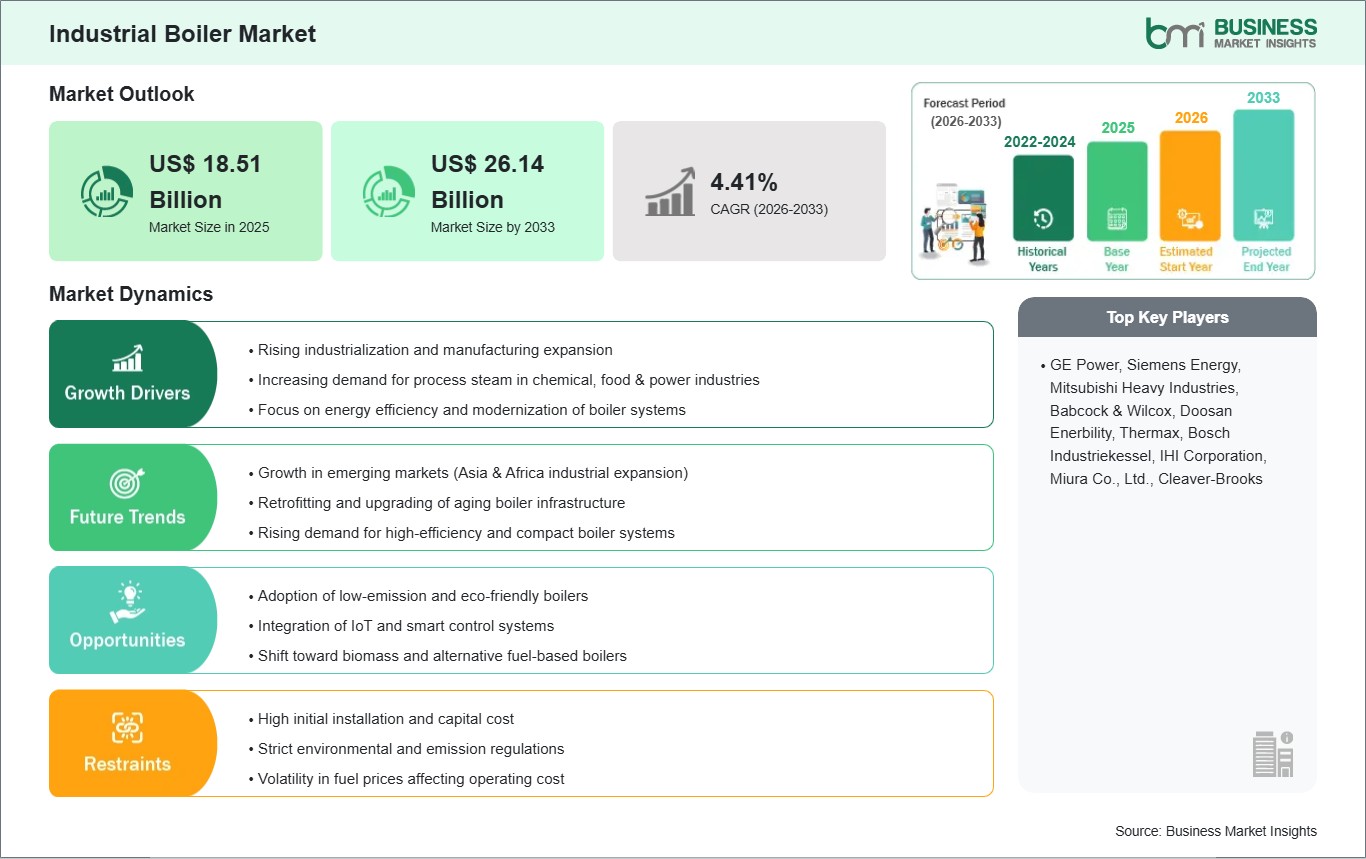
The global industrial boiler market is witnessing steady growth driven by rising industrialization and increasing demand for efficient steam and heat generation across manufacturing sectors. Industrial boilers are widely used in industries such as chemicals, food and beverage, power generation, and pulp and paper, where consistent thermal energy is essential for operations. Growing emphasis on energy efficiency and emission control is further shaping market expansion, particularly in developing economies where industrial output is rising rapidly.
From a global perspective, the Asia Pacific dominates the industrial boiler market due to strong manufacturing activity in China, India, and Southeast Asia. Rapid urbanization, infrastructure development, and expansion of industrial facilities continue to drive demand in the region. North America and Europe also hold significant shares, but growth is relatively moderate due to market maturity and stricter environmental regulations that encourage replacement and upgrading rather than new installations.
Technological advancement is playing a key role in reshaping the competitive landscape. Manufacturers are increasingly focusing on energy-efficient boiler systems, automation, and IoT-enabled monitoring solutions to enhance operational efficiency and reduce downtime. Additionally, there is a noticeable shift toward low-emission and alternative fuel boilers, including biomass-based systems, as industries align with global decarbonization goals.
Despite strong growth prospects, the market faces challenges such as high installation and maintenance costs, along with fluctuating fuel prices that impact operating expenses. Strict environmental regulations in developed regions also increase compliance requirements for manufacturers, pushing them to invest in cleaner technologies. These factors can restrain adoption, especially among small and medium-sized enterprises.
Overall, the industrial boiler market is expected to maintain steady growth supported by industrial expansion, modernization of existing systems, and increasing demand for sustainable energy solutions. Opportunities remain strong in emerging markets and retrofit projects, where older systems are being replaced with high-efficiency, low-emission boilers. This combination of replacement demand and new industrial installations continues to define the long-term outlook of the global market.
Segment Analysis
Industrial Boiler Market Segmentation
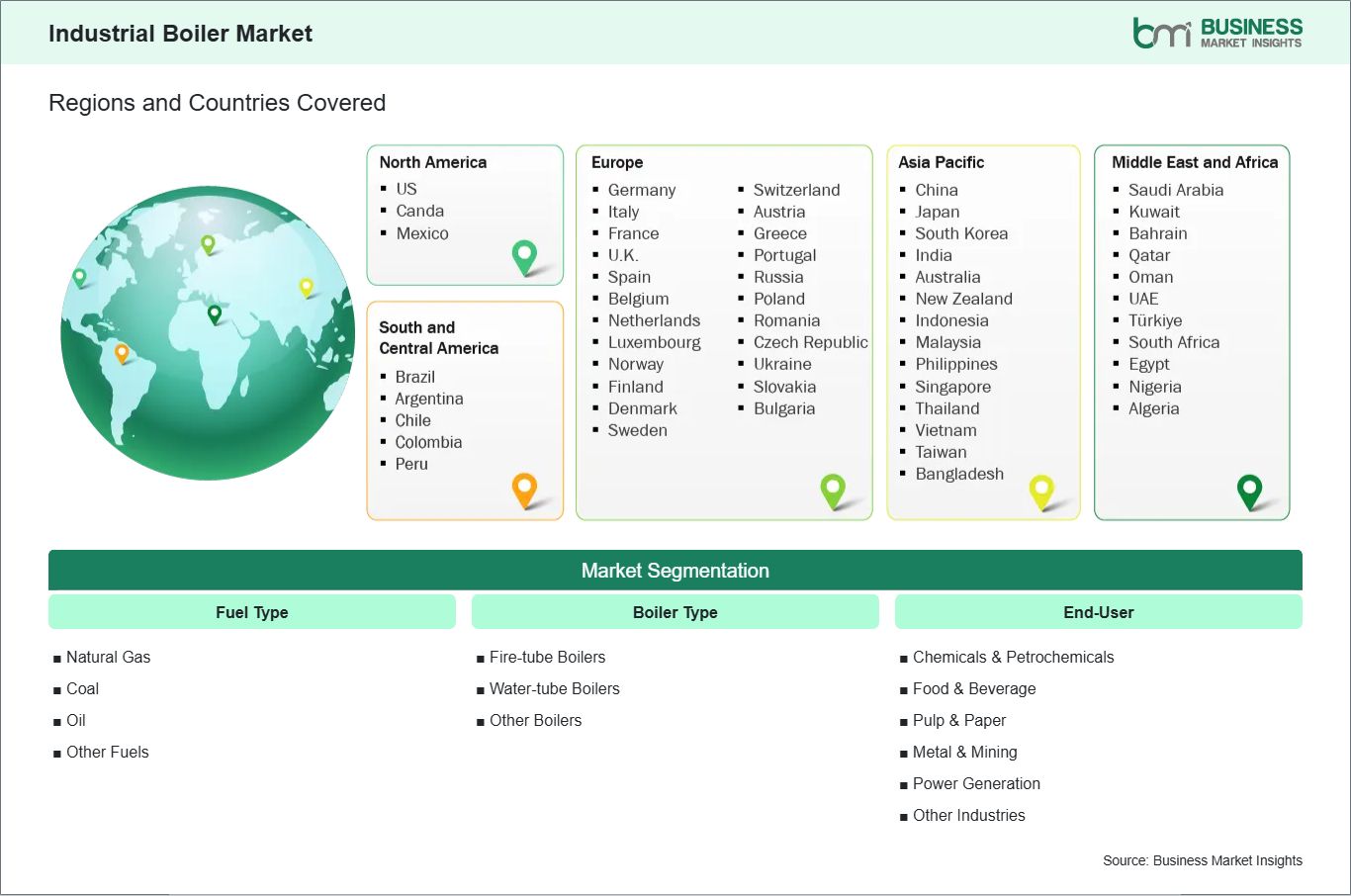
The Industrial Boiler market is segmented based on Fuel Type, Boiler Type, and End-Use Industry.
By Fuel Type
- Natural Gas – Widely preferred due to cleaner combustion and higher efficiency levels
- Coal – Used in cost-sensitive regions with abundant coal availability
- Oil – Applied in niche industrial operations requiring a flexible fuel supply
- Others – Includes biomass and alternative fuels supporting low-emission initiatives.
By Boiler Type
- Fire-tube boilers – Common in small to medium industries due to simple design
- Water-tube boilers – Preferred for high-pressure, large-scale industrial applications
- Other – Includes specialized boilers used for customized industrial requirements.
By End-Use Industry
- Chemicals & Petrochemicals – High steam demand drives largest boiler adoption globally
- Food & Beverage – Requires consistent steam for processing and sterilization operations
- Pulp & Paper – Uses boilers for drying, pulping, and production processes
- Metal & Mining – Needs high-temperature steam for processing and extraction activities
- Power Generation – Utilizes boilers for electricity production and auxiliary systems
- Others – Includes textiles, refining, and smaller industrial applications.
Market Forces
Industrial Boiler Market Drivers and Opportunities
Rising Industrialization and Energy Demand
Rapid industrialization across emerging economies is increasing the need for reliable steam and heat generation systems in manufacturing sectors. Expanding production activities in chemicals, food processing, and power generation require continuous thermal energy support. This rising demand is driving industries to adopt advanced industrial boilers that offer higher efficiency and operational reliability. Growing infrastructure development further strengthens the need for scalable boiler systems across diverse industrial applications.
This trend is significantly impacting global boiler demand, especially in Asia Pacific and Latin America. As industries modernize production facilities, older systems are being replaced with energy-efficient alternatives. The increasing focus on operational efficiency and productivity makes industrial boilers essential assets. Their relevance continues to grow as governments support industrial expansion and energy-intensive manufacturing sectors become central to economic development strategies worldwide.
Shift Toward Energy-Efficient and Low-Emission Boilers
Growing emphasis on sustainability is driving innovation in energy-efficient and low-emission boiler technologies. Industries are adopting biomass-based systems, IoT-enabled monitoring, and automated combustion controls to reduce fuel consumption and emissions. These innovations are enabling cleaner operations while maintaining high performance. Industrial boilers are increasingly used in eco-friendly manufacturing setups where compliance with environmental standards is critical for operational approval.
Future growth potential lies in expanding adoption across green manufacturing and retrofit projects. Industries are expected to replace outdated systems with smart, efficient boilers to meet regulatory requirements. This expansion will significantly reduce carbon footprints while improving energy utilization. The opportunity is highly relevant in developing regions where industrial capacity is increasing rapidly, creating strong demand for modern, sustainable boiler solutions.
Size and Share Analysis
Industrial Boiler Market Size and Share Analysis
The Industrial Boiler Market is projected to grow from US$ 18.51 Billion in 2025 to US$ 26.14 Billion by 2033 , registering a CAGR of 4.41% from 2026 to 2033.
The industrial boiler market is valued at a substantial global scale and continues to expand steadily with rising industrial energy demand and the modernization of manufacturing infrastructure. Growth is primarily driven by increasing adoption of energy-efficient boiler systems across process industries and utilities. Expanding industrial output in emerging economies, along with the replacement of aging boiler units in developed regions, is further strengthening overall market growth momentum across global regions.
In terms of segmentation, the market is largely dominated by natural gas as a fuel type due to its cleaner combustion and operational efficiency advantages. Among boiler types, fire-tube boilers hold a strong position in small and medium industrial applications, while water-tube boilers are preferred in high-capacity, high-pressure environments. Overall, demand patterns reflect a balance between cost efficiency, performance requirements, and regulatory compliance across industries.
By application, the chemicals and petrochemicals industry represents one of the leading segments due to its continuous requirement for high-pressure steam in production processes. Other key contributors include food and beverage, pulp and paper, and power generation sectors, which rely heavily on a consistent thermal energy supply. The dominance of these applications highlights the critical role of industrial boilers in supporting large-scale, energy-intensive manufacturing operations globally.
Report Coverage
Industrial Boiler Market Report Coverage and Deliverables
The "Industrial Boiler Market Size and Forecast (2022–2033)" report provides a detailed analysis of the market covering below areas:
- Industrial Boiler market size and forecast at global, regional, and country levels for all market segments covered under the scope
- Industrial Boiler market trends, as well as drivers, restraints, and opportunities
- Industrial Boiler market analysis covering key trends, global and regional framework, major players, regulations, and recent developments
- Industry landscape and competition analysis covering market concentration, heat map analysis, prominent players, and recent developments for the Industrial Boiler market
- Detailed company profiles, including SWOT analysis
Geographic Insights
Industrial Boiler Market Geographic Insights
The industrial boiler market shows diverse regional adoption patterns influenced by industrialization levels, energy policies, and manufacturing intensity across different geographies. Globally, demand is driven by expanding process industries such as chemicals, food processing, and power generation that require continuous steam and heat supply. Increasing focus on energy efficiency and emissions reduction is also shaping procurement decisions, leading to gradual adoption of advanced boiler systems worldwide. Emerging economies and developed regions together contribute to a balanced yet dynamic growth landscape.
North America represents a mature but technologically advanced market, driven by modernization and replacement of aging boiler infrastructure. Industries in the region increasingly focus on improving energy efficiency and complying with strict environmental regulations. This has accelerated the adoption of low-emission and automated boiler systems across manufacturing and power generation sectors. While new installations are limited compared to emerging markets, steady upgrades and retrofitting activities sustain consistent demand across industrial facilities.
Asia Pacific dominates the global industrial boiler market due to rapid industrialization, urbanization, and strong manufacturing growth in countries such as China, India, and Southeast Asian economies. Expanding chemical, textile, and food processing industries are major contributors to demand. Large-scale infrastructure development and government support for industrial expansion further boost installations. The region also benefits from relatively lower production costs and increasing investments in energy infrastructure, making it the fastest-growing and most influential regional market globally.
Europe, while a mature market, is heavily driven by stringent environmental regulations and decarbonization initiatives that encourage the adoption of cleaner and more efficient boiler systems. Industries are increasingly investing in biomass and low-emission technologies to align with sustainability goals. Emerging markets in Latin America, the Middle East, and Africa are witnessing gradual growth supported by industrial expansion, energy projects, and infrastructure development. These regions present long-term opportunities as industrial bases continue to develop and modernize.
Industry Activity
Recent Developments
The Industrial Boiler market is evaluated by gathering qualitative and quantitative data post primary and secondary research, which includes important corporate publications, association data, and databases. A few of the key developments in the Industrial Boiler market are:
- In June 2025,Alfa Laval announces a milestone in maritime decarbonization with an order for the world’s first marine boiler system designed for the safe incineration of ammonia emissions. Confirmed for a fleet of four ammonia dual-fuel vessels, this innovation is part of a joint development project with industry frontrunners and is set for delivery in 2027-2028.
- In May 2026, Valmet has been selected by Sappi Southern Africa to deliver a full EPC (Engineering, Procurement and Construction) package for the replacement of recovery boiler components at the Saiccor Mill in South Africa. This upgrade of critical boiler parts will improve operational safety, reduce the risk of unplanned downtime and improve overall reliability of the mill.
Trust & Transparency
Research Methodology
The market analysis combines proprietary research with secondary data from government agencies, company disclosures, regulatory filings, industry databases and expert interviews. Market estimates are validated through data triangulation, cross-market benchmarking and analyst
review.
View Full Research Methodology
Key Sources Referred:
U.S Energy Information Administration (EIA) U.S Department of Energy (DOE) Eurostat – EU industrial production and energy usage statistics India Ministry of Petroleum & Natural Gas China National Bureau of Statistics