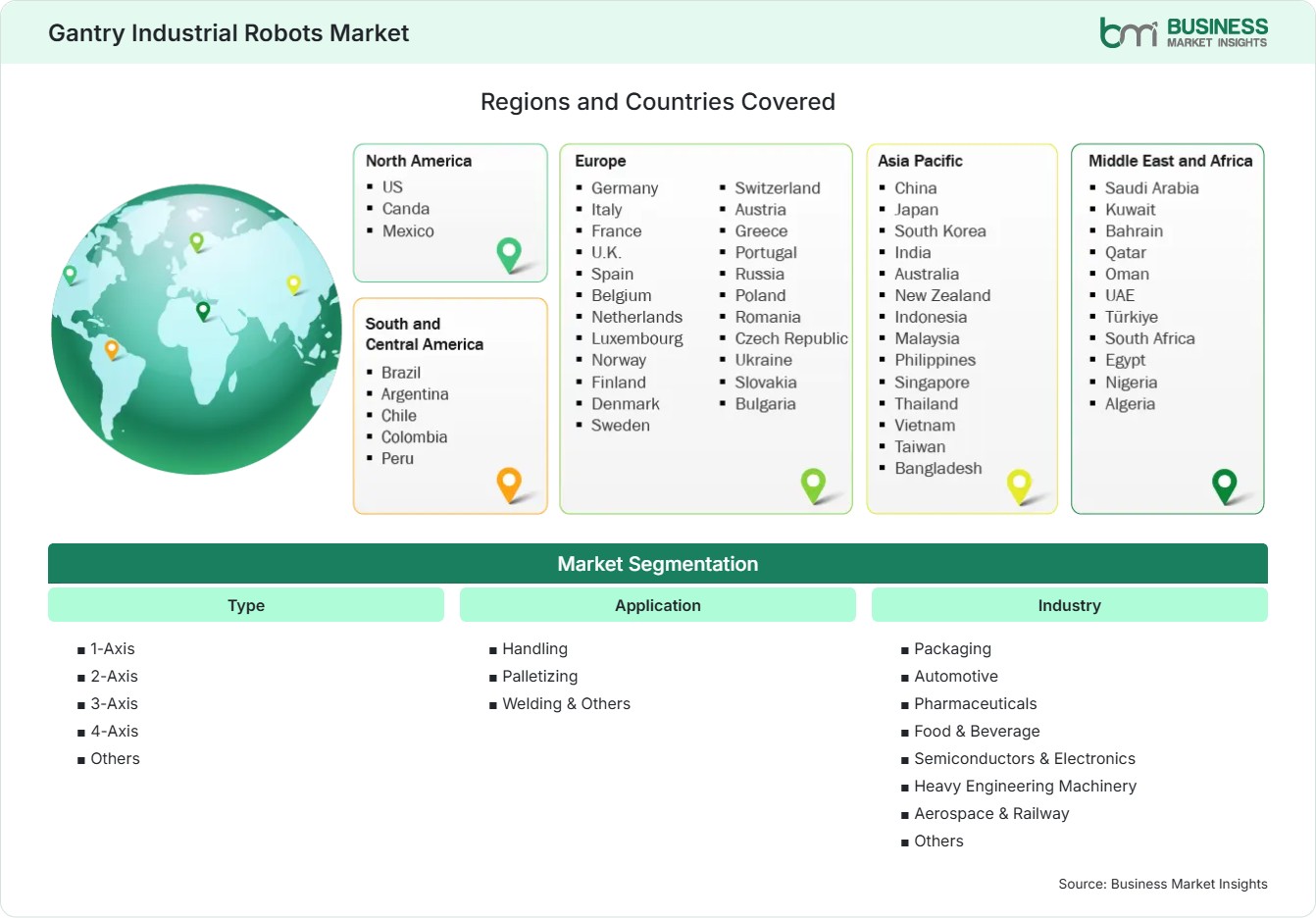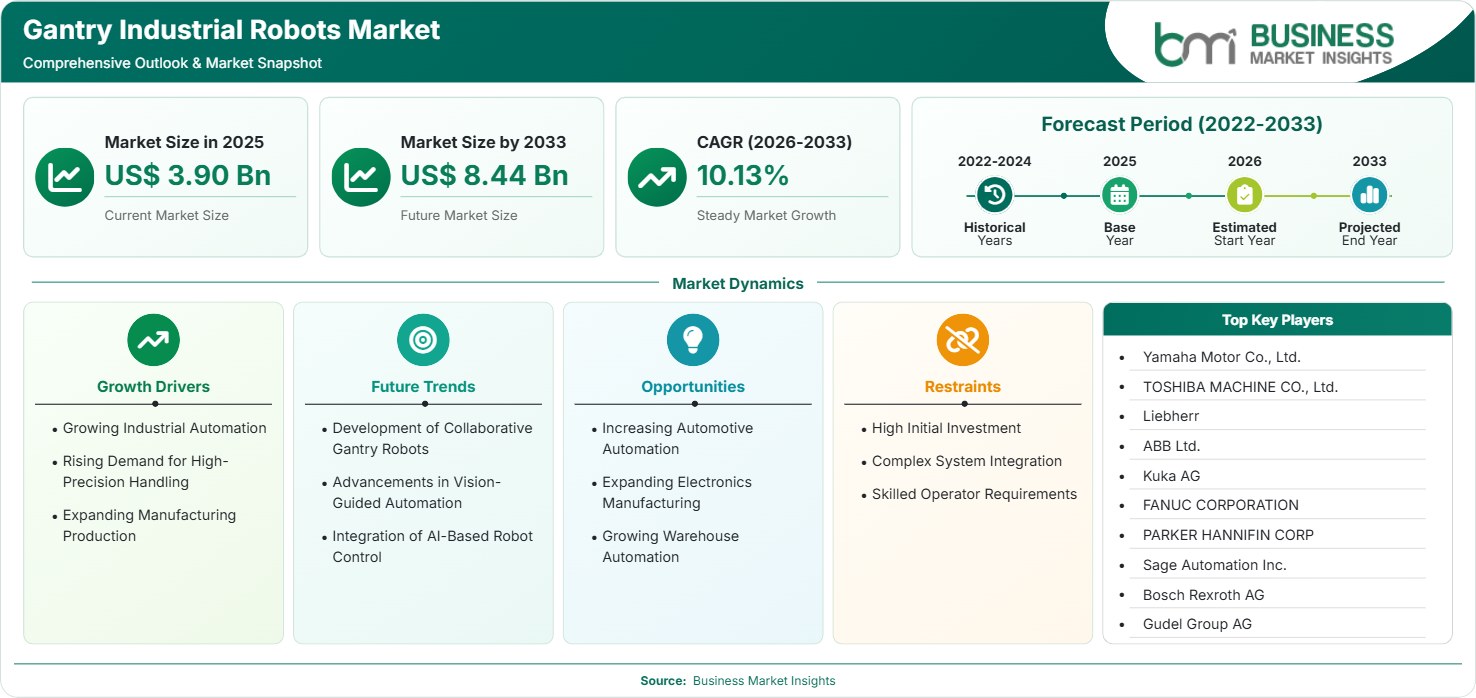
Gantry Industrial Robots Market Regional Highlights
North America Gantry Industrial Robots Market
North America represents a modeled 31%–35% share in 2025, with CAGR of 9.20%–10.10% during 2026–2033. The regional opportunity is strengthened by established automation ecosystems and application engineering capabilities. Manufacturers increasingly prioritize repeatability, production continuity, and flexible equipment layouts. The region’s Gantry Industrial Robots Market share reflects broad industrial adoption across applications requiring controlled linear movement, payload positioning, and integration with programmable manufacturing equipment.
- Automotive plants can deploy gantry systems for repetitive handling and positioning, particularly where predictable trajectories and controlled payload movement support automated production sequences.
- Packaging operations favor programmable motion because equipment can coordinate product movement, pallet formation, and line interfaces while maintaining repeatable production cycles.
- Warehouse automation provides opportunities for large-workspace robotic systems where controlled movement can complement conveyors, storage equipment, and automated material-handling architectures.
- Industrial integrators can capture value through engineering, tooling, commissioning, programming, and maintenance services surrounding robotic equipment deployments.
US Gantry Industrial Robots Market
The U.S. accounts for a modeled 22%–25% share of North America in 2025, with CAGR of 9.30%–10.20% during 2026–2033. Buyers increasingly evaluate equipment through lifecycle productivity rather than standalone hardware cost. Integration quality, controller compatibility, safety architecture, service responsiveness, and application engineering influence procurement decisions. These factors position the U.S. as a major contributor to regional automation deployment and the broader Gantry Industrial Robots Market.
- Automotive and machinery manufacturers can use gantry architectures for repeatable loading, positioning, transfer, and production-cell automation where consistent motion is operationally important.
- Packaging facilities provide opportunities for standardized robotic cells because palletizing and handling workflows can be configured around predictable product flows and production layouts.
- Warehouse modernization supports demand for automated movement systems capable of operating across defined work envelopes and coordinating with broader material-handling infrastructure.
Europe Gantry Industrial Robots Market
Europe holds a modeled 27%–31% share in 2025, expanding at a CAGR of 9.00%–10.00% during 2026–2033. Germany remains a leading industrial automation market, while Italy and France provide substantial opportunities across machinery, automotive, packaging, aerospace, and food processing. The Gantry Industrial Robots Market share is influenced by manufacturers seeking precision, production flexibility, and efficient use of industrial space.
- Germany provides a strong opportunity through automotive, machinery, electronics, and industrial production environments where precise automated positioning is integral to production cells.
- Italy offers opportunities in machinery, packaging, food processing, and industrial equipment manufacturing, where flexible automation can address repetitive handling and palletizing requirements.
- France supports adoption through automotive, aerospace, food, and packaging applications requiring controlled movement, programmable sequences, and integration with existing production equipment.
- European manufacturers can emphasize retrofit-compatible architectures that extend automation capabilities without requiring complete replacement of established production lines.
Asia Pacific Gantry Industrial Robots Market
Asia Pacific holds a modeled 34%–38% share in 2025, with CAGR of 11.20%–12.20% during 2026–2033, making it the fastest-growing regional opportunity. China, Japan, South Korea, and India provide diverse demand across electronics, automotive, packaging, machinery, and industrial production. Manufacturing scale and automation requirements support broad deployment potential. The regional Gantry Industrial Robots Market growth outlook is strengthened by factory modernization, expanding production capacity, labor optimization, and increasing interest in configurable robotic systems capable of supporting multiple manufacturing workflows.
- China provides extensive opportunities across electronics, automotive, packaging, and machinery production, where large manufacturing footprints support automated movement and repeatable material handling.
- Japan combines advanced manufacturing capabilities with demand for precise automation, supporting applications involving compact production cells, sophisticated motion control, and repeatable handling.
- South Korea offers opportunities in electronics and automotive manufacturing, where programmable robotic movement can support structured production sequences and high-consistency material positioning.
- India presents emerging opportunities across automotive, packaging, pharmaceuticals, food processing, and machinery as manufacturers increase automation within expanding industrial facilities.
Rest of World Gantry Industrial Robots Market
South and Central America represent an emerging opportunity, particularly across automotive, food processing, packaging, and industrial machinery. Middle Eastern and African markets offer narrower but developing opportunities around industrial modernization, packaging, logistics, food processing, and machinery operations. The modeled Rest of World share is 8%–12% in 2025, with CAGR of 8.20%–9.40% during 2026–2033, reflecting gradual automation penetration and selective investment.
- Brazil offers opportunities in food processing, packaging, machinery, and industrial manufacturing where repetitive handling can be automated through configurable robotic workstations.
- Mexico provides potential across automotive and manufacturing operations requiring dependable transfer, handling, palletizing, and production-line coordination.
- Middle Eastern markets can apply gantry automation within logistics, packaging, food processing, and industrial projects requiring controlled material movement.
- African markets provide developing opportunities as manufacturers evaluate automation for productivity, consistency, workforce utilization, and scalable production processes.