
Drywall Finishing Robots Market Outlook: Size, Share, Trends, Growth Analysis, Competitive Landscape & Forecast, 2022-2033

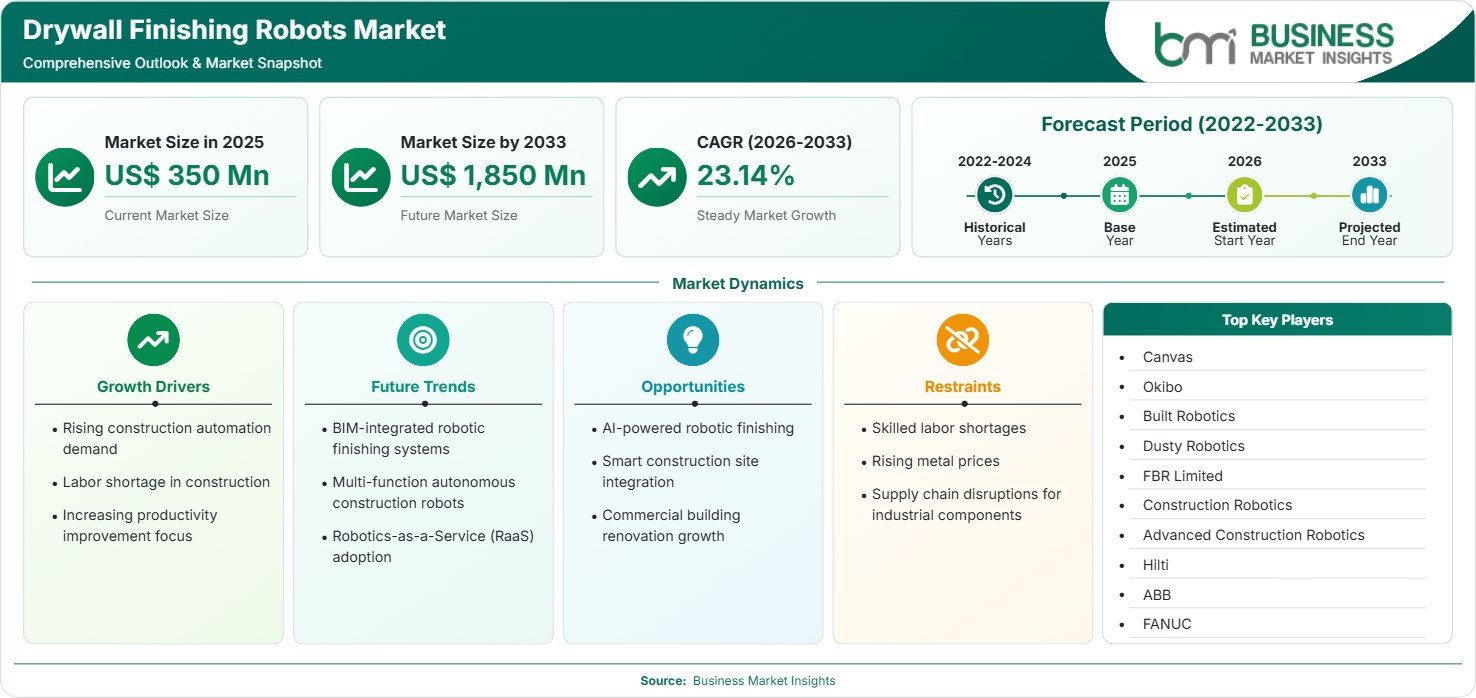
The Drywall Finishing Robots Market size was valued at USD 0.35 billion in 2025 and is projected to reach USD 1.85 billion by 2033, growing at a CAGR of 23.14% during 2026–2033. Rising labor shortages in finishing trades, accelerating adoption of AI-enabled construction robotics, increasing commercial building activity, and expanding modular construction practices are driving demand, while Robotics-as-a-Service (RaaS), digital jobsite integration, and productivity-focused automation create substantial long-term opportunities.

Report Coverage
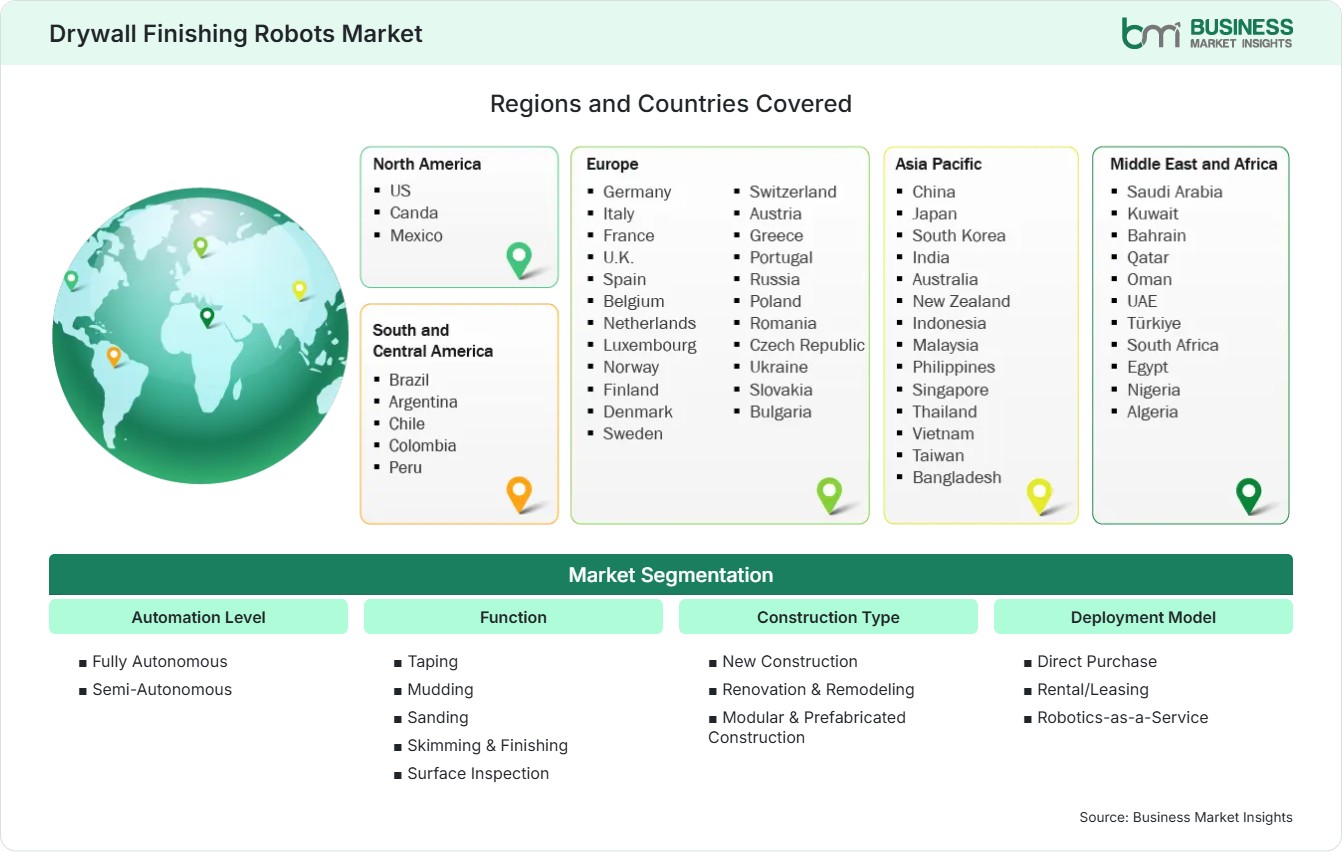
  • Automation Level: Fully Autonomous, Semi-Autonomous
  • Function: Taping, Mudding, Sanding, Skimming & Finishing, Surface Inspection
  • Construction Type: New Construction, Renovation & Remodeling, Modular & Prefabricated Construction
  • Deployment Model: Direct Purchase, Rental/Leasing, Robotics-as-a-Service
US$ 350 Mn Market size in 2025
US$ 1,850 Mn Market Size by 2033
23.14% CAGR, 2026 - 2033
2026-2033 Forecast Period

AI Overview

Drywall Finishing Robots Market Summary

  • North America Region: North America holds a market share of 45%–48% in 2025, growing at a CAGR of 21.5%–22.5% during 2026–2033, supported by severe skilled labor shortages, rapid construction automation, and strong investment in AI-enabled interior finishing systems. The U.S. market is driven by commercial construction modernization and is expected to expand at a CAGR of 21.8%–22.8% through 2033.
  • Fastest Growing Region: Asia Pacific accounts for 21%–24% of the market in 2025 and is projected to register a CAGR of 25.5%–26.5% during 2026–2033 as governments encourage industrialized construction, prefabrication, digital building technologies, and automation investments across China, Japan, South Korea, and India.
  • Leading Segment: Fully Autonomous automation represents 56%–59% market share in 2025 and is expected to grow at a CAGR of 24.0%–25.0% through 2033 owing to AI navigation improvements, consistent finishing quality, reduced rework, and higher productivity on large commercial projects.
  • High Growth Segment: Robotics-as-a-Service (RaaS) accounts for 16%–19% market share in 2025 while advancing at a CAGR of 27.0%–28.0% between 2026 and 2033 because contractors increasingly prefer subscription-based robotic deployment with lower capital expenditure and scalable fleet utilization.
  • Key Market Opportunity: Growing integration of robotic drywall finishing platforms with Building Information Modeling (BIM), AI-based vision systems, cloud analytics, and autonomous quality inspection enables contractors to improve project delivery speed, reduce material waste, and optimize workforce allocation.
  • Major Market Players: Canvas, Okibo Ltd., Built Robotics Inc., Dusty Robotics, FBR Limited, Construction Robotics, LLC, Advanced Construction Robotics, Inc., Hilti Corporation, ABB Ltd., and FANUC Corporation.
Strategic Insights

Drywall Finishing Robots Market: Strategic Insights

Drywall Finishing Robots Market Strategic Framework
FREE PDF
Request your free sample
Request free sample
Stakeholder View

Key Takeaways

  • The value chain is rapidly shifting toward integrated robotics ecosystems, where robot manufacturers collaborate with software developers, AI vision providers, BIM platform vendors, and specialty contractors to deliver complete drywall finishing solutions.
  • Commercial construction and modular building projects present the strongest near-term growth opportunities because repetitive interior finishing activities generate measurable productivity gains from automation.
  • Artificial intelligence is becoming the primary differentiator in robotic finishing systems. Advanced machine vision, simultaneous localization and mapping (SLAM), digital surface analysis, and adaptive finishing algorithms are enabling robots to achieve higher consistency while minimizing material waste and reducing costly rework compared with conventional drywall finishing methods.
  • North America remains the most attractive investment destination, supported by widespread construction automation adoption, persistent shortages of skilled drywall finishers, favorable contractor acceptance of emerging technologies, and increasing investments in digital construction workflows across the United States and Canada.
  • Strategic partnerships, venture funding, and technology collaborations continue shaping competitive dynamics. Robotics developers are increasingly partnering with general contractors, equipment manufacturers, and software providers to accelerate commercialization, expand rental-based business models, and improve integration with digital construction management platforms.
Geographic Outlook

Drywall Finishing Robots Market Regional Highlights

North America Drywall Finishing Robots Market

North America accounted for approximately 45%–48% share in 2025 and is projected to expand at a CAGR of 21.5%–22.5% during 2026–2033. The region benefits from rapid digital transformation within the construction sector, increasing labor shortages, and widespread adoption of robotic automation across commercial building projects. Continuous investment in AI-enabled construction technologies, together with strong contractor awareness and supportive innovation ecosystems, sustains long-term Drywall Finishing Robots Market growth throughout the region.

  • Severe shortages of experienced drywall finishers continue encouraging contractors to deploy autonomous finishing systems that improve workforce productivity, maintain consistent quality, reduce project delays, and lower dependency on scarce skilled labor across large commercial construction projects.
  • Growing investments in Building Information Modeling (BIM), AI-enabled jobsite monitoring, and connected construction platforms enable robotic finishing equipment to integrate seamlessly with digital workflows, improving operational efficiency while minimizing rework and material waste.
  • Commercial office developments, healthcare facilities, educational campuses, logistics centers, and mixed-use infrastructure projects increasingly utilize robotic finishing technologies to accelerate interior construction schedules while maintaining higher finishing consistency throughout large-scale developments.

US Drywall Finishing Robots Market

The United States represented nearly 39%–42% of the global Drywall Finishing Robots Market share in 2025 and is anticipated to register a CAGR of 21.8%–22.8% through 2033. High construction wages, persistent workforce shortages, increasing adoption of industrialized construction practices, and substantial investment in AI-powered robotics continue positioning the country as the technology commercialization leader for autonomous drywall finishing solutions.

  • Major commercial contractors increasingly deploy robotic drywall finishing platforms to improve schedule certainty, enhance finishing precision, and address ongoing shortages of experienced craft workers amid rising non-residential construction activity.
  • Venture capital investments and strategic collaborations between robotics developers, construction technology firms, and general contractors accelerate commercialization while enabling continuous improvements in autonomous navigation, AI vision systems, and digital quality inspection.
  • Federal infrastructure investments, expanding healthcare construction, advanced manufacturing facilities, and education projects continue generating strong demand for automated interior finishing technologies that improve labor productivity and project delivery performance.

Europe Drywall Finishing Robots Market

Europe accounted for approximately 24%–27% of the global market in 2025 and is projected to expand at a CAGR of 22.0%–23.0% during the Drywall Finishing Robots Market Forecasts. The region benefits from increasing adoption of construction automation, stringent workplace safety regulations, and growing investments in sustainable building practices. Aging construction workforces across Western Europe and rising labor costs continue encouraging contractors to deploy robotic drywall finishing systems that improve productivity while maintaining consistent finishing quality.

  • Germany leads regional adoption owing to its advanced construction equipment industry, strong industrial automation capabilities, and increasing commercial building investments, supporting a CAGR of 22.2%–23.2% through 2033.
  • The United Kingdom represents one of the fastest-growing national markets, expanding at a CAGR of 23.5%–24.5%, supported by digital construction initiatives, modular housing projects, and increasing investment in construction technology.
  • France and the Nordic countries continue integrating robotic finishing systems into commercial and public infrastructure developments to address skilled labor shortages while improving project efficiency and reducing construction waste.

Asia Pacific Drywall Finishing Robots Market

Asia Pacific held approximately 21%–24% of the global Drywall Finishing Robots Market in 2025 and is expected to register the fastest CAGR of 25.5%–26.5% during 2026–2033. Rapid urbanization, expanding commercial infrastructure, government support for smart construction, and increasing adoption of prefabricated building methods are driving widespread implementation of robotic drywall finishing technologies across major regional economies.

  • China dominates regional revenue through extensive commercial construction, industrial automation leadership, and government-backed smart construction initiatives, recording a CAGR of 25.8%–26.8%.
  • Japan remains a major technology innovator, utilizing advanced robotics to overcome workforce shortages while improving productivity and quality across residential and commercial interior finishing projects.
  • India is emerging as the fastest-growing country, advancing at a CAGR of 27.0%–28.0% due to accelerating urban infrastructure development, expanding commercial real estate, and increasing digitalization of construction operations.

Rest of World Drywall Finishing Robots Market

The Rest of World region accounted for approximately 8%–10% of the global Drywall Finishing Robots Market in 2025 and is projected to grow at a CAGR of 22.8%–23.8% through 2033. Adoption remains at an early stage but is accelerating as governments and private developers invest in digital construction technologies and large-scale commercial infrastructure projects. South & Central America is witnessing increasing interest in automation for commercial developments, while the Middle East & Africa benefits from smart city initiatives, high-value hospitality projects, and expanding industrial construction requiring efficient interior finishing solutions.

  • Brazil leads adoption in South & Central America with a CAGR of 23.0%–24.0%, supported by commercial construction modernization and growing awareness of productivity-enhancing construction technologies.
  • The United Arab Emirates represents the leading Middle Eastern market, recording a CAGR of 24.5%–25.5% as smart city developments and premium commercial projects increasingly deploy advanced construction robotics.
  • Saudi Arabia continues investing heavily in mega infrastructure developments and digitally enabled construction projects, creating favorable opportunities for autonomous interior finishing equipment.
Global Market Geography
FREE PDF
Request your free sample
Request free sample
Segment Analysis

Drywall Finishing Robots Market Segmentation

Automation Level

The Automation Level segment accounted for approximately 55%–58% of the market in 2025 and is projected to expand at a CAGR of 23.8%–24.8% during the forecast period. Rising labor shortages, increasing acceptance of AI-enabled construction robotics, and continuous improvements in autonomous navigation are accelerating adoption across commercial and industrial construction projects. The expanding Drywall Finishing Robots Market scope continues encouraging contractors to invest in robotic systems capable of delivering higher productivity, consistent finish quality, and reduced project timelines.

  • Fully Autonomous: AI-powered robotic systems independently perform drywall finishing operations with minimal human intervention, improving finishing consistency, reducing labor dependency, and supporting large commercial projects requiring repetitive, high-precision interior finishing activities.
  • Semi-Autonomous: Semi-autonomous robots combine operator supervision with automated finishing capabilities, offering flexible deployment for contractors seeking productivity improvements while maintaining human control in complex or customized construction environments.

Function

The Function segment represented nearly 42%–45% of the overall market in 2025 and is expected to register a CAGR of 24.5%–25.5% through 2033. Growing adoption of specialized robotic platforms allows contractors to automate individual finishing processes while improving quality assurance and operational efficiency. Increasing emphasis on digital quality inspection and precision finishing also supports evolving Drywall Finishing Robots Market trends across commercial construction.

  • Taping: Automated taping robots ensure uniform joint tape application while minimizing installation errors, improving finishing speed, reducing material waste, and supporting higher-quality interior wall construction across commercial and institutional buildings.
  • Mudding: Robotic mudding systems deliver consistent compound application with controlled thickness, reducing manual rework, improving productivity, and enhancing surface preparation for subsequent finishing operations.
  • Sanding: Automated sanding robots utilize precision motion control and integrated dust collection technologies to produce smooth wall surfaces while improving workplace safety and reducing airborne particulate exposure.
  • Skimming & Finishing: Advanced robotic skimming solutions provide highly consistent final surface finishes, reducing labor-intensive manual work while improving visual quality and accelerating project completion across large construction sites.
  • Surface Inspection: AI-enabled inspection robots use computer vision and sensor technologies to identify finishing defects, verify quality standards, and support digital documentation throughout the drywall finishing process.

Construction Type

The Construction Type segment accounted for approximately 48%–51% of the Drywall Finishing Robots Market in 2025 and is projected to expand at a CAGR of 22.8%–23.8% during 2026–2033. Increasing investments in commercial infrastructure, industrial facilities, and residential developments are accelerating the adoption of robotic drywall finishing systems. Contractors are increasingly selecting automation solutions that improve project efficiency, maintain uniform finishing quality, and address persistent skilled labor shortages while supporting modern construction methodologies.

  • New Construction: Large commercial buildings, hospitals, educational institutions, logistics centers, and residential developments increasingly utilize robotic drywall finishing systems to accelerate project delivery while maintaining consistent quality and reducing labor-intensive finishing operations.
  • Renovation & Remodeling: Growing renovation activities across commercial offices, hospitality facilities, healthcare buildings, and public infrastructure create steady demand for robotic finishing solutions capable of improving productivity with minimal disruption to occupied spaces.
  • Modular & Prefabricated Construction: Factory-based building production increasingly integrates robotic drywall finishing technologies to achieve standardized quality, faster manufacturing cycles, lower material waste, and seamless compatibility with industrialized construction processes.

Deployment Model

The Deployment Model segment represented nearly 49%–52% of the global market in 2025 and is anticipated to register a CAGR of 24.0%–25.0% through 2033. Contractors are increasingly adopting flexible acquisition strategies that align robotic investments with project size, capital availability, and operational requirements. The growing availability of subscription-based deployment models is expanding accessibility to advanced drywall finishing technologies among both large enterprises and mid-sized construction firms.

  • Direct Purchase: Large contractors with recurring construction workloads prefer direct ownership to maximize long-term utilization, integrate robotic assets into digital construction workflows, and achieve greater operational control over finishing processes.
  • Rental/Leasing: Rental and leasing models provide contractors with affordable access to advanced robotic finishing equipment for short-duration or project-specific applications while minimizing upfront capital expenditure and maintenance responsibilities.
  • Robotics-as-a-Service (RaaS): RaaS solutions combine robotic hardware, software updates, predictive maintenance, and technical support under subscription-based agreements, enabling scalable deployment and accelerating adoption among contractors transitioning toward automated construction operations.
Market Forces

Drywall Finishing Robots Market Dynamics

Key Market Drivers

Rising construction automation demand

Growing digital transformation across the global construction industry is accelerating the deployment of robotic finishing equipment to improve productivity, quality consistency, and project delivery. According to the International Federation of Robotics (IFR), professional service robot installations for construction applications continue to expand as contractors address workforce shortages and increasing project complexity. The adoption of Building Information Modeling (BIM), AI-powered computer vision, and autonomous navigation enables robotic drywall finishing systems to operate with greater precision while reducing material waste.

Labor shortage in construction

The global construction sector continues to experience persistent shortages of skilled drywall finishers, creating strong demand for automation technologies capable of maintaining project schedules. Industry organizations such as Associated Builders and Contractors (ABC) estimate that the U.S. construction industry requires hundreds of thousands of additional workers annually to satisfy project demand. Autonomous drywall finishing robots reduce dependence on specialized labor while improving workplace safety and minimizing physically demanding repetitive tasks.

Increasing productivity improvement focus

Contractors increasingly prioritize productivity improvements to offset rising labor costs, material price volatility, and compressed construction schedules. Robotic drywall finishing systems deliver consistent application quality, reduce rework, and improve finishing speed through AI-enabled navigation and precision control. Integration with digital construction platforms further enhances operational planning and quality documentation throughout project execution. Top of Form

Key Market Opportunities

AI-powered robotic finishing

Advancements in artificial intelligence, computer vision, and machine learning are creating new opportunities for autonomous drywall finishing solutions capable of adapting to varying wall geometries and surface conditions with minimal operator intervention. AI-based defect detection, predictive maintenance, and self-learning algorithms ensure efficiency by minimizing finishing mistakes and resource usage. Contractors being more concerned about digital construction systems are causing solution providers to develop their intelligent robotic systems using software and cloud technology.

Smart construction site integration

The growing adoption of connected construction technologies presents significant opportunities for robotic drywall finishing systems integrated with Building Information Modeling (BIM), digital twins, cloud-based project management platforms, and IoT-enabled equipment. Real-time performance tracking, process automation, and digital quality checking become possible thanks to seamless data exchange. As construction companies keep on spending money on intelligent jobsite environments, robot makers design systems that can communicate with several digital platforms at once.

Commercial building renovation growth

Increasing renovation and modernization of commercial offices, healthcare facilities, educational institutions, hospitality properties, and public infrastructure are generating substantial opportunities for robotic drywall finishing technologies. Aging building stock across developed economies requires efficient interior refurbishment solutions capable of minimizing project disruption while maintaining consistent finish quality. Governments are also supporting energy-efficient building upgrades and sustainable renovation programs, encouraging adoption of advanced construction automation.

Market Restraints and Challenges

High equipment investment

Factor: The primary Factor limiting adoption is the substantial upfront investment required for autonomous drywall finishing robots, supporting software, training, and maintenance infrastructure.

Impact: Small and medium-sized contractors often face budget constraints that delay technology adoption despite the long-term productivity benefits.

Limited contractor adoption

Factor: The key Factor restraining wider deployment is the conservative nature of the construction industry and limited familiarity with advanced robotic finishing technologies among many contractors.

Impact: Concerns regarding operational reliability, workforce training requirements, project-specific adaptability, and integration with existing construction workflows often slow purchasing decisions.

Company Analysis

Competitive Landscape

The competitive environment is characterized by continuous investments in artificial intelligence, autonomous navigation, machine vision, and connected construction technologies. The Drywall Finishing Robots Market analysis indicates that established automation companies and specialized construction robotics developers are strengthening their portfolios through product innovation, strategic partnerships, software integration, and contractor collaborations to improve productivity, finishing accuracy, and jobsite automation capabilities.

Company Name

Overview

Products and Services Relevant to this Market

Canvas

Develops autonomous drywall finishing robots that improve productivity, consistency, and construction quality through AI-driven automation.

Autonomous drywall finishing robots, machine vision software, finishing automation platforms, contractor support services.

Okibo Ltd.

Construction robotics company specializing in AI-powered autonomous finishing and painting solutions for commercial building projects.

Drywall finishing robots, robotic painting systems, autonomous navigation software, cloud-connected construction robotics.

Built Robotics, Inc.

Develops autonomous technologies that transform conventional construction equipment into intelligent robotic machines for infrastructure projects.

Autonomous equipment software, robotic control systems, construction automation platforms, fleet management solutions.

Dusty Robotics

Provides robotic layout automation solutions that improve construction accuracy and digital workflow integration.

Robotic layout systems, BIM integration, digital construction software, autonomous positioning technologies.

FBR Limited

Australian robotics company developing automated construction technologies for modern building applications.

Construction robotics platforms, automated building systems, robotic construction equipment, digital construction solutions.

Construction Robotics, LLC

Designs robotic equipment that improves productivity, worker safety, and automation across construction operations.

Material handling robots, construction automation equipment, robotic assistance technologies, project support solutions.

Advanced Construction Robotics, Inc.

Develops intelligent robotic systems focused on improving safety, productivity, and automation for construction contractors.

Autonomous construction robots, AI-enabled control systems, construction productivity solutions, robotics software.

Hilti Corporation

Global construction technology provider integrating digital solutions, automation, and advanced jobsite equipment.

Construction tools, robotic layout solutions, digital construction software, productivity management systems.

ABB Ltd.

Global industrial automation leader supplying robotics, AI, and industrial control technologies supporting construction automation.

Industrial robots, robotic controllers, automation software, machine vision technologies, digital robotics solutions.

FANUC Corporation

Leading industrial robotics manufacturer providing high-precision robotic automation across manufacturing and construction industries.

Industrial robotic arms, AI-enabled automation, robotic controllers, machine vision systems, automation engineering services.

Industry Activity

Recent Developments

March 2026

Canvas expanded its Robotics-as-a-Service (RaaS) offering, providing commercial contractors with flexible access to robotic drywall finishing systems without significant upfront capital investment, supporting wider adoption of construction automation technologies.

January 2026

JLG Industries (Oshkosh Corporation) acquired Canvas, a pioneer in robotic drywall finishing solutions, expanding its construction automation portfolio with AI-enabled drywall finishing robots designed to improve productivity, quality, and worker safety on construction sites.

December 2025

Okibo Ltd. launched the EG7+, an AI-guided autonomous drywall finishing robot designed for Level 4 and Level 5 sanding and finishing applications, expanding its portfolio of robotic solutions for commercial interior construction.

July 2024

Canvas launched the Canvas 1200CX, a compact robotic drywall finishing system capable of delivering Level 4 and Level 5 finishes. The new platform was designed for confined construction spaces and significantly reduces drywall mud application and sanding time while improving finish consistency.

Trust & Transparency

Research Methodology

The market analysis combines proprietary research with secondary data from government agencies, company disclosures, regulatory filings, industry databases and expert interviews. Market estimates are validated through data triangulation, cross-market benchmarking and analyst review.

View Full Research Methodology

Questions Answered

Frequently Asked Questions

Who are the major companies operating in the market?

Major market participants include Canvas, Okibo Ltd., Built Robotics, Inc., Dusty Robotics, FBR Limited, Construction Robotics, LLC, Advanced Construction Robotics, Inc., Hilti Corporation, ABB Ltd., and FANUC Corporation.

What are the major driving factors highlighted in the Drywall Finishing Robots Market Report?

Key growth drivers include persistent shortages of skilled construction labor, increasing investment in AI-powered robotics, expanding commercial infrastructure development, wider implementation of Building Information Modeling (BIM), and growing emphasis on construction productivity, safety, and digital transformation.

Which segment is expected to dominate the market during the forecast period?

The Fully Autonomous segment is expected to maintain its leadership due to its ability to perform drywall finishing tasks with minimal human intervention while improving productivity, operational efficiency, and finishing consistency across large-scale construction projects.

Which region leads the global market?

North America remains the leading regional market owing to widespread adoption of construction robotics, strong commercial construction activity, advanced digital construction practices, and significant investments in autonomous jobsite technologies.

What is the expected market outlook for the Drywall Finishing Robots Market?

The market is anticipated to experience robust expansion throughout the forecast period, supported by increasing adoption of construction automation, artificial intelligence, and robotic finishing solutions.

Access the Full Drywall Finishing Robots Market Report

Get segment-level forecasts, regional estimates, competitive benchmarking, company profiles and downloadable Excel datasets.

Access the full Drywall Finishing Robots Market Report
350 pages PDF & Excel | 2026-08-10
Similar Research

Related Market Reports