
Industrial Gas Regulator Market Outlook: Size, Share, Trends, Growth Analysis, Competitive Landscape & Forecast, 2026–2033

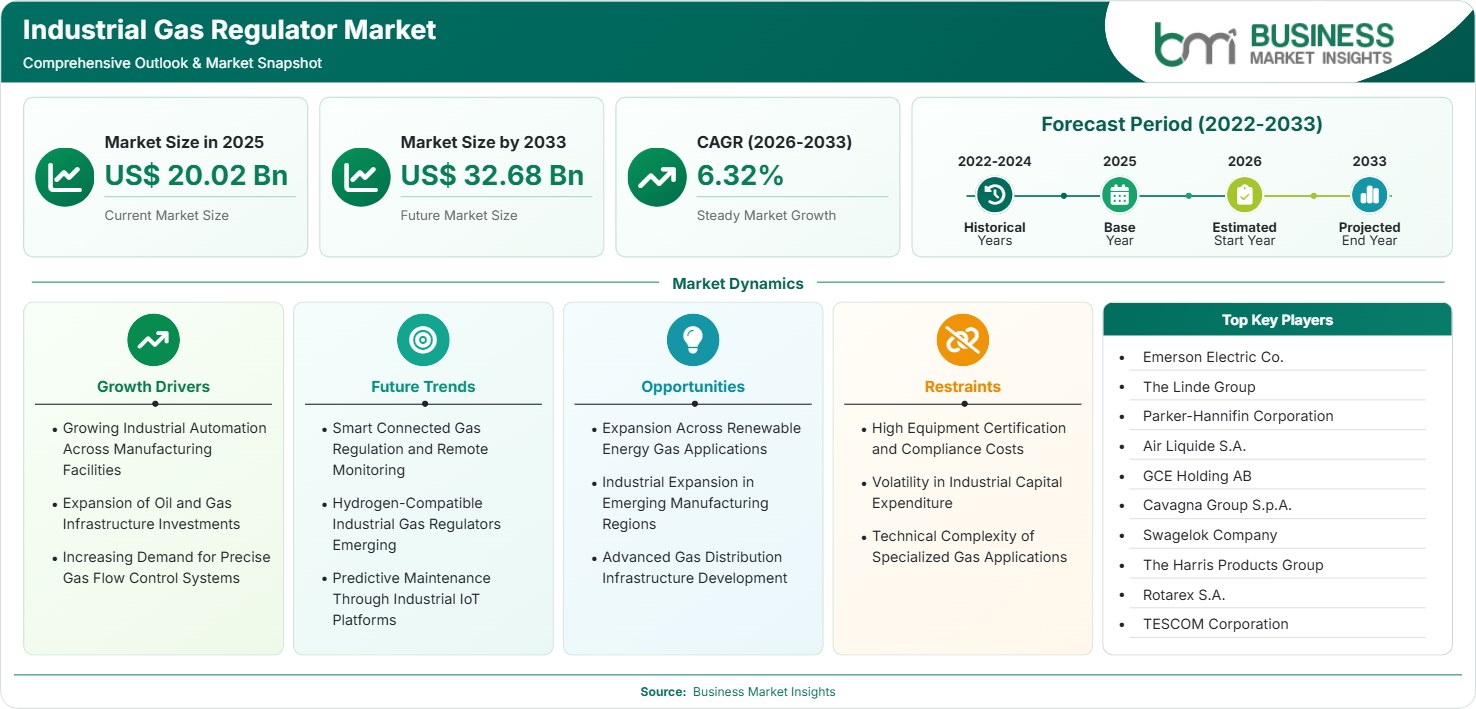
The Industrial Gas Regulator Market size was valued at US$ 20.02 Billion in 2025 and is projected to reach US$ 32.68 Billion by 2033, growing at a CAGR of 6.32% during 2026–2033. Increasing industrial automation, expanding oil and gas infrastructure, demand for precise gas flow control, renewable energy applications, and advanced gas distribution systems are driving market expansion.

Report Coverage
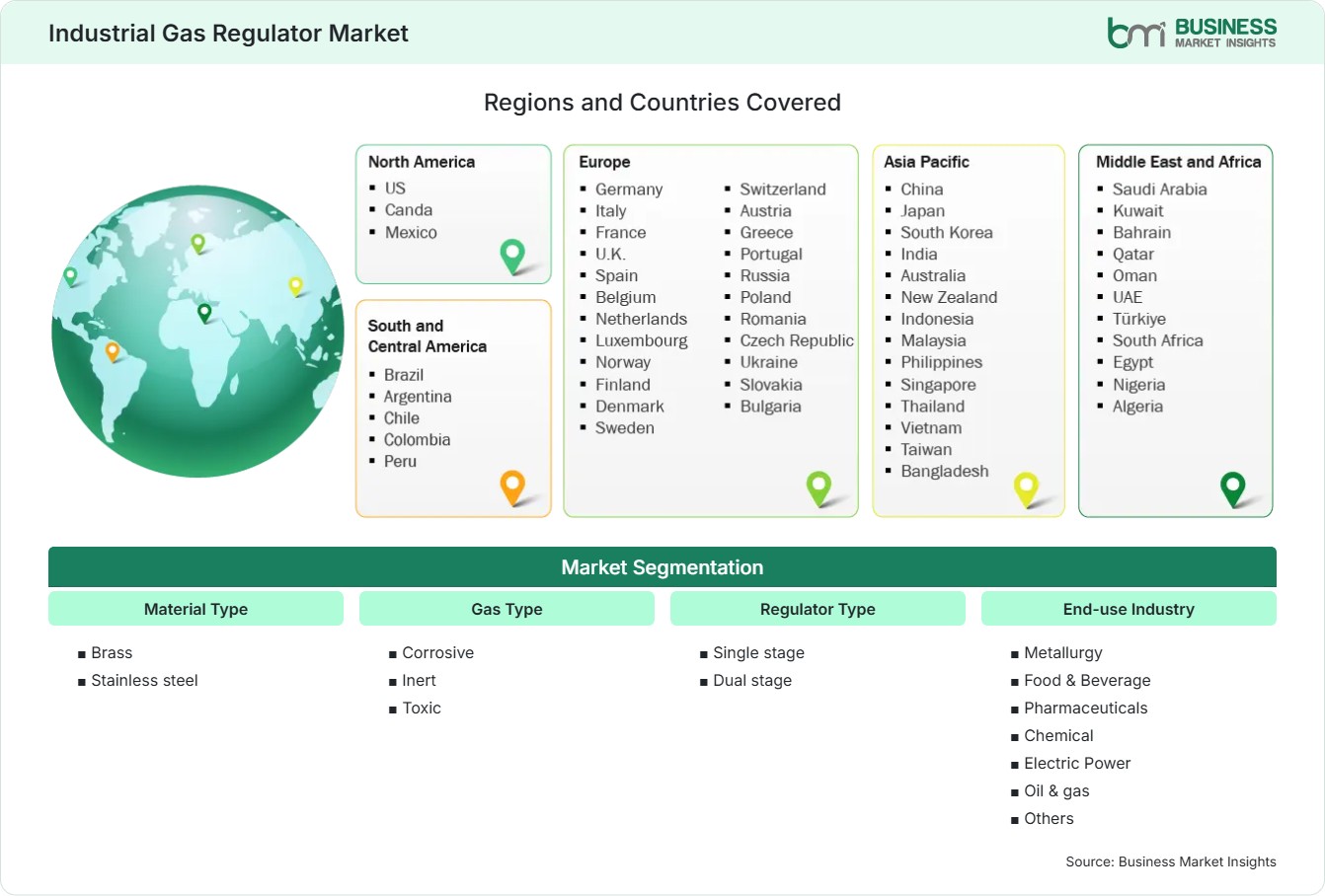
  • Material Type: Brass, Stainless steel
  • Gas Type: Corrosive, Inert, Toxic
  • Regulator Type: Single stage, Dual stage
  • End-use Industry: Metallurgy, Food & Beverage, Pharmaceuticals, Chemical, Electric Power, Oil & gas, Others
US$ 20.02 Bn Market size in 2025
US$ 32.68 Bn Market Size by 2033
6.32% CAGR, 2026 - 2033
2026-2033 Forecast Period

AI Overview

Industrial Gas Regulator Market Summary

  • North America Region: North America holds 32%–35% market share in 2025 and is projected to grow at a 5.8%–6.4% CAGR during 2026–2033. Strong industrial infrastructure, oil and gas activities, chemical production, and automation adoption are supporting regional demand. The U.S. represents the largest contributor due to advanced manufacturing facilities, energy investments, and industrial gas usage, with growth estimated at 6.0%–6.5% CAGR during the forecast period.
  • Fastest Growing Region: Asia Pacific accounts for 34%–37% market share in 2025 and is expected to expand at a 7.0%–7.6% CAGR through 2033. Manufacturing expansion, chemical production growth, energy infrastructure development, and increasing industrial gas consumption are accelerating regional adoption.
  • Leading Segment: Stainless steel Material Type holds 58%–62% market share in 2025 and is projected to grow at a 6.5%–7.0% CAGR during 2026–2033. Superior corrosion resistance, durability, and suitability for demanding industrial environments are supporting segment leadership.
  • High Growth Segment: Dual stage Regulator Type represents 42%–46% market share in 2025 and is expected to grow at a 6.8%–7.3% CAGR. Improved pressure stability, accuracy, and application suitability across critical gas handling operations are supporting segment growth.
  • Key Market Opportunity: Development of renewable energy gas applications, expansion of manufacturing regions, and investments in advanced gas distribution infrastructure are creating opportunities for high-performance regulator solutions.
  • Major Market Players: Emerson Electric Co., The Linde Group, Parker-Hannifin Corporation, Air Liquide S.A., GCE Holding AB, Cavagna Group S.p.A., Swagelok Company, The Harris Products Group, Rotarex S.A., TESCOM Corporation.
Strategic Insights

Industrial Gas Regulator Market: Strategic Insights

Industrial Gas Regulator Market Strategic Framework
FREE PDF
Request your free sample
Request free sample
Stakeholder View

Key Takeaways

  • The industrial gas ecosystem is evolving with increasing integration between regulator manufacturers, industrial gas suppliers, automation providers, and end-use industries.
  • Stainless steel regulators and dual-stage systems offer strong growth potential due to demand for durability, accuracy, and performance in critical applications.
  • Technology advancements are focused on smart monitoring capabilities, improved pressure control, corrosion resistance, and integration with automated industrial systems.
  • Asia Pacific provides strong investment opportunities due to manufacturing expansion, energy infrastructure development, and increasing industrial gas consumption.
  • Strategic partnerships, product innovation, and capacity expansion initiatives are influencing competitive positioning among global gas equipment manufacturers.
  • Rising adoption of hydrogen and renewable energy applications is creating additional opportunities for specialized gas regulation technologies.
Geographic Outlook

Industrial Gas Regulator Market Regional Highlights

North America Industrial Gas Regulator Market

North America accounts for 32%–35% of the Industrial Gas Regulator Market share in 2025 and is projected to grow at a 5.8%–6.4% CAGR during 2026–2033. The region maintains a strong position due to established industrial infrastructure, advanced manufacturing capabilities, oil and gas operations, and increasing automation adoption. The United States represents the largest contributor, supported by chemical processing, pharmaceuticals, energy, and industrial gas consumption.

  • The U.S. industrial sector is adopting advanced regulators to improve process efficiency, safety compliance, and automated gas delivery operations.
  • Chemical and pharmaceutical manufacturers are increasing demand for corrosion-resistant regulator systems suitable for precise gas handling applications.
  • Oil and gas infrastructure upgrades are supporting adoption of reliable pressure control equipment across production and processing facilities.
  • Increasing industrial automation is encouraging integration of advanced monitoring and control capabilities into gas regulation systems.

US Industrial Gas Regulator Market

The United States industrial gas regulator market contributes approximately 85%–88% of North American demand and is expected to grow at a 6.0%–6.5% CAGR through 2033. The country benefits from a mature industrial base, strong energy sector, advanced manufacturing facilities, and increasing adoption of automation technologies. Demand is supported by applications across metallurgy, pharmaceuticals, chemicals, food processing, and power generation.

  • Industrial manufacturers are upgrading gas management systems to enhance efficiency and reduce operational risks across production facilities.
  • Energy companies are investing in advanced gas control equipment for conventional and renewable energy applications.
  • Pharmaceutical and healthcare industries are increasing adoption of precise gas regulation systems for controlled processes.
  • Infrastructure modernization programs are supporting demand for reliable industrial gas distribution solutions.

Europe Industrial Gas Regulator Market

Europe represents approximately 26%–29% market share in 2025 and Europe Industrial Gas Regulator Market forecast to grow at a 5.5%–6.2% CAGR during 2026–2033. Germany, France, the United Kingdom, Italy, and Nordic countries are key contributors due to strong industrial manufacturing, chemical production, and energy transition initiatives. European industries are emphasizing process efficiency, safety standards, and sustainable production practices. The increasing adoption of hydrogen technologies and renewable energy projects is creating demand for advanced gas control systems.

  • Germany is driving demand through automotive manufacturing, chemical industries, and advanced industrial automation applications.
  • France is expanding adoption through energy transition initiatives, industrial gas applications, and clean technology investments.
  • The United Kingdom is increasing demand through hydrogen development projects and industrial infrastructure modernization.
  • Nordic countries are adopting advanced gas systems for renewable energy and industrial sustainability applications.
  • European regulatory standards are encouraging investments in safe and efficient gas handling technologies.

Asia Pacific Industrial Gas Regulator Market

Asia Pacific industrial gas regulator market holds 34%–37% market share in 2025 and is expected to achieve the fastest growth at a 7.0%–7.6% CAGR through 2033. The region is witnessing strong demand due to rapid industrialization, manufacturing expansion, chemical production growth, and infrastructure investments. China, India, Japan, and South Korea are major markets supported by expanding industrial facilities and increasing consumption of industrial gases.

  • China is expanding adoption through large-scale manufacturing growth, chemical production, and industrial automation investments.
  • India is witnessing rising demand due to manufacturing expansion, infrastructure development, and increasing industrial gas consumption.
  • Japan and South Korea are adopting precision gas control systems for semiconductor, electronics, and advanced manufacturing applications.
  • Southeast Asian countries are attracting industrial investments, creating new demand for gas distribution infrastructure.
  • Increasing hydrogen and renewable energy projects are supporting development of specialized regulator technologies.

Rest of World Industrial Gas Regulator Market

The Rest of World region contributes approximately 7%–9% market share in 2025 and is projected to grow at a 6.2%–7.0% CAGR during 2026–2033. Latin America, the Middle East, and Africa are witnessing gradual adoption due to industrial expansion, energy investments, and infrastructure development. Oil and gas activities remain key demand contributors, while manufacturing and renewable energy projects are creating additional opportunities. Latin American countries are improving industrial capabilities through manufacturing investments and energy sector development. Middle Eastern and African markets are focusing on gas infrastructure expansion and industrial diversification.

  • Brazil and Mexico are increasing adoption through industrial manufacturing growth and energy infrastructure investments.
  • Middle Eastern countries are deploying advanced gas regulation systems across oil, gas, and petrochemical facilities.
  • African markets are developing industrial gas infrastructure through mining, energy, and manufacturing projects.
  • Renewable energy initiatives are creating opportunities for advanced gas control applications.
  • Industrial expansion across developing regions is encouraging demand for cost-effective and durable regulator solutions.
Global Market Geography
FREE PDF
Request your free sample
Request free sample
Segment Analysis

Industrial Gas Regulator Market Segmentation

Material Type

The Material Type segment accounted for approximately 96%–98% industrial gas regulator market share in 2025 and is projected to grow at a 6.0%–6.7% CAGR during 2026–2033. Material selection plays a critical role in determining regulator performance, durability, corrosion resistance, and suitability for different industrial gases. Stainless steel regulators maintain a leading position due to their superior mechanical strength and compatibility with demanding applications involving corrosive and high-purity gases.

  • Brass: Brass regulators are widely used in general industrial applications due to cost efficiency, reliable performance, and suitability for non-corrosive gas handling operations.
  • Stainless steel: Stainless steel regulators are preferred for demanding applications requiring corrosion resistance, high durability, and compatibility with pharmaceutical, chemical, and high-purity gas processes.

Gas Type

The Gas Type segment represented approximately 97%–99% market share in 2025 and is expected to grow at a 6.1%–6.8% CAGR through 2033. Industrial gas applications require specialized regulator designs based on gas characteristics, pressure requirements, safety considerations, and operational environments. Inert gases represent significant demand due to extensive use in manufacturing and processing industries, while corrosive and toxic gases require advanced materials and precision control mechanisms.

  • Corrosive: Corrosive gas regulators require advanced materials and protective designs to ensure reliable performance in chemical processing and specialized industrial applications.
  • Inert: Inert gas regulators support applications involving gases such as nitrogen and argon across manufacturing, food processing, electronics, and laboratory environments.
  • Toxic: Toxic gas regulators require enhanced safety features, leak prevention mechanisms, and precise control systems for hazardous industrial operations.

Regulator Type

The Regulator Type segment accounted for approximately 98%–99% market share in 2025 and is projected to expand at a 6.2%–6.9% CAGR between 2026 and 2033. Single-stage and dual-stage regulators are widely used across industrial applications based on pressure control requirements and process complexity. Dual-stage regulators are gaining adoption due to improved pressure stability, consistent gas flow, and suitability for sensitive operations. Single-stage regulators remain important for applications requiring simpler pressure management systems.

  • Single stage: Single-stage regulators provide simple pressure reduction solutions and are widely adopted across general industrial applications requiring basic gas flow control.
  • Dual stage: Dual-stage regulators deliver improved pressure stability and accuracy, making them suitable for critical processes requiring consistent gas supply performance.

End-use Industry

The End-use Industry segment accounted for approximately 95%–97% market share in 2025 and is expected to grow at a 6.3%–7.0% CAGR during 2026–2033. Industrial gas regulators are essential across metallurgy, food and beverage, pharmaceuticals, chemicals, electric power, and oil and gas sectors. Oil and gas and chemical industries represent major demand contributors due to extensive gas processing requirements.

  • Metallurgy: Metallurgical industries use gas regulators for controlled gas supply during welding, heat treatment, metal processing, and manufacturing operations.
  • Food & Beverage: Food and beverage companies utilize regulators for controlled gas applications including packaging, preservation, and processing activities.
  • Pharmaceuticals: Pharmaceutical manufacturers require precise gas regulation systems for production processes, laboratory operations, and controlled manufacturing environments.
  • Chemical: Chemical industries adopt advanced regulators for safe handling and accurate control of specialized industrial gases.
  • Electric Power: Power generation facilities use gas regulation equipment for operational reliability, fuel management, and process efficiency.
  • Oil & gas: Oil and gas industries rely on regulators for exploration, processing, distribution, and controlled gas flow management applications.
Market Forces

Industrial Gas Regulator Market Dynamics

Key Market Drivers

Growing Industrial Automation Across Manufacturing Facilities

The growing use of automation in industrial processes has led to an increasing need for advanced gas regulators that ensure accuracy in terms of controlling pressure and performance of the process. Automation of industrial processes requires the supply of gas in welding, processing, reaction and specialized manufacturing processes. These developments are also influencing Industrial Gas Regulator Market trends as industries prioritize efficient gas management, enhanced production reliability, and reduced operational risks across multiple industrial applications.

Expansion of Oil and Gas Infrastructure Investments

The development of oil and gas industry infrastructures has caused an increase in demand for industrial gas regulators in all areas, from exploration to transportation. Pressure regulation devices are required for oil and gas companies to operate safely and efficiently in difficult conditions. Development of pipelines and other oil and gas industry infrastructures creates additional need for robust and reliable regulators. Corrosion resistance and advanced design are key priorities of modern oil and gas companies.

Increasing Demand for Precise Gas Flow Control Systems

The rising necessity of gas flow control systems for applications in various sectors including pharmaceuticals, chemicals, food, and electronics is driving the increasing demand for superior regulators. Precision in managing gases is highly important to ensure quality and efficiency of the process, besides being safe in the operation. It is increasingly becoming common for companies to utilize regulators with capabilities to manage pressure and other specific aspects of gases. Manufacturers are investing in technologies that improve reliability, and enhance performance under demanding conditions.

Key Market Opportunities

Expansion Across Renewable Energy Gas Applications

Shift towards renewable energy sources is creating new opportunities for manufacturers of industrial gas regulators especially when it comes to hydrogen production, storage, and delivery systems. New energy initiatives need specific pressure regulating systems that can handle hydrogen gas and other renewable gas sources. Investments are creating into renewable energy infrastructure by governments and industries. The manufacturers have started to come up with systems that can handle the high-pressure hydrogen and other renewable gases without any leakage issues.

Industrial Expansion in Emerging Manufacturing Regions

Industrial growth across emerging manufacturing regions is creating opportunities for gas regulator suppliers as companies establish new production facilities and expand industrial capacity. Countries across Asia Pacific, Latin America, and the Middle East are increasing investments in manufacturing, chemicals, pharmaceuticals, and energy infrastructure. New industrial facilities require reliable gas distribution and pressure control systems to support efficient operations. Manufacturers are expanding regional production capabilities and distribution networks to capture demand from developing markets.

Advanced Gas Distribution Infrastructure Development

Development of advanced gas distribution infrastructure is creating opportunities for next-generation regulator solutions with improved monitoring, control, and safety capabilities. Industrial facilities are investing in modern gas networks to enhance operational efficiency and reduce maintenance requirements. Smart monitoring features, digital controls, and remote management capabilities are becoming increasingly important for large-scale industrial operations.

Market Restraints and Challenges

High Equipment Certification and Compliance Costs

Factor: Industrial gas regulators require extensive certification, testing, quality validation, and compliance with regional safety standards before deployment in critical applications. Impact: High certification and compliance costs increase equipment development expenses and can delay product commercialization, particularly for manufacturers entering regulated markets. Industries using specialized gases must ensure equipment meets strict safety requirements, increasing procurement complexity and operational costs.

Volatility in Industrial Capital Expenditure

Factor: Industrial gas regulator demand is closely linked to capital investments in manufacturing facilities, energy infrastructure, and industrial expansion projects. Impact: Fluctuations in industrial spending can affect equipment procurement cycles and delay planned infrastructure upgrades. Economic uncertainty, changing energy investments, and project postponements may reduce short-term demand from capital-intensive industries. Manufacturers must manage production planning and inventory levels to address variable customer requirements.

Company Analysis

Competitive Landscape

The competitive environment includes industrial automation providers, gas technology companies, pressure control equipment manufacturers, and specialized flow management solution providers serving diverse industrial applications. Industrial Gas Regulator Market analysis indicates that leading companies are strengthening their market positions through advanced regulator designs, material innovations, safety-focused solutions, and expansion across energy, manufacturing, healthcare, and chemical sectors.

Company Name

Overview

Products and Services relevant to this market

Emerson Electric Co.

Global technology company providing automation and industrial control solutions across energy, manufacturing, and process industries.

TESCOM pressure regulators, gas control systems, precision pressure solutions, and industrial flow management technologies.

The Linde Group

Global industrial gases and engineering company supporting gas production, distribution, and related equipment applications.

Gas handling systems, pressure regulation equipment, industrial gas solutions, and engineered gas management services.

Parker-Hannifin Corporation

Motion and control technology provider offering fluid and gas handling solutions for industrial applications.

Pressure regulators, gas control systems, filtration solutions, and precision flow control equipment.

Air Liquide S.A.

Industrial gases company providing gases, technologies, and services for healthcare, manufacturing, and energy industries.

Industrial gas systems, gas distribution equipment, pressure control solutions, and engineered gas applications.

GCE Holding AB

Gas equipment manufacturer specializing in medical, industrial, and specialty gas control solutions.

Gas regulators, valves, cutting equipment, and gas management systems for industrial applications.

Cavagna Group S.p.A.

Industrial gas equipment company developing valves and regulation systems for multiple gas applications.

Gas pressure regulators, valves, LPG equipment, and industrial gas control components.

Swagelok Company

Fluid system solutions provider supporting industrial, energy, and research applications worldwide.

Precision regulators, pressure control systems, gas distribution components, and fluid management solutions.

The Harris Products Group

Welding and gas equipment manufacturer serving industrial, fabrication, and specialty gas markets.

Gas regulators, welding equipment, cutting systems, and industrial gas control products.

Rotarex S.A.

Gas control technology company specializing in valves and pressure regulation equipment.

Gas regulators, cylinder valves, specialty gas systems, and high-performance flow control solutions.

TESCOM Corporation

Pressure control technology provider offering engineered solutions for critical gas applications.

High-pressure regulators, precision pressure control systems, gas handling equipment, and specialty applications.

Trust & Transparency

Research Methodology

The market analysis combines proprietary research with secondary data from government agencies, company disclosures, regulatory filings, industry databases and expert interviews. Market estimates are validated through data triangulation, cross-market benchmarking and analyst review.

View Full Research Methodology

Questions Answered

Frequently Asked Questions

What challenges affect industrial gas regulator adoption?

High certification costs, regulatory compliance requirements, and fluctuations in industrial capital investments can influence equipment procurement and market expansion.

Which industries commonly use industrial gas regulator market report?

Metallurgy, chemicals, pharmaceuticals, food and beverage, electric power, and oil and gas industries use regulators for controlled gas management.

How are renewable energy projects influencing industrial gas regulator demand?

Hydrogen production and renewable gas infrastructure require advanced pressure control solutions, creating new opportunities for specialized industrial gas regulator technologies.

Which material type is preferred for industrial gas regulators?

Stainless steel regulators are widely preferred due to corrosion resistance, durability, and suitability for demanding applications involving specialty and high-purity gases.

What factors are driving demand for industrial gas regulator market?

Increasing industrial automation, expansion of oil and gas infrastructure, rising industrial gas consumption, and demand for accurate pressure control systems are supporting market growth.

Access the Full Industrial Gas Regulator Market Report

Get segment-level forecasts, regional estimates, competitive benchmarking, company profiles and downloadable Excel datasets.

Access the full Industrial Gas Regulator Market Report
350 pages PDF & Excel | 2026-08-25