
Hydraulic Cylinders Market Outlook: Size, Share, Trends, Growth Analysis, Competitive Landscape & Forecast, 2026–2033

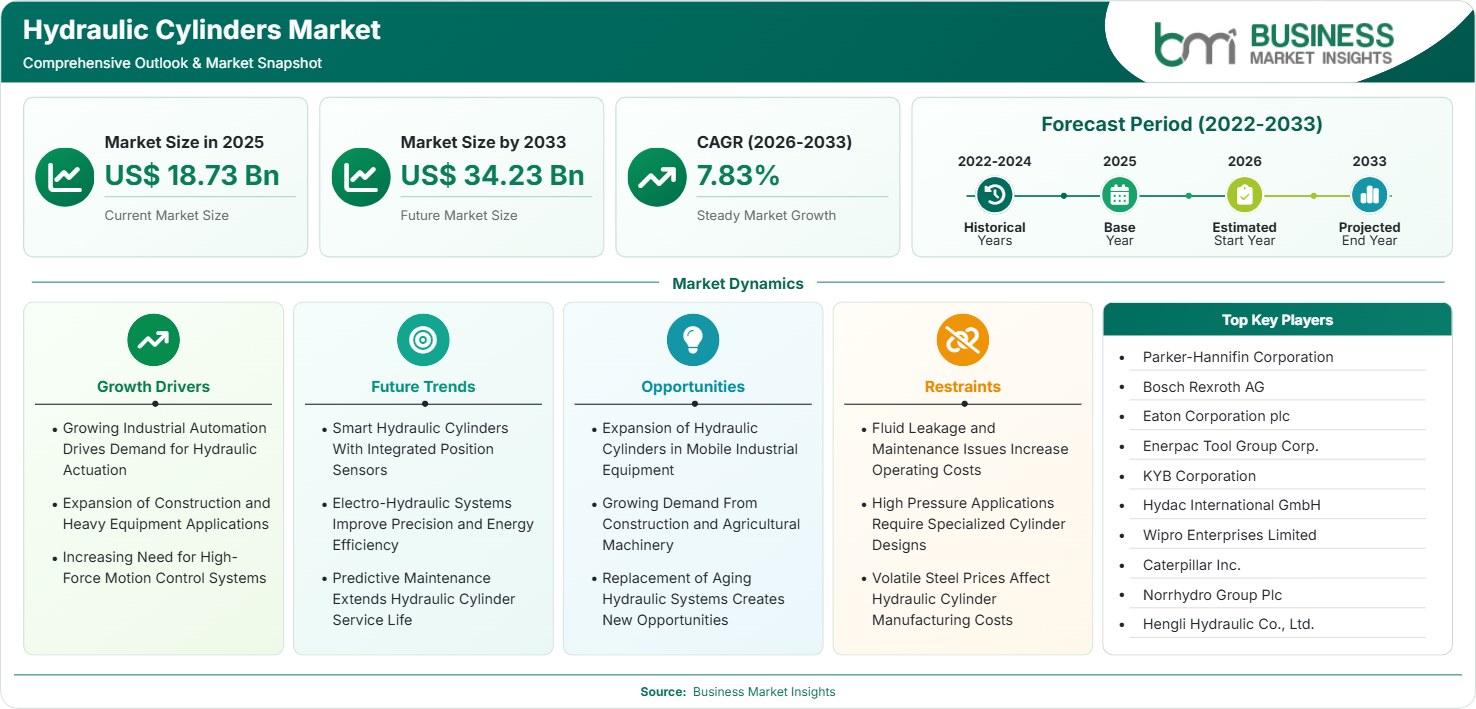
The Hydraulic Cylinders Market size was valued at US$ 18.73 Billion in 2025 and is projected to reach US$ 34.23 Billion by 2033, growing at a CAGR of 7.83% during 2026–2033, driven by industrial automation, construction equipment demand, high-force actuation, and hydraulic system replacement.

Report Coverage
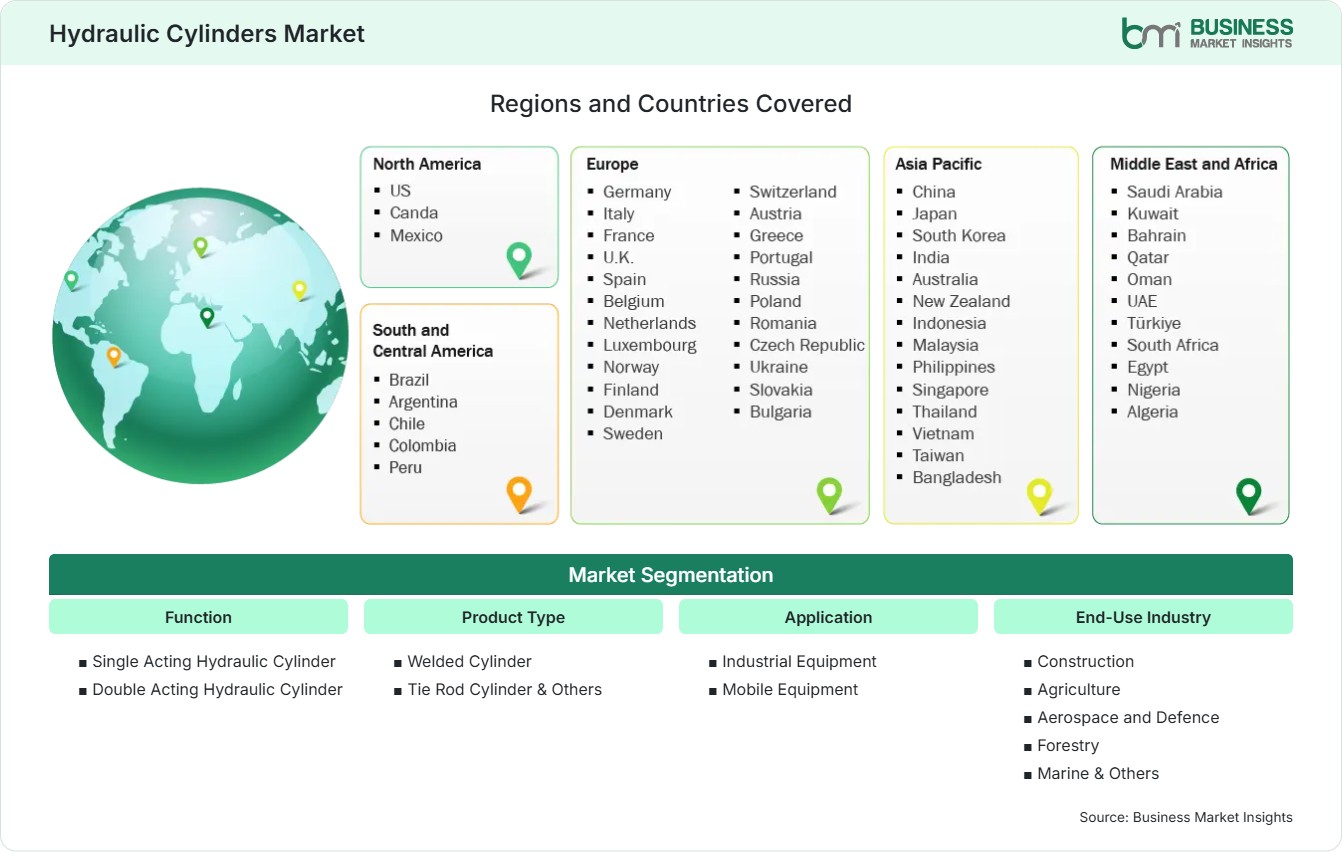
  • Function: Single Acting Hydraulic Cylinder, Double Acting Hydraulic Cylinder
  • Product Type: Welded Cylinder, Tie Rod Cylinder & Others
  • Application: Industrial Equipment, Mobile Equipment
  • End-Use Industry: Construction, Agriculture, Aerospace and Defence, Forestry, Marine & Others
US$ 18.73 Bn Market size in 2025
US$ 34.23 Bn Market Size by 2033
7.83% CAGR, 2026 - 2033
2026-2033 Forecast Period

AI Overview

Hydraulic Cylinders Market Summary

  • North America Region: North America holds a 24%–28% share in 2025 and grows at a 7.1%–7.8% CAGR during 2026–2033, supported by construction machinery, industrial automation, fleet modernization, and replacement demand. The US accounts for the largest regional demand, industrial machinery, agricultural mechanization, and replacement of aging hydraulic systems, with a 7.2%–7.9% CAGR during 2026–2033.
  • Fastest Growing Region: Asia Pacific holds a 34%–38% share in 2025 and grows at an 8.4%–9.2% CAGR during 2026–2033, supported by infrastructure investment, industrialization, construction machinery production, agricultural mechanization, manufacturing expansion, and increasing adoption of advanced mobile hydraulic equipment.
  • Leading Segment: Double Acting Hydraulic Cylinder holds a 58%–62% share in 2025 and grows at an 8.0%–8.6% CAGR during 2026–2033, supported by bidirectional force requirements, precise motion control, construction machinery, industrial equipment, agricultural machinery, and automated hydraulic systems.
  • High Growth Segment: Mobile Equipment holds a 52%–56% share in 2025 and grows at an 8.4%–9.1% CAGR during 2026–2033, driven by excavators, loaders, agricultural machinery, forestry equipment, material handling systems, and demand for compact, durable, and energy-efficient actuation.
  • Key Market Opportunity: Replacement of aging cylinders, smart hydraulic integration, electrified mobile machinery, customized designs, and growing construction and agricultural equipment production create attractive opportunities for specialized manufacturers.
  • Major Market Players: Parker-Hannifin Corporation, Bosch Rexroth AG, Eaton Corporation plc, Enerpac Tool Group Corp., KYB Corporation, Hydac International GmbH, Wipro Enterprises Limited, Caterpillar Inc., Norrhydro Group Plc, Hengli Hydraulic Co., Ltd.
Strategic Insights

Hydraulic Cylinders Market: Strategic Insights

Hydraulic Cylinders Market Strategic Framework
FREE PDF
Request your free sample
Request free sample
Stakeholder View

Key Takeaways

  • Cylinder demand is closely linked to the equipment manufacturing ecosystem, with OEM relationships, component availability, machining capabilities, sealing technologies, testing infrastructure, and after-sales support influencing supplier competitiveness.
  • Mobile equipment provides strong upside because construction, agriculture, forestry, and material-handling machinery require compact cylinders capable of delivering high force under changing loads and harsh operating conditions.
  • Product development is moving toward sensor-enabled cylinders, electronic control, improved sealing, lighter designs, and energy-efficient hydraulic architectures that support machine automation and more precise motion control.
  • Asia Pacific offers the strongest expansion opportunity as equipment manufacturing, infrastructure development, agricultural mechanization, and industrial production increase the installed base requiring hydraulic actuation.
  • Replacement demand creates a recurring revenue opportunity because cylinders operate in demanding environments and require periodic seal replacement, refurbishment, repair, or complete replacement as equipment ages.
  • Suppliers can strengthen margins by combining cylinder manufacturing with engineering, customization, condition monitoring, maintenance services, and integrated hydraulic solutions rather than competing solely on standard component pricing.
Geographic Outlook

Hydraulic Cylinders Market Regional Highlights

North America Hydraulic Cylinders Market

North America holds a 24%–28% share in 2025 and grows at a 7.1%–7.8% CAGR through 2033. The US represents the largest regional demand base, supported by construction machinery, industrial automation, agriculture, aerospace, forestry, and material handling. Canada contributes through mining, forestry, construction, and agricultural equipment. The Hydraulic Cylinders Market share reflects a mature installed base where replacement and modernization are important alongside new equipment demand.

  • Construction equipment remains an important demand source as excavators, loaders, cranes, and other heavy machinery depend on hydraulic cylinders for lifting, digging, steering, and attachment movement.
  • Industrial manufacturers increasingly require precise hydraulic motion for presses, forming equipment, material handling systems, and automated production machinery operating under demanding load conditions.
  • Replacement activity supports aftermarket demand because aging equipment requires cylinder refurbishment, seal replacement, rod repair, and complete actuator replacement to maintain machine availability.
  • Agricultural machinery manufacturers increasingly emphasize efficient hydraulic systems as farms adopt higher-capacity equipment and more automated implements requiring reliable high-force actuation.

US Hydraulic Cylinders Market

The US represents 82%–86% of North American demand in 2025 and U.S. Hydraulic Cylinders Market forecast to grow at a 7.2%–7.9% CAGR through 2033. Construction, agriculture, industrial equipment, aerospace and defense, forestry, and marine applications sustain demand. A large installed equipment base supports aftermarket activity, while automation encourages new cylinder designs with improved control and monitoring.

  • Construction and infrastructure equipment creates consistent demand for cylinders used in excavators, loaders, cranes, lifting systems, and other mobile machinery.
  • Industrial automation is increasing demand for hydraulic actuation where production equipment requires controlled high-force linear movement, particularly in pressing, forming, handling, and positioning applications.
  • Aftermarket suppliers benefit from equipment refurbishment requirements, providing replacement cylinders, seals, repair services, and application-specific solutions for established machinery fleets.

Europe Hydraulic Cylinders Market

Europe holds a 21%–25% share in 2025 and grows at a 6.5%–7.3% CAGR through 2033. Germany, Italy, France, the United Kingdom, and the Nordic countries represent leading markets, while Germany and Italy maintain strong manufacturing demand. Nordic markets provide attractive growth through forestry, mining, marine, and mobile machinery applications. The Hydraulic Cylinders Market growth is supported by industrial automation, machinery modernization, equipment efficiency requirements, and increasing integration of electronic controls with hydraulic systems.

  • Germany remains a major manufacturing center with demand from industrial machinery, construction equipment, agricultural systems, material handling, and automated production lines.
  • Italy and France provide demand across construction machinery, agriculture, industrial equipment, aerospace applications, and specialized hydraulic systems requiring customized cylinder configurations.
  • Nordic countries support specialized cylinder demand through forestry, mining, marine, and heavy mobile machinery operating under severe environmental and load conditions.
  • European manufacturers increasingly combine hydraulic components with sensors and electronic controls to improve machine efficiency, diagnostics, precision, and predictive maintenance capabilities.

Asia Pacific Hydraulic Cylinders Market

Asia Pacific holds a 34%–38% share in 2025 and grows at an 8.4%–9.2% CAGR through 2033, making it the fastest-growing region. China, Japan, India, South Korea, and Australia are leading markets, while India and Southeast Asia offer strong expansion opportunities. Construction, agriculture, mining, industrial production, and equipment manufacturing are driving demand. The Hydraulic Cylinders Market share is supported by expanding domestic machinery production, infrastructure development, and increasing adoption of advanced hydraulic systems.

  • China remains a major manufacturing base for construction and industrial machinery, supporting broad demand for standard and customized hydraulic cylinders across equipment platforms.
  • India offers strong potential through infrastructure development, agricultural mechanization, construction machinery production, and increasing industrial automation across manufacturing facilities.
  • Japan and South Korea support advanced cylinder demand through sophisticated machinery manufacturing, robotics, industrial automation, agricultural equipment, and specialized mobile applications.
  • Southeast Asian markets provide expansion opportunities as construction, mining, plantations, ports, manufacturing, and infrastructure projects increase demand for mobile and industrial hydraulic equipment.

Rest of World Hydraulic Cylinders Market

Rest of World holds a 13%–17% share in 2025 and grows at a 6.8%–7.6% CAGR through 2033. South and Central America are led by Brazil, Mexico, Argentina, Chile, and Colombia, with Brazil and Mexico providing stronger growth prospects. Agriculture, mining, construction, forestry, and industrial machinery support demand. The Hydraulic Cylinders Market growth in these countries is closely connected with equipment utilization and replacement requirements across resource-intensive industries. Middle East and Africa demand is supported by construction, mining, agriculture, ports, material handling, and industrial projects. Saudi Arabia, the UAE, South Africa, and Türkiye are leading markets, while Saudi Arabia and the UAE provide stronger growth potential.

  • Brazil provides demand from agricultural machinery, mining equipment, construction machinery, forestry operations, and industrial applications requiring high-force hydraulic actuation.
  • Middle Eastern construction and infrastructure projects support demand for cylinders used in cranes, lifting equipment, earthmoving machinery, and specialized mobile equipment.
  • South Africa and other African markets provide opportunities across mining, agriculture, construction, material handling, and equipment refurbishment.
  • Latin American customers increasingly prioritize reliable replacement components and localized support because equipment downtime can materially affect resource-intensive operations.
Global Market Geography
FREE PDF
Request your free sample
Request free sample
Segment Analysis

Hydraulic Cylinders Market Segmentation

Function

Double Acting Hydraulic Cylinder holds a 58%–62% share in 2025 and grows at an 8.0%–8.6% CAGR through 2033, supported by bidirectional force, precise positioning, and broad use in industrial and mobile equipment. The Hydraulic Cylinders Market scope increasingly favors double-acting designs where controlled extension and retraction are required across automated and heavy-duty applications.

  • Single Acting Hydraulic Cylinder: Uses hydraulic pressure for movement in one direction, making it suitable for lifting, clamping, tipping, and applications where return movement can use gravity or mechanical force.
  • Double Acting Hydraulic Cylinder: Provides controlled hydraulic movement in both directions, supporting excavators, presses, agricultural machinery, industrial automation, and applications requiring repeatable bidirectional motion.

Product Type

Welded Cylinder holds a 47%–51% share in 2025 and grows at a 7.9%–8.5% CAGR through 2033, supported by compact construction, high strength, and extensive use in mobile machinery. Tie Rod Cylinder remains important for industrial equipment because its construction facilitates servicing and component replacement. Product selection is increasingly application-specific.

  • Welded Cylinder: Compact welded construction supports high-pressure mobile applications, making these cylinders suitable for construction, agricultural, forestry, material handling, and heavy equipment.
  • Tie Rod Cylinder: Tie rod designs support industrial machinery where maintenance, configuration flexibility, standardized components, and serviceability are important purchasing considerations.

Application

Mobile Equipment holds a 52%–56% share in 2025 and grows at an 8.4%–9.1% CAGR through 2033, supported by construction, agricultural, forestry, mining, and material handling machinery. Mobile systems require cylinders that tolerate shock, vibration, contamination, and changing loads.

  • Industrial Equipment: Industrial applications use cylinders for pressing, forming, clamping, lifting, positioning, material handling, and automated production processes requiring controlled linear force.
  • Mobile Equipment: Mobile machinery relies on cylinders for boom, bucket, steering, lifting, tipping, and attachment functions across construction, agriculture, forestry, mining, and material handling.

End-Use Industry

Construction holds a 29%–33% share in 2025 and grows at a 7.8%–8.5% CAGR through 2033, supported by excavators, loaders, cranes, and lifting equipment. Agriculture remains a major application because tractors and implements increasingly use hydraulic functions. Aerospace and defense require specialized high-reliability designs, while forestry and marine applications demand corrosion resistance and durability under demanding operating environments.

  • Construction: Excavators, loaders, cranes, compactors, and other equipment use hydraulic cylinders for lifting, digging, steering, attachment movement, and load handling.
  • Agriculture: Tractors, harvesters, implements, and material-handling equipment use cylinders for steering, lifting, positioning, attachment control, and automated agricultural functions.
  • Aerospace and Defence: Specialized cylinders support actuation functions requiring strict reliability, controlled movement, durability, and performance under demanding operating conditions.
  • Forestry: Forestry machinery requires rugged cylinders capable of handling high loads, shock, vibration, contamination, and continuous operation in difficult outdoor environments.
  • Marine: Marine equipment uses corrosion-resistant hydraulic cylinders for steering, lifting, deck machinery, handling systems, and other applications exposed to demanding operating environments.
Market Forces

Hydraulic Cylinders Market Dynamics

Key Market Drivers

Growing Industrial Automation Drives Demand for Hydraulic Actuation

The need for controlled linear actuators is growing with industrial automation in presses, material handling systems, forming machines, manufacturing systems, and positioning systems. Hydraulics continue to be important when large amounts of force and small size of power transmission are needed. Companies are developing hydraulic cylinders with advanced technologies such as sensors, electronics, improved sealing, and monitoring to achieve automatic functioning. The Hydraulic Cylinders Market Trends are thus expanding from being purely mechanical actuators to motion control systems.

Expansion of Construction and Heavy Equipment Applications

Construction and heavy equipment remain major users of hydraulic cylinders because excavators, loaders, cranes, compactors, and lifting machinery require high-force linear movement. Infrastructure development and equipment modernization increase the installed base requiring cylinders, while higher machine productivity places greater demands on actuator durability and response. The Hydraulic Cylinders Market benefits from both original equipment production and replacement demand. Suppliers can strengthen their position by offering engineered cylinders, faster configuration, improved sealing, corrosion protection, and lifecycle support.

Increasing Need for High-Force Motion Control Systems

High-force applications continue to favor hydraulic actuation where compact systems must generate substantial linear force while tolerating shock and variable operating loads. This requirement spans industrial presses, heavy mobile machinery, agricultural equipment, forestry machines, marine systems, and specialized handling equipment. Hydraulic cylinders can deliver high power density while maintaining relatively straightforward mechanical integration. The Hydraulic Cylinders Market growth is consequently supported by demand for actuators that combine mechanical strength with greater control capability.

Key Market Opportunities

Expansion of Hydraulic Cylinders in Mobile Industrial Equipment

Mobile industrial equipment offers a broad opportunity because machinery manufacturers increasingly require compact and efficient hydraulic systems for variable operating conditions. Construction, agriculture, forestry, mining, ports, and material handling all require actuators capable of delivering controlled movement under heavy loads. Cylinder suppliers can benefit by developing application-specific products with integrated sensing, improved sealing, corrosion resistance, and optimized weight.

Growing Demand from Construction and Agricultural Machinery

The construction and agricultural machinery sectors have consistent opportunities due to the expansion of their fleet sizes and increasing complexity in the machines' operations. Excavators, loaders, tractors, harvesters, implements, and material handling systems are becoming more advanced such that they need multiple hydraulic functions, making them demand cylinders that vary in size, stroke, pressure, mount type, and controls. Suppliers can generate extra value by making modular designs, thus enabling them to customize quickly to fit various OEM platforms. Companies that offer services in both original equipment supply and after-market business are bound to have recurring revenue sources.

Replacement of Aging Hydraulic Systems Creates New Opportunities

The presence of many machines in place that use hydraulic systems provides a constant opportunity for replacement and refurbishment as a result of wear on cylinders, sealing, damage to the rod, corrosion, and reduced performance. It is always easy for the operator of the machine to opt for the replacement of components rather than scrapping the entire machine, especially where the equipment still has some more years to go in terms of its life cycle. The opportunity extends to predictive maintenance, condition monitoring, repair kits, and refurbishment services.

Market Restraints and Challenges

Fluid Leakage and Maintenance Issues Increase Operating Costs

Factor: Hydraulic cylinders operate under pressure and rely on seals, rods, bearings, and fluid systems that can deteriorate through contamination, wear, corrosion, misalignment, or demanding duty cycles. Impact: Leakage and component degradation increase maintenance requirements, downtime, fluid consumption, and operating costs for equipment owners. Manufacturers therefore face pressure to improve seal technology, rod surface quality, contamination resistance, and cylinder assembly precision.

High Pressure Applications Require Specialized Cylinder Designs

Factor: High pressure applications need strong materials, accurate machining, special seals, solid connections, and careful manufacturing processes to handle the tough load conditions. Impact: Special construction adds to the difficulty and expense of design, manufacturing, and testing, especially for specially built cylinders. High pressure systems also need careful consideration of fatigue life, rod stability, barrel strength, seal behavior, and mounting loads.

Company Analysis

Competitive Landscape

Hydraulic Cylinders Market analysis shows that there is a competitive scenario among diverse fluid power equipment manufacturers, cylinder manufacturers, equipment OEMs, and engineering-oriented suppliers. Competitiveness is shifting towards the following aspects: product reliability, customization, pressure capacity, delivery efficiency, digitization, after-market capabilities, and capability of developing cylinders for a particular part of equipment.

Company Name

Overview

Products and Services relevant to this market

Parker-Hannifin Corporation

Diversified motion and control technology company with broad hydraulic actuator and cylinder capabilities across industrial and mobile applications.

Hydraulic cylinders, mobile cylinders, industrial cylinders, telescopic cylinders, actuator systems, accessories, replacement solutions, and technical support.

Bosch Rexroth AG

Global drive and control technology supplier offering hydraulic components and integrated motion solutions for industrial and mobile machinery.

Tie-rod and application cylinders, hydraulic systems, compact hydraulics, controls, digital hydraulics, engineering, and maintenance services.

Eaton Corporation plc

Power management company with hydraulic technologies serving industrial, mobile, and specialized equipment applications.

Hydraulic cylinders, motion-control components, hydraulic systems, filtration, valves, pumps, and integrated fluid-power solutions.

Enerpac Tool Group Corp.

Specialized industrial tools and hydraulic technology supplier focused on controlled movement and high-force applications.

Hydraulic cylinders, high-pressure tools, lifting systems, jacking solutions, bolting systems, and engineered hydraulic equipment.

KYB Corporation

Japanese manufacturer with extensive hydraulic equipment capabilities serving mobile machinery and industrial applications.

Hydraulic cylinders, hydraulic components, shock absorbers, suspension products, and specialized machinery hydraulic solutions.

Hydac International GmbH

Fluid engineering company providing hydraulic, filtration, cooling, sensing, and system solutions across industrial applications.

Hydraulic cylinders, filtration systems, valves, sensors, fluid conditioning, cooling, and integrated hydraulic solutions.

Wipro Enterprises Limited

Indian engineering company with hydraulic cylinder manufacturing capabilities serving mobile and industrial equipment markets.

Hydraulic cylinders, custom actuators, hydraulic components, engineered solutions, and equipment-specific cylinder applications.

Caterpillar Inc.

Heavy equipment manufacturer with extensive in-house and application-driven hydraulic requirements across construction and resource industries.

Hydraulic cylinders, machine hydraulic systems, replacement components, equipment support, and integrated actuation solutions.

Norrhydro Group Plc

Specialized Nordic manufacturer focused on high-performance cylinders and energy-efficient linear motion solutions for demanding machinery.

Customized hydraulic cylinders, NorrDigi intelligent systems, energy-efficient linear motion, electric actuators, and lifecycle support.

Hengli Hydraulic Co., Ltd.

Major Chinese hydraulic manufacturer serving construction machinery, industrial equipment, and mobile machinery applications.

Hydraulic cylinders, pumps, valves, motors, integrated hydraulic systems, electronic controls, and customized equipment solutions.

Trust & Transparency

Research Methodology

The market analysis combines proprietary research with secondary data from government agencies, company disclosures, regulatory filings, industry databases and expert interviews. Market estimates are validated through data triangulation, cross-market benchmarking and analyst review.

View Full Research Methodology

Questions Answered

Frequently Asked Questions

How are hydraulic cylinders competing with electromechanical actuators?

Hydraulic cylinders retain advantages in high-force and shock-loaded applications, while electromechanical alternatives can offer precision and simpler energy management in selected duties. Application requirements increasingly determine the preferred architecture.

What makes the aftermarket important for cylinder manufacturers?

Hydraulic cylinders operate under demanding mechanical and environmental conditions, creating recurring requirements for replacement, refurbishment, seals, rods, and complete actuator assemblies throughout equipment lifecycles.

How are smart technologies affecting hydraulic cylinder design?

Sensors and electronic controls are enabling better position monitoring, condition assessment, diagnostics, and integration with machine-control systems. This is shifting cylinder development toward connected actuation rather than purely mechanical components.

Why are customized hydraulic cylinders gaining importance in Hydraulic Cylinders Market report?

OEMs increasingly require cylinders matched to specific pressure, stroke, mounting, dimensional, environmental, and control requirements. Customization helps optimize machine performance while allowing manufacturers to address specialized operating conditions.

What is driving demand for hydraulic cylinders across mobile equipment?

Demand is being supported by continued use of hydraulic actuation in construction, agriculture, forestry, mining, material handling, and specialized mobile machinery where high force, compact packaging, and shock tolerance are important.

Access the Full Hydraulic Cylinders Market Report

Get segment-level forecasts, regional estimates, competitive benchmarking, company profiles and downloadable Excel datasets.

Access the full Hydraulic Cylinders Market Report
350 pages PDF & Excel | 2026-08-19
Similar Research

Related Market Reports