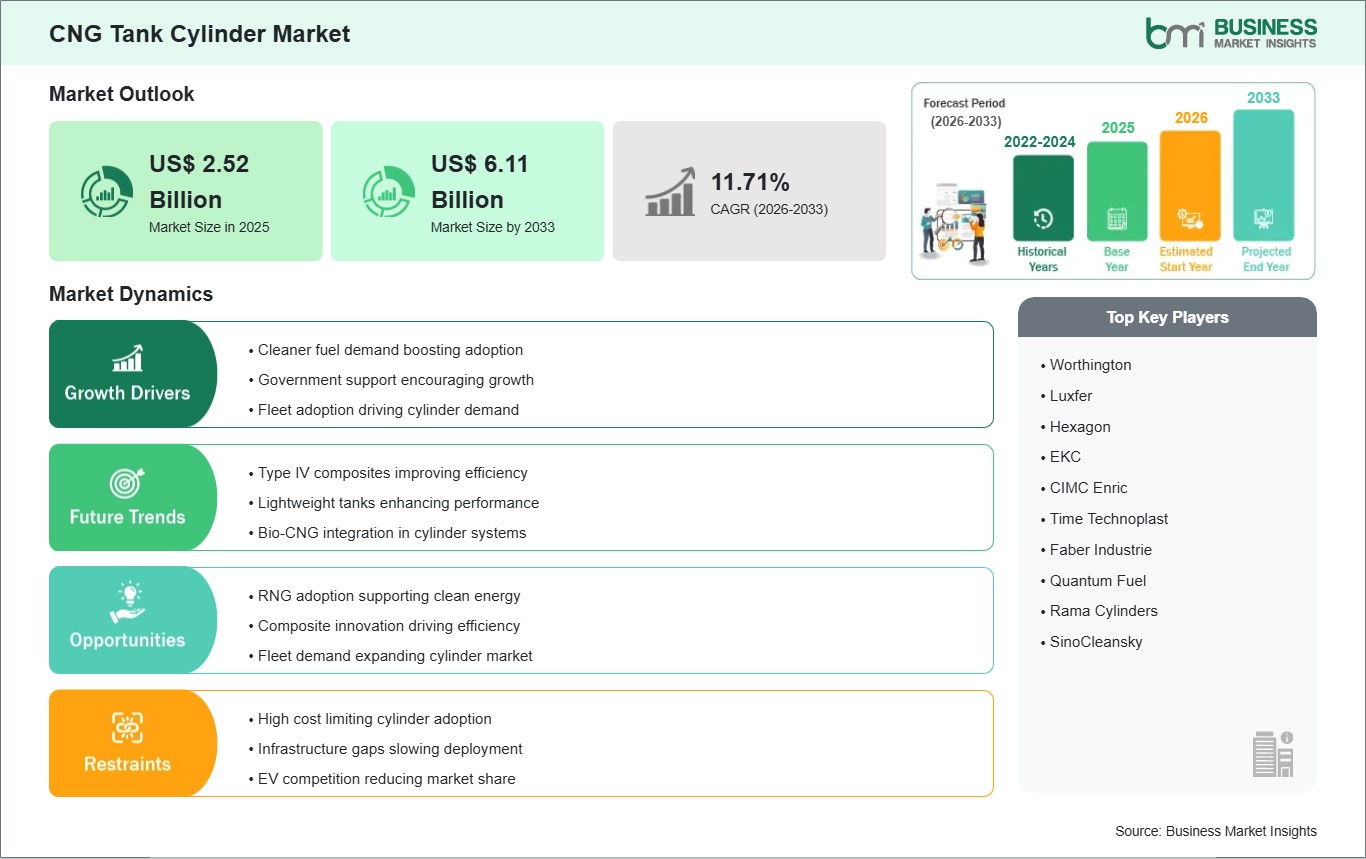
The CNG Tank Cylinder Market size is expected to reach US$ 6.11 Billion by 2033 from US$ 2.52 Billion in 2025.The market is estimated to record a CAGR of 11.71% from 2026 to 2033.
CNG Cylinder Tank Market can be defined as those containers used in vehicles to store highly compressed gas. This market involves the manufacture of cylinders to store CNG gas, in addition to being part of a refueling ecosystem that allows safe storage. These are very important parts that make up the CNG transport systems, made of advanced materials such as high-strength steel and composites of carbon fiber and glass fiber.
CNG tanks serve the important purpose of storing gas within their highly pressurized environment, ensuring its integrity, safety, durability, and impact resistance. The global market for this is rapidly growing due to an increased demand for alternative energy sources that emit less pollution and have higher fuel efficiency. The Hexagon Composites ASA 2024, the company has increased its production capacity for composite cylinders of CNG utilized in trucks, demonstrating the rise of global demands for the lightweight and high pressure cylinders for gas transportation.
There has been an increased growth in demand in the market owing to the higher incorporation of factory-installed CNG systems into vehicles, higher fleet conversion rates, and growing interest in lightweight composite cylinders. Type I steel cylinders have largely been adopted in areas where costs matter and retrofits take place, whereas composite cylinders of Type III and Type IV have started gaining popularity because of their lightweight nature as well as safety advantages.
But high manufacturing costs for composite materials, stringent safety certifications, and uneven infrastructure development act as restraints in the global CNG-based mobility market.

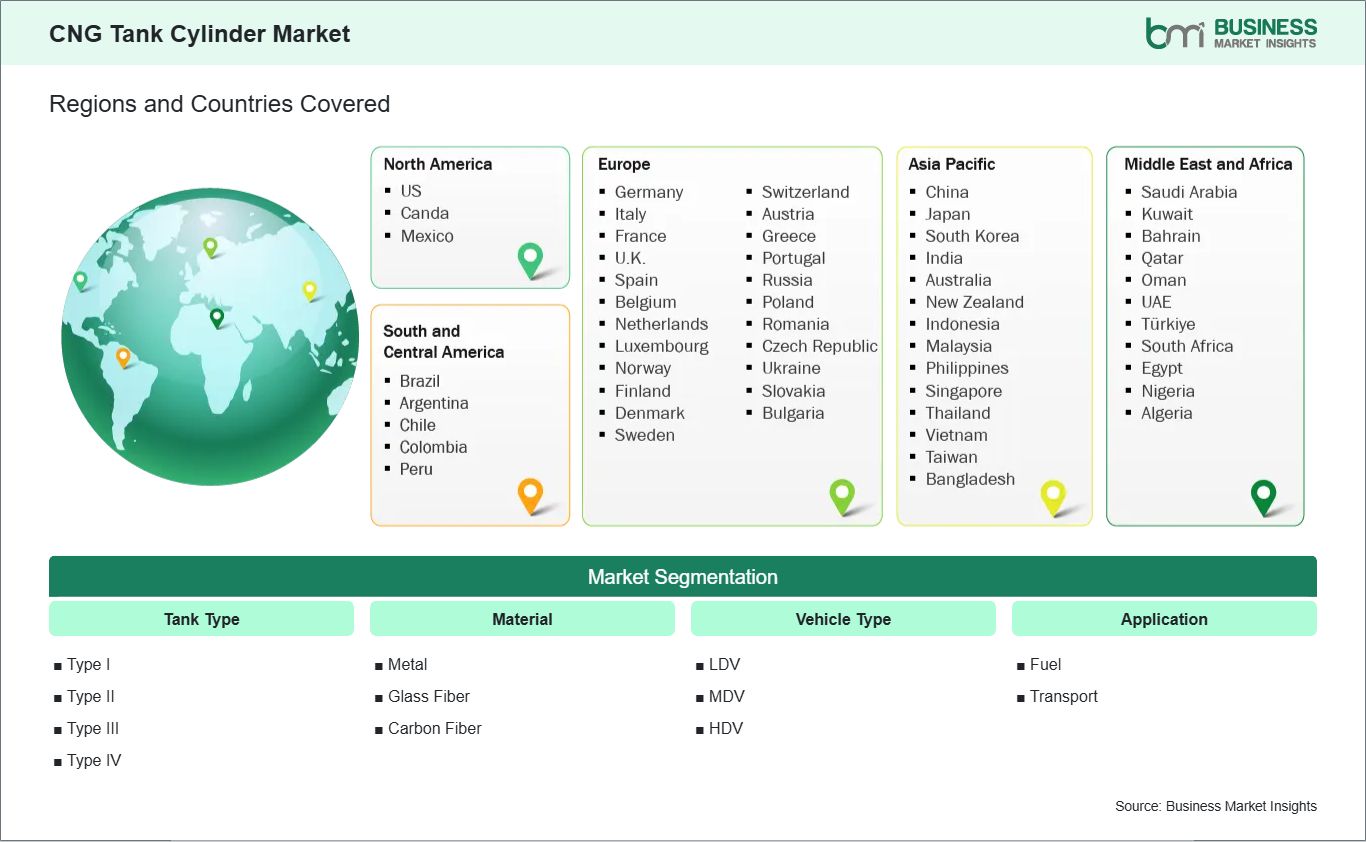
The CNG tank cylinder market is segmented based on tank type, material, vehicle type, and application, reflecting the increasing demand for lightweight, high-strength, and safe storage solutions for compressed natural gas across transportation and industrial uses.
The global market for the CNG tank cylinder industry is experiencing robust growth due to a preference for alternative energy sources that help to cut down emissions from burning liquid fossil fuels. This trend is supported by the increased usage of the CNG tank cylinder in Type 3 and Type 4 composite designs, which have helped make CNG storage more efficient in terms of pressure, safety, and weight. In the case of the worldwide transport sector, the growth is being witnessed due to the rising use of CNG in private cars, buses, and even three-wheelers.
In developing countries, fast urbanization and rising costs of fuel have led to a move towards alternative fuels such as CNG as compared to petrol and diesel, hence increasing demand for gas cylinders within vehicles. In countries like India, China, and Southeast Asia, there is high demand for factory-fitted CNG vehicles, thus increasing the demand for standard cylinders that would be integrated into the car during production, hence increasing demand for light weight composite cylinders.
On the other hand, in more advanced countries, cylinder development and replacement has been shaped by emission and safety standards. Europe, for instance, is focused on development of lightweight cylinders to ensure high vehicle efficiency in view of stringent CO₂ limits, while North America has seen an uptake in last mile delivery and mass transit, thus increased demand for cylinders. In addition, development of hydrogen-CNG as dual fuel has been contributing to innovation in materials used to make cylinders.
Fleet decarbonization remains one of the key drivers behind the CNG tank cylinder industry on a global scale, with logistics firms, transport services, and municipalities shifting towards less harmful fuel systems for their vehicles. One of the most important components behind the adoption of new fuel systems and fleets is the usage of CNG cylinders, providing reliable fuel containment capabilities for fleets that cannot be effectively electrified due to various reasons.
In commercial transport industries, including buses and delivery vehicles, CNG vehicles have become more popular than diesel ones owing to their higher environmental performance and lower operational costs. Such trends are especially noticeable among fleets operating in metropolitan areas and requiring rapid refueling cycles. The preference for CNG vehicles by commercial fleet owners can be explained by the predictable costs of such technology and easier maintenance, thus contributing to greater cylinder demand.
On a regional basis, the Asia-Pacific region ranks as the highest adopter because of the presence of comprehensive modernization initiatives on public transport systems. Additionally, in Latin America, there is an increasing adoption of CNG in taxis and buses. Europe, on the other hand, is adopting CNG as part of a strategy to reduce carbon emissions. Finally, in North America, the application of CNG technology is becoming more common in waste management and regional freight transportation. The demand for light, high-pressure, and durable tanks continues to rise within all these sectors.
The CNG Tank Cylinder Market is projected to grow from US$ 2.52 Billion in 2025 to US$ 6.11 Billion by 2033 , registering a CAGR of 11.71% from 2026 to 2033.
By Tank Type, Type IV cylinders dominate the market as they offer the highest weight reduction, superior fuel storage efficiency, and enhanced safety performance due to their fully composite structure with polymer liners. Their advantages in improving vehicle range and fuel efficiency make them the preferred choice in modern OEM CNG vehicles.
By Material, carbon fiber dominates the market due to its superior strength-to-weight ratio, high pressure resistance, and ability to significantly reduce overall vehicle weight, making it essential for advanced Type IV cylinder manufacturing. Metal materials still hold relevance in conventional cylinders because of their affordability and established production base, while glass fiber is used as a cost-effective reinforcement option in composite structures.
By Vehicle Type, light-duty vehicles (LDVs) dominate the market as passenger cars and small commercial vehicles increasingly adopt CNG systems for lower fuel costs and emissions compliance. Medium-duty vehicles are witnessing steady growth driven by urban logistics demand, while heavy-duty vehicles are emerging as a key segment supported by government initiatives to decarbonize buses and freight transport.
By Application, fuel in vehicles dominates the market as CNG cylinders are primarily used for onboard compressed gas storage to enable cleaner combustion and reduced operating costs. Transport applications, including industrial gas logistics and specialized high-pressure gas movement, represent a smaller but important secondary segment.
| Report Attribute | Details |
|---|---|
| Market size in 2025 | US$ 2.52 Billion |
| Market Size by 2033 | US$ 6.11 Billion |
| Global CAGR (2026 - 2033) | 11.71% |
| Historical Data | 2022-2024 |
| Forecast period | 2026-2033 |
| Segments Covered | By Tank Type
|
|
Regions and Countries Covered
| |
| North America | US, Canada, Mexico |
| Europe | Germany, Italy, France, U.K., Spain, Belgium, Netherlands, Luxembourg, Norway, Finland, Denmark, Sweden, Switzerland, Austria, Greece, Portugal, Russia, Poland, Romania, Czech Republic, Ukraine, Slovakia, Bulgaria |
| Asia-Pacific | China, Japan, South Korea, India, Australia, New Zealand, Indonesia, Malaysia, Philippines, Singapore, Thailand, Vietnam, Taiwan, Bangladesh |
| South and Central America | Brazil, Argentina, Chile, Colombia, Peru |
| Middle East and Africa | Saudi Arabia, United Arab Emirates, Kuwait, Bahrain, Qatar, Oman, Turkiye, South Africa, Egypt, Nigeria, Algeria |
| Market leaders and key company profiles |
|
The "CNG Tank Cylinder Market Size and Forecast (2022 and 2033)" report provides a detailed analysis of the market covering below areas:
The CNG tank cylinder market has varying adoption trends in different regions, which can be attributed to growing demand for clean fuel vehicles, emission control norms, growing natural gas infrastructures, and the need for cost-efficient and low-carbon emitting transport.
North America is technologically advanced and is highly regulated, and thus the region has a significant presence in the adoption and manufacture of CNG tank cylinders. North America encompasses the United States and Canada where substantial investments have been made in NGV infrastructure development, modernization of fleets, and alternative fuel technologies. North America aims to improve fuel storage safety and increase the durability of cylinders along with promoting the adoption of a commercial fleet of vehicles powered by CNGs. Highly developed automotive and energy sectors facilitate the extensive utilization of CNG cylinders in buses, trucks, delivery vans, and municipal fleets in North America.
Asia Pacific is developing rapidly due to increased urbanization, rise in emissions from vehicles, increase in fuel prices, and governmental initiatives for green and economic mobility options. Countries like China, India, Pakistan, and South Korea have increasing natural gas pipeline infrastructure along with favorable governmental policies, which are promoting the uptake of CNG vehicles. The region aims at improving domestic manufacturing capabilities of high-pressure cylinders and safety norms as well as increasing refueling infrastructure for such tanks. High demand from public transportation, logistics companies, and governmental schemes for green fuel are driving the market forward. Besides, there are high investments in the development of lightweight composite cylinders and increasing concerns regarding energy security in the region.
The two regions are significantly contributing towards market development due to advanced technologies related to high-pressure cylinders, natural gas pipelines, strict safety policies, and usage of clean and economical transportation solutions.

The CNG tank cylinder market is evaluated by gathering qualitative and quantitative data post primary and secondary research, which includes important corporate publications, association data, and databases. A few of the key developments in the CNG tank cylinder market are:
The CNG Tank Cylinder Market is valued at US$ 2.52 Billion in 2025, it is projected to reach US$ 6.11 Billion by 2033.
As per our report CNG Tank Cylinder Market, the market size is valued at US$ 2.52 Billion in 2025, projecting it to reach US$ 6.11 Billion by 2033. This translates to a CAGR of approximately 11.71% during the forecast period.
The CNG Tank Cylinder Market report typically cover these key segments-
The historic period, base year, and forecast period can vary slightly depending on the specific market research report. However, for the CNG Tank Cylinder Market report:
The CNG Tank Cylinder Market is populated by several key players, each contributing to its growth and innovation. Some of the major players include:
The CNG Tank Cylinder Market report is valuable for diverse stakeholders, including:
Essentially, anyone involved in or considering involvement in the CNG Tank Cylinder Market value chain can benefit from the information contained in a comprehensive market report.
Please tell us your area of interest
(Market Segments/ Regions and Countries/ Companies)