
Hydraulic Elevators Market Outlook: Size, Share, Trends, Growth Analysis, Competitive Landscape & Forecast, 2026-2033

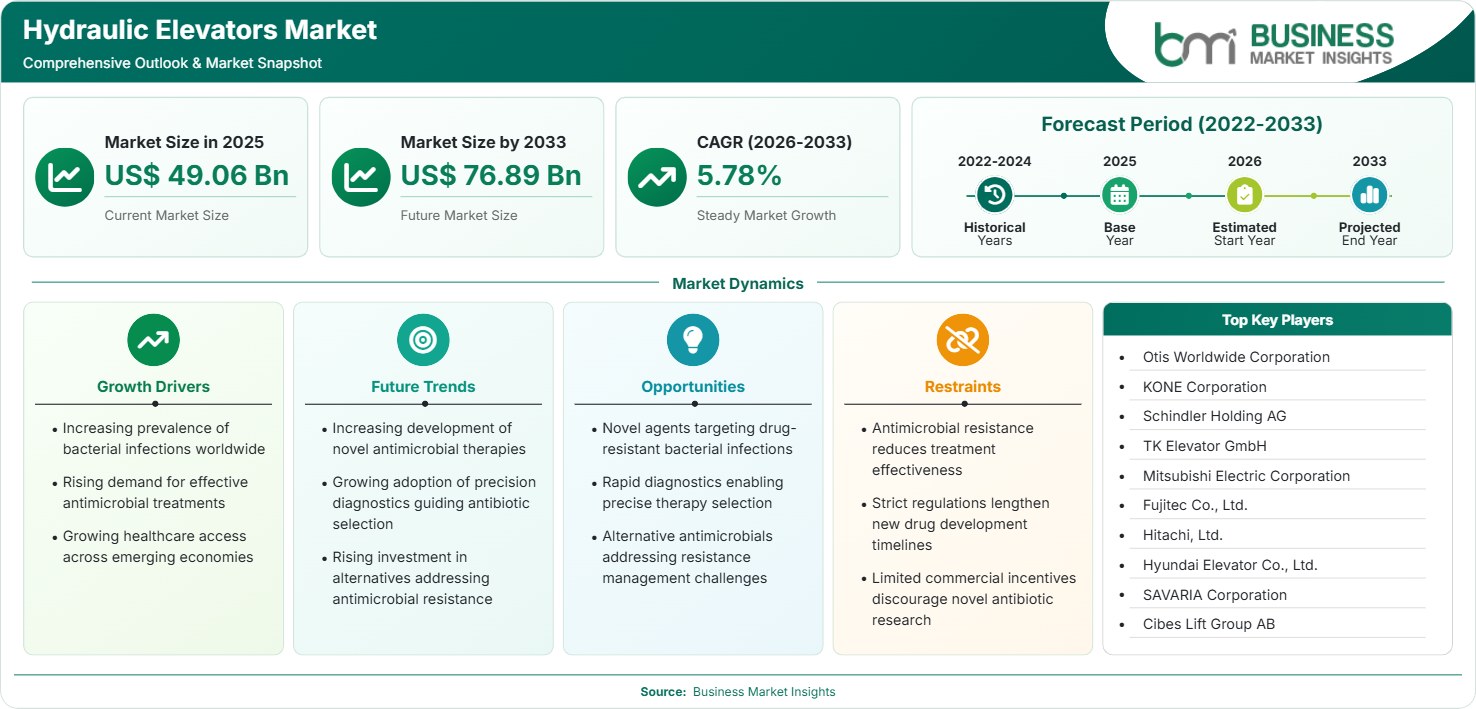
The Hydraulic Elevators Market size was valued at US$ 49.06 Billion in 2025 and is projected to reach US$ 76.89 Billion by 2033, growing at a CAGR of 5.78% during 2026–2033. Growth is supported by low-rise construction activity, demand for modernization, energy-efficient hydraulic systems, smart building integration, urban redevelopment projects, and expanding infrastructure investments across commercial, residential, and industrial facilities worldwide.

Report Coverage
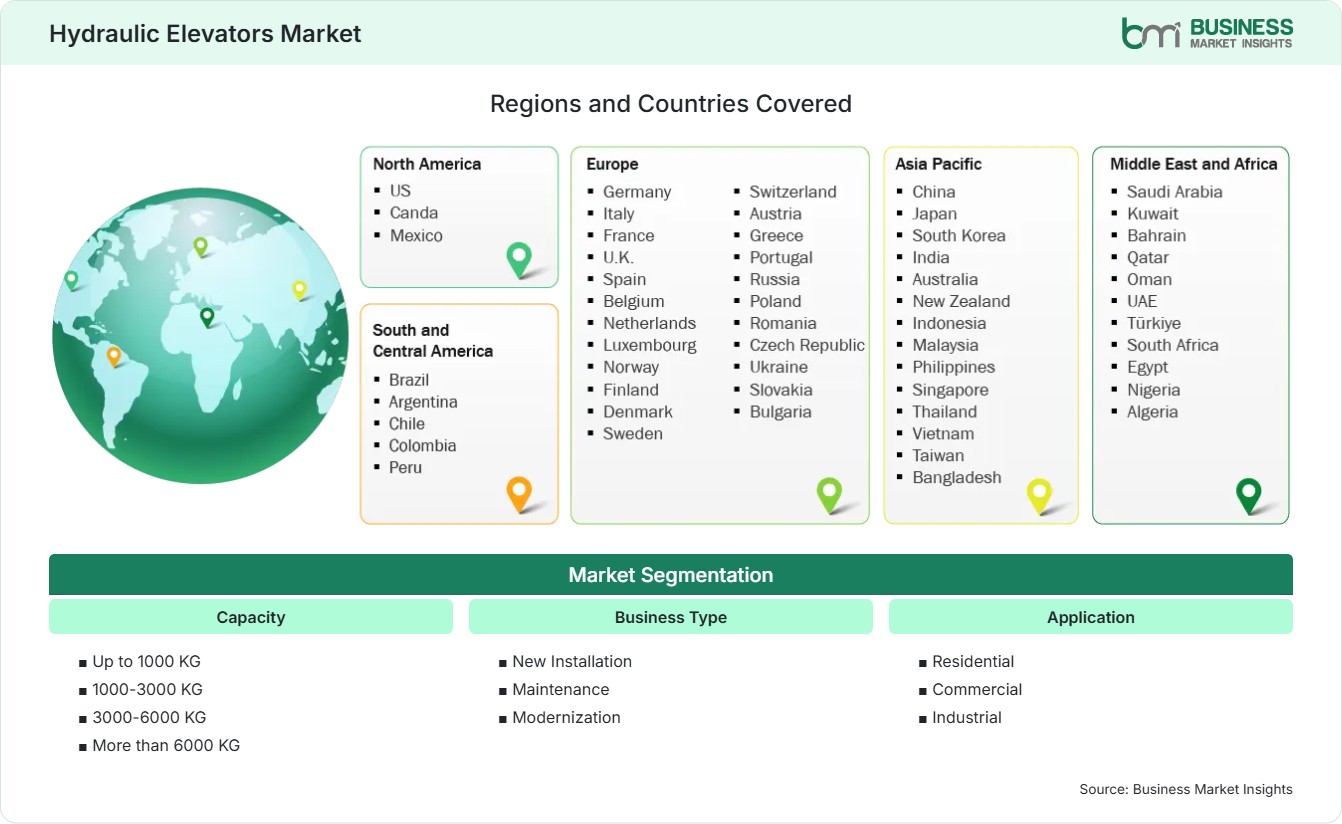
  • Capacity: Up to 1000 KG, 1000-3000 KG, 3000-6000 KG, More than 6000 KG
  • Business Type: New Installation, Maintenance, Modernization
  • Application: Residential, Commercial, Industrial
US$ 49.06 Bn Market size in 2025
US$ 76.89 Bn Market Size by 2033
5.78% CAGR, 2026 - 2033
2026-2033 Forecast Period

AI Overview

Hydraulic Elevators Market Summary

  • North America Region: North America holds 34%–37% share in 2025, growing at a CAGR of 5.1%–5.5% during 2026–2033, supported by modernization spending, infrastructure upgrades, accessibility regulations, smart building deployment, and replacement demand across aging commercial facilities. The U.S. represents the largest regional contributor with strong retrofit activity and a CAGR of 5.2%–5.6% through 2033.
  • Fastest Growing Region: Asia Pacific holds 28%–31% share in 2025, expanding at a CAGR of 6.7%–7.2% during 2026–2033, driven by rapid urbanization, residential tower construction, industrial expansion, public infrastructure investments, and wider adoption of affordable vertical transportation solutions.
  • Leading Segment: Commercial application accounts for 41%–44% share in 2025, advancing at a CAGR of 5.4%–5.8% during 2026–2033, supported by office developments, healthcare infrastructure, hospitality projects, retail expansion, and modernization requirements across established building stocks.
  • High Growth Segment: Modernization business accounts for 19%–22% share in 2025, recording a CAGR of 6.8%–7.3% during 2026–2033, driven by aging elevator fleets, safety compliance mandates, demand for digital monitoring, energy-efficiency upgrades, and lifecycle-extension strategies.
  • Key Market Opportunity: Increasing replacement of aging elevator systems with connected hydraulic solutions enables improved safety, predictive maintenance, lower operating costs, enhanced building performance, and stronger compliance with evolving accessibility standards globally.
  • Major Market Players: Otis Worldwide Corporation, KONE Corporation, Schindler Holding AG, TK Elevator GmbH, Mitsubishi Electric Corporation, Fujitec Co., Ltd., Hitachi, Ltd., Hyundai Elevator Co., Ltd., SAVARIA Corporation, and Cibes Lift Group AB.
Strategic Insights

Hydraulic Elevators Market: Strategic Insights

Hydraulic Elevators Market Strategic Framework
FREE PDF
Request your free sample
Request free sample
Stakeholder View

Key Takeaways

  • The value chain is becoming more focused on services, since maintenance contracts, remote monitoring platforms, and modernization packages are now producing higher recurring revenue than sales of the equipment alone.
  • The best long-term prospects for installation are found in healthcare facilities, schools, low-rise residential buildings, and mixed-use commercial developments because of the need for accessibility and mobility.
  • Innovation is now focusing on smart controllers, digital diagnostics, compact hydraulic systems, energy-efficient pumps, and predictive maintenance technologies, all of which help to increase uptime and lower lifecycle costs.
  • Asia Pacific has one of the best investment opportunities, due to the fact that urbanization is accelerating, infrastructure spending is increasing, and the demand for affordable vertical transportation systems is rising.
  • The trend of industry consolidation is ongoing, with the major elevator companies reinforcing their regional distribution networks, extending their maintenance offerings, and picking up specialized modernization capabilities.
  • Sustainability factors are having an effect on procurement choices, promoting the use of environmentally friendly hydraulic fluids, energy-efficient drives, and modernization solutions that cut building operating costs.
Geographic Outlook

Hydraulic Elevators Market Regional Highlights

North America Hydraulic Elevators Market

North America accounted for approximately 34%–37% share in 2025 and is anticipated to expand at a CAGR of 5.1%–5.5% during 2026–2033. Market demand is primarily supported by elevator modernization programs, aging commercial infrastructure, healthcare facility expansion, and stricter accessibility regulations. The region benefits from a mature maintenance ecosystem and high adoption of predictive maintenance technologies. Construction of educational institutions, warehouses, mixed-use developments, and senior living facilities continues to generate steady demand for installations across the United States and Canada.

  • Retrofit projects are the main focus of investment since property owners want to achieve higher safety standards, reduce downtime, and cut down on energy consumption from the existing vertical transportation systems in old commercial and institutional buildings.
  • Healthcare construction continues to be a driver of demand since hospitals, clinics, and long-term care facilities need reliable low-rise elevator systems that efficiently transport equipment, patients, and support staff.
  • Digital monitoring platforms are now being incorporated into service contracts, which allows predictive maintenance strategies to enhance the availability of equipment and cut down on costs associated with emergency repairs throughout commercial building portfolios.
  • The expansion of the warehouse and the development of the logistics infrastructure are intended to meet demand for new installations, especially for facilities that require robust load-handling capabilities and reliable freight transportation.
  • The increasing focus on accessibility compliance in building regulations is still promoting modernization and replacement schemes in both public-sector and privately owned buildings.

US Hydraulic Elevators Market

The U.S. represented approximately 76%–80% share within North America in 2025 and is projected to record a CAGR of 5.2%–5.6% during 2026–2033. Strong investment in healthcare infrastructure, mixed-use developments, educational campuses, and modernization projects supports market expansion. Demand is further strengthened by growing adoption of smart building technologies and recurring maintenance requirements associated with extensive installed elevator bases throughout urban and suburban regions.

  • Because hospitals are expanding and because more outpatient facilities and specialised care centres are being built, the healthcare sector is creating long-term opportunities thanks to the need for reliable vertical transportation systems to aid patient movement and logistics.
  • Commercial real estate owners continue prioritizing modernization programs that improve performance, energy efficiency, passenger comfort, and compliance with updated building accessibility requirements.
  • Smart diagnostics and remote monitoring solutions are gaining traction as building operators focus on predictive maintenance strategies and long-term lifecycle cost optimization.
  • Industrial and logistics developments increasingly deploy heavy-duty hydraulic systems to support freight movement requirements while maintaining operational reliability in demanding environments.

Europe Hydraulic Elevators Market

Europe held approximately 26%–29% Hydraulic Elevators Market share in 2025 and is expected to grow at a CAGR of 5.3%–5.8% during 2026–2033. Strong modernization activity, energy-efficiency requirements, and renovation of aging building stock remain central market drivers. Germany leads regional demand, with growth of around 5.2%–5.6%, while Eastern European countries, including Poland, show faster expansion of around 6.1%–6.6%. Rising investments in public infrastructure, healthcare modernization, and commercial redevelopment continue to support equipment replacement and service opportunities.

  • Sustainability initiatives encourage building owners to replace outdated systems with energy-efficient hydraulic configurations that reduce operating costs and support environmental objectives.
  • Germany is still the biggest market in the region as a result of its solid commercial infrastructure, the services networks that are already in place, and the wide-ranging modernization taking place in institutional facilities.
  • In Poland and in a number of other economies in central Europe, growth is speeding up as a result of investment in infrastructure, the redeveloping of cities, and the expansion of modern commercial construction.
  • Regulatory emphasis on accessibility and safety compliance continues to encourage the replacement of older elevator installations across residential and commercial properties.
  • Demand for connected maintenance solutions is increasing as facility operators seek improved equipment performance, reliability, and service transparency.

Asia Pacific Hydraulic Elevators Market

Asia Pacific captured approximately 28%–31% Hydraulic Elevators Market share in 2025 and is projected to register the fastest expansion at a CAGR of 6.7%–7.2% during 2026–2033. Rapid urbanization, industrialization, and construction of residential complexes continue driving installation volumes. China accounts for the largest regional demand base, while India exhibits one of the strongest growth trajectories at approximately 7.4%–7.9% CAGR. Infrastructure megaprojects, commercial real estate developments, and affordable housing programs significantly strengthen long-term market prospects throughout the region.

  • Urban population growth is driving substantial demand for low-rise residential developments that often use hydraulic elevator solutions due to their cost and installation advantages.
  • China is still the leading force in terms of regional demand, as a result of its continued investment in commercial buildings, public infrastructure, and large-scale residential construction projects.
  • India is showing strong growth momentum, thanks to its smart city initiatives, housing programs, the expansion of its healthcare infrastructure, and the development of industrial corridors.
  • Manufacturing localization strategies are improving supply chain efficiency and supporting wider adoption across developing economies within the region.
  • Rising disposable incomes and the modernization of commercial properties contribute to increased demand for technologically advanced elevator systems.

Rest of World Hydraulic Elevators Market

The Rest of World region accounted for approximately 8%–11% Hydraulic Elevators Market share in 2025 and is forecast to expand at a CAGR of 5.9%–6.4% during 2026–2033. South & Central America benefit from urban redevelopment and commercial construction activity, particularly in Brazil and Mexico. Meanwhile, Middle East and Africa markets are supported by infrastructure diversification initiatives, tourism-related developments, healthcare investments, and the modernization of aging facilities. Growth opportunities remain strongest within rapidly urbanizing metropolitan areas across emerging economies.

  • Brazil offers one of the foremost opportunities in South and Central America as a result of the level of activity involved in commercial construction and the continuous modernization of the existing building infrastructure.
  • Mexico gains as a result of industrial development projects, logistical investments, and the growing demand for efficient transportation solutions for people and freight.
  • Saudi Arabia and the United Arab Emirates are still investing in mixed-use developments, in healthcare infrastructure, and in hospitality projects which include the installation of elevators.
  • In Africa, economies are gradually adopting via urban housing projects, the building of healthcare facilities, and by expanding public infrastructure.
  • Maintenance and modernization services are gaining importance as the installed base of elevators expands and building owners focus on lifecycle optimization.
Global Market Geography
FREE PDF
Request your free sample
Request free sample
Segment Analysis

Hydraulic Elevators Market Segmentation

Type

The Type segment represents a fundamental component of the Hydraulic Elevators Market scope, with holed configurations continuing to serve traditional applications while hole-less and roped designs gain popularity due to installation flexibility and efficiency benefits. This segment accounted for approximately 32%–35% market share in 2025 and is projected to expand at a CAGR of 5.6%–6.0% during 2026–2033, driven by evolving building requirements and modernization programs.

  • Holed: Traditional installations remain widely utilized in low-rise buildings where deep pit construction is feasible and lifting performance requirements prioritize proven hydraulic operating reliability.
  • Hole-less: Growing adoption is supported by construction flexibility, lower installation complexity, reduced site preparation requirements, and suitability for retrofit applications across commercial properties.
  • Roped: Roped hydraulic designs offer enhanced travel capability and operational efficiency, supporting deployment in structures requiring greater lifting heights than conventional configurations.

Capacity

Capacity requirements vary significantly across residential, commercial, healthcare, and industrial applications. The segment maintains a substantial contribution to market revenue with estimated 28%–31% Hydraulic Elevators Market share in 2025 and expected growth of 5.7%–6.2% CAGR through 2033. Demand patterns closely align with infrastructure development, freight transportation needs, and regulatory requirements governing accessibility and occupant movement.

  • Up to 1000 KG: Widely adopted across residential developments, clinics, educational facilities, and smaller commercial buildings where passenger traffic volumes remain moderate.
  • 1000-3000 KG: Strong demand emerges from commercial offices, healthcare institutions, hospitality properties, and mixed-use developments requiring balanced passenger handling capabilities.
  • 3000-6000 KG: Commonly utilized within industrial facilities, distribution centers, and specialized commercial environments requiring efficient movement of heavier loads and equipment.
  • More than 6000 KG: Predominantly installed in heavy industrial operations, manufacturing facilities, and logistics environments where substantial freight transportation capacity is essential.

Business Type

Business Type remains a critical revenue category as recurring service activities increasingly influence profitability. The segment accounted for approximately 34%–37% Hydraulic Elevators Market share in 2025 and is expected to record a CAGR of 6.0%–6.4% during 2026–2033. Aging elevator infrastructure and digital maintenance technologies are reshaping service strategies throughout the industry.

  • New Installation: Demand remains linked to commercial construction, residential development, institutional projects, and ongoing infrastructure expansion across emerging and developed economies.
  • Maintenance: Service contracts generate recurring revenue through inspections, preventive maintenance programs, repairs, and digital monitoring solutions that improve operational reliability.
  • Modernization: Strong growth is supported by safety compliance needs, energy efficiency upgrades, digital control integration, and lifecycle extension objectives among building owners.

Application

Application analysis highlights the dominance of commercial facilities due to elevator dependence within offices, healthcare facilities, hospitality properties, and retail centers. The segment delivered approximately 41%–44% market share in 2025 and is anticipated to grow at a CAGR of 5.4%–5.8% through 2033. Evolving Hydraulic Elevators Market trends continue to increase demand across diverse end-use environments.

  • Residential: Demand is supported by low-rise housing developments, senior living communities, luxury residences, and accessibility-focused home mobility solutions.
  • Commercial: Offices, healthcare facilities, hospitality establishments, educational institutions, and retail properties account for significant deployment activity and modernization requirements.
  • Industrial: Manufacturing plants, warehouses, logistics hubs, and specialized industrial facilities use hydraulic systems for reliable passenger and freight transportation.
Market Forces

Hydraulic Elevators Market Dynamics

Key Market Drivers

Expansion of Low-Rise Commercial and Institutional Construction

Low-rise commercial buildings remain among the strongest deployment environments for hydraulic systems because they provide cost-effective vertical transportation for limited travel distances. Growing investments in healthcare facilities, educational institutions, warehouses, retail centers, and municipal buildings continue generating installation demand worldwide. Accessibility regulations across developed economies increasingly require elevator integration in both public and private facilities. The Hydraulic Elevators Market growth trajectory is also supported by the renovation of existing structures to comply with updated mobility standards. Rapid development of healthcare infrastructure in the Asia Pacific and the Middle East further accelerates equipment procurement, while continued urban expansion sustains demand for reliable and economical mobility solutions in low- and mid-rise environments.

Increasing Modernization and Replacement of Aging Elevator Fleets

A substantial installed base of hydraulic elevator systems across North America and Europe has created a robust modernization pipeline. Building owners are investing in controller upgrades, advanced safety components, energy-efficient power units, and digital monitoring technologies to extend system lifecycles. Many installations approaching operational maturity require modernization rather than complete replacement, creating significant recurring revenue opportunities. Hydraulic Elevators Market trends increasingly favor predictive maintenance, remote diagnostics, and connected service models that improve elevator availability while reducing downtime. Modernization programs also help property owners comply with updated safety regulations and sustainability objectives without undertaking costly structural modifications, strengthening demand throughout the forecast period.

Growing Emphasis on Accessibility and Building Safety Regulations

Standards in accessibility, passenger safety, and building modernization are still being tightened by governments and regulatory bodies, and compliance requirements are affecting how investment is allocated in residential, commercial, and public infrastructure. There is a growing trend among hospitals, educational institutions, transportation centers, and government buildings to either install or upgrade their accessible vertical transport systems. This demand is also being driven by the aging populations in developed countries, where mobility-friendly infrastructure is still a key concern. The introduction of new hydraulic technologies has led to smoother operation, better safety features, and improved reliability, all of which help building operators to meet the changing expectations. As a result, upgrades that are driven by regulation have become a steady source of demand and are supporting long-term growth in a number of geographical markets.

Key Market Opportunities

Integration of IoT and Predictive Maintenance Platforms

Digital transformation offers a significant opportunity to manufacturers and service providers. By using IoT-enabled sensors, cloud analytics platforms, and predictive maintenance technologies, it is possible to carry out real-time monitoring of elevator performance and the condition of their components. These solutions reduce unplanned downtime, optimize service scheduling, and improve customer satisfaction. There is an increasing need for facility managers for data-enabled asset management functionalities that lower lifecycle costs and improve operational efficiencies. Companies that offer intelligent diagnostics along with maintenance services will increase their recurring revenue. In light of the expansion of smart building ecosystems worldwide, the connected elevator platform offerings will be considered standard inclusions.

Urban Redevelopment and Smart City Infrastructure Programs

Urban renewal projects are opening up great opportunities for vertical transportation providers. Urban redevelopment projects involving old commercial districts, mixed-use properties, healthcare buildings, and urban infrastructures usually require updating or installing state-of-the-art mobility systems. Most smart cities have made access, efficiency, and digital connectivity of buildings priorities, and the hydraulic system is being continuously developed in these areas. Another key market for the hydraulic system is emerging economies. These trends support long-term equipment demand while opening new service and modernization opportunities. Hydraulic Elevators Market Forecasts remain positively influenced by redevelopment spending and infrastructure modernization initiatives worldwide.

Rising Demand for Energy-Efficient Hydraulic Technologies

Sustainability goals are driving the adoption of new hydraulic systems, designed to use less energy and have a smaller environmental impact. To this end, manufacturers are now offering more efficient pumps, smart valves, biodegradable hydraulic fluids, and improved power units that enhance operational performance. Building owners are increasingly assessing equipment in terms of its lifecycle costs rather than just its initial purchase price. This shift is opening up opportunities for technology-based differentiation and for positioning products as premium items. Those who manage commercial properties and are aiming to obtain green building certifications are especially interested in efficient mobility solutions. As sustainability standards become more important in procurement decisions, demand for next-generation hydraulic technologies is expected to increase significantly.

Market Restraints and Challenges

Competition from Traction Elevator Technologies

The fact that advanced traction elevators are still expanding into areas that have traditionally been the domain of hydraulic systems has led to a situation in which competitive pressure may limit installation opportunities in certain building types. Because of improvements in machine-room-less designs, energy efficiency, travel speed, and space saving, traction systems have become more attractive as alternatives. When assessing the long-term operational performance of different systems, developers might choose competing technologies for certain projects, especially when higher travel heights are required. Even though hydraulic systems still have major advantages in some low-rise applications, manufacturers must continue innovating to remain relevant in the market. This competitive situation affects pricing strategies, product development priorities, and procurement choices in a number of end-user groups.

Volatility in Construction Spending and Capital Investment

The elevator demand continues to be closely associated with cycles of construction and capital spending. Economic uncertainty can delay installation projects and modernization investments. Variations in interest rates, construction material costs, commercial real estate development, and financing availability can lead to a decline in purchasing activity when the economy is performing poorly. Postponement of projects affects equipment suppliers, installation contractors, and maintenance service providers at all stages of the value chain. In emerging markets, sensitivity to changes in public infrastructure budgets and private-sector investment conditions is especially high. For this reason, participants still have to deal with the difficulties of forecasting demand and achieving steady revenue growth in different economic conditions.

Company Analysis

Competitive Landscape

The competitive environment remains characterized by strong global brands, broad maintenance networks, and increasing investment in digital service capabilities. Current Hydraulic Elevators Market analysis indicates that companies are emphasizing modernization solutions, predictive maintenance platforms, sustainability-focused technologies, and geographic expansion strategies.

Company Name

Overview

Products and Services relevant to this market

Otis Worldwide Corporation

Global elevator and escalator leader with extensive service presence and strong modernization portfolio across developed and emerging markets.

Hydraulic elevators, modernization solutions, maintenance contracts, digital monitoring platforms, repair services, and building mobility technologies.

KONE Corporation

International elevator manufacturer focused on sustainable mobility solutions and smart building integration technologies.

Hydraulic elevator systems, maintenance solutions, connected services, modernization programs, and intelligent people-flow technologies.

Schindler Holding AG

Major vertical transportation provider with extensive project execution capabilities and global maintenance operations.

Hydraulic elevators, modernization offerings, service agreements, accessibility solutions, and digital building connectivity technologies.

TK Elevator GmbH

Global mobility company serving commercial, residential, healthcare, and industrial customers worldwide.

Hydraulic elevator installations, maintenance services, modernization packages, monitoring systems, and mobility infrastructure solutions.

Mitsubishi Electric Corporation

Established engineering company with advanced elevator technologies and strong international market presence.

Hydraulic elevators, elevator control systems, modernization services, safety technologies, and integrated building solutions.

Fujitec Co., Ltd.

Elevator and escalator specialist known for engineering expertise and comprehensive after-sales support capabilities.

Hydraulic elevator systems, maintenance services, modernization technologies, monitoring platforms, and repair solutions.

Hitachi, Ltd.

Diversified technology company with experience in infrastructure, building systems, and vertical transportation applications.

Hydraulic elevators, smart building technologies, modernization offerings, service support, and infrastructure solutions.

Hyundai Elevator Co., Ltd.

Leading elevator manufacturer with growing international deployment and service capabilities.

Hydraulic elevator products, maintenance contracts, modernization projects, control technologies, and mobility systems.

SAVARIA Corporation

Accessibility-focused company serving residential and commercial mobility requirements through diverse lift solutions.

Hydraulic lifts, accessibility elevators, modernization services, maintenance support, and mobility enhancement technologies.

Cibes Lift Group AB

Specialized lift provider focused on efficient and flexible mobility systems for various building environments.

Hydraulic lift solutions, platform lifts, modernization services, accessibility products, and maintenance programs.

Trust & Transparency

Research Methodology

The market analysis combines proprietary research with secondary data from government agencies, company disclosures, regulatory filings, industry databases and expert interviews. Market estimates are validated through data triangulation, cross-market benchmarking and analyst review.

View Full Research Methodology

Questions Answered

Frequently Asked Questions

How are digital technologies changing elevator operations?

IoT sensors, remote monitoring platforms, predictive analytics, and connected maintenance systems improve reliability, minimize downtime, optimize service scheduling, and help building operators reduce lifecycle operating costs.

What does the Hydraulic Elevators Market Report indicate about regional opportunities?

The report indicates strong opportunities in Asia Pacific because of urbanization and infrastructure growth, while North America and Europe continue benefiting from extensive modernization and maintenance spending.

Why is modernization growing faster than new installations?

Modernization addresses aging infrastructure, safety compliance requirements, energy efficiency targets, and digital connectivity goals while allowing building owners to extend equipment lifecycles with lower investment than full replacement.

Which application segment currently leads revenue generation?

Commercial applications lead revenue generation due to strong demand from office buildings, hospitals, hotels, retail centers, and educational facilities requiring dependable and cost-effective vertical transportation systems.

What factors are driving demand for hydraulic elevators?

Demand is primarily supported by low-rise building construction, modernization of aging equipment, accessibility compliance requirements, healthcare infrastructure expansion, and growing adoption of predictive maintenance technologies among commercial property owners.

Access the Full Hydraulic Elevators Market Report

Get segment-level forecasts, regional estimates, competitive benchmarking, company profiles and downloadable Excel datasets.

Access the full Hydraulic Elevators Market Report
350 pages PDF & Excel | 2026-09-10
Similar Research

Related Market Reports