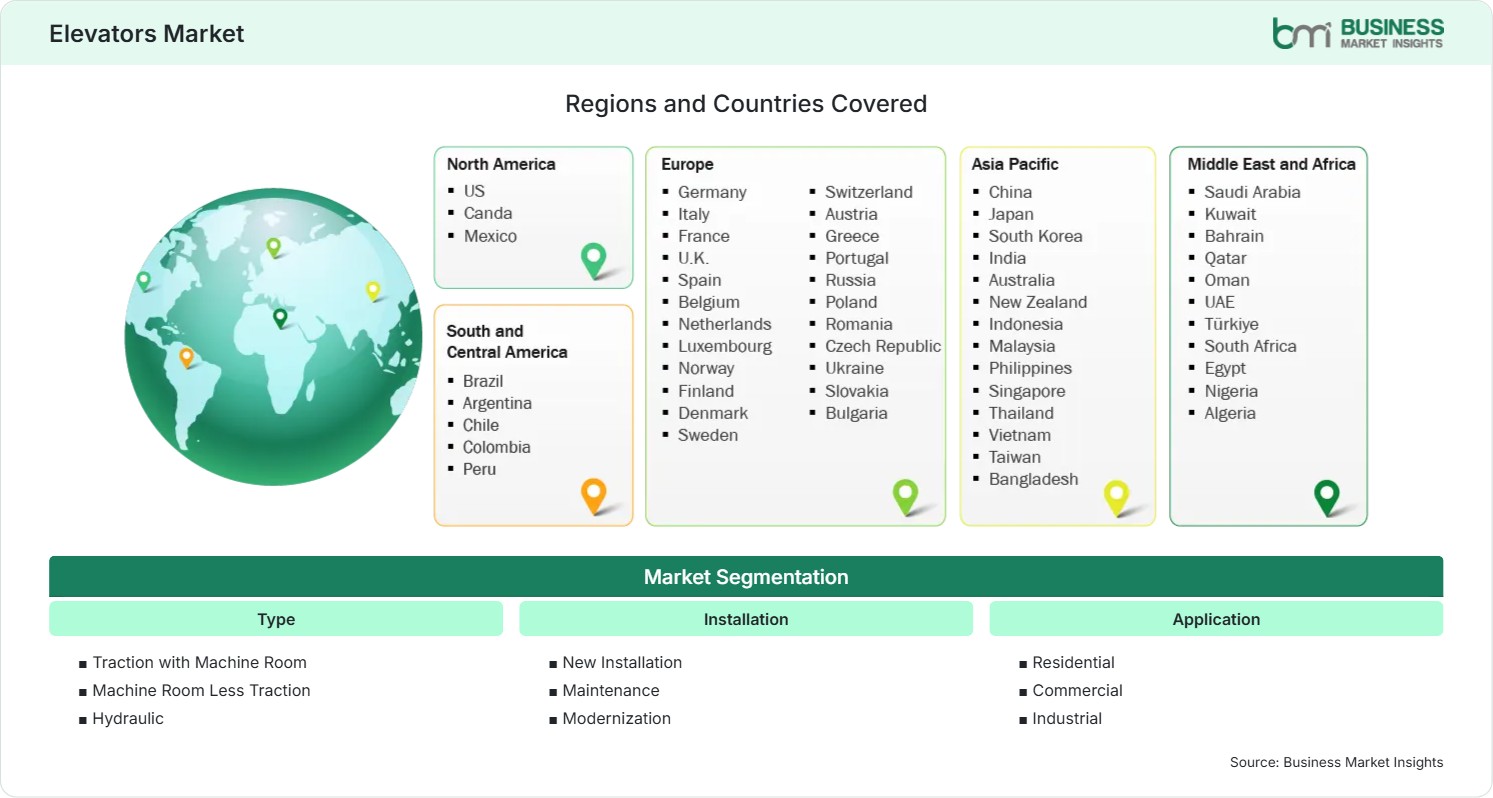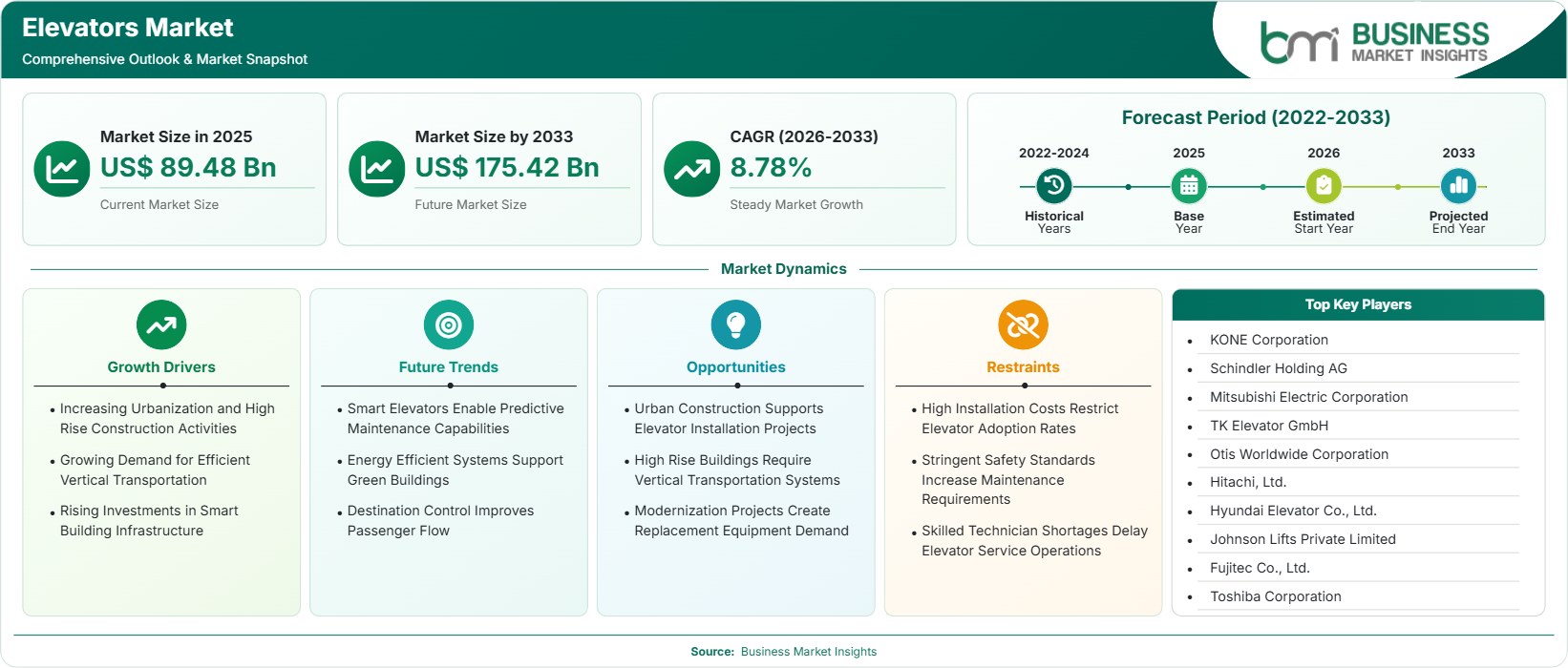
Elevators Market Regional Highlights
North America Elevators Market
North America accounted for approximately 24%–27% of global demand in 2025 and is projected to expand at a CAGR of 7.6%–8.2% through 2033. The region benefits from substantial modernization requirements across commercial buildings, healthcare facilities, airports, and institutional infrastructure. The Elevators Market share remains supported by regulatory requirements focused on safety, accessibility, and energy performance. Growing adoption of predictive maintenance technologies, smart building integration, and digital service platforms is strengthening aftermarket revenues. Investment activity across mixed-use developments continues supporting equipment replacement and modernization programs.
- Modernization activity across aging commercial properties is accelerating replacement demand for controllers, drives, doors, and destination dispatch technologies, supporting service revenue growth while improving building operational efficiency and occupant experience.
- Increasing adoption of IoT-enabled monitoring solutions allows building owners to reduce downtime, optimize maintenance scheduling, and improve equipment reliability, strengthening long-term service contract penetration throughout major metropolitan areas.
- Healthcare infrastructure expansion and airport modernization projects are creating sustained demand for advanced vertical transportation systems capable of handling higher passenger volumes and enhanced accessibility requirements.
- Sustainability initiatives encourage deployment of regenerative drive technologies and energy-efficient systems, helping developers meet environmental certification objectives while lowering lifecycle operating expenses across large facilities.
- Growing investments in mixed-use urban developments continue supporting premium mobility solutions that integrate security, analytics, and building automation platforms for improved operational performance.
US Elevators Market
The Elevators Market in the United States was identified as the largest contributor in North America, holding around 72%-76% of regional demand in 2025 and registering a CAGR of 7.8%-8.4% during 2025-2033. Sizable expenditure on office renovations, healthcare buildings, residential high-rises, and transport infrastructure is fueling growth in this market. The demand for digitized maintenance, security systems, and energy-efficient mobility solutions is rising among building owners. Growing investment in large metropolitan areas is generating business prospects for elevator modernization and maintenance.
- Commercial property owners are prioritizing modernization initiatives that improve energy performance, passenger flow management, and regulatory compliance, creating robust demand for advanced control and monitoring solutions.
- Expansion of multifamily residential developments in urban centers continues supporting installation volumes, particularly for machine-room-less systems offering improved space utilization and efficiency advantages.
- Transportation hubs, airports, and public infrastructure projects require high-capacity mobility systems with advanced reliability standards, contributing to sustained procurement activity across the country.
- Integration of cloud-based diagnostics and predictive maintenance tools enables proactive servicing strategies, helping reduce operational disruptions while improving equipment lifecycle management.
Europe Elevators Market
The elevators market in Europe accounted for about 22%–25% of the global market share in 2025 and is projected to grow at a CAGR of 7.3%–7.9% through 2033. The market benefits from strict safety standards, sustainability policies, and modernization requirements. Germany leads in national markets, with growth of around 7.4%–8.0%, while Eastern European nations have high growth at an 8.5%–9.2% CAGR. The adoption of technology in buildings and transport systems enables equipment replacement. Service-based business models are vital due to their large installed base.
- European Green Deal objectives encourage investment in energy-efficient modernization projects, supporting replacement of older systems with regenerative technologies and digitally connected solutions.
- Germany maintains leadership through strong commercial construction activity, industrial infrastructure investment, and a large installed base requiring continuous maintenance and upgrades.
- Eastern European countries are benefiting from urban redevelopment projects and infrastructure funding, creating favorable conditions for new installations and modernization programs.
- Demand for accessibility-focused upgrades continues increasing as governments and property owners invest in inclusive building infrastructure across residential and public facilities.
- Digital service platforms and predictive maintenance technologies are gaining traction as operators seek improved reliability and reduced operational expenditure.
Asia Pacific Elevators Market
Asia Pacific accounted for about 40% - 44% of total consumption in 2025 and is forecast to see the fastest growth rate, at 10.2% - 10.9%, between 2026 and 2033. The region is growing fast with rapid urbanization and developments in housing, transportation, and technology. China remains the leading country, with the market expected to grow by about 9.8% - 10.5% per year on average, while India will become the fastest-growing major country in the region, with a CAGR of 11.2% - 12.0%.
- China's extensive residential tower construction and urban redevelopment initiatives continue generating significant demand for advanced vertical transportation systems across both tier-one and emerging metropolitan areas.
- India is witnessing strong investment in residential complexes, metro infrastructure, commercial properties, and smart city programs, creating substantial opportunities for equipment suppliers and service providers.
- Southeast Asian economies are expanding commercial real estate portfolios, hospitality developments, and transportation infrastructure, increasing demand for energy-efficient and digitally connected mobility solutions.
- Growing adoption of machine-room-less systems reflects developer preference for space optimization, lower installation costs, and enhanced sustainability performance across new construction projects.
- Smart building integration and AI-enabled predictive maintenance technologies are gaining momentum as property owners seek operational efficiency and improved passenger experiences.
Rest of World Elevators Market
The Elevators Market in the Rest of World accounted for approximately 10%–13% of global demand in 2025 and is anticipated to expand at a CAGR of 8.8%–9.5% through 2033. South & Central America continue benefiting from urban housing developments and commercial construction activity, while Middle East and Africa markets are supported by large infrastructure projects, tourism investments, and smart-city initiatives.
The Gulf Cooperation Council countries remain leading contributors with growth of 9.5%–10.2%, while selected African economies are experiencing accelerating demand due to urbanization and expanding commercial infrastructure. Long-term opportunities are emerging from modernization requirements and increasing adoption of premium building technologies.
- Saudi Arabia and the United Arab Emirates continue investing in large-scale mixed-use developments, hospitality projects, and transportation infrastructure requiring advanced mobility systems and premium service offerings.
- Brazil remains a key South American market due to expanding residential construction, commercial real estate investments, and modernization activity across urban centers.
- African urbanization trends are encouraging installation demand in residential and commercial buildings, particularly in rapidly developing metropolitan regions.
- Tourism-driven construction across the Middle East is supporting procurement of high-capacity systems capable of handling substantial passenger volumes in premium developments.
- Increasing focus on smart cities and sustainability objectives is creating opportunities for connected technologies, energy-efficient equipment, and long-term maintenance contracts.