
Elevator Maintenance Market Outlook: Size, Share, Trends, Growth Analysis, Competitive Landscape & Forecast, 2026-2033

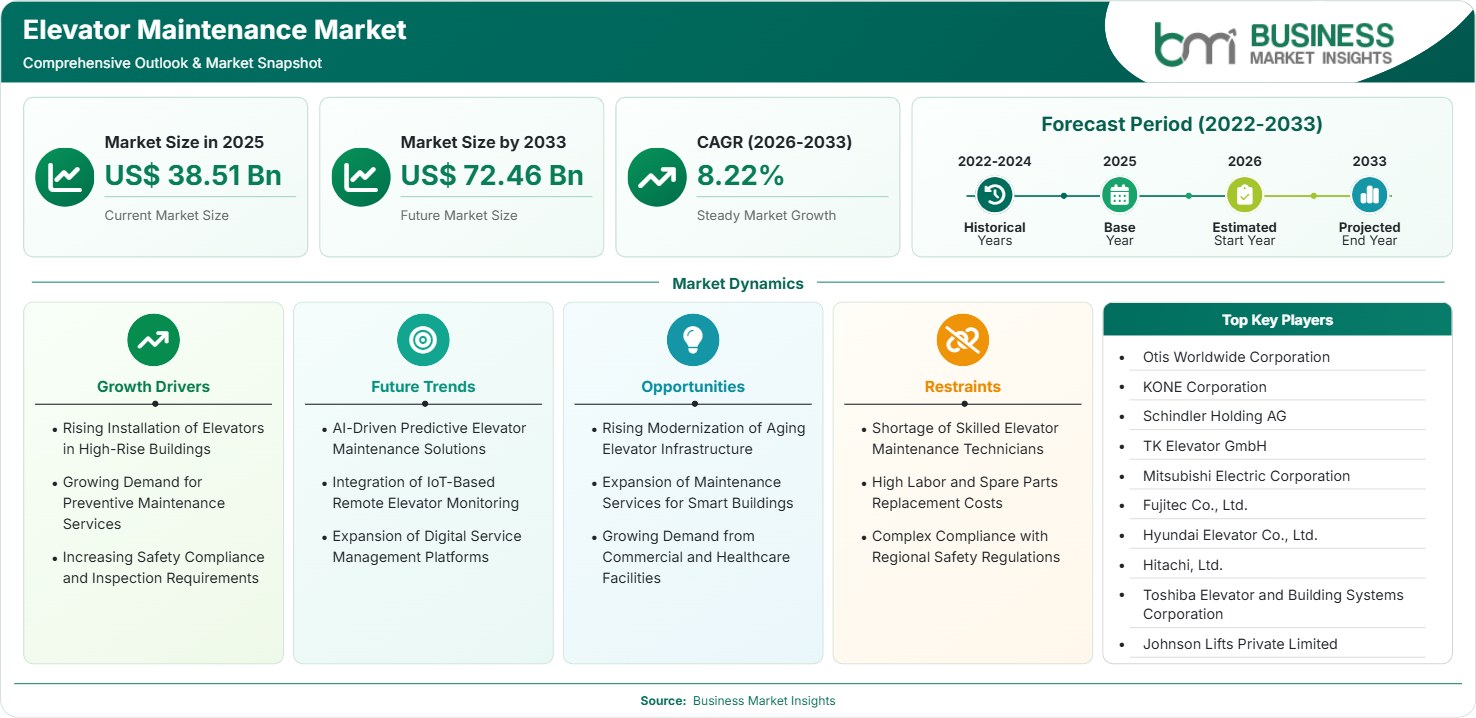
The Elevator Maintenance Market size was valued at US$ 38.51 Billion in 2025 and is projected to reach US$ 72.46 Billion by 2033, growing at a CAGR of 8.22% during 2026–2033. Growing urbanization, rising installation of elevators in high-rise buildings, increasing focus on passenger safety, and expanding adoption of predictive maintenance technologies are supporting market growth globally.

Report Coverage
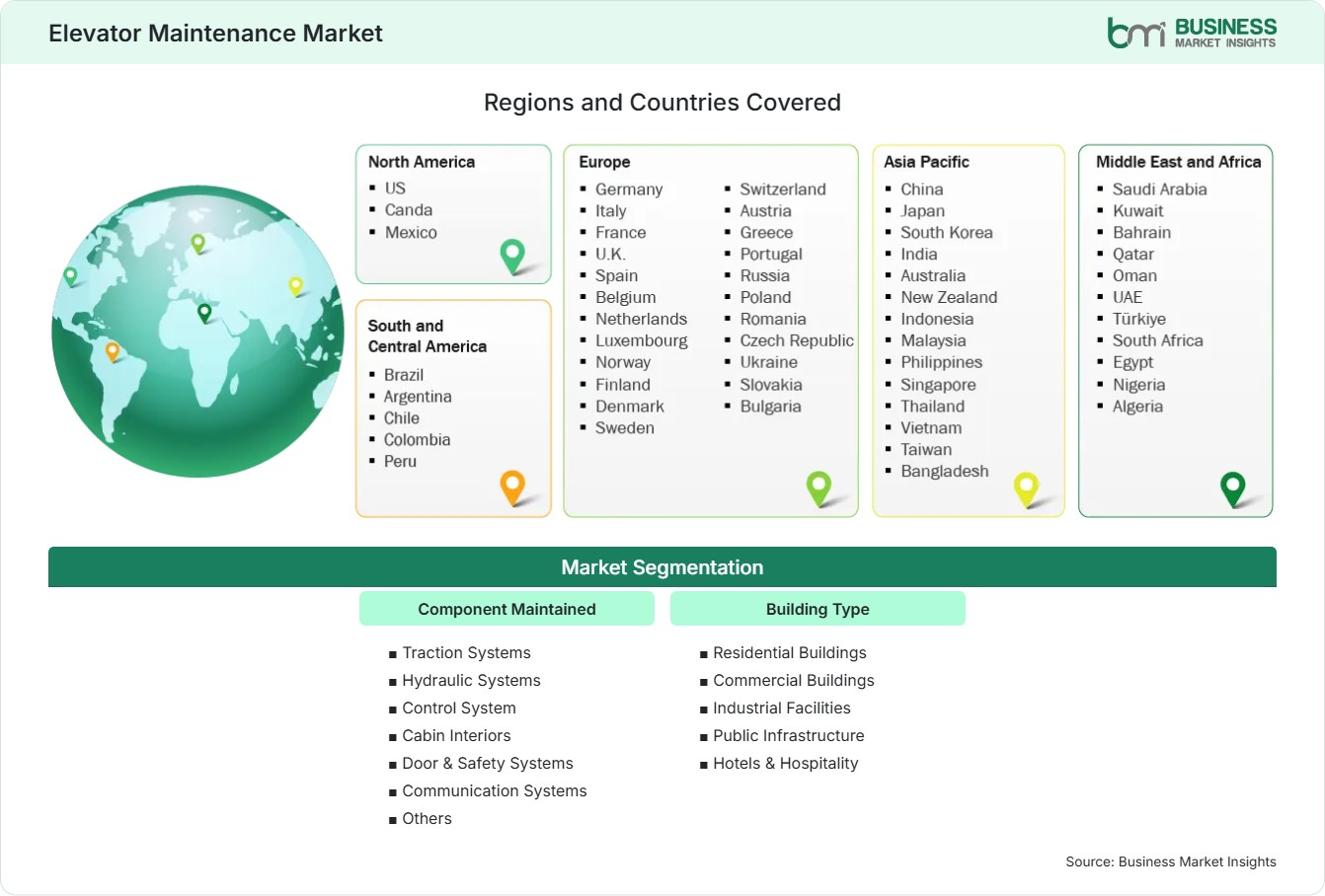
  • Component Maintained: Traction Systems, Hydraulic Systems, Control System, Cabin Interiors, Door & Safety Systems, Communication Systems, Others
  • Building Type: Residential Buildings, Commercial Buildings, Industrial Facilities, Public Infrastructure, Hotels & Hospitality
US$ 38.51 Bn Market size in 2025
US$ 72.46 Bn Market Size by 2033
8.22% CAGR, 2026 - 2033
2026-2033 Forecast Period

01 AI Overview

Elevator Maintenance Market Summary

  • North America Region: North America holds a elevator maintenance market share of 34%–37% in 2025, growing with a CAGR of 7.5%–8.0% during 2026–2033. Aging elevator infrastructure, stringent safety regulations, increasing modernization projects, and growing adoption of smart maintenance technologies continue supporting regional growth. The U.S. market is expected to register a CAGR of 7.7%–8.2%.
  • Fastest Growing Region: Asia Pacific accounts for 29%–32% share in 2025 and is projected to grow at a CAGR of 9.2%–9.8% through 2033. Rapid urbanization, expanding construction activities, increasing high-rise developments, and rising investments in infrastructure modernization continue driving market expansion.
  • Leading Segment: Traction Systems represent 29%–32% share in 2025 and are expected to grow at a CAGR of 8.0%–8.6% through 2033. High installation volumes in residential and commercial buildings and regular maintenance requirements support segment leadership.
  • High Growth Segment: Public Infrastructure accounts for 14%–17% share in 2025 and is forecast to grow at a CAGR of 9.6%–10.2% during 2026–2033. Increasing investments in airports, metro stations, railway terminals, and government facilities continue supporting segment growth.
  • Key Market Opportunity: Increasing deployment of IoT-enabled predictive maintenance solutions is creating opportunities for maintenance providers to enhance operational efficiency, reduce downtime, and improve service quality.
  • Major Market Players: Otis Worldwide Corporation, KONE Corporation, Schindler Holding AG, TK Elevator GmbH, Mitsubishi Electric Corporation, Fujitec Co., Ltd., Hyundai Elevator Co., Ltd., Hitachi, Ltd., Toshiba Elevator and Building Systems Corporation, Johnson Lifts Private Limited.
02 Strategic Insights

Elevator Maintenance Market: Strategic Insights

Elevator Maintenance Market Strategic Framework
FREE PDF
Request your free sample
Request free sample
03 Stakeholder View

Key Takeaways

  • Maintenance services are becoming increasingly critical as global elevator installations continue expanding across residential, commercial, and public infrastructure projects.
  • Traction systems remain the largest maintenance category because of their widespread use in modern high-rise buildings and transportation facilities.
  • Public infrastructure projects represent a significant growth opportunity due to increasing investments in transportation and government facilities.
  • Asia Pacific elevator maintenance market offers substantial growth potential driven by urbanization, high-rise construction, and infrastructure modernization initiatives.
  • Predictive maintenance and IoT-enabled monitoring technologies are transforming traditional maintenance practices and improving operational efficiency.
  • Safety regulations and modernization requirements continue encouraging building owners to adopt comprehensive maintenance programs.
04 Geographic Outlook

Elevator Maintenance Market Regional Highlights

North America Elevator Maintenance Market

North America accounts for 34%–37% Elevator Maintenance Market share in 2025 and is projected to grow at a CAGR of 7.5%–8.0% through 2033. Aging elevator infrastructure, regulatory compliance requirements, and increasing modernization initiatives continue supporting market growth. Building owners are increasingly investing in predictive maintenance technologies and service contracts to improve system reliability and passenger safety.

  • Commercial and residential property owners are prioritizing preventive maintenance programs to reduce unexpected equipment failures and improve operational efficiency while ensuring compliance with strict safety standards.
  • Increasing modernization of older elevator installations is creating substantial demand for maintenance services that support upgraded control systems, safety features, and connectivity capabilities.
  • Smart building initiatives are encouraging adoption of connected maintenance platforms capable of delivering real-time diagnostics and predictive service scheduling.
  • Demand for uninterrupted elevator operations across healthcare facilities, office buildings, and transportation hubs continues supporting long-term service requirements.
  • Service providers are increasingly leveraging remote monitoring and analytics technologies to improve maintenance productivity and customer satisfaction.

US Elevator Maintenance Market

The United States contributes approximately 80%–84% of North American revenue and is expected to register a CAGR of 7.7%–8.2% through 2033. High elevator installation density, strong modernization activity, and increasing focus on passenger safety continue supporting elevator maintenance market expansion.

  • Property owners are increasingly adopting long-term service agreements to ensure operational reliability and compliance with inspection requirements.
  • Commercial office complexes and mixed-use developments continue generating significant maintenance demand because of high elevator usage levels.
  • Growing adoption of data-driven maintenance strategies is improving service efficiency and reducing equipment downtime.
  • Infrastructure modernization projects continue supporting demand for advanced elevator maintenance solutions across public and private facilities.

Europe Elevator Maintenance Market

Europe represents 25%–28% of global revenue in 2025 and is anticipated to expand at a CAGR of 7.9%–8.5% through 2033. Aging building infrastructure, strict safety regulations, and growing demand for modernization services continue supporting regional growth. Germany remains the leading market while Poland exhibits stronger growth momentum.

  • Germany maintains regional leadership through its large installed elevator base and strong emphasis on equipment safety and modernization activities.
  • Poland is among the fastest-growing countries and is expected to register a CAGR of 8.8%–9.4% during the forecast period.
  • Building owners are increasingly upgrading aging elevator systems to improve energy efficiency and compliance with evolving regulations.
  • Growth in mixed-use developments and commercial real estate projects is creating additional maintenance service opportunities.
  • Increasing integration of digital technologies is enhancing maintenance efficiency and service quality across the region.

Asia Pacific Elevator Maintenance Market

Asia Pacific accounts for 29%–32% of global revenue in 2025 and is expected to achieve the fastest CAGR of 9.2%–9.8% through 2033. Rapid urbanization, growing vertical construction, and increasing installation of elevators in residential and commercial buildings continue supporting strong market expansion.

  • China remains the largest regional elevator maintenance market due to its extensive high-rise construction activity and large installed elevator base requiring ongoing maintenance services.
  • India is projected to achieve approximately 10.0%–10.7% CAGR, supported by rapid urban development, expanding infrastructure projects, and growing demand for modern building transportation systems.
  • Rising investments in metro systems, airports, and public transportation infrastructure are strengthening maintenance service requirements.
  • Building developers are increasingly incorporating smart elevator technologies that require specialized monitoring and maintenance capabilities.
  • Growth in commercial complexes, hospitality facilities, and residential towers continues supporting long-term market demand.

Rest of World Elevator Maintenance Market

Rest of World accounts for 9%–12% of global revenue in 2025 and is projected to expand at a CAGR of 8.1%–8.7% through 2033. Increasing urbanization, expanding infrastructure projects, and growing investments in commercial real estate continue supporting market development across emerging economies.

  • Brazil continues generating strong maintenance demand due to expanding urban infrastructure and increasing deployment of elevators across residential and commercial properties.
  • The UAE is witnessing growing demand for maintenance services supported by large-scale commercial developments and high-rise construction projects.
  • Saudi Arabia is expected to achieve approximately 8.9%–9.5% CAGR through 2033, driven by infrastructure expansion and smart city development initiatives.
  • Growing investments in transportation and public infrastructure facilities are increasing the need for specialized maintenance services.
  • Rising awareness regarding passenger safety and operational reliability continues encouraging adoption of comprehensive maintenance contracts.
Global Market Geography
FREE PDF
Request your free sample
Request free sample
05 Segment Analysis

Elevator Maintenance Market Segmentation

Component Maintained

The component maintained segment represents the core service area of the elevator maintenance industry, covering critical systems required to ensure operational reliability, passenger safety, and regulatory compliance. The segment accounts for approximately 29%–32% share in 2025 and is projected to grow at a CAGR of 8.0%–8.6% through 2033. The expanding Elevator Maintenance Market scope is supported by increasing elevator installations, aging equipment bases, modernization initiatives, and growing adoption of predictive maintenance technologies.

  • Traction Systems: Traction systems remain the largest maintenance category due to widespread deployment in high-rise buildings, continuous operational usage, and the need for regular inspection of motors, ropes, pulleys, and drive mechanisms.
  • Hydraulic Systems: Hydraulic elevator systems require routine maintenance of pumps, cylinders, valves, and fluid management systems to ensure safe and efficient operation, particularly in low- and mid-rise buildings.
  • Control System: Control systems are increasingly important due to growing digitalization and automation of elevators. Maintenance activities focus on software updates, controllers, sensors, and performance optimization.
  • Cabin Interiors: Cabin maintenance includes inspections of lighting, flooring, wall panels, ventilation systems, displays, and aesthetic components that influence passenger experience and building standards.
  • Door & Safety Systems: Safety and door systems constitute a critical service area involving sensors, interlocks, door operators, emergency brakes, and safety mechanisms that ensure regulatory compliance and passenger protection.
  • Communication Systems: Communication system maintenance includes emergency communication devices, monitoring systems, intercoms, and connectivity solutions designed to support safety, diagnostics, and remote management functions.
  • Others: Additional maintenance requirements include power supply systems, structural components, guide rails, machine room equipment, and specialized elevator technologies installed across various building types.

Building Type

Building type significantly influences maintenance frequency, service complexity, and long-term contract requirements. This segment accounts for approximately 36%–39% share in 2025 and is expected to grow at a CAGR of 8.4%–9.0% through 2033. Current Elevator Maintenance Market trends indicate increasing demand for preventive and predictive maintenance solutions across both private and public infrastructure environments.

  • Residential Buildings: Residential buildings remain major contributors to maintenance demand due to growing urbanization, increasing construction of apartment complexes, and rising elevator installation rates in multi-story housing developments.
  • Commercial Buildings (Offices & Malls): Commercial properties generate substantial maintenance demand because of high passenger traffic, continuous operation, strict uptime requirements, and premium service expectations.
  • Industrial Facilities: Industrial facilities require specialized elevator and lift maintenance to support material handling operations, workforce mobility, and compliance with occupational safety requirements.
  • Public Infrastructure: Public infrastructure is the fastest-growing segment, supported by increasing investments in airports, railway stations, metro systems, government facilities, and transportation hubs requiring continuous maintenance services.
  • Hotels & Hospitality: Hotels and hospitality facilities prioritize maintenance to ensure uninterrupted guest experiences, equipment reliability, and compliance with safety regulations while maintaining premium service standards.
06 Market Forces

Elevator Maintenance Market Dynamics

Key Market Drivers

Rising Installation of Elevators in High-Rise Buildings

The trend towards urbanization and increased construction of high-rise buildings is leading to an increased installation base of elevators around the world. As the population in cities keeps growing, there is increased construction of vertical transport structures that need several elevators to function effectively. Every new elevator needs maintenance over its entire period of operation. Furthermore, increased building construction in developing nations is driving the demand for maintenance services. The increase in the number of elevators globally will keep driving market growth.

Growing Demand for Preventive Maintenance Services

Preventive maintenance has become widely utilized by building owners and facility management personnel in order to limit equipment breakdowns and ensure passenger safety, among other benefits. It serves the purpose of detecting component deterioration, maximizing efficiency of systems, and increasing equipment life span. Unlike reactive maintenance, preventive maintenance contributes to greater reliability and less expenditure over time. There is an incorporation of digital monitoring and predictive technologies by service providers to increase the efficacy of the preventive maintenance programs. The need for preventive maintenance will continue to grow due to increasing demands for operational continuity.

Increasing Safety Compliance and Inspection Requirements

Governments and regulatory authorities continue enforcing stricter safety standards for elevator operation and maintenance. Building owners must comply with periodic inspection requirements and maintain equipment according to established regulations. Failure to meet compliance requirements can result in penalties, operational disruptions, and safety risks. Consequently, maintenance activities are becoming more systematic and technology-driven. Increasing emphasis on passenger safety, liability reduction, and regulatory compliance is encouraging broader adoption of professional elevator maintenance services globally.

Key Market Opportunities

Rising Modernization of Aging Elevator Infrastructure

A large proportion of installed elevators worldwide are reaching advanced stages of their operational lifecycle, creating substantial modernization opportunities. Building owners are increasingly upgrading outdated systems to improve safety, energy efficiency, reliability, and digital capabilities. Modernization projects often require long-term maintenance support, creating recurring revenue opportunities for service providers. Demand is particularly strong across developed economies where aging elevator infrastructure requires performance enhancements and compliance upgrades. These trends are expected to generate significant opportunities throughout the forecast period.

Expansion of Maintenance Services for Smart Buildings

The growing adoption of smart building technologies is transforming the elevator maintenance landscape. Connected elevators equipped with IoT sensors, remote diagnostics, predictive analytics, and cloud-based monitoring platforms require specialized service capabilities. Maintenance providers are increasingly deploying digital tools that enable real-time equipment monitoring and proactive issue identification. Smart building integration is creating opportunities for value-added maintenance services while improving overall system performance and uptime. As intelligent infrastructure adoption expands, demand for technology-enabled maintenance solutions is expected to increase substantially.

Growing Demand from Commercial and Healthcare Facilities

Commercial office buildings, shopping centers, hospitals, and healthcare facilities rely heavily on elevator systems to support continuous daily operations. These facilities require high equipment reliability and minimal downtime because service interruptions can affect business activities and patient care. As construction of commercial and healthcare infrastructure continues expanding globally, demand for specialized maintenance contracts is increasing. Long-term Elevator Maintenance Market Forecasts remain favorable due to growing investments in critical infrastructure and service-intensive building environments.

Market Restraints and Challenges

Shortage of Skilled Elevator Maintenance Technicians

Factor: Elevator maintenance requires specialized technical expertise involving mechanical systems, electronics, software controls, and safety compliance procedures. However, many markets are experiencing shortages of skilled technicians capable of servicing increasingly complex elevator technologies. Aging workforces and limited availability of specialized training programs further intensify workforce challenges. Impact: Labor shortages can increase service response times, raise operational costs, and restrict the ability of maintenance providers to expand service coverage. These challenges may affect service quality and limit market growth in certain regions.

High Labor and Spare Parts Replacement Costs

Factor: Maintenance activities often involve significant labor expenses, specialized tools, and replacement of high-value components such as motors, controllers, drives, sensors, and safety systems. Price fluctuations across supply chains can further increase servicing costs. Impact: Rising maintenance expenditures can create budget pressures for building owners and facility managers. Higher service costs may delay modernization projects or encourage cost-sensitive customers to reduce maintenance frequency, affecting long-term revenue growth opportunities for service providers.

07 Company Analysis

Competitive Landscape

The Elevator Maintenance Market analysis highlights a competitive landscape characterized by long-term service contracts, predictive maintenance technologies, modernization services, remote monitoring capabilities, and safety compliance expertise. Market participants are increasingly investing in IoT-enabled maintenance platforms, digital diagnostics, technician training programs, and modernization solutions to improve operational efficiency, reduce downtime, and strengthen customer retention across residential, commercial, and infrastructure applications.

Company Name

Overview

Products and Services relevant to this market

Otis Worldwide Corporation

Global elevator and escalator manufacturer with an extensive maintenance and modernization service network.

Elevator maintenance services, modernization solutions, predictive maintenance platforms, remote monitoring systems, and safety inspection services.

KONE Corporation

Elevator and escalator company focused on intelligent building mobility and lifecycle services.

Preventive maintenance services, predictive analytics solutions, modernization programs, smart elevator monitoring, and building mobility services.

Schindler Holding AG

Global provider of elevators, escalators, and mobility solutions with a strong maintenance portfolio.

Elevator servicing, remote diagnostics, modernization services, digital maintenance solutions, and safety compliance programs.

TK Elevator GmbH

Elevator technology company specializing in maintenance, modernization, and digital service offerings.

Elevator maintenance contracts, predictive maintenance systems, modernization solutions, connectivity platforms, and performance monitoring services.

Mitsubishi Electric Corporation

Manufacturer of elevator systems serving residential, commercial, and infrastructure projects worldwide.

Elevator maintenance services, control system upgrades, modernization solutions, remote monitoring technologies, and lifecycle support services.

Fujitec Co., Ltd.

Elevator and escalator company offering maintenance and modernization services across multiple building sectors.

Preventive maintenance, equipment inspections, modernization services, safety upgrades, and elevator performance management solutions.

Hyundai Elevator Co., Ltd.

Vertical transportation company providing maintenance and modernization support for elevator systems.

Maintenance programs, smart elevator services, modernization projects, remote monitoring systems, and operational reliability solutions.

Hitachi, Ltd.

Technology company offering advanced elevator systems and lifecycle maintenance services.

Elevator maintenance, predictive diagnostics, control system modernization, smart building integration, and safety management services.

Toshiba Elevator and Building Systems Corporation

Provider of elevator technologies and maintenance solutions for urban infrastructure and commercial facilities.

Elevator servicing, modernization upgrades, digital monitoring tools, equipment maintenance contracts, and lifecycle management solutions.

Johnson Lifts Private Limited

Elevator manufacturer and service provider with a strong presence in residential and commercial markets.

Elevator maintenance services, annual maintenance contracts, modernization solutions, repair services, and safety inspection programs.

10 Trust & Transparency

Research Methodology

The market analysis combines proprietary research with secondary data from government agencies, company disclosures, regulatory filings, industry databases and expert interviews. Market estimates are validated through data triangulation, cross-market benchmarking and analyst review.

View Full Research Methodology

11 Questions Answered

Frequently Asked Questions

How is digital technology transforming elevator maintenance services?

IoT-enabled sensors, predictive analytics, remote monitoring platforms, and real-time diagnostics are helping service providers improve maintenance efficiency, reduce downtime, and enhance passenger safety.

What does this Elevator Maintenance Market Report cover?

This report covers component maintained analysis, building type trends, regional opportunities, competitive landscape assessment, market dynamics, and future growth prospects through 2033.

Why is public infrastructure the fastest-growing building type segment?

Increasing investments in airports, railway stations, metro systems, transportation hubs, and government facilities are creating substantial demand for continuous elevator maintenance services.

Which component maintained segment holds the largest market share?

Traction systems represent the leading segment because of their widespread deployment in residential and commercial high-rise buildings and their requirement for regular maintenance and inspection.

What factors are driving growth in the market?

Growing installation of elevators in high-rise buildings, increasing demand for preventive maintenance services, stricter safety regulations, and rising modernization activities are the primary factors supporting market growth.

Access the Full Elevator Maintenance Market Report

Get segment-level forecasts, regional estimates, competitive benchmarking, company profiles and downloadable Excel datasets.

Access the full Elevator Maintenance Market Report
350 pages PDF & Excel | 2026-08-07