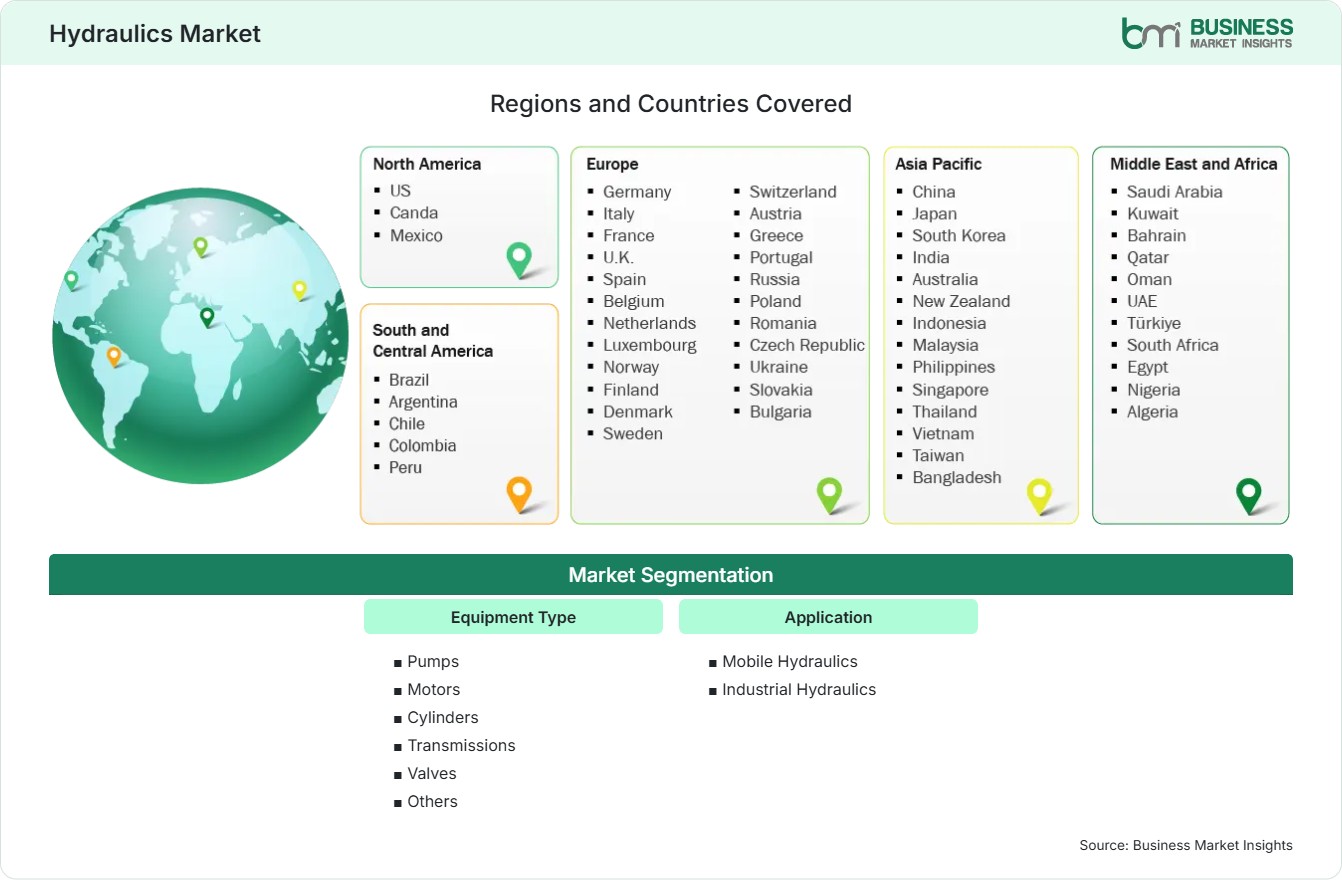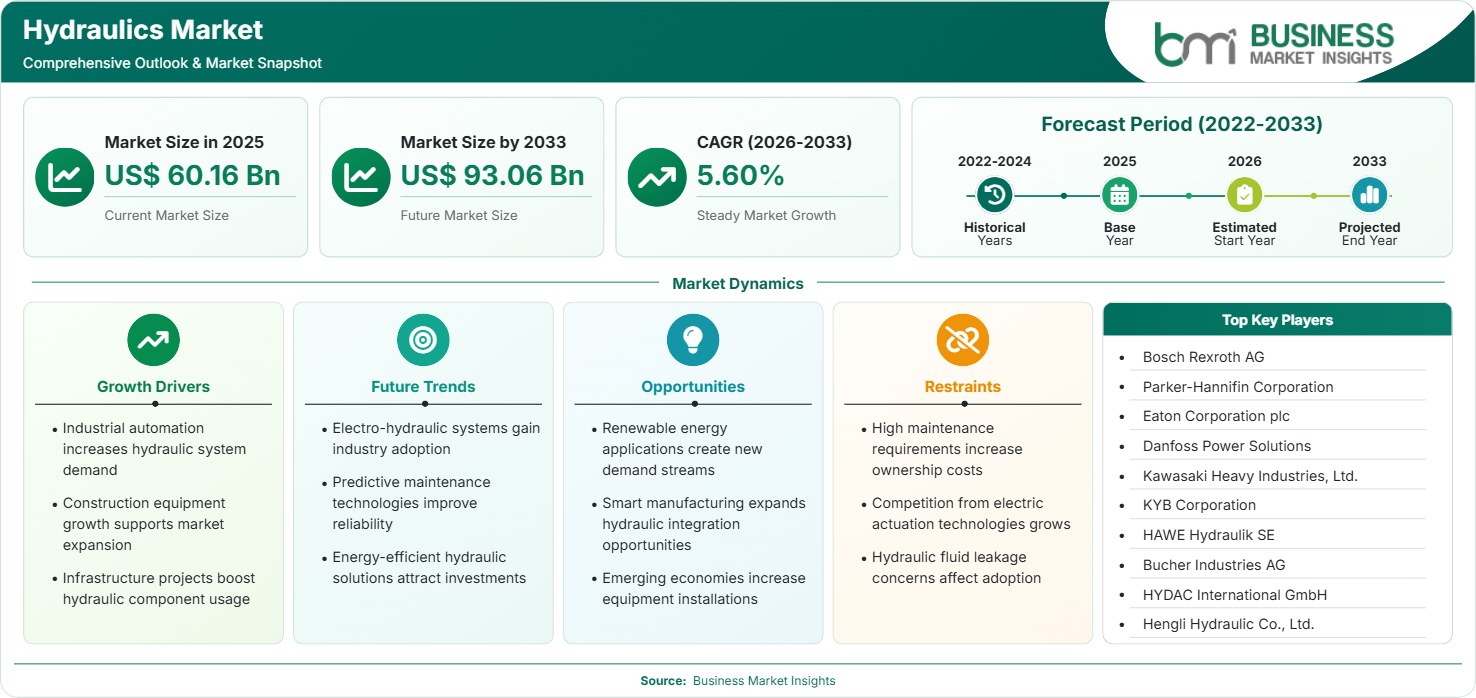
Hydraulics Market Regional Highlights
North America Hydraulics Market
North America accounts for 34%–37% of global revenue in 2025 and is projected to expand at a CAGR of 4.8%–5.3% through 2033. Strong demand from construction equipment, aerospace manufacturing, agriculture, and energy applications supports regional leadership. The Hydraulics Market share remains concentrated among established OEM relationships and aftermarket networks. Fleet modernization initiatives, automation investments, and replacement demand for aging machinery continue supporting long-term performance across major industrial sectors.
- Infrastructure and transportation investment programs support sustained equipment purchases and replacement demand.
- Aerospace manufacturing growth increases demand for high-performance pumps, valves, and actuation systems.
- Digital service platforms strengthen predictive maintenance adoption and aftermarket revenues.
- Defense procurement programs support specialized fluid power system deployment across multiple applications.
US Hydraulics Market
The US represents 76%–80% of North American demand and records a CAGR of 4.9%–5.4% through 2033. Construction activity, industrial automation projects, agricultural equipment upgrades, and energy sector investments remain primary demand drivers. Large equipment fleets generate significant replacement and service requirements. Manufacturers continue investing in smart hydraulic technologies, production capacity optimization, and digital monitoring solutions to improve customer productivity and lifecycle economics.
- Construction machinery utilization rates support ongoing replacement activity and component demand.
- Agricultural mechanization trends increase adoption of advanced load-sensing systems.
- Domestic manufacturing investments encourage machinery procurement and facility modernization.
- Industrial connectivity initiatives accelerate deployment of intelligent fluid power technologies.
Europe Hydraulics Market
Europe holds 24%–27% of global revenue in 2025 and is expected to grow at a CAGR of 4.7%–5.2%. Germany leads regional demand, while Eastern Europe demonstrates stronger expansion potential at approximately 5.8%–6.3% CAGR. Advanced manufacturing, industrial automation, and stringent efficiency standards support component demand. Regional suppliers emphasize sustainable designs, energy-efficient systems, and digitally enabled maintenance practices to strengthen competitiveness across industrial end markets.
- Germany remains the largest regional market through strong machinery manufacturing exports.
- Italy maintains robust demand from industrial equipment and automation sectors.
- Poland demonstrates high-growth potential from industrial expansion and logistics investment.
- Sustainability targets encourage efficient hydraulic power unit adoption.
- Advanced motion-control applications support premium product demand.
Asia Pacific Hydraulics Market
Asia Pacific captures 29%–32% of global revenue in 2025 and records the highest CAGR of 6.5%–7.1% through 2033. China leads regional consumption, while India remains the fastest-growing major market with growth near 7.2%–7.8%. Manufacturing expansion, infrastructure development, mining activity, and agricultural mechanization underpin demand. Hydraulics Market share continues increasing across emerging economies due to localization initiatives and rising domestic equipment production.
- Chinese manufacturers increasingly strengthen component self-sufficiency and export capabilities.
- India benefits from infrastructure spending and industrial capacity expansion.
- Southeast Asian economies support machinery procurement through manufacturing investment.
- Mining and resource industries generate strong demand for heavy-duty systems.
- Localization strategies encourage production of pumps, valves, and cylinders.
Rest of World Hydraulics Market
Rest of World contributes 10%–13% of global revenue in 2025 and expands at a CAGR of 5.4%–5.9% through 2033. South and Central America benefit from agriculture and mining investments, while Middle East and Africa demand is supported by construction and resource projects. Brazil leads regional consumption. Saudi Arabia and the UAE emerge as key growth centers driven by industrial diversification and infrastructure development initiatives.
- Brazil benefits from mechanized agriculture and mining equipment investments.
- Mexico strengthens manufacturing-linked equipment demand across industrial sectors.
- Gulf economies support large-scale infrastructure and industrial development projects.
- Mining operations across Africa require durable fluid power solutions.
- Energy diversification initiatives create opportunities for specialized hydraulic equipment.