
Hydraulic Equipment Market Outlook: Size, Share, Trends, Growth Analysis, Competitive Landscape & Forecast, 2026-2033

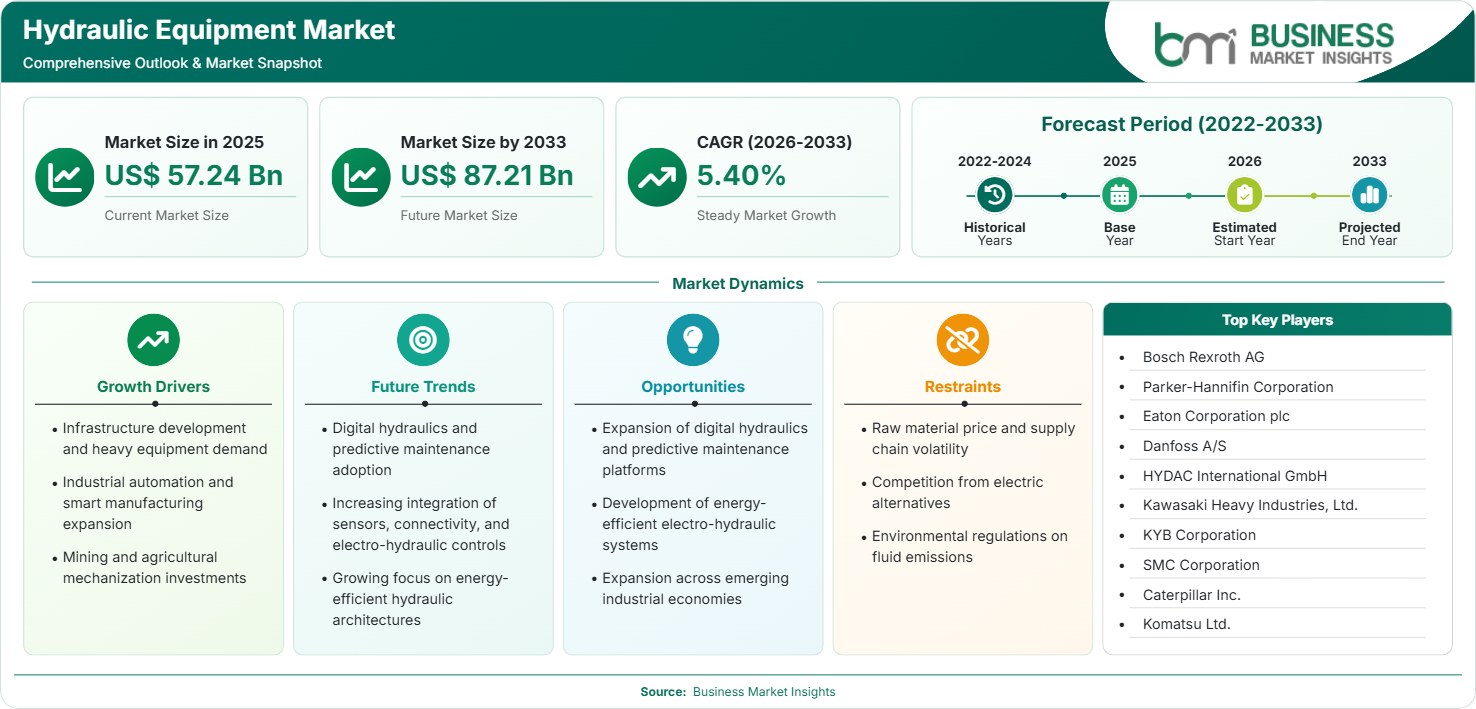
The Hydraulic Equipment Market size was valued at US$ 57.24 Billion in 2025 and is projected to reach US$ 87.21 Billion by 2033, growing at a CAGR of 5.40% during 2026–2033. Rising infrastructure spending, industrial automation, mining modernization, smart hydraulics adoption, electrified machinery integration, and aftermarket service expansion are creating strong revenue opportunities across multiple end-use industries.

Report Coverage
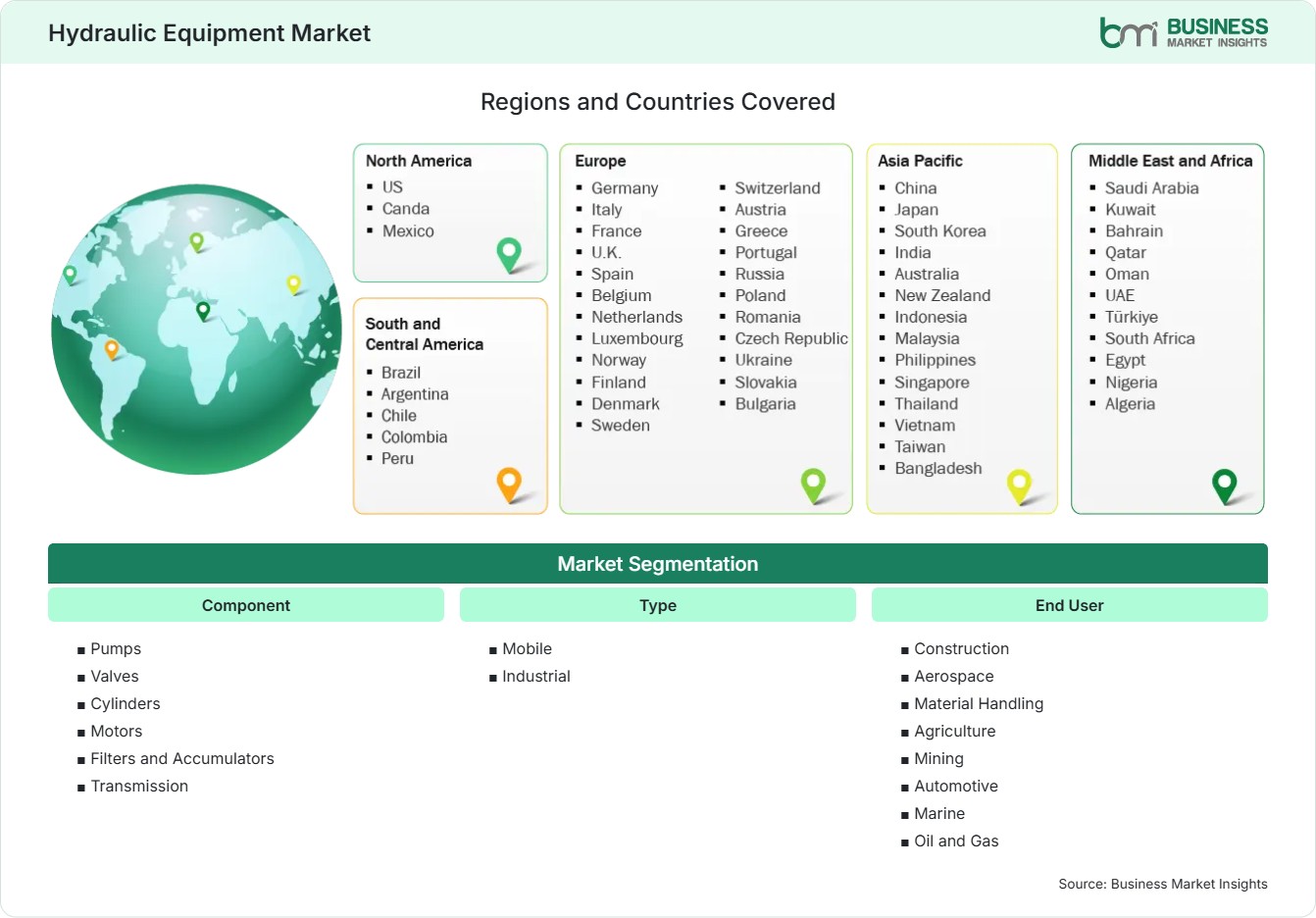
  • Component: Pumps, Valves, Cylinders, Motors, Filters and Accumulators, Transmission
  • Type: Mobile, Industrial
  • End User: Construction, Aerospace, Material Handling, Agriculture, Mining, Automotive, Marine, Oil and Gas
US$ 57.24 Bn Market size in 2025
US$ 87.21 Bn Market Size by 2033
5.40% CAGR, 2026 - 2033
2026-2033 Forecast Period

AI Overview

Hydraulic Equipment Market Summary

  • North America Region: North America holds market share of 32%–35% in 2025, growing with a CAGR of 4.8%–5.2% during 2026–2033. Infrastructure renewal, automation investments, energy sector upgrades, and advanced equipment replacement cycles improve demand. The US benefits from manufacturing investments, fluid power innovation, and strong construction activity, expanding at 4.9%–5.3% CAGR.
  • Fastest Growing Region: Asia Pacific holds 36%–39% share in 2025 and records 6.3%–6.8% CAGR through 2033. Industrialization, infrastructure megaprojects, mining expansion, agricultural mechanization, and manufacturing relocation support long-term demand across emerging economies.
  • Leading Segment: Industrial type accounts for 55%–58% share in 2025 and expands at 5.1%–5.5% CAGR. Growth stems from factory automation, process industries, material handling systems, precision control requirements, and modernization of production facilities worldwide.
  • High Growth Segment: Construction end user represents 20%–23% share in 2025 while advancing at 6.0%–6.5% CAGR. Large-scale infrastructure programs, urbanization projects, equipment fleet replacement, and smart construction machinery investments accelerate equipment deployment globally.
  • Key Market Opportunity: Digital hydraulics, predictive maintenance platforms, sensor-enabled actuators, and energy-efficient hydraulic architectures are creating new service revenues, improving uptime, reducing operating costs, and strengthening lifecycle value propositions.
  • Major Market Players: Bosch Rexroth AG, Parker-Hannifin Corporation, Eaton Corporation plc, Danfoss A/S, HYDAC International GmbH, Kawasaki Heavy Industries, Ltd., KYB Corporation, SMC Corporation, Caterpillar Inc., and Komatsu Ltd.
Strategic Insights

Hydraulic Equipment Market: Strategic Insights

Hydraulic Equipment Market Strategic Framework
FREE PDF
Request your free sample
Request free sample
Stakeholder View

Key Takeaways

  • The value chain remains highly interconnected, with pumps, valves, cylinders, electronics, software, and service providers increasingly collaborating to deliver integrated motion-control solutions.
  • Construction equipment and industrial automation applications offer the strongest upside due to continuing investments in infrastructure, warehousing, and smart manufacturing facilities.
  • Innovation is shifting toward digitally connected systems featuring predictive maintenance, real-time monitoring, energy optimization, and electro-hydraulic control architectures.
  • Asia Pacific presents the most compelling expansion opportunity because of rapid industrialization, manufacturing growth, mining investments, and rising mechanization rates.
  • Strategic acquisitions increasingly focus on fluid power technologies, intelligent controls, and aftermarket capabilities that expand recurring revenue streams and customer retention.
  • Sustainability objectives are encouraging adoption of leak-resistant designs, biodegradable fluids, and efficient hydraulic circuits that reduce lifecycle operating costs.
Geographic Outlook

Hydraulic Equipment Market Regional Highlights

North America Hydraulic Equipment Market

North America accounted for 32%–35% Hydraulic Equipment Market share in 2025 and is projected to register a CAGR of 4.8%–5.2% during 2026–2033. Strong construction spending, energy infrastructure upgrades, advanced manufacturing activity, and high replacement demand support equipment procurement. Regional players emphasize automation-compatible systems and connected hydraulics. Demand remains particularly resilient across construction, aerospace, agriculture, and oilfield applications where reliability, precision, and high-force performance remain critical operational requirements.

  • US infrastructure modernization programs continue supporting demand for excavators, cranes, loaders, and industrial machinery equipped with advanced hydraulic assemblies and connected component technologies.
  • Energy sector investments across conventional and renewable projects encourage deployment of durable fluid power systems designed for demanding operating conditions and continuous service cycles.
  • Aerospace manufacturers increasingly adopt precision hydraulic components for motion control, testing systems, and production equipment requiring reliability and operational accuracy.
  • Growing warehouse automation and logistics infrastructure spending strengthens demand for material-handling machinery incorporating efficient hydraulic actuation solutions.

US Hydraulic Equipment Market

The United States represents 68%–72% Hydraulic Equipment Market share within North America and is anticipated to achieve a CAGR of 4.9%–5.3% through 2033. Domestic manufacturing investments, infrastructure funding, industrial reshoring, and agricultural equipment upgrades reinforce market fundamentals. OEMs continue prioritizing intelligent hydraulics integrated with sensors and automation software. Increased demand from aerospace, material handling, and construction industries supports replacement cycles and technology upgrades across operating fleets nationwide.

  • Large federal infrastructure allocations continue generating procurement opportunities for contractors deploying hydraulic machinery in transportation, utility, and civil construction projects.
  • Industrial automation investments stimulate adoption of advanced cylinders, pumps, and valves integrated into production and warehouse systems.
  • Agriculture equipment modernization enhances demand for precision hydraulic control systems supporting efficiency, productivity, and digital farm operations.
  • Strong aftermarket activity supports revenue growth through maintenance services, replacement components, and retrofit programs.

Europe Hydraulic Equipment Market

Europe held 24%–27% Hydraulic Equipment Market share in 2025 and is forecast to grow at 4.6%–5.0% CAGR through 2033. Germany remains the leading national market, while Eastern European manufacturing centers deliver stronger expansion rates. Industrial automation leadership, machine engineering expertise, and sustainability requirements drive adoption. Equipment manufacturers increasingly emphasize energy-efficient solutions and intelligent controls. Demand remains diversified across automotive, industrial machinery, marine, aerospace, and renewable energy sectors.

  • Germany maintains leadership through advanced machinery manufacturing and extensive deployment of industrial fluid power technologies.
  • Poland and Czech Republic demonstrate above-regional growth supported by expanding manufacturing investments and equipment production capabilities.
  • Energy-efficiency regulations encourage replacement of older systems with digitally controlled hydraulic equipment reducing operating costs.
  • Marine and offshore industries sustain demand for durable actuation and motion control systems used in demanding environments.

Asia Pacific Hydraulic Equipment Market

Asia Pacific accounts for 36%–39% Hydraulic Equipment Market share in 2025 and records the strongest CAGR of 6.3%–6.8% through the forecast period. China remains the largest contributor, while India exhibits the fastest expansion among major economies. The region benefits from manufacturing growth, infrastructure development, mining investments, urbanization, and rising equipment ownership. Large-scale industrial capacity additions create significant opportunities for component suppliers and system integrators serving both mobile and industrial applications.

  • China leads regional demand through extensive construction activity, industrial capacity expansion, and equipment manufacturing scale.
  • India records rapid growth supported by infrastructure corridors, mining projects, and agricultural mechanization initiatives.
  • Southeast Asian nations attract manufacturing relocation investments, increasing demand for factory equipment incorporating hydraulic technologies.
  • Expanding logistics, ports, and warehousing networks enhance procurement of material handling machinery and supporting components.
  • Mining development across Australia and Indonesia supports deployment of high-performance hydraulic systems in heavy equipment.

Rest of World Hydraulic Equipment Market

Rest of World contributes 8%–10% share in 2025 and is expected to expand at a CAGR of 5.2%–5.8%. South and Central America benefit from mining, agriculture, and infrastructure spending. The Middle East and Africa gain momentum through energy investments, transportation projects, and industrial diversification initiatives. Equipment suppliers increasingly establish local partnerships and service capabilities to improve customer support and enhance participation in regional development programs.

  • Brazil remains the largest Latin American market driven by agriculture machinery purchases and mining sector investments.
  • Chile benefits from mining modernization initiatives requiring advanced hydraulic systems for extraction and processing equipment.
  • Saudi Arabia supports demand through industrial diversification and major infrastructure development programs.
  • United Arab Emirates expands logistics and construction investments, creating opportunities for mobile hydraulic machinery suppliers.
  • South Africa maintains steady demand through mining and industrial equipment replacement cycles.
Global Market Geography
FREE PDF
Request your free sample
Request free sample
Segment Analysis

Hydraulic Equipment Market Segmentation

Component

Component segment represents the technology foundation of the industry, with pumps and cylinders generating significant demand across mobile and industrial applications. This segment accounted for approximately 48%–51% share in 2025 and is expected to expand at 5.2%–5.7% CAGR. Hydraulic Equipment Market scope continues expanding through digital monitoring capabilities, efficiency improvements, and enhanced durability requirements.

  • Pumps: Essential power-generation units supporting pressure creation across industrial equipment, construction machinery, mining vehicles, and agricultural platforms. Innovation focuses on efficiency, compact design, durability, and reduced energy consumption.
  • Valves: Critical for fluid regulation and motion control in automated machinery. Increasing adoption of proportional and electronic control valves supports precision, safety performance, and operational productivity.
  • Cylinders: Widely utilized for lifting, pushing, and positioning applications. Demand remains strong across construction equipment, processing facilities, and material handling operations requiring high-force movement.
  • Motors: Convert hydraulic energy into mechanical motion for equipment operating under heavy loads. Growth is supported by industrial automation and mobile machinery deployment.
  • Filters and Accumulators: Improve system reliability through contamination control and energy storage functions. Growing emphasis on maintenance optimization strengthens adoption.
  • Transmission: Supports power transfer requirements in heavy equipment. Demand remains linked to productivity enhancement and improved machine performance.

Type

The type category differentiates demand between mobile and industrial installations. Industrial systems hold the leading position with 55%–58% share in 2025 and are projected to advance at 5.1%–5.5% CAGR. Hydraulic Equipment Market size benefits from rising automation investments, while mobile deployments remain supported by infrastructure development and equipment fleet expansion.

  • Mobile: Demand originates from construction, agriculture, mining, and transportation equipment requiring powerful and reliable actuation under challenging operating environments.
  • Industrial: Strong adoption across manufacturing, metal processing, packaging, warehousing, and process industries where precision control and high productivity are operational priorities.

End User

The end-user landscape remains diverse, reflecting broad application coverage. Construction constitutes the leading revenue contributor with 20%–23% share in 2025 and the strongest growth outlook at 6.0%–6.5% CAGR. Hydraulic Equipment Market trends indicate increasing integration of digital controls, telemetry, and predictive maintenance solutions across end-use sectors.

  • Construction: Infrastructure expansion and urban development projects continue driving deployment of excavators, cranes, loaders, and earthmoving machinery.
  • Aerospace: Precision actuation requirements support demand for advanced hydraulic assemblies in manufacturing, testing, and operational systems.
  • Material Handling: Warehouse modernization and e-commerce logistics expansion increase adoption of hydraulic lifting and positioning equipment.
  • Agriculture: Mechanization trends and precision farming techniques stimulate investment in advanced fluid power technologies.
  • Mining: Heavy-duty operations require robust hydraulic systems capable of operating under harsh environmental and load conditions.
  • Automotive: Manufacturing automation and assembly-line equipment support ongoing component demand.
  • Marine: Vessel steering, deck machinery, and offshore activities continue utilizing hydraulic solutions for reliable motion control.
  • Oil and Gas: Exploration, drilling, and processing activities require high-performance hydraulic equipment supporting operational continuity.
Market Forces

Hydraulic Equipment Market Dynamics

Key Market Drivers

Infrastructure Development and Heavy Equipment Demand

Global infrastructure programs continue to stimulate the procurement of hydraulic-powered equipment for transportation, utilities, housing, and industrial facilities. Major investments across Asia Pacific, North America, and the Middle East support sustained equipment utilization rates. The Hydraulic Equipment Market growth is still tied to excavators, loaders, cranes, and other material handling machines that use fluid power technologies. Increased urbanization and government spending lead to a need for equipment replacement in the future. Today, contractors tend to choose more sophisticated hydraulic technology that allows them to save fuel and increase productivity. With infrastructure development growing, OEMs gain benefits from increased manufacturing volume, wider after-sales opportunities, and more integrated digital monitoring.

Industrial Automation and Smart Manufacturing Expansion

Manufacturing industries are increasingly deploying intelligent production systems requiring precise force control, reliability, and operational flexibility. Hydraulic systems will continue to be crucial in metal forming, press work, robot-assistive devices, and heavy-duty automation processes. Increased trends in warehouse automation, packing activities, and material handling add to their significance. Integration with sensors, condition monitoring systems, and predictive maintenance systems enhances the use of such machines and minimizes downtime. As companies undertake various measures to boost productivity, the requirement for digitally connected hydraulic systems keeps rising. Such measures enable longer replacement intervals and create avenues for suppliers offering industry 4.0-compliant fluid power systems.

Mining and Agricultural Mechanization Investments

Objectives for resource extraction and agricultural production keep motivating the use of modern machinery equipped with hydraulic systems. The increasing need for minerals and food security, along with labor constraints, motivates mechanization. Hydraulic Equipment Market trends suggest substantial penetration in harvesters, tractors, drilling machines, loaders, and hauling applications. The users are more concerned about systems that have the ability to sustain their performance in tough environmental conditions without having high maintenance needs. The benefits of advanced hydraulic systems include fuel economy, accurate control, and increased productivity. This enhances the justification for investments in such systems.

Key Market Opportunities

Digital Hydraulics and Predictive Maintenance Platforms

The integration of sensors, connectivity solutions, cloud analytics, and artificial intelligence creates transformative opportunities. Equipment operators increasingly seek predictive maintenance capabilities that reduce unplanned downtime and optimize servicing schedules. Hydraulic Equipment Market Forecasts indicate the need for connected systems that monitor parameters like pressure, temperature, contamination, and system performance is increasing. Providers who offer service contracts based on data can reap continuous revenue streams and build customer retention. Digital hydraulics make it easier to determine lifecycle costs and optimize asset management. As industrial companies keep focusing on productivity and efficiency, intelligent fluid power systems are expected to gain increasing investments in various sectors.

Energy-Efficient Electro-Hydraulic Systems

Stricter sustainability objectives create opportunities for manufacturers developing energy-efficient architectures. Variable speed drives, intelligent control, and efficient fluid management technologies can substantially decrease energy usage compared with traditional technologies. The industrial consumer is moving toward the total cost of ownership instead of cost only when evaluating a purchase decision. Electro-hydraulic technology assists in decreasing energy loss, increasing reaction time, and improving overall accuracy of operation. With the changing energy costs and environmental regulations, the customer will move faster on upgrading their existing systems. Suppliers who can prove higher efficiency benefit from a competitive advantage.

Expansion Across Emerging Industrial Economies

Rapid industrialization in Southeast Asia, India, the Middle East, and selected African markets creates substantial white-space opportunities. Fluid Power Systems are heavily relied upon in manufacturing plants, transport networks, logistics centers, and mining operations. The growing production capabilities in the country encourage locally manufactured products and components, as well as partnerships in manufacturing components. International firms stand to gain much from setting up regional service centers and supply networks. More government policies for the industries are leading to more investments in productive capital.

Market Restraints and Challenges

Volatile Raw Material Costs and Supply Chain Exposure

Factor: Hydraulic systems depend heavily on steel, aluminum, specialty alloys, seals, and electronic components. Impact: The volatility of costs can squeeze the margins for manufacturers, result in higher prices for equipment, and lead to delays in making purchasing decisions. The disruptions of the global supply chain, logistical issues, and political uncertainties persistently affect the purchasing strategy. Suppliers are forced to keep higher levels of inventory to provide for continuity, thus necessitating increased cash flow. Budgeting constraints can lead customers to put off their equipment-replacement projects during times of high cost inflation.

Competition from Electrification in Selected Applications

Factor: Electric actuation technologies are advancing rapidly in applications demanding compact designs, lower maintenance, and simplified operation. Impact: Some equipment categories in the light-duty segment will redirect investments away from conventional hydraulics. While hydraulics continue to have definite strengths when high forces come into play, original equipment manufacturers have started to consider hybrids and electrical options. The demand for efficiency and environmental friendliness by consumers can drive technology substitution if performance needs allow for it. Innovation will have to come through electro-hydraulic integration, energy management, and electronics.

Company Analysis

Competitive Landscape

Hydraulic Equipment Market analysis indicates competition is centered on product breadth, digital capabilities, aftermarket reach, and global manufacturing presence.

Company Name

Overview

Products and Services relevant to this market

Bosch Rexroth AG

Global motion control and fluid power specialist serving industrial and mobile equipment sectors.

Hydraulic pumps, valves, cylinders, drives, controls, smart hydraulics, engineering services.

Parker-Hannifin Corporation

Diversified industrial technology company with extensive fluid power expertise worldwide.

Hydraulic systems, filtration products, pumps, motors, connectors, maintenance solutions.

Eaton Corporation plc

Power management leader with broad industrial and mobile hydraulics portfolio.

Hydraulic pumps, valves, power units, controls, fluid conveyance solutions.

Danfoss A/S

Major supplier of electrification and fluid power technologies.

Hydraulic motors, pumps, valves, digital controls, mobile equipment solutions.

HYDAC International GmbH

Specialized provider focused on fluid engineering and filtration technologies.

Filtration, accumulators, cooling systems, sensors, hydraulic accessories, services.

Kawasaki Heavy Industries, Ltd.

Precision machinery manufacturer serving construction and industrial markets.

Hydraulic pumps, motors, valves, mobile equipment hydraulic assemblies.

KYB Corporation

Established producer of motion control and hydraulic technologies.

Hydraulic cylinders, industrial equipment components, mobile machinery solutions.

SMC Corporation

Automation specialist with expanding fluid control capabilities.

Hydraulic actuators, valves, control systems, automation integration products.

Caterpillar Inc.

Heavy equipment manufacturer with extensive hydraulic technology utilization.

Hydraulic cylinders, pumps, machine-integrated hydraulic systems, support services.

Komatsu Ltd.

Global construction and mining equipment leader.

Hydraulic excavator systems, pumps, controls, equipment-integrated solutions.

Trust & Transparency

Research Methodology

The market analysis combines proprietary research with secondary data from government agencies, company disclosures, regulatory filings, industry databases and expert interviews. Market estimates are validated through data triangulation, cross-market benchmarking and analyst review.

View Full Research Methodology

Questions Answered

Frequently Asked Questions

How are sustainability goals influencing product development?

Manufacturers are investing in efficient power units, leak-resistant systems, biodegradable fluids, digital monitoring, and optimized hydraulic circuits to reduce energy consumption and environmental impact.

What does the Hydraulic Equipment Market Report typically include?

A comprehensive study generally covers market sizing, forecasts, competitive benchmarking, regional insights, technology trends, segment analysis, regulatory impacts, and strategic opportunities across end-user industries.

What technologies are reshaping the industry?

Digital hydraulics, predictive maintenance platforms, sensor-enabled systems, electro-hydraulic controls, and energy-efficient architectures are improving performance, reliability, and lifecycle economics.

Why is Asia Pacific emerging as the fastest-growing region?

Large infrastructure programs, manufacturing expansion, mining activity, urbanization, and increasing mechanization rates across China, India, and Southeast Asia are driving stronger regional demand growth.

Which industries generate the largest demand for hydraulic equipment?

Construction, manufacturing, mining, agriculture, material handling, aerospace, oil and gas, and marine industries represent the largest demand centers due to their dependence on high-force motion control and equipment reliability.

Access the Full Hydraulic Equipment Market Report

Get segment-level forecasts, regional estimates, competitive benchmarking, company profiles and downloadable Excel datasets.

Access the full Hydraulic Equipment Market Report
350 pages PDF & Excel | 2026-08-27