Market Summary
Executive Summary and Global Market Analysis
Centrifugal pumps are fluid transfer systems that convert rotational mechanical energy into hydrodynamic flow movement. Such pumps have been widely employed in industrial, municipal, and commercial processes that require constant circulation, regulation of pressure, and efficient process execution. With their ease of operation and ability to be used in large scale applications, their use has continued to flourish in different infrastructural environments. Construction of new facilities for water treatment, industry, and power has increased procurement activities within the industry.
Municipalities and industries have started focusing more on pumps that ensure consistent performance in terms of flow rate and reduced downtime. Demand for such pumps is also driven by initiatives aimed at ensuring energy-efficient flow in industrial and utility processes. There has been diversified application of products depending on their stages, hydraulic nature, and ultimate usage. The radial flow design remains prevalent for applications that require constant pressure supply as well as controlled handling of liquids.
The enclosed impeller is also becoming very popular in fluids with little contaminants due to its ability to offer efficient performance with minimal hydraulic losses. Recent technology advancements have largely focused on intelligent controls, materials that resist corrosion, and energy efficiency. The industry is working towards incorporating diagnostic tools alongside intelligent monitoring systems into its products for increased reliability at key infrastructure facilities.
Improved material durability along with better impeller technology is also contributing to increased durability of pumps used in chemical and mining environments. The competitive environment continues to be driven by product durability and ability to customize. Strategic investments in manufacturing efficiency and regional distribution networks further influence procurement competitiveness across the global marketplace.
Segment Analysis
Centrifugal Pump Market Segmentation
The Centrifugal Pump market is segmented based on type, application, and end-user industries. The market structure reflects the broad operational requirements of fluid handling systems across industrial and infrastructure sectors.
By Type
- Single-stage: Widely used for standard industrial and municipal fluid transfer applications due to simple construction and cost efficiency.
- Multi-stage: Preferred in high-pressure operations such as boiler feed systems, industrial processing, and long-distance fluid transportation.
- Submersible: Commonly deployed in wastewater treatment, mining, drainage, and underground pumping applications.
By Application
- Water & Wastewater: Extensively utilized in water treatment plants, sewage systems, and municipal infrastructure projects.
- Mining: Used for slurry handling, dewatering, and mineral processing activities in mining operations.
- Oil & Gas: Supports fluid transportation, refinery operations, and offshore processing requirements.
- Agriculture: Applied in irrigation systems, groundwater extraction, and agricultural water management.
By End-User
- Industrial: Represents significant demand from manufacturing, chemical processing, and heavy industrial operations.
- Residential: Used in household water supply, drainage, and pressure boosting systems.
- Commercial: Supports water circulation and HVAC systems in commercial buildings and facilities.
- Municipal: Deployed in public water distribution, wastewater management, and urban infrastructure projects.
Market Forces
Centrifugal Pump Market Drivers and Opportunities
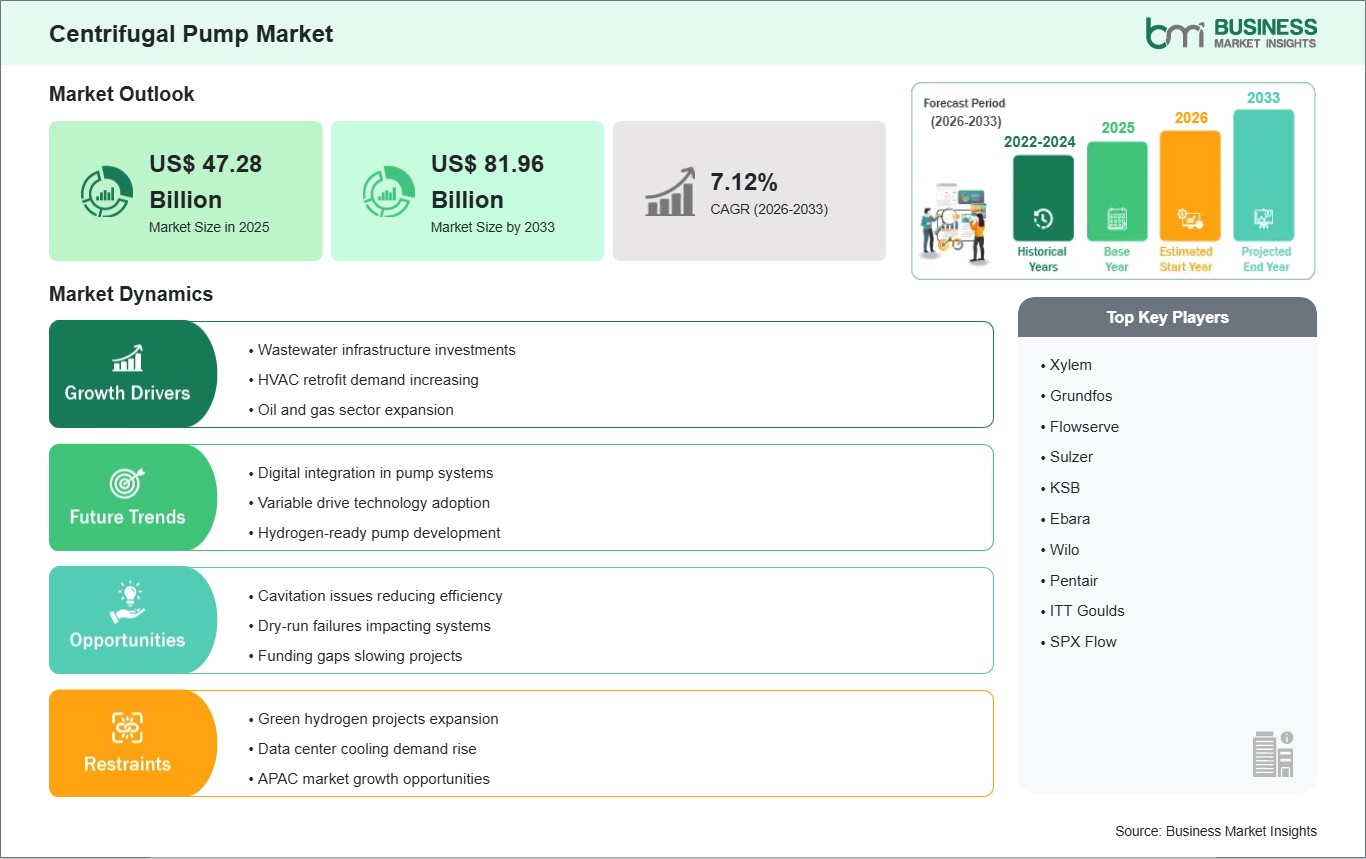
Wastewater infrastructure investments
Expansion of wastewater treatment infrastructure continues strengthening centrifugal pump procurement across municipal and industrial facilities. Fluid handling systems that have the capacity to facilitate water transportation, sludge handling, and pressure regulation have become increasingly preferred by governments and utility companies. This preference has brought about greater adoption of strong pump designs built for constant use in harsh environments.
Modernization of infrastructure is having a significant impact on demand for old pump systems that have been replaced by energy-efficient counterparts. Wastewater treatment plants need to function with optimal efficiency and minimal repair needs to enhance their reliability. Centrifugal pumps have relevance when it comes to planning for water resources in the future.
Green hydrogen projects expansion
Rising investment in green hydrogen production facilities is creating new application opportunities for advanced centrifugal pumping systems. There is a need for efficient fluid circulation equipment that will support the processes of hydrogen cooling, transportation, and chemical processes. In response, companies have come up with corrosion-resistant pumps designed to operate in energy infrastructures.
There are anticipated to be more opportunities for future installation with the incorporation of renewable energy on a large scale and the decarbonization of industries. The hydrogen project facilities would demand that there should be an efficient liquid handling mechanism to ensure that the processes continue safely. The development will enhance engineering creativity and increase pump application.
Size and Share Analysis
Centrifugal Pump Market Size and Share Analysis
The Centrifugal Pump Market is projected to grow from US$ 47.28 Billion in 2025 to US$ 81.96 Billion by 2033 , registering a CAGR of 7.12% from 2026 to 2033. Market expansion reflects increasing deployment across water infrastructure systems, industrial fluid handling networks, and energy-efficient pumping modernization programs supporting operational continuity and process optimization.
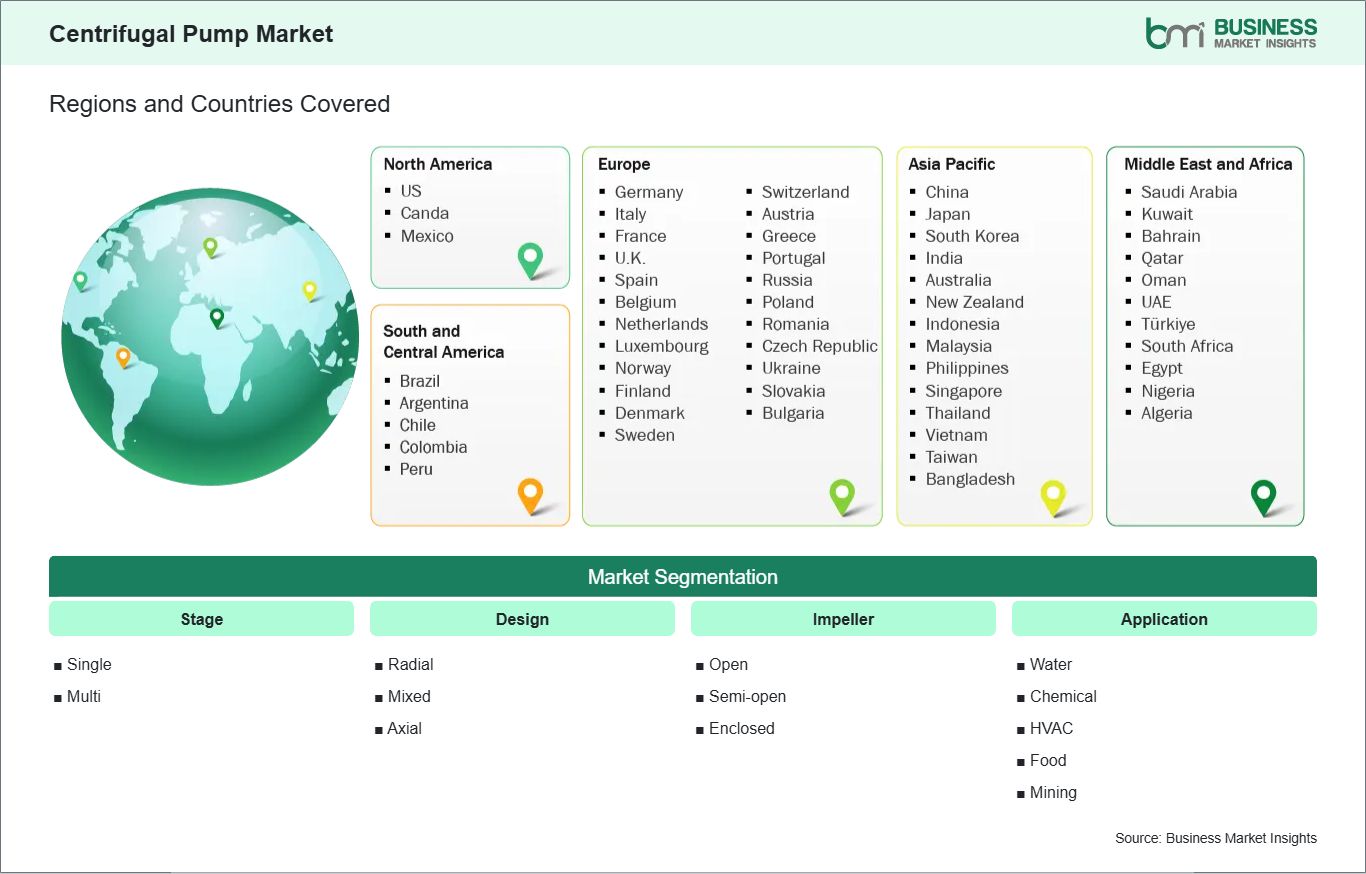
By stage, single-stage pumps account for a significant share due to their extensive use in low to medium pressure applications across municipal water distribution and HVAC systems. Multi-stage pumps hold strong positioning in high-pressure environments such as industrial processing and long-distance water transport, where efficiency under elevated head conditions is essential.
By design, radial pumps dominate market utilization because of their stable pressure generation and suitability for a wide range of industrial and municipal applications. Mixed flow designs maintain steady adoption in systems requiring balanced discharge and pressure performance, while axial pumps serve high-volume, low-pressure operations in large-scale circulation systems such as flood control and cooling applications.
By impeller type, enclosed impellers hold a substantial market share due to their high efficiency and ability to handle clean fluids in industrial and water treatment applications. Semi-open impellers are widely used in moderately contaminated fluid environments requiring operational flexibility. Open impellers maintain relevance in applications involving solids handling, particularly in wastewater and slurry transport systems.
By application, water-related operations represent the largest share driven by municipal supply, treatment facilities, and distribution infrastructure expansion. Chemical applications maintain steady demand due to requirements for corrosion-resistant pumping systems in processing environments. HVAC applications continue expanding with commercial infrastructure development, while food processing emphasizes hygienic fluid transfer systems. Mining applications contribute consistently through heavy-duty pumping requirements in abrasive and high-load conditions.
Report Coverage
Centrifugal Pump Market Report Coverage and Deliverables
The "Centrifugal Pump Market Size and Forecast (2022 - 2033)" report provides a detailed analysis of the market covering below areas:
- The market size and forecast at global, regional, and country levels for all market segments covered under the scope
- The market trends, as well as drivers, restraints, and opportunities
- The market analysis covering key trends, global and regional framework, major players, regulations, and recent developments
- Industry landscape and competition analysis covering market concentration, heat map analysis, prominent players, and recent developments for the market
- Detailed company profiles, including SWOT analysis
Geographic Insights
Centrifugal Pump Market Geographic Insights
The Centrifugal Pump Market shows diverse regional adoption patterns influenced by industrial infrastructure development, water management requirements, and energy-efficient system upgrades across economies with varying maturity levels. Demand distribution reflects differences in municipal investment cycles, manufacturing intensity, and regulatory focus on fluid handling efficiency across global regions.
North America demonstrates stable adoption supported by modernization of water distribution systems and replacement of aging pumping infrastructure. Municipal utilities continue prioritizing energy-efficient pumping solutions to improve operational reliability and reduce lifecycle maintenance requirements. Industrial sectors such as chemical processing, HVAC, and food manufacturing further reinforce steady demand for advanced centrifugal pump systems across the region.
The Asia Pacific region displays robust growth due to rapid urbanization, industrialization, and continuous development of water treatment facilities. Construction of more business complexes and industries bolsters demand within water transfer and processing applications. Mining and energy production activities also make up part of the demand in this region, where high-powered pumps are required for heavy operational loads.
Europe maintains consistent adoption influenced by strict energy efficiency regulations and sustainability-focused industrial upgrades. Replacement of conventional pumping systems with optimized, low-energy designs remains a key trend across municipal and industrial applications. Emerging regions across the Middle East, Africa, and South and Central America show gradual uptake supported by infrastructure development, mining expansion, and growing investment in water supply and distribution networks.
Industry Activity
Recent Developments
The centrifugal pump market is evaluated by gathering qualitative and quantitative data post primary and secondary research, which includes important corporate publications, association data, and databases. A few of the key developments in the centrifugal pump market are:
- In November 2023, Grundfos, announced the launch of its new NK and NKE end-suction centrifugal pump range in Asia-Pacific, designed for higher energy efficiency, connectivity, and improved hydraulic performance for industrial and building applications.
- In November 2023, Xylem Inc., announced the launch of the e-80SCXL vertical inline centrifugal pump (Bell and Gossett series), targeting hydronic heating, cooling, and industrial process applications with improved efficiency and installation flexibility.
Trust & Transparency
Research Methodology
The market analysis combines proprietary research with secondary data from government agencies, company disclosures, regulatory filings, industry databases and expert interviews. Market estimates are validated through data triangulation, cross-market benchmarking and analyst
review.
View Full Research Methodology
Key Sources Referred:
Hydraulic Institute International Organization for Standardization American Water Works Association European Pump Manufacturers Association S. Environmental Protection Agency International Energy Agency American Society of Mechanical Engineers Water Environment Federation