Market Summary
Executive Summary and Global Market Analysis
Canned motor pumps are hermetically sealed pumping systems designed to prevent fluid leakage during hazardous and high-purity operations. These systems integrate the motor and pump within a single enclosed unit, eliminating conventional shaft seals and minimizing contamination risks. Their operational reliability supports continuous processing environments where safety, fluid integrity, and low maintenance remain operational priorities. Industrial facilities handling corrosive, volatile, and temperature-sensitive fluids continue strengthening investments in sealed pumping technologies.
Chemical processing units, hydrocarbon transportation networks, and refrigeration infrastructure increasingly prefer compact pumping systems with enhanced containment performance. Environmental compliance frameworks and workplace safety requirements are further reinforcing procurement of leak-proof fluid transfer equipment across regulated industries. Demand distribution differs notably across product and application categories due to operational complexity and installation requirements. Standard variants maintain broad deployment in industrial circulation processes, while high temperature models address extreme thermal conditions in energy-intensive environments.
Horizontal installations remain prevalent in large industrial facilities because of simplified maintenance accessibility and alignment flexibility across integrated piping systems. Advancements in motor efficiency and thermal management technologies are reshaping product engineering strategies throughout the industry. Permanent magnet motor configurations are attracting attention for their energy optimization capabilities and compact structural design. Manufacturers are also refining insulation materials, hydraulic balancing systems, and vibration reduction mechanisms to improve operational continuity under demanding processing conditions.
The competitive environment reflects a combination of engineering specialization, product customization capabilities, and long-term service integration. Market participants emphasize operational durability, regulatory compatibility, and application-specific configurations to strengthen customer retention. Strategic focus increasingly centers on technological differentiation, localized support infrastructure, and efficiency-oriented product development suited for critical industrial operations.
Segment Analysis
Canned Motor Pumps Market Segmentation
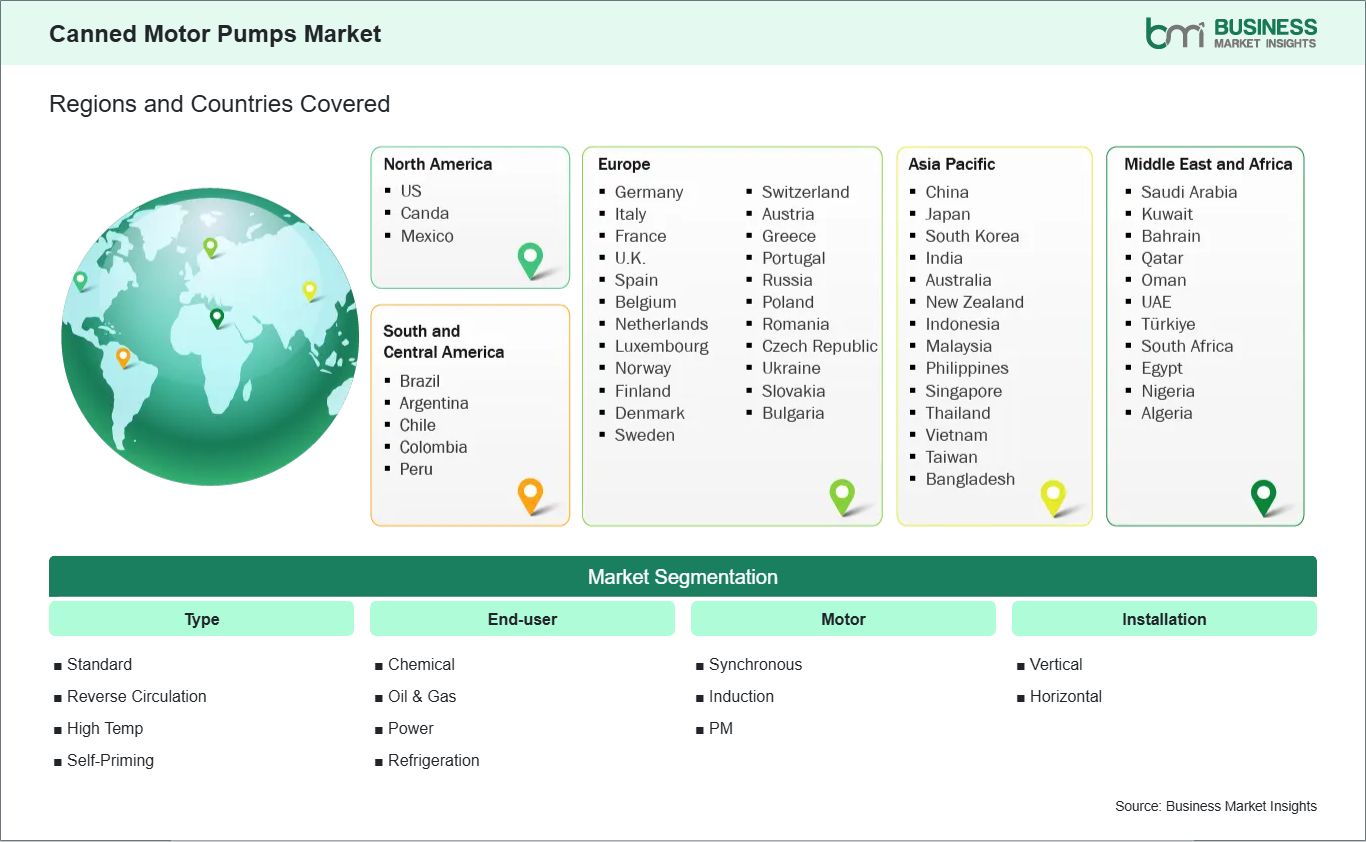
The canned motor pumps market is segmented based on, type, end-user, motor, and installation, reflecting the increasing demand for leak-free, energy-efficient, and maintenance-free pumping solutions across critical industrial applications.
By Type
- Standard - Preferred for continuous industrial circulation with balanced operational efficiency.
- Reverse Circulation - Suitable for handling contaminated fluids requiring controlled internal cooling.
- High Temp - Engineered for thermal stability in elevated process temperature conditions.
- Self-Priming - Facilitates rapid fluid movement in intermittent suction applications.
By End-user
- Chemical - Supports leak-free transfer of corrosive and hazardous process media.
- Oil and Gas - Enhances operational containment across refining and hydrocarbon processing facilities.
- Power - Maintains fluid circulation reliability within high-pressure energy systems.
- Refrigeration - Enables controlled coolant movement in temperature-regulated infrastructure.
By Motor
- Synchronous - Delivers stable rotational accuracy for precision industrial operations.
- Induction - Widely utilized due to operational simplicity and durable performance characteristics.
- PM - Improves energy utilization through compact and efficient motor architecture.
By Installation
- Vertical - Optimizes floor utilization in compact industrial processing environments.
- Horizontal - Simplifies servicing procedures across large-scale operational facilities.
Market Forces
Canned Motor Pumps Market Drivers and Opportunities
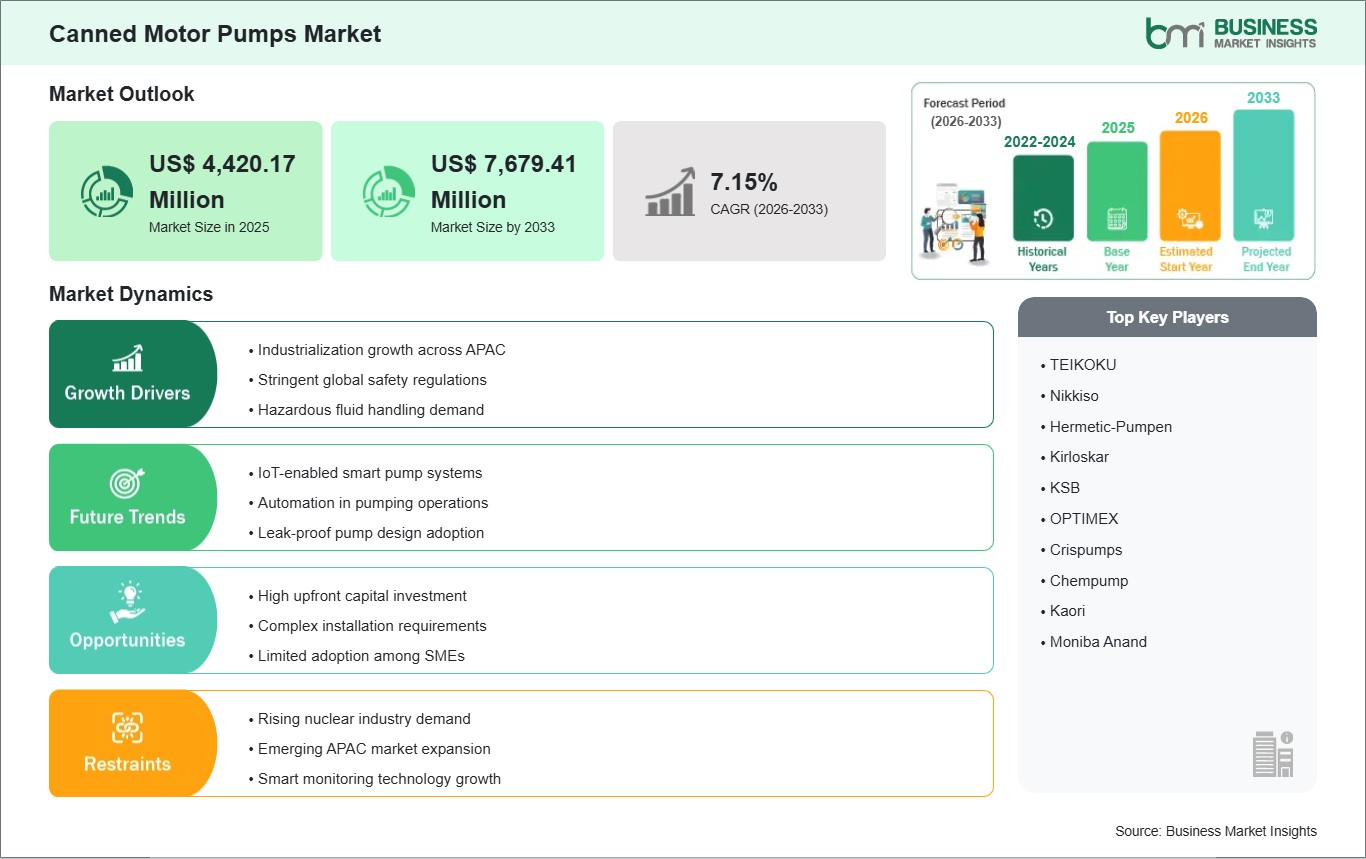
Stringent global safety regulations
Industrial safety regulations governing hazardous fluid handling continue reshaping equipment procurement priorities across processing industries. Facilities managing toxic, flammable, and chemically reactive materials increasingly require hermetically sealed pumping systems to reduce leakage exposure. Canned motor pumps align with these operational expectations by eliminating mechanical seals and minimizing emission-related operational risks. Their enclosed architecture also supports regulatory compliance in applications demanding contamination-free fluid transfer conditions.
The regulatory emphasis on environmental containment has accelerated modernization initiatives within aging industrial infrastructure. Operators are replacing conventional pumping systems with sealed alternatives capable of supporting safer long-duration operations. This transition remains particularly relevant in sectors where operational interruptions create safety and environmental liabilities. As compliance frameworks become stricter across industrial regions, sealed pump technologies continue gaining strategic relevance within process-intensive industries.
Rising nuclear industry demand
Expansion of nuclear energy infrastructure is strengthening interest in specialized pumping technologies capable of supporting controlled fluid circulation environments. Nuclear facilities require highly reliable equipment designed to operate under radiation exposure, elevated temperatures, and strict containment conditions. Canned motor pumps provide integrated sealing capabilities that reduce leakage risks within reactor cooling and auxiliary circulation systems. Their compact design also supports operational consistency in technically sensitive installations.
Future nuclear development programs across emerging and established economies may broaden deployment opportunities for advanced canned motor pump systems. Manufacturers are refining thermal resistance capabilities, insulation technologies, and monitoring systems to align with evolving reactor operational standards. Rising investment in clean energy diversification further enhances the long-term relevance of sealed pumping technologies within nuclear power infrastructure and associated industrial support systems.
Size and Share Analysis
Canned Motor Pumps Market Size and Share Analysis
The Canned Motor Pumps Market is projected to grow from US$ 4,420.17 Million in 2025 to US$ 7,679.41 Million by 2033 , registering a CAGR of 7.15% from 2026 to 2033. The market expansion is supported by rising deployment of leak-proof pumping systems across hazardous fluid handling applications requiring operational safety, environmental compliance, and maintenance efficiency.
By type, standard canned motor pumps account for a significant share due to their operational reliability and suitability for continuous industrial processing environments. Reverse circulation variants continue gaining traction in applications handling contaminated fluids requiring controlled internal cooling mechanisms. High temp models are expanding across power generation and energy-intensive industries because of their thermal endurance capabilities. Self-priming pumps are witnessing broader utilization in installations requiring efficient suction handling and operational flexibility.
By end-user, the chemical sector dominates market utilization owing to strict containment requirements for corrosive and hazardous process fluids. Oil and gas applications maintain substantial deployment because of the need for secure hydrocarbon transfer and refinery operations. The power industry continues integrating canned motor pumps within high-pressure circulation systems supporting uninterrupted operational performance. Refrigeration applications are also expanding steadily with rising emphasis on controlled coolant transfer efficiency.
By motor, induction motors hold a considerable market share due to their durable structure and simplified operational characteristics. Synchronous motors remain relevant in precision-driven industrial environments requiring stable rotational performance. Permanent magnet motors are gaining attention with their compact configuration and energy-efficient operating capabilities.
By installation, horizontal systems represent a major share as they simplify maintenance access and support large-scale industrial layouts. Vertical installations continue expanding in facilities prioritizing optimized floor utilization and compact equipment arrangement.
Report Coverage
Canned Motor Pumps Market Report Coverage and Deliverables
The "Canned Motor Pumps Market Size and Forecast (2022 - 2033)" report provides a detailed analysis of the market covering below areas:
- The market size and forecast at global, regional, and country levels for all market segments covered under the scope
- The market trends, as well as drivers, restraints, and opportunities
- The market analysis covering key trends, global and regional framework, major players, regulations, and recent developments
- Industry landscape and competition analysis covering market concentration, heat map analysis, prominent players, and recent developments for the market
- Detailed company profiles, including SWOT analysis
Geographic Insights
Canned Motor Pumps Market Geographic Insights
The Canned Motor Pumps Market shows diverse regional adoption patterns influenced by industrial safety frameworks, infrastructure modernization priorities, and sector-specific processing requirements. Global demand continues evolving alongside stricter environmental controls and operational reliability expectations across chemical processing, refrigeration, and energy industries. Manufacturers are also adapting product configurations to meet varying regulatory and operational standards across established and emerging industrial economies.
North America demonstrates stable deployment supported by refinery modernization projects and advanced industrial safety compliance requirements. Process industries across the region increasingly prioritize hermetically sealed pumping technologies to minimize operational leakage and maintenance disruptions. The presence of technologically mature industrial facilities also encourages replacement demand for efficient and containment-focused fluid transfer systems across energy and chemical processing operations.
Asia Pacific represents a significant regional growth landscape due to expanding industrial manufacturing capacity and rising infrastructure investment. Chemical production facilities, power generation projects, and refrigeration system installations continue strengthening equipment procurement activity throughout the region. Industrial expansion across manufacturing-intensive economies is also encouraging localized production capabilities and wider integration of advanced pumping technologies within large-scale processing environments.
Europe maintains strong emphasis on energy efficiency and environmental containment standards, supporting continued utilization of sealed pump technologies. Regulatory focus on emission reduction and workplace safety reinforces replacement demand across industrial processing sectors. Meanwhile, emerging markets in the Middle East, Africa, and South and Central America are gradually expanding deployment through energy infrastructure development, hydrocarbon processing investments, and industrial capacity enhancement initiatives.
Industry Activity
Recent Developments
The canned motor pumps market is evaluated by gathering qualitative and quantitative data post primary and secondary research, which includes important corporate publications, association data, and databases. A few of the key developments in the canned motor pumps market are:
- In February 2024, Curtiss-Wright Corporation announced that it entered into a technology cooperation agreement with Petrobras to develop and test a subsea seal-less canned motor boosting system for offshore hydrocarbon production in Brazil.
- In July 2024, EBARA Corporation successfully operated its newly developed liquid ammonia canned motor pump at JERA’s Hekinan Thermal Power Station in Japan, proving its reliability and safety in real-world conditions for fuel ammonia conversion projects
Trust & Transparency
Research Methodology
The market analysis combines proprietary research with secondary data from government agencies, company disclosures, regulatory filings, industry databases and expert interviews. Market estimates are validated through data triangulation, cross-market benchmarking and analyst
review.
View Full Research Methodology
Key Sources Referred:
World Bank - Global Trade Indicators
World Trade Organization (WTO)
International Monetary Fund (IMF)
International Trade Administration (ITA)
Company Websites
Company Annual Reports
Company Investor Presentations