Gear Motor Market Outlook: Size, Share, Trends, Growth Analysis, Competitive Landscape & Forecast, 2026-2033

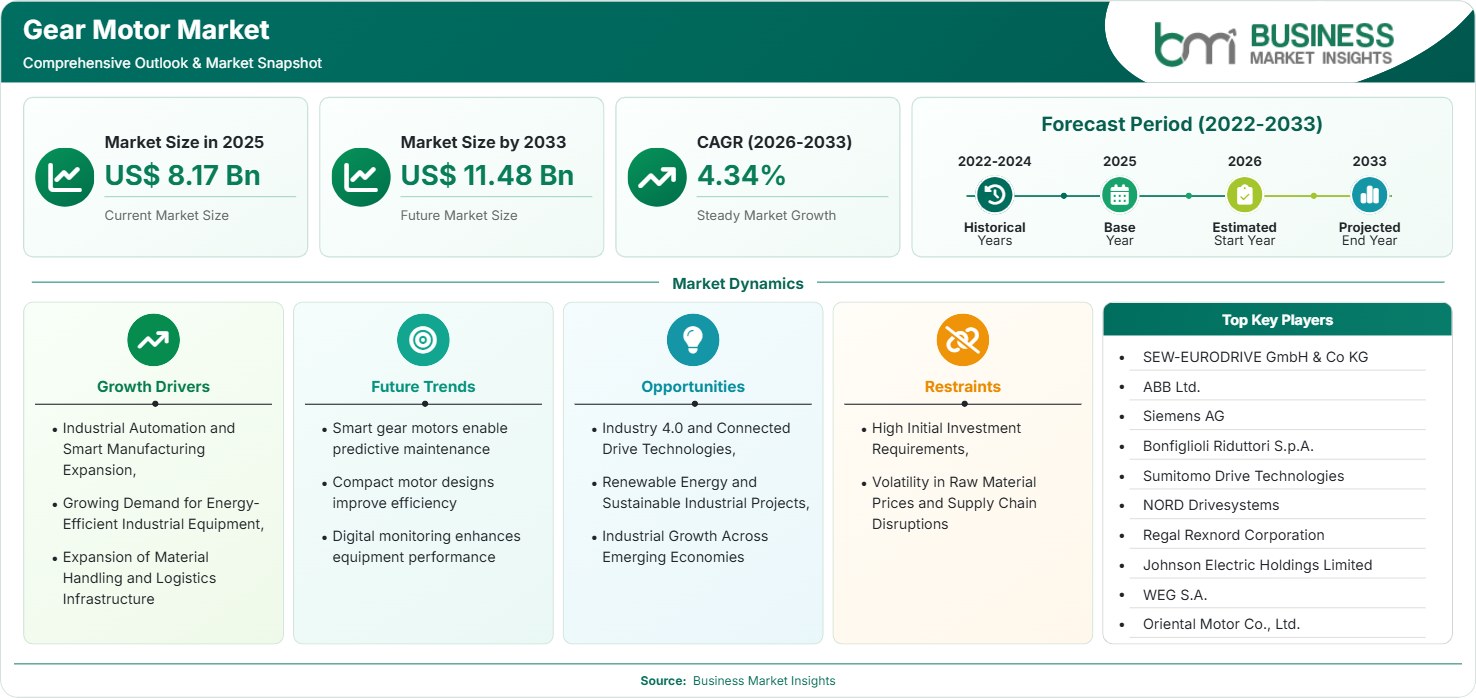
The Gear Motor Market size was valued at USD 8.17 Billion in 2025 and is projected to reach USD 11.48 Billion by 2033, growing at a CAGR of 4.43% during 2026–2033. Growth is supported by increasing industrial automation, smart manufacturing investments, demand for energy-efficient drive systems, and expanding applications across material handling, manufacturing, and renewable energy.

Report Coverage
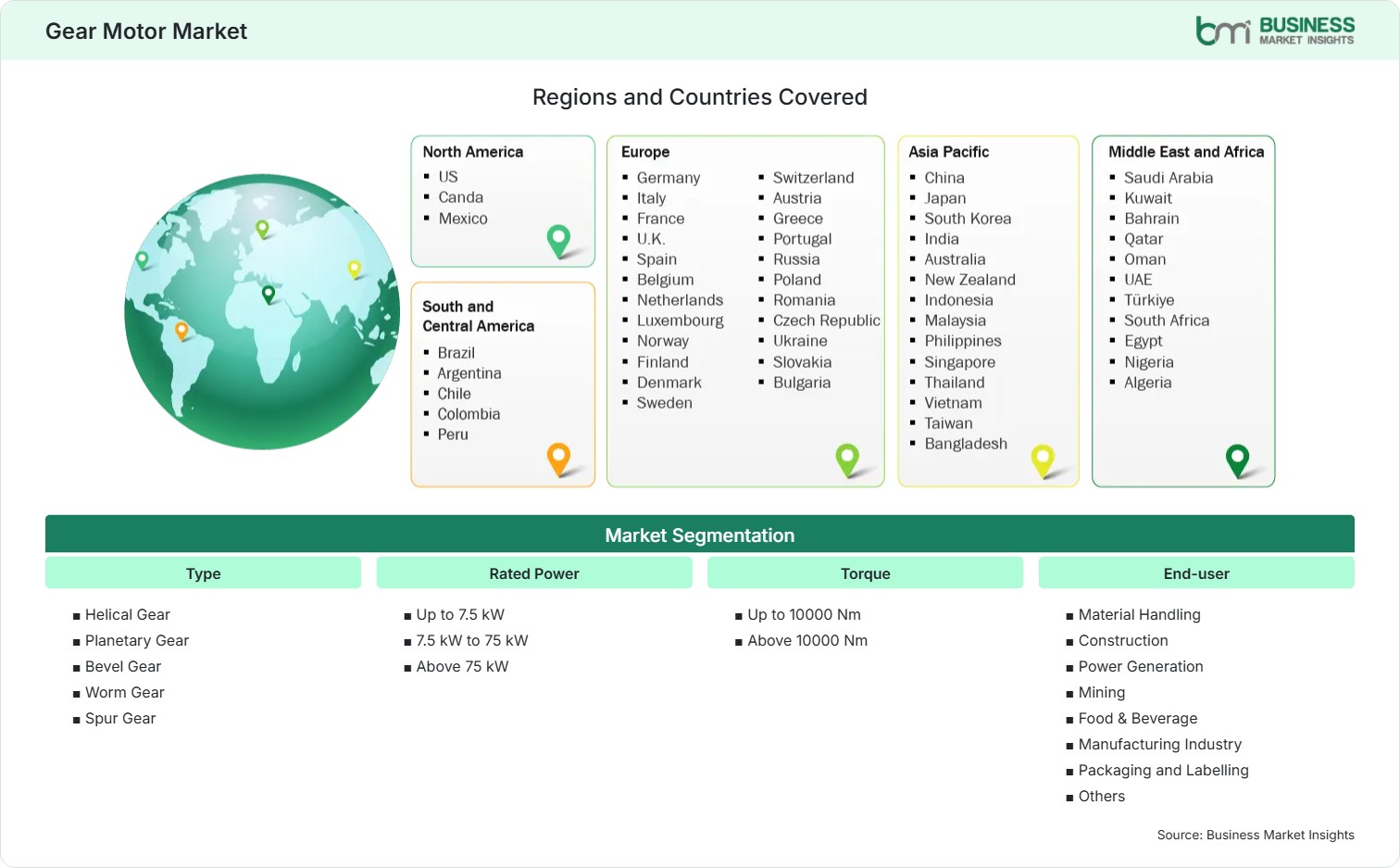
  • Type: Helical Gear, Planetary Gear, Bevel Gear, Worm Gear, Spur Gear
  • Rated Power: Up to 7.5 kW, 7.5 kW to 75 kW, Above 75 kW
  • Torque: Up to 10000 Nm, Above 10000 Nm
  • End-user: Material Handling, Construction, Power Generation, Mining, Food & Beverage, Manufacturing Industry, Packaging and Labelling, Others
US$ 8.17 Bn Market size in 2025
US$ 11.48 Bn Market Size by 2033
4.34% CAGR, 2026 - 2033
2026-2033 Forecast Period

01 AI Overview

Gear Motor Market Summary

  • North America Region: North America holds 30%–33% market share in 2025 and is expected to grow at a CAGR of 3.9%–4.3% during 2026–2033. Factory automation, warehouse modernization, and energy-efficient industrial equipment continue supporting demand. The U.S. leads regional adoption through smart manufacturing and logistics investments, advancing at a CAGR of 4.0%–4.4%.
  • Fastest Growing Region: Asia Pacific accounts for 29%–32% market share in 2025 and is projected to register a CAGR of 5.4%–5.9% during 2026–2033, supported by manufacturing expansion, robotics adoption, and infrastructure development.
  • Leading Segment: Helical Gear represents 34%–37% market share in 2025 and is anticipated to grow at a CAGR of 4.4%–4.8% owing to high efficiency, smooth torque transmission, and low maintenance.
  • High Growth Segment: Material Handling holds 23%–26% market share in 2025 and is forecast to expand at a CAGR of 5.5%–6.0% due to warehouse automation, e-commerce logistics, and conveyor system deployment.
  • Key Market Opportunity: Rising investments in Industry 4.0, predictive maintenance, connected manufacturing, and intelligent motion control systems are creating opportunities for advanced, energy-efficient gear motor solutions.
  • Major Market Players: SEW-EURODRIVE GmbH & Co KG, ABB Ltd., Siemens AG, Bonfiglioli Riduttori S.p.A., Sumitomo Drive Technologies, NORD Drivesystems, Regal Rexnord Corporation, Johnson Electric Holdings Limited, WEG S.A., and Oriental Motor Co., Ltd.
02 Strategic Insights

Gear Motor Market: Strategic Insights

Gear Motor Market Strategic Framework
FREE PDF
Request your free sample
Request free sample
03 Stakeholder View

Key Takeaways

  • Integrated automation ecosystems are increasing collaboration between gear motor manufacturers, robotics suppliers, and system integrators.
  • Material handling, packaging, manufacturing, and food processing applications offer the strongest commercial growth opportunities.
  • Smart gear motors with sensors, predictive maintenance, and digital monitoring are becoming key product development priorities.
  • Asia Pacific remains the most attractive investment destination due to rapid industrialization and automation adoption.
  • Strategic partnerships, acquisitions, and localized manufacturing continue strengthening competitive positioning across the global industry.
04 Geographic Outlook

Gear Motor Market Regional Highlights

North America Gear Motor Market

North America accounted for 30%–33% of the Gear Motor Market share in 2025 and is expected to expand at a CAGR of 3.9%–4.3% through 2033. Industrial automation investments, warehouse modernization, and advanced manufacturing technologies continue supporting demand across the U.S., Canada, and Mexico.

  • Growth in warehouse automation is increasing deployment of conveyor and material handling systems.
  • Automotive and food processing industries continue investing in energy-efficient drive technologies.
  • Smart factory initiatives support replacement demand for high-performance motion systems.
  • Rising robotics integration improves adoption across manufacturing operations.

US Gear Motor Market

The U.S. represented 72%–76% of North American revenue in 2025 and is projected to grow at a CAGR of 4.0%–4.4% through 2033. Investments in industrial automation, logistics infrastructure, and advanced manufacturing remain major demand drivers.

  • E-commerce fulfillment centers continue expanding automated material handling capacity.
  • Manufacturing reshoring initiatives support demand for industrial automation equipment.
  • Food and beverage facilities increasingly adopt efficient motion control systems.
  • Renewable energy projects create additional industrial equipment requirements.

Europe Gear Motor Market

Europe held 25%–28% market share in 2025 and is expected to record a CAGR of 3.8%–4.2% through 2033. Germany remains the leading market, while Poland demonstrates faster growth supported by industrial modernization and manufacturing investments.

  • Germany benefits from strong industrial automation and machinery manufacturing.
  • Energy-efficiency regulations encourage upgrades of industrial drive systems.
  • Packaging and food processing industries support consistent equipment demand.
  • Eastern European manufacturing expansion creates additional growth opportunities.

Asia Pacific Gear Motor Market

Asia Pacific accounted for 29%–32% of market revenue in 2025 and is forecast to expand at a CAGR of 5.4%–5.9% through 2033, making it the fastest-growing region. China leads regional demand, while India records the strongest growth rate.

  • Manufacturing expansion continues increasing industrial equipment installations.
  • Robotics adoption accelerates across automotive and electronics production.
  • Infrastructure development supports construction and material handling applications.
  • Government-backed industrial modernization programs stimulate equipment demand.
  • Renewable energy investments create opportunities for advanced drive technologies.

Rest of World Gear Motor Market

The Rest of World region accounted for 12%–15% market share in 2025 and is projected to grow at a CAGR of 4.4%–4.8% through 2033. Brazil leads demand in South & Central America, while Saudi Arabia demonstrates strong growth within the Middle East and Africa.

  • Mining investments support industrial equipment demand across Latin America.
  • Food processing capacity expansion encourages adoption of automated systems.
  • Infrastructure projects increase requirements for material handling equipment.
  • Industrial diversification programs in the Gulf region support manufacturing investments.
Global Market Geography
FREE PDF
Request your free sample
Request free sample
05 Segment Analysis

Gear Motor Market Segmentation

Type

The Type segment accounted for the largest portion of the market, representing 34%–37% market share in 2025 and expanding at a CAGR of 4.4%–4.8% through 2033. Product selection depends on efficiency, torque requirements, installation flexibility, and operating conditions. The Market scope continues expanding as industries increasingly adopt specialized gear configurations to improve productivity and energy efficiency.

  • Helical Gear: Widely used in manufacturing and material handling applications due to high efficiency, smooth operation, and strong load-carrying capability.
  • Planetary Gear: Preferred where compact dimensions and high torque density are required, particularly in automation and robotics systems.
  • Bevel Gear: Suitable for applications requiring directional power transmission and efficient operation in industrial machinery.
  • Worm Gear: Commonly deployed in lifting, positioning, and conveyor systems requiring high reduction ratios.
  • Spur (in-line) Gear: Utilized in straightforward industrial applications requiring cost-effective and reliable motion transmission.

Rated Power

The Rated Power segment reflects varying industrial operating requirements and represented 31%–34% market share in 2025, growing at a CAGR of 4.2%–4.7% through 2033. Demand is influenced by manufacturing automation, process industries, and infrastructure development projects.

  • Up to 7.5 kW: Extensively used in compact automation systems, packaging machinery, and light-duty industrial applications.
  • 7.5 kW to 75 kW: Supports medium-scale industrial operations requiring balanced performance, efficiency, and operational flexibility.
  • Above 75 kW: Applied in heavy-duty industries such as mining, power generation, and large-scale manufacturing facilities.

By Torque

The torque segment plays a critical role in application-specific equipment selection and accounted for 27%–30% market share in 2025, advancing at a CAGR of 4.5%–5.0% through 2033. Demand is influenced by industrial load requirements and operating conditions.

  • Up to 10,000 Nm: Commonly adopted across packaging, manufacturing, and material handling applications requiring moderate torque output.
  • Above 10,000 Nm: Used in mining, heavy processing, construction equipment, and demanding industrial environments requiring superior performance.

End-user

The End-user segment remains highly diversified, with Material Handling holding 23%–26% market share in 2025 and registering the fastest expansion at a CAGR of 5.5%–6.0%. The Gear Motor Market trends indicate increasing adoption of automated movement systems across logistics and production facilities.

  • Material Handling: Demand is supported by warehouse automation, logistics modernization, and conveyor system deployment.
  • Construction: Equipment manufacturers utilize advanced drive solutions to improve operational efficiency and reliability.
  • Power Generation: Adoption is driven by auxiliary equipment requirements across conventional and renewable energy facilities.
  • Mining: Heavy-duty operations require durable drive systems capable of operating under challenging environmental conditions.
  • Food & Beverage: Hygienic processing requirements support investment in efficient and reliable motion technologies.
  • Manufacturing Industry: Automation and productivity improvement initiatives continue increasing equipment deployment.
  • Packaging and Labelling: Rising production speeds and precision requirements support sustained adoption of advanced drive solutions.
06 Market Forces

Gear Motor Market Dynamics

Key Market Drivers

Industrial Automation and Smart Manufacturing Expansion

The increasing adoption of industrial automation remains one of the strongest growth drivers for the Market. The International Federation of Robotics (IFR) indicates that record-breaking installation rates of industrial robots in the world continue as companies speed up their efforts to automate and digitize factories. Gear motors are key parts of robotic systems, conveyor belts, automated storage and retrieval systems, packaging machinery, and assembly lines, where accurate speed and high torque are necessary. The Gear Motor Market growth is further supported by Industry 4.0 implementation, predictive maintenance platforms, digital twins, and connected manufacturing environments that require intelligent motion control solutions. Modern manufacturers are now using gear motors which are more efficient in terms of size and energy consumption, offering better productivity, reduced maintenance needs, and enhanced reliability. Investments made in automobile manufacturing, electronics production, pharmaceutical industry, food processing, and logistics automation have contributed to increased demand for new technologies used in gear motors around the world.

Growing Demand for Energy-Efficient Industrial Equipment

Industrial facilities worldwide are increasingly prioritizing energy efficiency to reduce electricity consumption, operating costs, and carbon emissions while complying with evolving environmental regulations. According to the International Energy Agency (IEA), one of the biggest industrial consumers of electricity is the electric motor drive system, and this has led industries to opt for highly energy-efficient motion control machinery. The new generation of gear motors is designed to reduce losses in power transmission and increase torque efficiency along with increased durability through advanced gear design and lubrication technology. Premium-efficiency machines using lightweight materials have been introduced by manufacturers. The growing awareness about lifecycle cost savings promotes industries to move from outdated mechanical drives to modern gear motors in order to ensure efficiency and reduce maintenance. The continuous efforts in sustainable manufacturing increase the demand for energy-saving industrial drives even more.

Expansion of Material Handling and Logistics Infrastructure

The growth of e-commerce and logistics is driving the demand for material handling equipment through rapid growth across the globe. Systems like conveyors, automated guided vehicles, palletizers, sorter, and storage systems make use of gear motors that provide precise motion control due to their durability. The gear motor market trends highlight the fact that intelligent logistics centers are being invested in. The increasing automation of warehouses in sectors such as retail, pharmaceuticals, consumer goods, and third-party logistics companies will also ensure that there is a growing demand for machinery. Manufacturers are also coming up with gear motors that are smaller but have high torque and that help increase efficiency and decrease maintenance needs.

Key Market Opportunities

Industry 4.0 and Connected Drive Technologies

The transition toward digitally connected manufacturing environments presents substantial opportunities for manufacturers developing intelligent gear motor solutions. Modern industrial facilities increasingly require motion systems capable of communicating operational data, monitoring equipment condition, and supporting predictive maintenance strategies through Industrial Internet of Things (IIoT) platforms. The Gear Motor Market Forecasts indicate growing adoption of smart gear motors equipped with embedded sensors, cloud connectivity, vibration monitoring, temperature diagnostics, and remote performance analytics. Through these technologies, it will be possible for operators to minimize unplanned downtime, plan maintenance activities effectively, and enhance production efficiency. Organizations that invest in software-driven drives and digital services will be able to generate extra income streams in addition to building a lasting relationship with their customers.

Renewable Energy and Sustainable Industrial Projects

Global investments in renewable energy infrastructure continue creating attractive opportunities for gear motor manufacturers supplying reliable and energy-efficient motion control systems. Wind turbine auxiliary equipment, biomass processing facilities, recycling plants, wastewater treatment systems, and solar manufacturing operations require robust gear motors capable of operating under demanding environmental conditions. Countries around the world have been providing support to industrial companies in terms of carbon-free industries through incentives, clean energy, and sustainable manufacturing programs. Companies that manufacture high-efficiency gear motors with low maintenance costs and higher life spans will be able to capitalize on the rising investments in eco-friendly industrial infrastructures.

Industrial Growth Across Emerging Economies

Expanding industrial production across Asia Pacific, Latin America, the Middle East, and Eastern Europe continues creating significant opportunities for gear motor manufacturers. Governments are encouraging domestic manufacturing through industrial development policies, infrastructure investments, and foreign direct investment initiatives that support production capacity expansion. Automotive manufacturing, food processing, mining, packaging, construction materials, and logistics industries increasingly require advanced motion control equipment capable of supporting higher productivity and operational efficiency. Manufacturers establishing localized production facilities, technical service centers, and regional distribution networks can strengthen competitiveness while reducing delivery times and improving customer support. Continued industrialization across emerging economies is expected to generate sustained long-term demand for advanced gear motor technologies.

Market Restraints and Challenges

High Initial Investment Requirements

Advanced gear motor systems require considerable capital investment, particularly when integrated with intelligent automation platforms, industrial robotics, and digital monitoring technologies. Premium-efficiency products equipped with sensors, communication modules, and predictive maintenance capabilities involve higher acquisition and installation costs than conventional mechanical drive systems.

Factor: High equipment acquisition, installation, and automation integration costs.

Impact: Small and medium-sized manufacturers frequently postpone modernization projects because of budget limitations and longer investment payback periods. Economic uncertainty, fluctuating industrial production, and restricted capital expenditure further influence purchasing decisions across cost-sensitive industries. These factors can extend replacement cycles for existing machinery, limiting short-term adoption of advanced gear motor technologies despite their long-term operational and energy-saving benefits.

Volatility in Raw Material Prices and Supply Chain Disruptions

Gear motor manufacturing depends on critical raw materials including steel, copper, aluminum, specialty alloys, permanent magnets, and electronic components, all of which remain susceptible to global price volatility and supply chain disruptions. Transportation bottlenecks, geopolitical uncertainties, and fluctuating commodity markets continue influencing production planning across industrial equipment manufacturers.

Factor: Unstable raw material costs and global supply chain uncertainties.

Impact: Manufacturers experience increased production expenses, pricing pressure, and longer procurement cycles that may reduce profit margins and delay product deliveries. Companies are responding through supplier diversification, localized sourcing strategies, inventory optimization, and greater investment in supply chain resilience. However, prolonged material shortages and cost fluctuations remain important challenges affecting manufacturing efficiency, pricing competitiveness, and project execution across the global gear motor industry.

07 Company Analysis

Competitive Landscape

The competitive environment remains highly competitive, with global manufacturers emphasizing product innovation, digitalization, energy efficiency, and regional expansion to strengthen their market positions. The Gear Motor Market analysis indicates that companies are increasingly investing in intelligent drive technologies, customized motion solutions, and localized manufacturing capabilities to address growing industrial automation requirements. Strategic collaborations, acquisitions, and research and development initiatives continue supporting portfolio diversification while enabling manufacturers to improve operational efficiency, reduce energy consumption, and enhance lifecycle performance across industrial applications.

Company Name

Overview

Products and Services Relevant to this Market

SEW-EURODRIVE GmbH & Co KG

Global leader specializing in industrial drive technology with extensive manufacturing, engineering, and service capabilities supporting automation projects across numerous industrial sectors worldwide.

Helical, bevel, worm, and planetary gear motors, industrial gear units, variable frequency drives, servo systems, decentralized drive solutions, and digital maintenance services.

ABB Ltd.

International technology company delivering electrification and automation solutions with a strong portfolio of industrial motion products for manufacturing and process industries.

IE-efficient gear motors, electric motors, variable speed drives, motion control systems, industrial automation solutions, and predictive maintenance technologies.

Siemens AG

Leading industrial technology provider delivering integrated automation, digital manufacturing, and intelligent motion solutions for industrial customers across global markets.

Gear motors, industrial motors, SIMOGEAR drive systems, automation software, industrial controllers, digital factory solutions, and motion control technologies.

Bonfiglioli Riduttori S.p.A.

Established manufacturer recognized for innovative power transmission technologies serving industrial automation, construction, renewable energy, and material handling applications.

Planetary gearboxes, helical gear motors, bevel gear units, electric motors, inverters, and customized drive solutions for industrial machinery.

Sumitomo Drive Technologies

Global supplier of power transmission equipment with expertise in precision engineering and high-performance industrial gear systems.

Cyclo drives, planetary gear reducers, gear motors, speed reducers, industrial gearboxes, and customized motion control solutions.

NORD Drivesystems

International drive technology company providing energy-efficient motion solutions supported by strong engineering capabilities and worldwide service networks.

Helical, bevel, worm, and parallel shaft gear motors, frequency inverters, industrial gear units, and intelligent decentralized drive systems.

Regal Rexnord Corporation

Diversified industrial manufacturer delivering motion control and power transmission technologies serving automation, logistics, and manufacturing industries globally.

Gear motors, electric motors, conveyor drive solutions, couplings, bearings, industrial power transmission equipment, and automation technologies.

Johnson Electric Holdings Limited

Global motion technology manufacturer supplying precision drive products for industrial, commercial, and specialized equipment manufacturers worldwide.

Compact gear motors, precision motors, actuators, motion subsystems, integrated drive technologies, and customized engineering solutions.

WEG S.A.

Multinational manufacturer recognized for high-efficiency industrial electrical equipment supporting manufacturing, mining, utilities, and infrastructure projects.

Industrial gear motors, electric motors, variable frequency drives, automation systems, industrial controls, and energy-efficient drive technologies.

Oriental Motor Co., Ltd.

Japanese manufacturer specializing in precision motion control solutions designed for factory automation and advanced industrial equipment applications.

Compact gear motors, stepper motors, servo motors, linear actuators, speed controllers, and precision motion control products.

10 Trust & Transparency

Research Methodology

The market analysis combines proprietary research with secondary data from government agencies, company disclosures, regulatory filings, industry databases and expert interviews. Market estimates are validated through data triangulation, cross-market benchmarking and analyst review.

View Full Research Methodology

11 Questions Answered

Frequently Asked Questions

5. What does the Gear Motor Market Report cover?

The Market Report provides detailed analysis of market size, regional performance, segmentation, competitive landscape, technological developments, key growth drivers, investment opportunities, recent industry developments, and future market outlook through 2033.

4. Which industries generate the highest demand?

Material handling, manufacturing, packaging, food & beverage, construction, mining, and power generation represent the largest end-user industries owing to their continuous requirement for reliable and energy-efficient motion control equipment.

3. Which product type leads the market?

Helical gear motors remain the leading product category due to their high operating efficiency, smooth torque transmission, low maintenance requirements, and suitability for continuous industrial operations across diverse manufacturing environments.

2. Which region is expected to grow the fastest?

Asia Pacific is projected to record the highest growth during the forecast period because of rapid industrialization, manufacturing expansion, increasing robotics adoption, infrastructure development, and supportive government initiatives promoting advanced manufacturing technologies.

1. What is driving demand for the Gear Motor Market?

Demand is primarily driven by industrial automation, smart manufacturing, warehouse automation, robotics adoption, and increasing investments in energy-efficient industrial equipment. Growing applications across logistics, food processing, mining, and manufacturing further support long-term expansion.

Access the Full Gear Motor Market Report

Get segment-level forecasts, regional estimates, competitive benchmarking, company profiles and downloadable Excel datasets.

Access the full Gear Motor Market Report
350 pages PDF & Excel | 2026-08-06