
Heat Pump Water Heater Market Outlook: Size, Share, Trends, Growth Analysis, Competitive Landscape & Forecast, 2026-2033

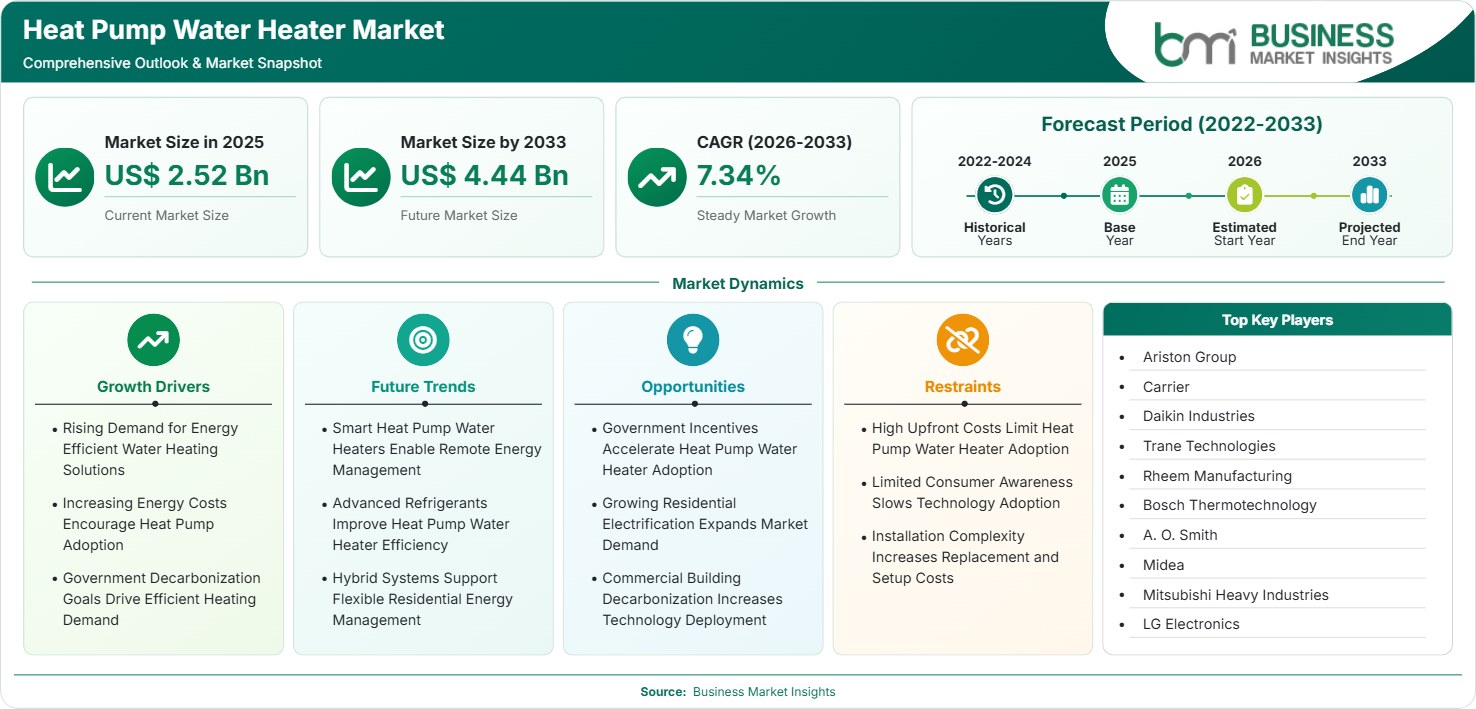
The Heat Pump Water Heater Market size was valued at US$ 2.52 billion in 2025 and is projected to reach US$ 4.44 billion by 2033, growing at a CAGR of 7.34% during 2026–2033. The market is expanding due to increasing demand for energy-efficient water heating technologies, rising energy costs, growing emphasis on carbon reduction, and government initiatives promoting sustainable heating solutions. Heat pump water heaters are gaining adoption across residential, commercial, and industrial applications as consumers and businesses seek alternatives that reduce energy consumption and improve long-term operational efficiency.

Report Coverage
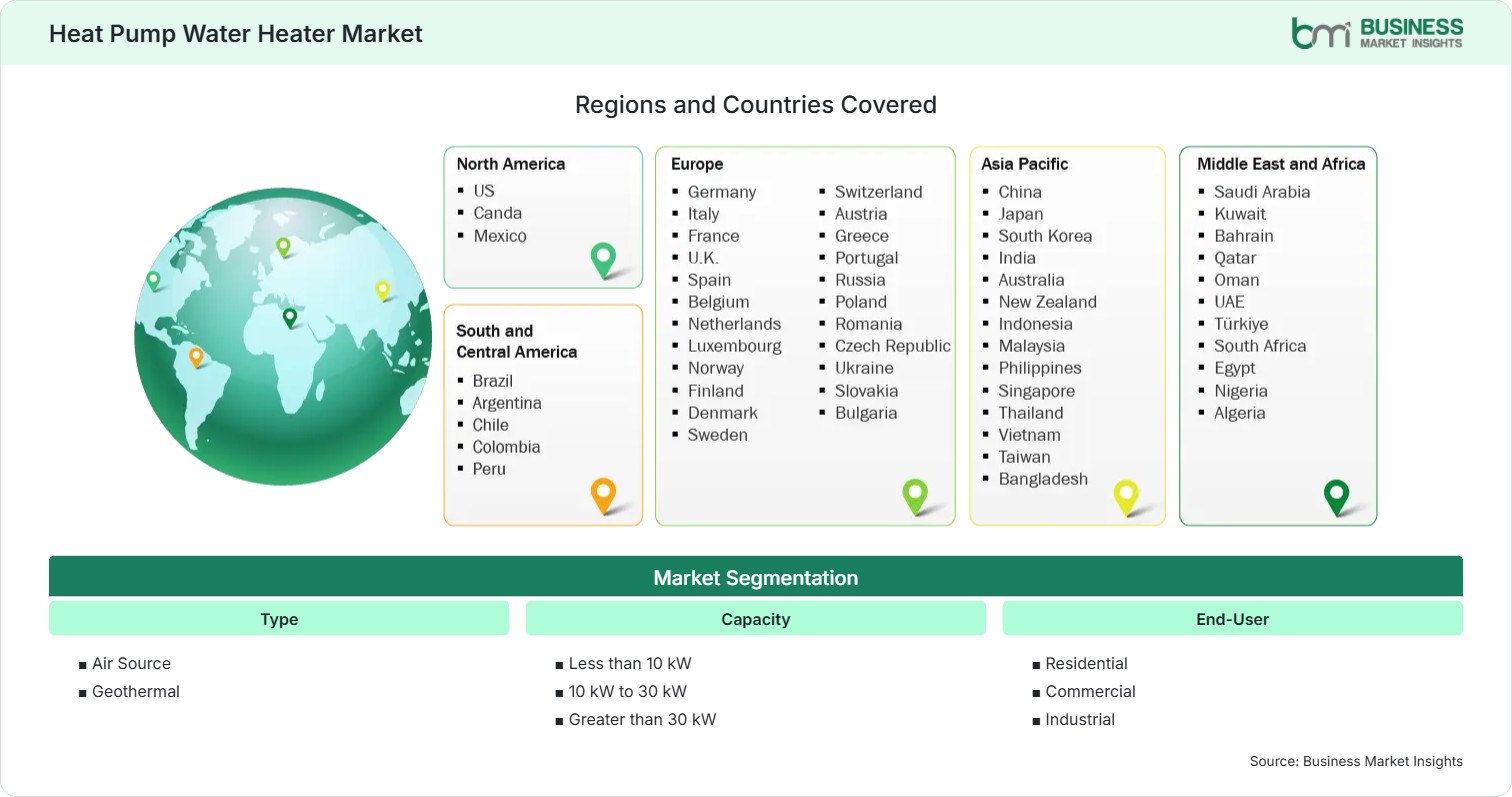
  • Type: Air Source, Geothermal
  • Capacity: Less than 10 kW, 10 kW to 30 kW, Greater than 30 kW
  • End-User: Residential, Commercial, Industrial
US$ 2.52 Bn Market size in 2025
US$ 4.44 Bn Market Size by 2033
7.34% CAGR, 2026 - 2033
2026-2033 Forecast Period

01 AI Overview

Heat Pump Water Heater Market Summary

  • North America Region: North America accounted for 35%–39% share in 2025 and is projected to grow at a CAGR of 7.0%–7.5% during 2026–2033. Growth is supported by increasing adoption of energy-efficient appliances, government incentives, building electrification initiatives, and rising consumer awareness regarding sustainable technologies. The U.S. represents 80%–85% of regional demand, supported by favorable energy efficiency programs, residential electrification trends, and a CAGR of 7.1%–7.6% during 2026–2033.
  • Fastest Growing Region: Asia Pacific represented 28%–32% share in 2025 and is expected to expand at a CAGR of 8.0%–8.5% during 2026–2033. Growth is driven by urbanization, increasing energy demand, rising construction activities, and government initiatives supporting efficient heating technologies.
  • Leading Segment: Air Source heat pump water heaters accounted for 75%–79% share in 2025 and are projected to grow at a CAGR of 7.1%–7.6% during 2026–2033. Lower installation complexity, wider availability, and suitability across residential applications are supporting segment dominance.
  • High Growth Segment: Residential end-users represented 50%–54% share in 2025 and are expected to grow at a CAGR of 7.8%–8.3% during 2026–2033. Increasing household electrification and demand for efficient appliances are driving adoption.
  • Key Market Opportunity: Government incentives, building decarbonization initiatives, and increasing adoption of electric heating solutions are creating opportunities for manufacturers developing advanced and cost-effective heat pump water heating systems.
  • Major Market Players: Ariston Group, Carrier, Daikin Industries, Trane Technologies, Rheem Manufacturing, Bosch Thermotechnology, A. O. Smith, Midea, Mitsubishi Heavy Industries, LG Electronics.
02 Strategic Insights

Heat Pump Water Heater Market: Strategic Insights

Heat Pump Water Heater Market Strategic Framework
FREE PDF
Request your free sample
Request free sample
03 Stakeholder View

Key Takeaways

  • The ecosystem includes heat pump water heater manufacturers, HVAC companies, building developers, energy service providers, installers, utilities, residential consumers, commercial facility operators, and industrial users.
  • Air source systems continue to dominate due to easier installation, broader applicability, and cost advantages, while geothermal systems provide opportunities in specialized applications requiring higher efficiency.
  • The industry is shifting toward smart heating technologies, improved energy management, integrated renewable energy solutions, and advanced systems designed for sustainable buildings.
  • Asia Pacific provides an attractive expansion opportunity due to urban development, increasing energy demand, government efficiency programs, and growing adoption of electrified appliances.
  • Strategic investments are increasingly directed toward efficient heating technologies, product innovation, manufacturing expansion, and partnerships supporting sustainable infrastructure development.
  • Product efficiency, installation capability, regulatory compliance, lifecycle cost advantages, and availability of incentives remain important competitive factors influencing adoption.
04 Geographic Outlook

Heat Pump Water Heater Market Regional Highlights

North America Heat Pump Water Heater Market

North America held 35%–39% share in 2025 and is projected to grow at a CAGR of 7.0%–7.5% during 2026–2033. The region benefits from increasing awareness of energy efficiency, supportive government programs, building electrification initiatives, and growing demand for sustainable HVAC solutions. The Heat Pump Water Heater Market share is supported by increasing replacement of traditional water heating systems with advanced electric alternatives. The United States remains the dominant market due to strong consumer adoption, favorable policy support, and increasing residential and commercial decarbonization efforts.

  • The U.S. market is supported by energy efficiency incentives and growing demand for low-carbon household appliances.
  • Canada is witnessing increased adoption due to sustainability programs and colder climate heating requirements.
  • Manufacturers are expanding product portfolios with improved efficiency and smart energy management features.
  • Commercial facilities are adopting heat pump water heaters to reduce operating costs and emissions.
  • Utility programs are encouraging consumers to transition toward efficient electric heating technologies.

US Heat Pump Water Heater Market

The U.S. accounted for 80%–85% of North America’s share in 2025 and is expected to grow at a CAGR of 7.1%–7.6% during 2026–2033. Growth is supported by federal and state-level energy efficiency initiatives, increasing consumer awareness, and rising demand for electrified home systems. Residential adoption is increasing as homeowners seek solutions that reduce energy expenses and support sustainability objectives.

  • Residential electrification programs are increasing demand for efficient water heating technologies.
  • Commercial buildings are adopting advanced systems to meet sustainability targets.
  • Manufacturers are improving product efficiency and simplifying installation processes.
  • Energy incentive programs are encouraging replacement of conventional water heaters.

Europe Heat Pump Water Heater Market

Europe accounted for 25%–29% share in 2025 and is projected to grow at a CAGR of 6.8%–7.3% during 2026–2033. The region benefits from strong climate policies, energy efficiency regulations, and increasing demand for renewable heating technologies. Germany, France, the United Kingdom, and Italy represent major markets due to established sustainability initiatives and building modernization programs.

  • Germany is witnessing adoption through energy transition programs and efficient building requirements.
  • The United Kingdom is promoting electrification of residential heating systems.
  • France and Italy are supporting sustainable appliance adoption through government initiatives.
  • European manufacturers are investing in efficient and environmentally friendly heating solutions.
  • Commercial buildings are increasingly integrating heat pump systems into renovation projects.

Asia Pacific Heat Pump Water Heater Market

Asia Pacific represented 28%–32% share in 2025 and is expected to register a CAGR of 8.0%–8.5% during 2026–2033. The region is experiencing strong growth due to rapid urbanization, rising construction activity, increasing energy consumption, and improving awareness of efficient technologies. China, Japan, South Korea, and India are key contributors. Growing residential development and government sustainability initiatives are supporting adoption.

  • China is expanding adoption through energy efficiency policies and manufacturing capabilities.
  • Japan is focusing on advanced heating technologies and energy-saving residential solutions.
  • India is witnessing opportunities through urban development and increasing consumer awareness.
  • South Korea is adopting efficient heating systems through smart building initiatives.
  • Emerging economies are creating opportunities through infrastructure expansion.

Rest of World Heat Pump Water Heater Market

Rest of World accounted for 7%–10% share in 2025 and is projected to grow at a CAGR of 7.2%–7.7% during 2026–2033. Latin America, the Middle East, and Africa are gradually adopting heat pump water heating technologies due to rising energy costs, infrastructure development, and sustainability initiatives. Increasing investment in commercial buildings and hospitality infrastructure is creating additional opportunities.

  • Latin America is expanding adoption through energy efficiency programs and commercial applications.
  • Middle Eastern countries are exploring sustainable cooling and heating technologies.
  • African markets are developing opportunities through improving infrastructure and energy access.
  • International manufacturers are strengthening regional distribution partnerships.
Global Market Geography
FREE PDF
Request your free sample
Request free sample
05 Segment Analysis

Heat Pump Water Heater Market Segmentation

Type

The Type segment is led by Air Source heat pump water heaters, which accounted for 75%–79% share in 2025 and are projected to grow at a CAGR of 7.1%–7.6% during 2026–2033. Their dominance is supported by easier installation, lower upfront complexity, and suitability across residential and commercial applications. The Heat Pump Water Heater Market scope is expanding as consumers and businesses increasingly prioritize energy efficiency and reduced operating expenses. Geothermal systems are also gaining attention in applications requiring higher efficiency and long-term performance.

  • Air Source: Air source systems dominate due to cost advantages, flexible installation options, and broad applicability across different building types.
  • Geothermal: Geothermal systems provide higher efficiency and are preferred for applications requiring consistent performance and long-term energy savings.

Capacity

The Capacity segment is influenced by varying requirements across residential, commercial, and industrial applications. Smaller systems are widely adopted in households, while larger capacity systems support commercial and industrial facilities requiring higher hot water demand.

  • Less than 10 kW: These systems are commonly used in residential applications due to lower energy requirements and compact installation needs.
  • 10 kW to 30 kW: Medium-capacity systems support commercial buildings and larger residential properties requiring increased hot water availability.
  • Greater than 30 kW: Large-capacity systems are used in industrial facilities and large commercial applications with significant heating requirements.

End-User

The End-User segment is expanding as residential, commercial, and industrial users increasingly adopt energy-efficient heating technologies. Growing sustainability goals and rising energy costs are encouraging organizations and consumers to replace traditional systems with heat pump alternatives.

  • Residential: Residential users represent the leading application due to increasing household electrification and demand for energy-saving appliances.
  • Commercial: Commercial buildings are adopting heat pump water heaters to reduce operating costs and achieve sustainability objectives.
  • Industrial: Industrial users are adopting larger systems for efficient hot water generation and process-related applications.
06 Market Forces

Heat Pump Water Heater Market Dynamics

Key Market Drivers

Rising Demand for Energy Efficient Water Heating Solutions

Due to the growing emphasis on energy conservation and the reduction of household and commercial energy use, there is a growing need for energy-efficient water-heating solutions. Heat pump water heaters offer higher efficiency because they use ambient heat and do not produce direct heat in the process. This way, people can save on electricity and reduce their costs. The Heat Pump Water Heater Market growth is driven by rising awareness of energy efficiency and the growing requirements for energy-efficient, sustainable construction solutions. Users and manufacturers alike have realized that it is important to ensure low carbon emissions while providing an assured hot water supply.

Increasing Energy Costs Encourage Heat Pump Adoption

Higher electricity and energy costs are prompting people to consider heat pump water heaters as an efficient alternative to other heating devices. With the advantage of greater efficiency and reduced energy use, heat pump water heaters have gained popularity among people looking to save money. Heat Pump Water Heater Market Trends show that rising operating costs are driving companies and individuals to invest in technologies that reduce their electricity bills. The fluctuating energy prices and increased awareness of lifecycle cost savings are additional factors contributing to the trend. With energy efficiency becoming a priority in building renovation and construction, the demand for heat pump water heating systems is likely to grow.

Government Decarbonization Goals Drive Efficient Heating Demand

As governments work to reduce greenhouse gas emissions and meet their decarbonization goals, the installation of efficient heating equipment, including heat pump water heaters, is becoming more common. Policies aimed at regulating energy use and minimizing carbon emissions have promoted the adoption of electric water heaters over older models. The Heat Pump Water Heater Market analysis shows that government support is rapidly becoming a major driver of technology adoption in both developed and developing countries. Government incentives and rebates will help increase consumer awareness and remove barriers to adoption. With more countries adopting clean energy policies, heat pump water heaters will be instrumental in sustainable buildings.

Key Market Opportunities

Government Incentives Accelerate Heat Pump Water Heater Adoption

Incentives, rebates, and financial assistance schemes have opened up huge possibilities for manufacturers of heat pump water heaters by reducing the costs consumers and companies incur at the time of purchase. There have been several cases in which governments have launched energy-efficiency programs to help consumers adopt sustainable heating solutions. According to the Heat Pump Water Heater Market forecast, existing policy support will drive penetration rates across the residential, commercial, and industrial markets. There have been incentive programs that are boosting consumer awareness and making the installation of heat pumps economically viable compared to traditional water heating units.

Growing Residential Electrification Expands Market Demand

Residential electrification is becoming more common, offering many new avenues for the use of heat pump water heaters. People are becoming more interested in reducing their carbon emissions and energy consumption, leading them to turn to other sources of heat. The growth in smart homes and energy management technology is increasingly driving the adoption of heat pumps. Companies are now developing smaller, more efficient, and easier-to-control devices that align with consumers' new demands. With the rising popularity of residential electrification worldwide, heat pump water heaters are predicted to become an integral part of energy systems.

Commercial Building Decarbonization Increases Technology Deployment

With growing focus on the decarbonization of commercial structures, heat pumps are becoming increasingly relevant in many business applications, from office spaces to hotels, hospitals, and schools. The owners of such buildings are employing energy-efficient heating methods to lower costs and meet environmental standards. According to the Heat Pump Water Heater Market Report, the commercial sector is an important growth area owing to the increasing need for efficient hot water systems. With the integration of renewable energy management systems, these systems have become even more attractive. As the commercial sectors move toward greener building methods, the installation of such systems is likely to increase.

Market Restraints and Challenges

High Upfront Costs Limit Heat Pump Water Heater Adoption

Factor: High initial purchase, installation, and infrastructure modification costs make heat pump water heaters less affordable compared with conventional water heating systems. Impact: Higher upfront investment remains a significant barrier for residential consumers, small businesses, and commercial property owners, particularly in price-sensitive markets. Although heat pump water heaters provide long-term energy savings, the initial capital requirement can delay replacement decisions and limit adoption rates. Manufacturers and industry stakeholders need to focus on cost optimization, financing options, and incentive-based programs to improve affordability and support broader market penetration.

Limited Consumer Awareness Slows Technology Adoption

Factor: Limited understanding of heat pump water heater benefits, installation requirements, and long-term energy savings restricts consumer acceptance. Impact: Awareness could act as a barrier to adoption, since many consumers remain attached to traditional water-heating methods, which are less efficient than heat pumps. People’s perceptions of performance, maintenance needs, and applicability across varied climatic conditions may influence their decision-making. There is a need for education campaigns within the industry to convince prospective consumers of the advantages of such systems.

07 Company Analysis

Competitive Landscape

Company Name

Overview

Products and Services Relevant to this Market

Ariston Group

Global heating and water heating solutions provider offering energy-efficient technologies.

Heat pump water heaters, water heating systems, and sustainable heating solutions.

Carrier

HVAC technology company providing heating, cooling, and energy-efficient solutions.

Heat pump systems, water heating technologies, and climate solutions.

Daikin Industries

Global HVAC manufacturer specializing in advanced heating and cooling technologies.

Heat pump water heaters, heat pump systems, and energy-efficient solutions.

Trane Technologies

Climate technology company focused on sustainable heating and cooling solutions.

Energy-efficient HVAC systems and heat pump technologies.

Rheem Manufacturing

Water heating and HVAC manufacturer offering residential and commercial solutions.

Heat pump water heaters, electric water heating systems, and related products.

Bosch Thermotechnology

Provider of heating, cooling, and energy management solutions.

Heat pump water heaters and efficient heating technologies.

A. O. Smith

Water heating equipment manufacturer serving residential and commercial markets.

Heat pump water heaters, water heating solutions, and energy-efficient systems.

Midea

Global appliance and HVAC manufacturer offering heating technologies.

Heat pump water heaters and smart home energy solutions.

Mitsubishi Heavy Industries

Industrial technology company providing advanced energy solutions.

Heat pump technologies and efficient heating systems.

LG Electronics

Technology company offering smart appliances and energy solutions.

Heat pump water heaters, smart heating systems, and connected appliances.

10 Trust & Transparency

Research Methodology

The market analysis combines proprietary research with secondary data from government agencies, company disclosures, regulatory filings, industry databases and expert interviews. Market estimates are validated through data triangulation, cross-market benchmarking and analyst review.

View Full Research Methodology

11 Questions Answered

Frequently Asked Questions

What does the Heat Pump Water Heater Market Report provide?

The market report provides insights into market size, segmentation, regional trends, competitive landscape, growth drivers, opportunities, restraints, and future industry developments. It helps stakeholders understand market dynamics, investment opportunities, and factors influencing industry growth through 2033.

What challenges affect the market?

Major challenges include high upfront costs, limited consumer awareness, installation requirements, and lack of familiarity with heat pump technology. These factors can slow adoption, particularly in markets where incentives, education programs, and installer availability remain limited.

Why are residential applications important for market expansion?

Residential users are increasingly adopting heat pump water heaters due to rising energy costs, electrification trends, and demand for sustainable household appliances. Growing interest in reducing utility expenses and improving home energy efficiency is expected to support residential market growth.

How are government policies influencing market growth?

Government incentives, energy efficiency regulations, and decarbonization programs are encouraging consumers and businesses to adopt heat pump water heating technologies. Financial support initiatives help reduce upfront costs and improve the economic feasibility of switching from traditional water heating systems.

Which type dominates the Heat Pump Water Heater Market?

Air source heat pump water heaters represent the leading type segment due to lower installation complexity, cost advantages, and wider application across residential and commercial environments. Their flexibility and ability to deliver improved efficiency compared with conventional systems continue supporting market dominance.

What factors are driving the market?

The market is driven by rising demand for energy-efficient water heating solutions, increasing energy costs, government decarbonization initiatives, and growing adoption of sustainable technologies. Rising consumer awareness regarding energy savings and environmental benefits is further encouraging adoption across residential, commercial, and industrial sectors.

Access the Full Heat Pump Water Heater Market Report

Get segment-level forecasts, regional estimates, competitive benchmarking, company profiles and downloadable Excel datasets.

Access the full Heat Pump Water Heater Market Report
350 pages PDF & Excel | 2026-08-05