
Water Desalination Equipment Market Outlook: Size, Share, Trends, Growth Analysis, Competitive Landscape & Forecast, 2026-2033

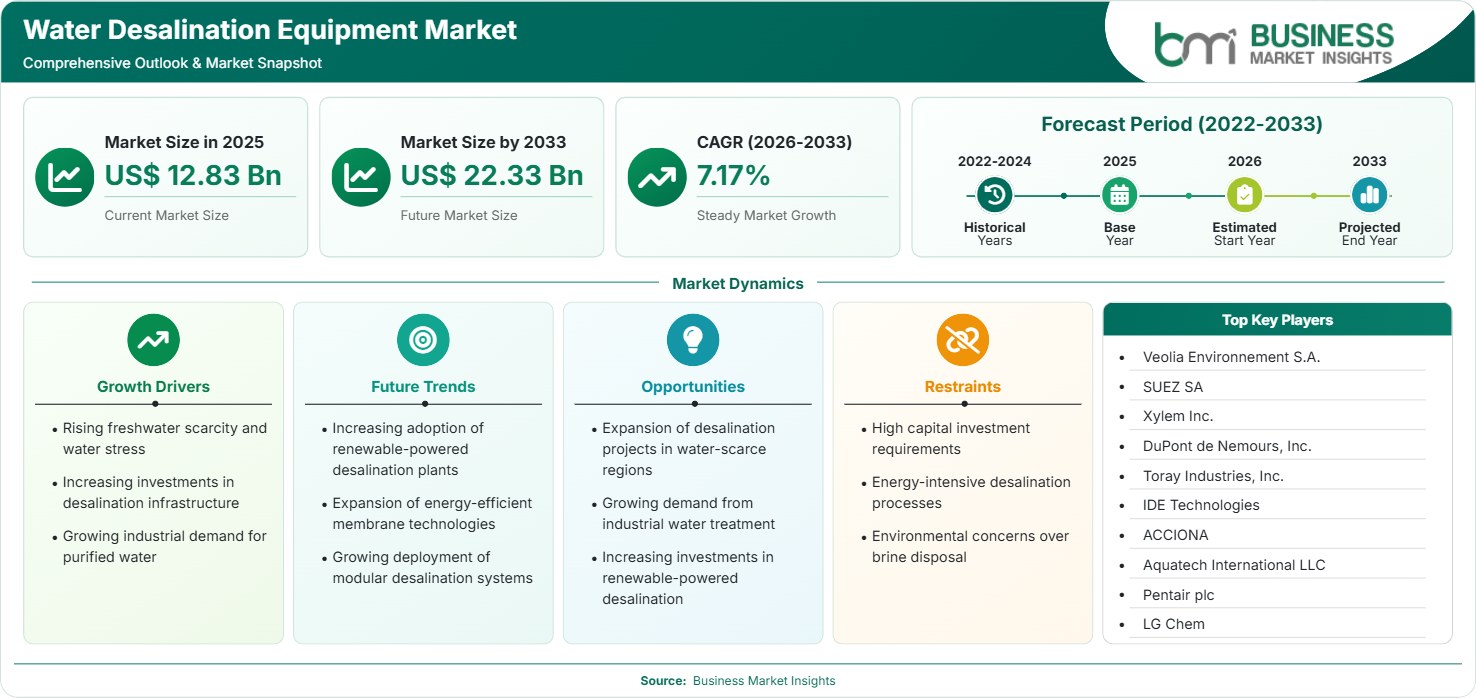
The Water Desalination Equipment Market size was valued at US$ 12.83 Billion in 2025 and is projected to reach US$ 22.33 Billion by 2033, growing at a CAGR of 7.17% from 2026 to 2033. Rising freshwater scarcity, expanding desalination infrastructure, increasing industrial water demand, and renewable-powered desalination investments are creating opportunities for equipment manufacturers and technology providers.

Report Coverage
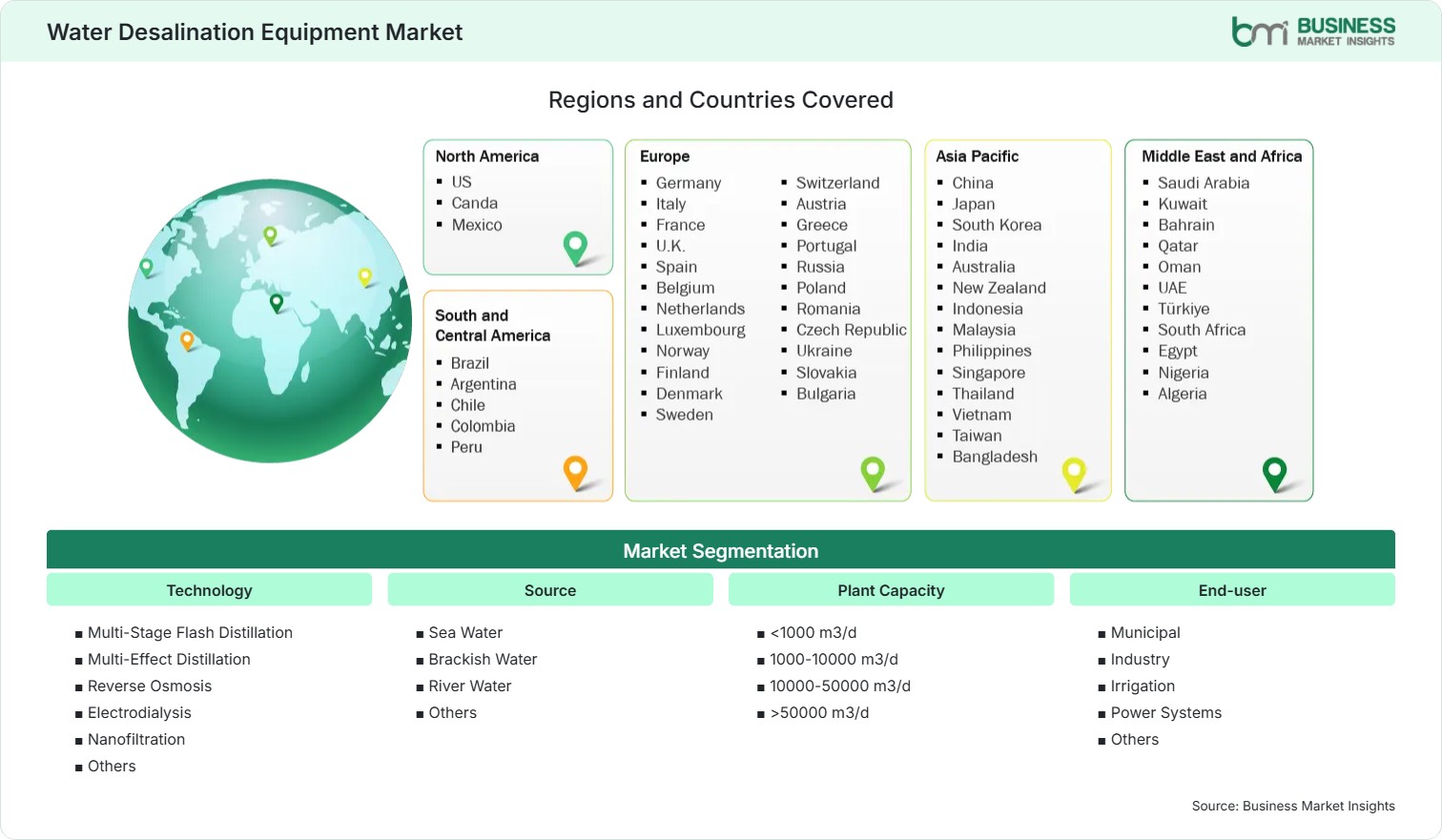
  • Technology: Multi-Stage Flash Distillation, Multi-Effect Distillation, Reverse Osmosis, Electrodialysis, Nanofiltration, Others
  • Source: Sea Water, Brackish Water, River Water, Others
  • Plant Capacity: <1000 m3/d,1000-10000 m3/d,10000-50000 m3/d, >50000 m3/d
  • End-user: Municipal, Industry, Irrigation, Power Systems, Others
US$ 12.83 Bn Market size in 2025
US$ 22.33 Bn Market Size by 2033
7.17% CAGR, 2026 - 2033
2026-2033 Forecast Period

AI Overview

Water Desalination Equipment Market Summary

  • North America Region: North America accounted for approximately 25%–28% market share in 2025 and is projected to grow at a 6.5%–7.0% CAGR during 2026–2033. Regional growth is supported by drought-related water challenges, infrastructure modernization, industrial water treatment requirements, and municipal desalination investments. The U.S. represents the largest regional contributor, supported by coastal desalination projects, industrial applications, and water security initiatives, with an estimated 6.6%–7.1% CAGR during 2026–2033.
  • Fastest Growing Region: Asia Pacific held approximately 34%–37% market share in 2025 and is expected to expand at a 7.8%–8.4% CAGR from 2026 to 2033. Growth is driven by rising water stress, rapid industrialization, urban population expansion, coastal infrastructure development, and increasing government investments in large-scale desalination facilities.
  • Leading Segment: Reverse Osmosis (RO) technology accounted for approximately 60%–64% market share in 2025 and is expected to grow at a 7.3%–7.8% CAGR during 2026–2033. Higher energy efficiency, modular scalability, and suitability for seawater and brackish water treatment support technology leadership.
  • High Growth Segment: Renewable-powered desalination applications represent a rapidly expanding opportunity, supported by a 8.0%–8.6% CAGR during 2026–2033. Growing focus on reducing operational emissions, improving energy efficiency, and integrating solar and wind power systems is encouraging adoption.
  • Key Market Opportunity: Expansion of desalination projects in water-stressed regions, industrial water treatment demand, and renewable energy integration are creating opportunities for advanced equipment suppliers, technology developers, and infrastructure operators.
  • Major Market Players: Veolia Environnement S.A., SUEZ SA, Xylem Inc., DuPont de Nemours, Inc., Toray Industries, Inc., IDE Technologies, ACCIONA, Aquatech International LLC, Pentair plc, and LG Chem.
Strategic Insights

Water Desalination Equipment Market: Strategic Insights

Water Desalination Equipment Market Strategic Framework
FREE PDF
Request your free sample
Request free sample
Stakeholder View

Key Takeaways

  • The desalination equipment market will evolve into an ecosystem involving integration of membranes, automation systems, energy recovery systems, and digital monitoring systems for increased efficiency.
  • Reverse osmosis will be the main area of investment owing to the factors of scalability, reduction in equipment cost, and applicability in various municipal, industrial, and commercial water treatment applications.
  • Innovations will involve energy-efficient membranes, artificial intelligence monitoring, renewable energy utilization, and hybrid desalination solutions intended for reducing operational costs.
  • Asia Pacific and the Middle East are ideal areas of investment due to water scarcity, growing urban population, and desalination projects backed by governments.
  • Strategic alliances and partnership deals will grow since there will be competition among firms for lucrative desalination projects and operational contracts.
  • Industries will be a growth factor owing to the need for reliable water sources in power plants, chemicals, mining, and manufacturing industries.
Geographic Outlook

Water Desalination Equipment Market Regional Highlights

North America Water Desalination Equipment Market

North America accounted for approximately 25%–28% of the Water Desalination Equipment Market share in 2025 and is expected to grow at a 6.5%–7.0% CAGR during 2026–2033. Growth is supported by increasing water stress, coastal population growth, industrial demand, and infrastructure modernization. The U.S. remains the largest contributor, driven by municipal desalination projects in drought-prone regions and rising industrial adoption of reliable water sources.

  • The U.S. market is supported by coastal desalination projects, drought management programs, and rising investment in advanced water treatment technologies for municipal applications.
  • Canada is gradually adopting desalination solutions for remote communities and industrial operations requiring dependable water supply alternatives in water-constrained regions.
  • Industrial sectors including energy, manufacturing, and chemicals are increasing investments in desalination systems to improve water security and reduce dependency on freshwater resources.
  • Digital monitoring, automation, and energy-efficient equipment adoption are improving operational performance and reducing maintenance requirements across desalination facilities.

US Water Desalination Equipment Market

The United States accounted for approximately 78%–82% of North America's Water Desalination Equipment Market in 2025 and is projected to grow at a 6.6%–7.1% CAGR during 2026–2033. Growth is driven by water shortages, municipal security initiatives, industrial demand, and coastal desalination investments. California, Texas, and Florida remain key markets due to population growth, climate challenges, and rising demand for alternative water sources.

  • Municipal desalination projects are expanding as regional authorities seek reliable water supplies to address drought conditions and long-term water availability concerns.
  • Industrial users are adopting desalination equipment to support manufacturing, power generation, and processing operations requiring consistent water quality standards.
  • Federal and state-level water infrastructure investments are encouraging modernization of treatment facilities and adoption of advanced desalination technologies.
  • Technology providers are focusing on energy-efficient systems, improved membranes, and automation solutions to reduce operating costs for large-scale facilities.

Europe Water Desalination Equipment Market

Europe accounted for approximately 22%–25% market share in 2025 and is projected to grow at a 6.3%–6.8% CAGR during 2026–2033. Growth is supported by rising water scarcity concerns, sustainability goals, and demand for efficient water management solutions. Spain leads due to established desalination infrastructure, while Italy and Greece are seeing increased adoption. Regional investments focus on energy-efficient and renewable-powered desalination technologies.

  • Spain leads regional adoption due to established seawater desalination facilities supporting municipal water supply and agricultural requirements in dry regions.
  • Italy and Greece are expanding desalination capacity as tourism growth and seasonal water shortages increase pressure on freshwater resources.
  • European Union sustainability initiatives are encouraging adoption of low-energy desalination technologies and improved resource management practices.
  • Industrial manufacturers are investing in advanced water treatment systems to meet environmental regulations and improve operational resilience.
  • Renewable energy integration is gaining importance as companies seek to reduce carbon emissions associated with desalination operations.

Asia Pacific Water Desalination Equipment Market

Asia Pacific accounted for approximately 34%–37% of the Water Desalination Equipment Market in 2025 and is expected to achieve the fastest growth at a 7.8%–8.4% CAGR during 2026–2033. Growth is driven by rapid urbanization, industrial expansion, freshwater shortages, and government investment in water infrastructure. China, India, Japan, and Australia are key markets, focusing on large-scale desalination projects and advanced treatment technologies.

  • China is investing in large-scale desalination facilities to support industrial development, coastal cities, and growing municipal water requirements.
  • India is expanding desalination projects in coastal states to address freshwater challenges and support industrial corridors requiring reliable water resources.
  • Japan continues adopting advanced desalination systems with emphasis on energy efficiency, technological innovation, and resilient water infrastructure.
  • Australia is increasing desalination investments due to prolonged drought conditions and the need for climate-resilient water supply solutions.
  • Southeast Asian countries are developing desalination infrastructure to support urban growth, tourism activities, and industrial development.

Rest of World Water Desalination Equipment Market

The Rest of World region accounted for approximately 14%–17% of global revenue in 2025 and is projected to grow at a 7.4%–8.0% CAGR during 2026–2033. The Middle East leads regional demand due to severe water scarcity and high reliance on seawater desalination. South America and Africa are expanding adoption through infrastructure development, industrial demand, and water security initiatives in Water Desalination Equipment Market. Saudi Arabia, the UAE, and Chile remain key markets driving regional growth.

  • Saudi Arabia continues expanding desalination capacity through government-backed projects aimed at securing sustainable freshwater supplies.
  • The UAE is investing in advanced desalination technologies, including renewable-powered solutions, to improve water security and operational efficiency.
  • Chile is adopting desalination systems to support mining operations and reduce pressure on traditional freshwater sources.
  • African countries are exploring desalination projects to address urban water shortages and improve access to reliable water resources.
  • Public-private partnerships are supporting infrastructure development by combining government initiatives with private technology expertise and investment capabilities.
Global Market Geography
FREE PDF
Request your free sample
Request free sample
Segment Analysis

Water Desalination Equipment Market Segmentation

Technology

Technology segmentation influences desalination efficiency, energy use, and project economics. Reverse Osmosis (RO) held approximately 60%–64% market share in 2025 and is expected to grow at a 7.3%–7.8% CAGR during 2026–2033, driven by lower energy consumption, modular deployment, improved membranes, and broad municipal and industrial adoption in Water Desalination Equipment Market.

  • Multi-Stage Flash (MSF) Distillation: MSF technology remains relevant in large-scale desalination projects, particularly in regions with access to affordable energy resources and established thermal desalination infrastructure.
  • Multi-Effect Distillation (MED): MED adoption is increasing due to improved thermal efficiency, lower energy consumption compared with traditional thermal methods, and suitability for integrated power and water production facilities.
  • Reverse Osmosis (RO): RO remains the preferred technology due to high efficiency, scalability, reduced operating costs, and extensive application across seawater and brackish water desalination projects.
  • Electrodialysis (ED): ED technology is gaining attention for specialized applications involving brackish water treatment and selective ion removal with lower chemical requirements.
  • Nanofiltration (NF): NF systems are expanding in applications requiring partial desalination, water softening, and removal of specific contaminants from industrial and municipal water sources.

Source

Source segmentation reflects the availability and treatment needs of different water resources. Sea Water accounted for approximately 65%–69% market share in 2025 and is projected to grow at a 7.4%–7.9% CAGR during 2026–2033, driven by coastal desalination projects and freshwater shortages. Rising demand for alternative water sources, industrial needs, and urban growth is accelerating investment in advanced desalination systems across water-stressed regions in Water Desalination Equipment Market.

  • Sea Water: Seawater desalination remains the largest application due to extensive availability, increasing coastal infrastructure development, and rising municipal demand for alternative freshwater sources.
  • Brackish Water: Brackish water treatment is expanding due to lower energy requirements compared with seawater desalination and growing adoption in agricultural and industrial applications.
  • River Water: River water treatment solutions are being integrated with desalination-related technologies to improve purification efficiency and address contamination challenges in freshwater systems.

Plant Capacity

Plant capacity segmentation is influenced by project scale, end-user requirements, and regional water demand. Large-scale facilities above 50,000 m3/d accounted for approximately 42%–46% market share in 2025 and are expected to grow at a 7.1%–7.6% CAGR during 2026–2033. Increasing government investments, urban water requirements, and industrial projects are supporting deployment of high-capacity desalination plants.

  • >50,000 m3/d: Large-scale plants are preferred for municipal water supply and major industrial projects requiring continuous high-volume freshwater production.
  • 10,000-50,000 m3/d: Medium-scale desalination facilities are gaining adoption among municipalities and industries seeking flexible capacity expansion and efficient infrastructure investments.
  • 1,000-10,000 m3/d: Smaller industrial and commercial facilities utilize these systems for localized water treatment requirements and operational water security.
  • <1000 m3/d: Compact desalination systems are increasingly used in remote areas, small communities, and specialized industrial applications requiring decentralized water solutions.

End-user

End-user segmentation is expanding as municipal authorities, industries, and infrastructure operators seek reliable water supply solutions. Municipal applications accounted for approximately 45%–49% market share in 2025 and are projected to grow at a 7.0%–7.5% CAGR during 2026–2033. Increasing urban populations, water scarcity concerns, and government-led infrastructure programs are driving municipal desalination adoption globally in Water Desalination Equipment Market.

  • Municipal: Municipal users represent the largest application segment due to rising urban water demand, freshwater shortages, and government investments in public water infrastructure.
  • Industry: Industrial adoption is increasing across sectors such as chemicals, manufacturing, mining, and power generation requiring high-quality process water.
  • Irrigation: Desalination systems are being explored for agricultural applications in water-scarce regions seeking alternative sources for crop production.
  • Power Systems: Power plants utilize desalination equipment for cooling, boiler feed water, and operational processes requiring consistent water quality.
Market Forces

Water Desalination Equipment Market Dynamics

Key Market Drivers

Rising freshwater scarcity and water stress

Increasing freshwater shortages caused by population growth, climate variability, and uneven water distribution are accelerating investments in desalination infrastructure. According to global water resource assessments, billions of people experience water stress during parts of the year, increasing demand for alternative water supply solutions. The market growth is supported by rising adoption of seawater and brackish water treatment systems across municipalities and industrial facilities. Governments in water-scarce regions are prioritizing desalination projects to strengthen long-term water security. These developments are also influencing Water Desalination Equipment Market trends, with manufacturers focusing on energy-efficient membranes, automation systems, and advanced treatment technologies to improve operational performance and reduce lifecycle costs.

Increasing investments in desalination infrastructure

Increasing investment by both the government and private sectors in desalination infrastructure is facilitating the growth of large water treatment plants on a global scale. Countries that experience shortages of fresh water are investing in desalination plants through public-private partnerships, infrastructure projects, and utility improvement programs. Investments are being made in modern reverse osmosis, thermal desalination, and water management systems. Infrastructural growth in the Middle East, Asia Pacific, and coastal areas is opening up markets for equipment suppliers, engineers, and technology providers. Strategies for water security are pushing governments to improve their treatment capacities and deploy effective desalination systems.

Growing industrial demand for purified water

The growing need for high-quality process water in various industries like manufacturing, power plants, chemicals, pharmaceuticals, and mining has led to increased use of desalination equipment by industrial sectors. The industrial processes need an assured water supply to sustain their efficiency and meet environmental regulations. Desalination equipment comes in handy where the traditional supply of fresh water is scarce or uncertain. Various industrial firms have been investing in customized solutions in the form of membrane desalination equipment and filtration systems. The industrialization process in developing countries and the growth of industries that consume more water are driving up the demand for efficient desalination equipment.

Key Market Opportunities

Expansion of desalination projects in water-scarce regions

Water-scarce regions are creating significant opportunities for desalination equipment suppliers as governments seek sustainable solutions to address freshwater shortages. Countries across the Middle East, North Africa, and parts of Asia Pacific are increasing investments in seawater desalination facilities to support urban development and economic growth. Large-scale infrastructure projects are creating demand for advanced membranes, pumps, energy recovery systems, and monitoring technologies. The Water Desalination Equipment Market Forecasts indicate increasing opportunities for companies capable of delivering efficient, reliable, and cost-effective solutions. Expansion of coastal desalination capacity, combined with modernization of existing plants, is expected to strengthen demand for innovative equipment and integrated water treatment systems.

Growing demand from industrial water treatment

The increasing water demand from industry is creating opportunities for desalination equipment suppliers as firms strive to secure reliable sources of clean water. Sectors such as semiconductor fabrication, pharmaceuticals, the chemical industry, and power generation have high standards for water quality in their production activities. Desalination solutions are increasingly being combined with filtration and purification technologies to meet these needs. Industrialists are investing more in decentralizing their treatment plants to reduce their reliance on municipal water systems.

Increasing investments in renewable-powered desalination

The integration of renewable energy into desalination plant operations has offered opportunities to reduce operating costs and improve environmental performance. Desalination plants that run on solar or wind energy have become more popular in places where there is an abundance of renewable energy but scarcity of fresh water. Renewable energy-powered systems assist in addressing the challenges posed by energy-consuming desalination operations. Governments and private entities have been looking at systems that integrate renewable energy, advanced membranes, and energy recovery systems. Equipment manufacturers have been coming up with systems that would work well with renewable energy sources.

Market Restraints and Challenges

High capital investment requirements

Factor: Desalination projects require substantial upfront investment for plant construction, specialized equipment installation, engineering services, and supporting infrastructure development. Impact: High capital costs can delay project implementation, limit adoption among smaller municipalities, and create financing challenges in developing economies. Large-scale projects are very expensive to construct and take a long time to receive approvals. While desalination offers long-term advantages in terms of securing water resources, the expense is a big obstacle to areas that lack sufficient funds for their infrastructure needs. Companies are addresing this problem using modular plants, public-private partnership, and efficient technology.

Energy-intensive desalination processes

Factor: Desalination operations, particularly thermal technologies and large-scale reverse osmosis systems, require significant energy consumption for water separation and purification processes. Impact: High energy requirements increase operational expenses, influence water production costs, and create environmental concerns where electricity generation depends on fossil fuels. Energy utilization is an important factor in the planning of projects, particularly in areas where electricity costs are high. Membrane technologies and other methods of energy recovery as well as renewable energy desalination techniques are being developed by manufacturers to lower energy needs. Continuous development in terms of energy efficiency is important for increasing sustainability.

Company Analysis

Competitive Landscape

The competitive landscape includes global water technology companies, desalination specialists, membrane manufacturers, and infrastructure providers competing through technology innovation, project execution capabilities, and energy-efficient solutions. The Water Desalination Equipment Market analysis highlights increasing focus on reverse osmosis systems, advanced membranes, digital monitoring, and sustainable desalination technologies.

Company Name

Overview

Products and Services Relevant to this Market

Veolia Environnement S.A.

Global water management company offering integrated water treatment and desalination solutions.

Desalination plants, RO systems, water treatment solutions, and operational services.

SUEZ SA

Water technology provider specializing in resource management and advanced treatment systems.

Seawater desalination, membrane technologies, and water infrastructure solutions.

Xylem Inc.

Water technology company providing equipment and digital water solutions.

Pumps, monitoring systems, treatment equipment, and desalination support solutions.

DuPont de Nemours, Inc.

Specialty materials company developing advanced filtration technologies.

Reverse osmosis membranes and water purification solutions.

Toray Industries, Inc.

Manufacturer of high-performance membrane technologies for water treatment applications.

RO membranes, filtration materials, and desalination components.

IDE Technologies

Desalination specialist delivering large-scale water infrastructure projects.

Seawater desalination plants, RO systems, engineering, and project management.

ACCIONA

Infrastructure company focused on sustainable water and desalination projects.

Desalination facilities, renewable-powered solutions, and water infrastructure services.

Aquatech International LLC

Water treatment company providing customized industrial and municipal solutions.

Desalination systems, membrane treatment, and water reuse technologies.

Pentair plc

Water solutions provider offering filtration and treatment technologies.

Filtration systems, water treatment equipment, and industrial solutions.

LG Chem

Advanced materials company producing membrane solutions for water purification.

RO membranes, filtration technologies, and desalination materials.

Trust & Transparency

Research Methodology

The market analysis combines proprietary research with secondary data from government agencies, company disclosures, regulatory filings, industry databases and expert interviews. Market estimates are validated through data triangulation, cross-market benchmarking and analyst review.

View Full Research Methodology

Questions Answered

Frequently Asked Questions

How does the Water Desalination Equipment Market Report help stakeholders?

The report provides insights into technology trends, regional developments, competitive strategies, market opportunities, and industry challenges, helping manufacturers, investors, and service providers evaluate growth prospects and strategic priorities.

Which industries are creating demand for desalination equipment?

Industries including power generation, chemicals, pharmaceuticals, manufacturing, and mining are increasing demand for desalination equipment due to requirements for high-quality process water.

How are renewable energy sources influencing desalination development?

Renewable energy integration is reducing the environmental impact and operating costs of desalination processes. Solar and wind-powered desalination projects are gaining traction in regions seeking sustainable water solutions and lower reliance on conventional energy sources.

Why is reverse osmosis widely used in desalination projects?

Reverse osmosis is preferred because of lower energy consumption compared with thermal desalination methods, modular scalability, and suitability for seawater and brackish water treatment.

What is driving the adoption of water desalination equipment market forecasts worldwide?

Increasing freshwater scarcity, climate-related water challenges, industrial water requirements, and government investments in water infrastructure are accelerating adoption of desalination equipment

Access the Full Water Desalination Equipment Market Report

Get segment-level forecasts, regional estimates, competitive benchmarking, company profiles and downloadable Excel datasets.

Access the full Water Desalination Equipment Market Report
350 pages PDF & Excel | 2026-08-07