
Point of Entry Water Treatment Systems Market Outlook: Size, Share, Trends, Growth Analysis, Competitive Landscape & Forecast, 2026-2033

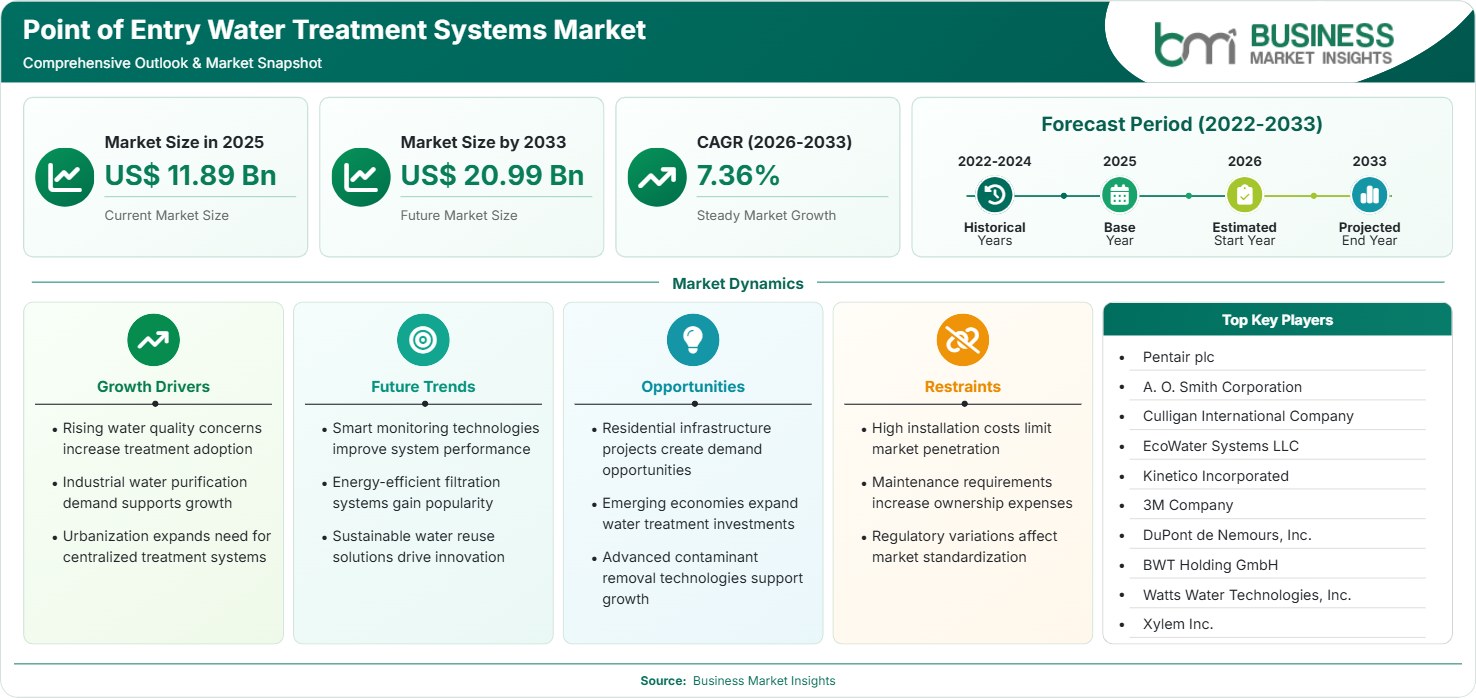
The Point of Entry Water Treatment Systems Market size was valued at US$ 11.89 Billion in 2025 and is projected to reach US$ 20.99 Billion by 2033, growing at a CAGR of 7.36% during 2026–2033, driven by rising water quality concerns, aging distribution infrastructure, stricter drinking water regulations, smart treatment adoption, residential upgrades, and opportunities across emerging economies and decentralized treatment applications.

Report Coverage
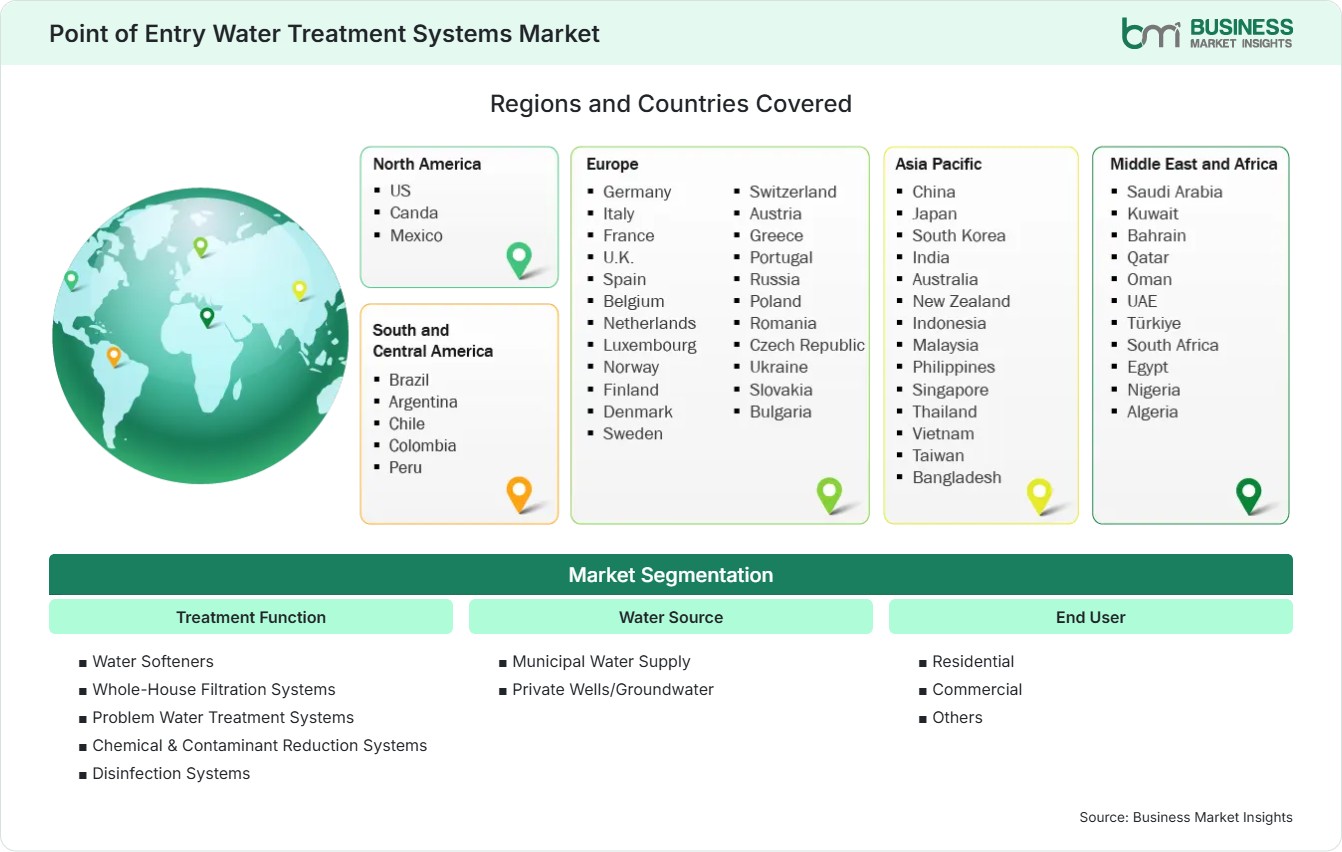
  • Treatment Function: Water Softeners, Whole-House Filtration Systems, Problem Water Treatment Systems, Chemical & Contaminant Reduction Systems, Disinfection Systems
  • Water Source: Municipal Water Supply, Private Wells/Groundwater
  • End User: Residential, Commercial, Others
US$ 11.89 Bn Market size in 2025
US$ 20.99 Bn Market Size by 2033
7.36% CAGR, 2026 - 2033
2026-2033 Forecast Period

AI Overview

Point of Entry Water Treatment Systems Market Summary

  • North America Region: North America holds a market share of 33%–36% in 2025 and is projected to grow at a CAGR of 6.5%–7.1% during 2026–2033. Growth is supported by aging pipelines, hard-water prevalence, residential replacement demand, regulatory compliance requirements, smart monitoring adoption, and increasing investments in whole-home water protection solutions. US market remains the regional anchor, supported by residential retrofits and water-quality compliance initiatives, expanding at approximately 6.7%–7.2% CAGR.
  • Fastest Growing Region: Asia Pacific accounts for 25%–28% of the Entry Water Treatment Systems Market share in 2025 and is anticipated to expand at 8.6%–9.4% CAGR. Urbanization, groundwater contamination concerns, expanding middle-income households, infrastructure projects, and government water safety programs continue creating substantial installation opportunities across residential and commercial facilities.
  • Leading Segment: Water Softeners represent a 30%–33% share in 2025 and are expected to grow at 6.8%–7.4% CAGR. High hard-water incidence, appliance protection requirements, plumbing maintenance savings, increasing household awareness, and replacement demand continue supporting strong adoption across developed and developing regions.
  • High Growth Segment: Chemical & Contaminant Reduction Systems account for 18%–21% share in 2025 and are projected to grow at 8.5%–9.2% CAGR. PFAS concerns, heavy metal contamination risks, stricter standards, advanced media development, and consumer demand for safer water are accelerating deployment.
  • Key Market Opportunity: Expansion of intelligent connected treatment platforms enables predictive maintenance, performance monitoring, contaminant tracking, subscription service models, and recurring revenue generation while improving customer retention and operational efficiency globally.
  • Major Market Players: Pentair plc, A. O. Smith Corporation, Culligan International Company, EcoWater Systems LLC, Kinetico Incorporated, 3M Company, DuPont de Nemours, Inc., BWT Holding GmbH, Watts Water Technologies, Inc., and Xylem Inc.
Strategic Insights

Point of Entry Water Treatment Systems Market: Strategic Insights

Point of Entry Water Treatment Systems Market Strategic Framework
FREE PDF
Request your free sample
Request free sample
Stakeholder View

Key Takeaways

  • The industry value chain increasingly integrates media suppliers, system manufacturers, digital monitoring providers, distributors, installers, and recurring service networks, creating opportunities for margin expansion through lifecycle services.
  • Residential applications remain the largest demand generator, while contaminant reduction technologies linked to PFAS, nitrates, and heavy metals present the highest long-term upside.
  • Product innovation is shifting from standalone filtration equipment toward intelligent connected systems with remote diagnostics, predictive maintenance capabilities, and data-driven service models.
  • Asia Pacific offers one of the strongest investment cases due to urbanization, groundwater quality challenges, and increasing consumer spending on water safety technologies.
  • Strategic acquisitions continue strengthening regional distribution capabilities, aftermarket services, and proprietary filtration technology portfolios among leading suppliers.
  • Sustainability considerations are encouraging development of lower-maintenance systems, reduced backwash consumption, recyclable materials, and energy-efficient disinfection platforms.
Geographic Outlook

Point of Entry Water Treatment Systems Market Regional Highlights

North America Point of Entry Water Treatment Systems Market

North America represented 33%–36% of global revenue in 2025 and is projected to record a CAGR of 6.5%–7.1% during 2026–2033. The region benefits from extensive awareness regarding drinking water quality, hard-water treatment demand, and replacement sales. Strong installer networks, regulatory compliance requirements, and premium product adoption continue supporting market expansion. The Point of Entry Water Treatment Systems Market share remains highest in North America due to widespread residential ownership and advanced treatment infrastructure.

  • PFAS remediation programs are increasing demand for advanced contaminant reduction systems.
  • Residential renovation spending supports replacement and upgrade activities.
  • Smart monitoring adoption improves service efficiency and customer retention.
  • Commercial facilities increasingly deploy centralized filtration for compliance and operational protection.

US Point of Entry Water Treatment Systems Market

The United States accounts for 76%–80% of North American demand and is expected to expand at 6.7%–7.2% CAGR through 2033. Demand is driven by hard-water concerns, aging infrastructure, PFAS awareness, and strong residential spending. Growth is additionally supported by installer expansion, premium filtration adoption, and increasing preference for comprehensive whole-home treatment systems.

  • PFAS regulations create opportunities for advanced filtration media providers.
  • Suburban housing upgrades sustain residential replacement demand.
  • Smart-home integration enhances market differentiation.
  • Water quality concerns support adoption across commercial establishments.

Europe Point of Entry Water Treatment Systems Market

Europe contributes a 26%–29% share in 2025 and is projected to grow at 6.4%–7.0% CAGR. Demand stems from regulatory emphasis on water quality, energy-efficient building systems, and appliance protection from scale formation. Germany remains the leading country, while Eastern European markets demonstrate stronger expansion rates as household modernization accelerates.

  • Germany leads regional installations through established treatment infrastructure.
  • France and the UK maintain strong residential replacement activity.
  • Eastern Europe records faster adoption due to modernization investments.
  • Sustainability goals encourage efficient filtration and disinfection technologies.

Asia Pacific Point of Entry Water Treatment Systems Market

Asia Pacific accounts for 25% to 28% of global demand and will post a CAGR of 8.6% to 9.4%, the highest region-wise growth rate. Urbanization, pollution-related issues, and increasing disposable income spur installations. The demand volume is dominated by China, whereas India and Southeast Asia offer greater growth potential owing to infrastructure development and water-quality awareness.

  • China remains the largest regional market by installed base.
  • India delivers accelerated adoption across urban households.
  • Southeast Asia benefits from government water quality initiatives.
  • Commercial real estate growth supports centralized treatment demand.

Rest of World Point of Entry Water Treatment Systems Market

The rest of world accounts for 12%-15% of market share and is projected to grow at a CAGR of 7.4%-8.1%. South and Central America are driven by residential modernization and groundwater quality. The Middle East and Africa benefit from water shortages, desalination, and decentralized treatment facilities.

  • Brazil remains the largest South American market.
  • GCC countries support premium treatment installations.
  • Water scarcity drives adoption across arid regions.
  • Commercial hospitality projects generate incremental demand.
Global Market Geography
FREE PDF
Request your free sample
Request free sample
Segment Analysis

Point of Entry Water Treatment Systems Market Segmentation

Treatment Function

This segment represents the core demand structure and accounts for nearly all installed systems. Treatment Function holds approximately 48%–52% share of market value and is projected to expand at 7.2%–7.8% CAGR. The scope of the Point of Entry Water Treatment Systems market continues to broaden due to contaminant concerns, hard-water prevalence, and increasing consumer preference for whole-building treatment.

  • Water Softeners: Widely adopted in hard-water regions to reduce scale accumulation, protect appliances, extend plumbing life, and lower maintenance costs across residential and commercial applications.
  • Whole-House Filtration Systems: Increasingly selected where sediment, chlorine, and odor issues impact household water quality, supporting comprehensive building-wide protection and improving user confidence.
  • Problem Water Treatment Systems: Address iron, sulfur, manganese, and specialty contamination challenges that vary by geography and groundwater composition.
  • Chemical & Contaminant Reduction Systems: Growing rapidly due to PFAS, heavy-metal, pesticide, and emerging contaminant concerns influencing premium filtration purchases.
  • Disinfection Systems: UV and related technologies provide microbial control without extensive chemical use, supporting residential and commercial hygiene objectives.

Water Source

Water Source accounts for about 27%–31% of market share and has a projected CAGR of 7.1%–7.7%. There are differences in adoption trends between municipal and private additional owners, requiring more intensive approaches due to groundwater variability.

  • Municipal Water Supply: Users increasingly invest in additional treatment layers addressing chlorine, taste, odor, and emerging contaminants despite utility treatment.
  • Private Wells/Groundwater: Higher contaminant variability supports stronger demand for specialized filtration, softening, oxidation, and disinfection technologies.

End User

The End User Segment has a market share of 20%-24% and is expected to grow at a 7.4%-8.0% CAGR. The residential segment still leads owing to consumer consciousness, appliance safety issues, and water safety concerns.

  • Residential: Largest application segment, driven by water quality concerns, home upgrades, and increasing interest in whole-house treatment.
  • Commercial: Hotels, healthcare facilities, offices, and educational institutions use centralized systems to maintain consistent water quality standards.
Market Forces

Point of Entry Water Treatment Systems Market Dynamics

Key Market Drivers

Rising Water Quality and Contaminant Concerns

Concern about contaminants such as PFAS, heavy metals, nitrates, pathogens, and industrial wastes has led to increased implementation of centralized treatment facilities. WHO and national regulatory authorities still emphasize safe access to drinking water and advocate that homeowners and industries adopt holistic treatment methods. Point of Entry Water Treatment Systems Market trends are now pointing toward equipment that can handle multiple contaminants at once. These entities have developed novel carbon filters, catalytic, membrane, and hybrid media filtration systems with increased treatment capacities. The growing disclosure standards and concerns about contamination cases add an extra layer to purchasing decisions in the domestic and commercial spheres.

Aging Water Infrastructure and Hard-Water Management

A significant proportion of the developed world needs upgrading, making people more worried about the quality of water available in their buildings. The presence of hard water is still common in North America, Europe, and certain parts of Asia, thus the continued need for water softening technologies. Property owners wish to be protected against scale formation, machine damage, and rust, among other issues. These are some reasons that can trigger replacement as well as technological advancements. Integrated water treatment technologies that improve water quality in a building are becoming attractive to property owners.

Expansion of Smart and Connected Treatment Platforms

The incorporation of sensor technologies, automation, cloud-based monitoring, and predictive maintenance capabilities is changing consumer expectations. Intelligent systems provide performance insights, maintenance notifications, and services that optimize performance. Manufacturers derive benefits in the form of periodic service income and improved consumer relations. In addition, intelligent systems enable proactive contamination monitoring, helping consumers stay compliant and operate efficiently. Digitalization is becoming an increasingly important factor in premium consumers' purchases.

Key Market Opportunities

PFAS and Emerging Contaminant Mitigation Investments

There is global emphasis on regulating PFAS and other emerging contaminants, resulting in an increasing need for innovative treatment techniques. Utilities, commercial establishments, and residential customers require additional safety from their traditional filtration systems. Point of Entry Water Treatment Systems Market Forecasts provide a positive outlook for businesses producing contamination-reduction products. Investments are anticipated in product development, testing capacity, specialty media production, and distribution channels. Those firms that can provide demonstrable results will have premium margin opportunities.

Growth Across Emerging Residential Markets

The growing disposable incomes, urban housing construction, and the emergence of middle classes are prompting consumers in Asia, Latin America, and some African countries to seek residential water treatment products. Product localization, installer training, and financing can make this process go even faster. Market participants are increasingly targeting regions with tailored solutions that take into account local water quality, thereby improving adoption prospects. The market is not just about selling equipment but also services like maintenance and replacement media.

Commercial Building Water Management Solutions

Water quality management is becoming an essential component for hotels, hospitals, schools, and mixed-use development projects. Centralized systems facilitate operational efficiencies, regulatory compliance, and asset protection. Operators of large buildings need comprehensive monitoring and reporting systems, presenting an opportunity to deliver high-end products. Service contracts and life-cycle management offerings provide additional revenue streams while strengthening customer retention.

Market Restraints and Challenges

High Initial Installation Costs

Factor: Whole-building treatment systems require equipment acquisition, plumbing modifications, installation expertise, and ongoing maintenance commitments. Impact: Cost-sensitive households and smaller commercial establishments may delay purchases despite recognized water-quality benefits. Price barriers are particularly evident in emerging markets where disposable income remains constrained. Manufacturers must balance technology advancement with affordability. Financing options, modular solutions, and broader installer networks can help reduce adoption friction, yet upfront expenditure continues limiting faster penetration among first-time buyers.

Maintenance Complexity and Consumer Awareness Gaps

Factor: Effective operation requires media replacement, monitoring, periodic servicing, and understanding of local water conditions. Impact: Some consumers underestimate maintenance requirements, resulting in performance concerns and reduced satisfaction. Limited awareness regarding whole-house treatment benefits can also delay purchasing decisions. Vendors must invest in education, service infrastructure, and transparent performance communication. Addressing these challenges is important for sustaining long-term adoption and maximizing lifecycle value.

Company Analysis

Competitive Landscape

Point of Entry Water Treatment Systems Market analysis indicates competition is centered on filtration performance, installer networks, aftermarket services, smart monitoring, and contaminant-specific treatment capabilities.

Company Name

Overview

Products and Services relevant to this market

Pentair plc

Global water solutions provider with strong residential and commercial treatment presence.

Water softeners, filtration systems, monitoring solutions, whole-house treatment platforms.

A. O. Smith Corporation

Major water technology company with expanding treatment portfolio.

Filtration, softening, contaminant reduction, residential treatment systems.

Culligan International Company

Established water treatment specialist with extensive dealer network.

Whole-house systems, softeners, filtration services, maintenance programs.

EcoWater Systems LLC

Residential water treatment specialist operating through dealer channels.

Water softeners, filtration units, contaminant reduction systems.

Kinetico Incorporated

Premium non-electric water treatment equipment manufacturer.

Whole-home filtration, softeners, specialty treatment technologies.

3M Company

Diversified technology company serving filtration applications.

Water filtration products and contaminant reduction technologies.

DuPont de Nemours, Inc.

Advanced materials company with water treatment expertise.

Membranes, filtration media, purification technologies.

BWT Holding GmbH

European water treatment leader focused on residential solutions.

Softening, filtration, disinfection, water optimization products.

Watts Water Technologies, Inc.

Water quality and flow control specialist.

Filtration systems, treatment equipment, monitoring solutions.

Xylem Inc.

Global water technology company with broad treatment capabilities.

Water quality technologies, monitoring systems, filtration solutions.

Trust & Transparency

Research Methodology

The market analysis combines proprietary research with secondary data from government agencies, company disclosures, regulatory filings, industry databases and expert interviews. Market estimates are validated through data triangulation, cross-market benchmarking and analyst review.

View Full Research Methodology

Questions Answered

Frequently Asked Questions

What does a Point of Entry Water Treatment Systems Market Report typically evaluate?

It commonly assesses demand trends, competitive positioning, technology developments, regulations, regional opportunities, end-user adoption patterns, and long-term revenue potential across key segments.

What differentiates point-of-entry systems from point-of-use systems?

Point-of-entry systems treat water as it enters a building, while point-of-use systems typically treat water at a specific faucet or appliance.

Which end-user category generates the greatest demand?

Residential applications remain the largest source of revenue because households increasingly seek water quality protection throughout the entire home rather than only at consumption points.

How are smart technologies changing water treatment equipment?

Connected sensors, predictive maintenance, cloud monitoring, and automated alerts improve system reliability while creating recurring service opportunities for providers.

What factors most influence adoption of whole-house water treatment systems?

Rising concern over contaminants, hard-water damage, aging infrastructure, appliance protection, and stricter water-quality expectations are among the most influential purchasing factors.

Access the Full Point of Entry Water Treatment Systems Market Report

Get segment-level forecasts, regional estimates, competitive benchmarking, company profiles and downloadable Excel datasets.

Access the full Point of Entry Water Treatment Systems Market Report
350 pages PDF & Excel | 2026-08-31