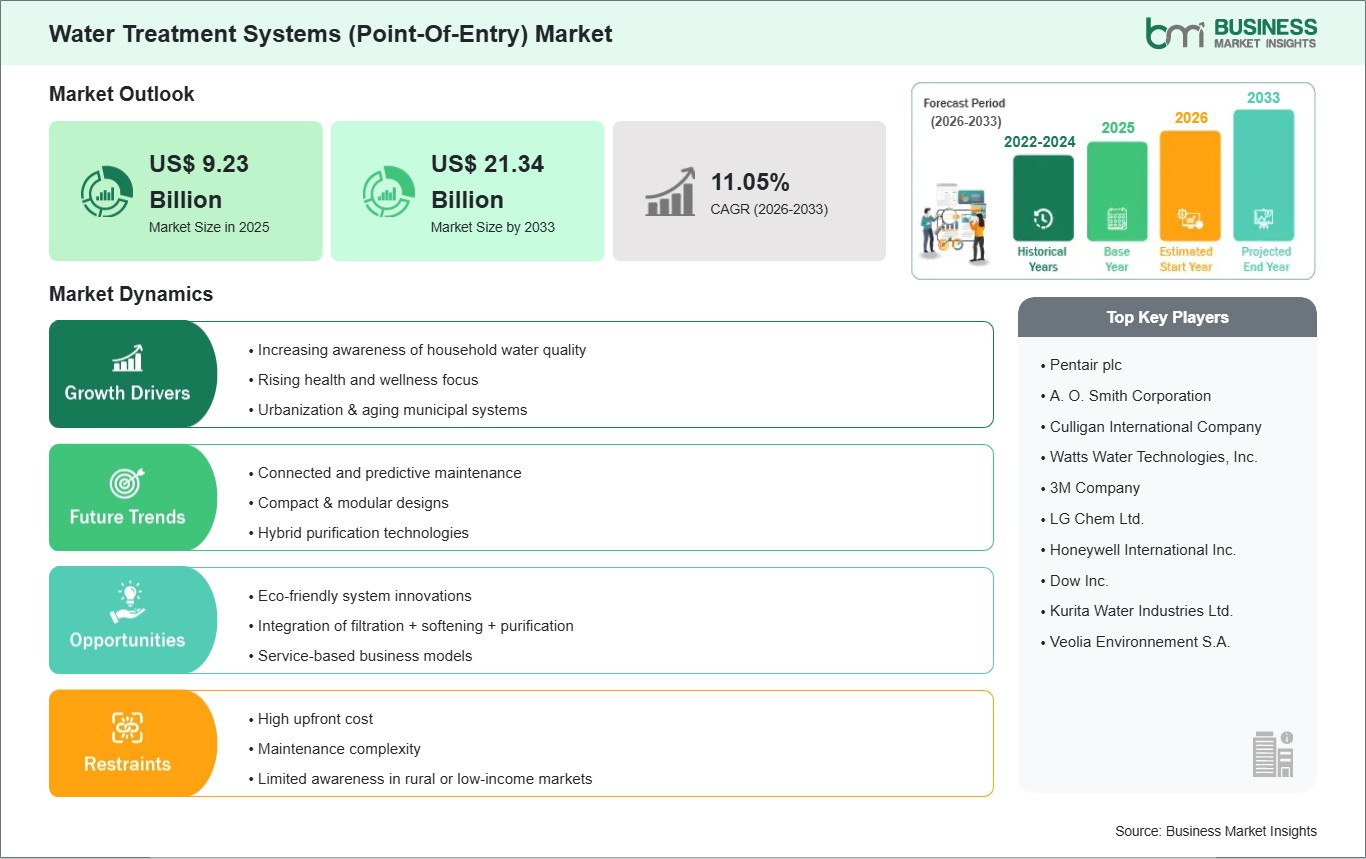
The Water Treatment Systems (Point-Of-Entry) Market size is expected to reach US$ 21.34 billion by 2033 from US$ 9.23 billion in 2025. The market is estimated to record a CAGR of 11.05% from 2026 to 2033.
The global Water Treatment Systems (Point-of-Entry, or POE) market is increasingly significant as residential, commercial, and industrial consumers seek whole-house water purification solutions that deliver safe, high-quality water directly at the entry point. POE systems are designed to treat all water entering a facility, addressing contaminants such as sediments, chlorine, heavy metals, hardness, and microbial impurities. The rising awareness of waterborne health risks, coupled with growing concerns over aging municipal infrastructure, is a major driver for the adoption of these systems globally.
Additionally, increasing demand for convenience and integrated home water solutions is encouraging manufacturers to develop advanced systems that combine filtration, softening, and disinfection in a single unit. Despite robust growth potential, the market faces certain restraints. High initial installation costs and maintenance requirements can limit adoption, particularly in price-sensitive regions. Moreover, variability in water quality standards across regions presents a challenge for global manufacturers aiming to deliver universally effective solutions.
However, ongoing technological innovation such as smart monitoring systems, energy-efficient designs, and eco-friendly filtration media—is helping to overcome these hurdles. Overall, the global POE water treatment systems market is poised for expansion, driven by health awareness, regulatory push for safe water, and a shift toward sustainable and automated home water solutions.

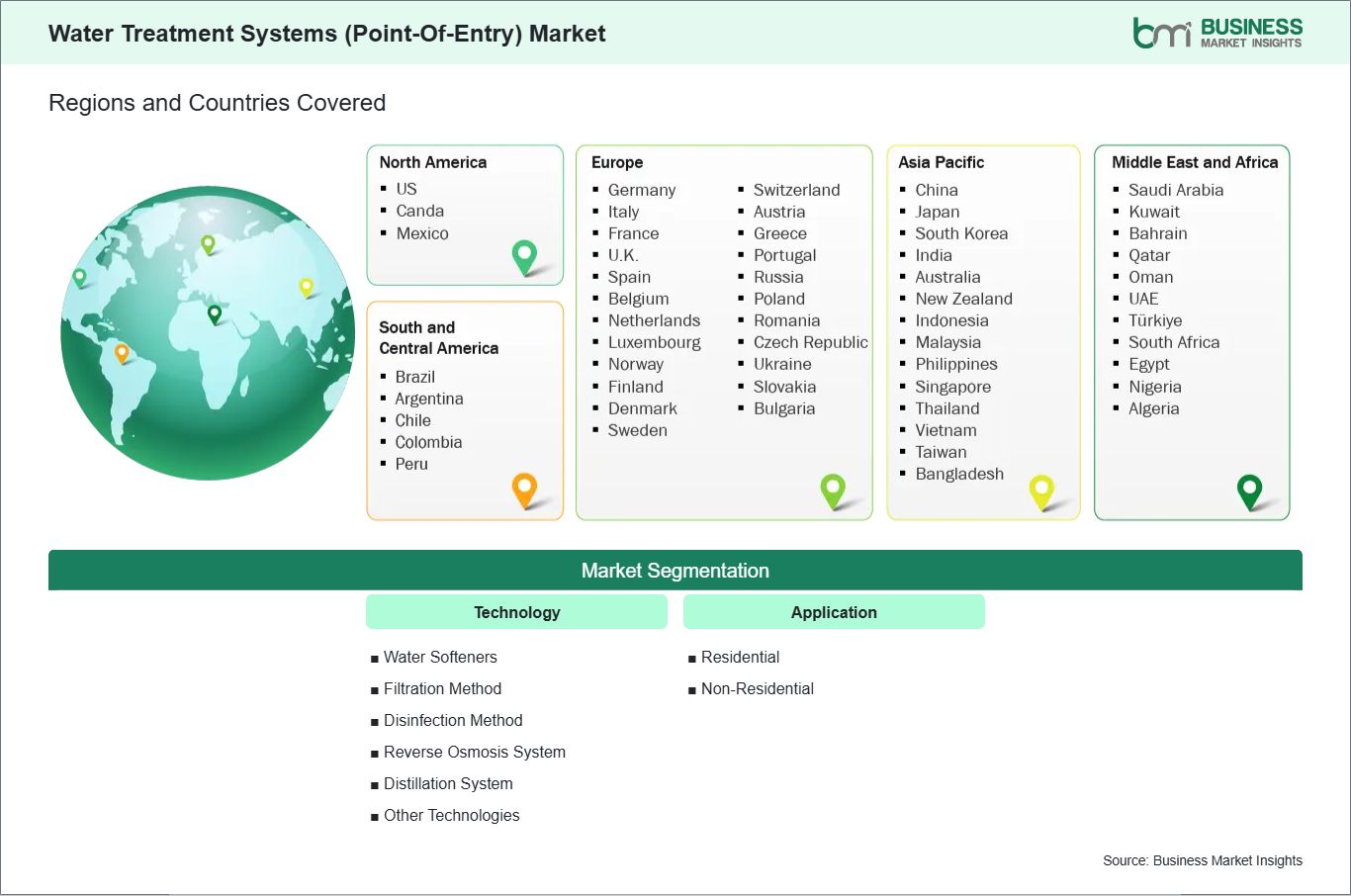
Key segments that contributed to the derivation of the Water treatment systems (point-of-entry) market analysis are technology and application
Public interest in household water quality in North America has risen significantly in the past decade due to various high-profile contaminations in water supplies and increased media attention to aging water infrastructure. Notable incidents of increased lead levels in Flint, Michigan, as well as newly discovered water contaminant issues such as PFAS in New England groundwater supplies, have prompted many water consumers to invest in point-of-use water treatment systems as well as point-of-entry water treatment systems. This trend is increasing the need for water treatment chemicals such as activated carbon media, anti-scalants, as well as safe disinfectants suitable for consumer water treatment applications.
Municipal water utilities are also responding to increased consumer awareness by working in conjunction with local communities to increase transparency in water quality improvement initiatives. For example, in Ontario, Canada, there are now several water utilities that offer real-time water quality information dashboards that provide information on residual disinfectant levels as well as health standards. This trend is increasing consumer interest in water treatment chemicals that offer consistent results, such as chloramine and chlorine alternatives that offer effective disinfection without unpleasant taste and odor problems.
In addition, the growing household water concerns can be partly attributed to intermittent supplies and local well sources, especially in arid regions of the northern states of Mexico, such as Baja California and Sonora. In this regard, household chemicals like corrosion inhibitors and shock chlorination kits are used to treat common water concerns like microbes and metallic tastes. Market surveys have shown that the sales of water treatment products have grown by between 8 and 12 percent over the past year, especially in these regions, where people are becoming increasingly aware of the need for household water treatment products and are willing to pay for these products as their middle-class lifestyle improves.
Environmental regulations and consumer interest in sustainable products are fueling the pace at which water treatment chemistries that are more eco-friendly are being adopted in water utilities across North America. In the United States' Pacific Northwest region, water utilities serving Seattle and Portland, among other cities, are exploring alternative disinfectants to traditional chemical disinfectants, such as ultraviolet light and hydrogen peroxide, to minimize the formation of regulated disinfection byproducts. Not only do these more sustainable water treatment chemistries comply with strict regulatory requirements for drinking water quality under the U.S. Environmental Protection Agency's Safe Drinking Water Act, they also eliminate long-term chemical handling and disposal risks for water utilities.
Similarly, water-intensive industries such as food processors in California's Central Valley and breweries in Quebec are adopting sustainable water treatment innovations such as closed-loop rinse systems that utilize biodegradable chelating agents and enzymatic cleaners to minimize water and chemical waste. These water treatment innovations not only support corporate social responsibility for sustainable development but also help optimize operational efficiency, including a 15-20% reduction in chemical costs for some facilities that have adopted more eco-friendly water treatment chemistries.
In addition, there are emerging trends favoring bio-based corrosion inhibitors and plant-based coagulants that help reduce the use of synthetic polymers. In the metropolitan area of Mexico City, cactus-based coagulants derived from nopal cactus have shown preliminary results for treating surface water. This type of system innovation can be characterized by the overall regional trend favoring sustainable chemistry, which corresponds with North American interests in environmental protection, public health, and cost-effective operations.

The global Water treatment systems (point-of-entry) market is experiencing steady growth, with market size and share analysis reflecting evolving treatment preferences and competitive dynamics among key players. The report evaluates important subsegments categorized within technology and application, highlighting their respective contributions to overall market performance.
By technology, the reverse osmosis systems subsegment dominated the market in 2025 because reverse osmosis provides high-efficiency purification, effectively removing dissolved salts, heavy metals, microorganisms, and other contaminants from water, making it suitable for both household and industrial applications.
By application, residential subsegment dominated the market in 2025 because of rapid growth in strong global demand for both residential and commercial furnishings. Wood coatings are extensively used in furniture manufacturing to enhance visual appeal, improve surface smoothness, and provide protection against scratches, stains, and environmental damage.
| Report Attribute | Details |
|---|---|
| Market size in 2025 | US$ 9.23 Billion |
| Market Size by 2033 | US$ 21.34 Billion |
| Global CAGR (2026 - 2033) | 11.05% |
| Historical Data | 2022-2024 |
| Forecast period | 2026-2033 |
| Segments Covered | By Technology
|
|
Regions and Countries Covered
| |
| North America | US, Canada, Mexico |
| Europe | Belgium, Austria, Finland, Denmark, Greece, Poland, Romania, Russia, Ukraine, Czech Republic, Slovakia, Bulgaria, Italy, Luxembourg, Germany, Switzerland, France, Netherlands, Norway, Portugal, Spain, Sweden, United Kingdom |
| Asia-Pacific | Australia, China, India, Japan, South Korea, Indonesia, Malaysia, Philippines, Singapore, Thailand, Vietnam, Bangladesh, New Zealand, Taiwan |
| South and Central America | Brazil, Argentina, Peru, Chile, Colombia |
| Middle East and Africa | Bahrain, Kuwait, Oman, Qatar, Saudi Arabia, United Arab Emirates, Turkiye, South Africa, Egypt, Algeria, Nigeria |
| Market leaders and key company profiles |
|
The "Water Treatment Systems (Point-Of-Entry) Market Size and Forecast (2022 - 2033)" report provides a detailed analysis of the market covering below areas:
The geographical scope of the water treatment systems (point-of-entry) market report is divided into: North America, Asia Pacific, Europe, Middle East & Africa, and South & Central America. North America held the largest share in 2025.
North America leads the global POE water treatment systems market, driven by high consumer awareness of water quality, regulatory mandates, and mature distribution networks. The region’s urban and suburban populations are increasingly investing in whole-house water treatment systems to ensure consistent safety and taste of potable water. The United States is the primary market driver, fueled by growing concerns over contaminants such as lead, chlorine by-products, and hard water, as well as rising adoption of smart home technologies that integrate water treatment monitoring. Canada complements the U.S. market with demand focused on remote and rural water systems, where municipal supply is limited and homeowners rely on private wells.
In North America, technological innovation is a key differentiator, with manufacturers offering modular systems that allow customization based on household water composition. Energy efficiency, low-maintenance designs, and eco-friendly filtration media are increasingly important features driving adoption. The region’s dominance is further reinforced by strong after-sales service infrastructure and public awareness campaigns highlighting the importance of water quality, positioning North America as a benchmark for POE water treatment solutions worldwide.

The water treatment systems (point-of-entry) market is evaluated by gathering qualitative and quantitative data post primary and secondary research, which includes important corporate publications, association data, and databases. A few of the key developments in the Water treatment systems (point-of-entry) market are:
The Water Treatment Systems (Point-Of-Entry) Market is valued at US$ 9.23 Billion in 2025, it is projected to reach US$ 21.34 Billion by 2033.
As per our report Water Treatment Systems (Point-Of-Entry) Market, the market size is valued at US$ 9.23 Billion in 2025, projecting it to reach US$ 21.34 Billion by 2033. This translates to a CAGR of approximately 11.05% during the forecast period.
The Water Treatment Systems (Point-Of-Entry) Market report typically cover these key segments-
The historic period, base year, and forecast period can vary slightly depending on the specific market research report. However, for the Water Treatment Systems (Point-Of-Entry) Market report:
The Water Treatment Systems (Point-Of-Entry) Market is populated by several key players, each contributing to its growth and innovation. Some of the major players include:
The Water Treatment Systems (Point-Of-Entry) Market report is valuable for diverse stakeholders, including:
Essentially, anyone involved in or considering involvement in the Water Treatment Systems (Point-Of-Entry) Market value chain can benefit from the information contained in a comprehensive market report.
Please tell us your area of interest
(Market Segments/ Regions and Countries/ Companies)