Market Summary
Executive Summary and Global Market Analysis
Water recycling filtration systems are engineered solutions designed to treat, purify, and reuse wastewater across industrial and agricultural applications. These systems integrate physical, chemical, and membrane-based processes to remove contaminants and enable water reuse within controlled operational cycles. Their significance continues to expand as industries prioritize resource conservation and regulatory compliance.
Heightened pressure on freshwater resources has intensified reliance on recycling filtration infrastructure across sectors. Industrial facilities increasingly incorporate closed-loop water systems to minimize discharge volumes and operational costs. Regulatory frameworks enforcing water reuse standards further accelerate deployment across high-consumption industries, supporting long-term sustainability objectives.
Segmentation reveals a broad technology mix addressing diverse filtration requirements and throughput capacities. Membrane filters exhibit strong integration in advanced treatment processes, while conventional systems maintain relevance in pre-filtration stages. Flow rate segmentation demonstrates varied deployment across small, mid-scale, and large industrial setups, reflecting operational flexibility across different end-users.
Technological advancement continues to reshape filtration efficiency and monitoring capabilities. Innovations in membrane materials, automation systems, and hybrid filtration configurations are enhancing contaminant removal precision. Digital integration supports predictive maintenance and operational optimization, enabling more efficient system performance over extended lifecycle periods.
Competitive conditions remain structured around technological differentiation and application-specific solutions. Participants emphasize customization, reliability, and lifecycle cost efficiency to sustain market positioning. Strategic emphasis on innovation pipelines and service integration further strengthens competitive resilience in this evolving industrial landscape.
Segment Analysis
Recycling Water Filtration Market Segmentation
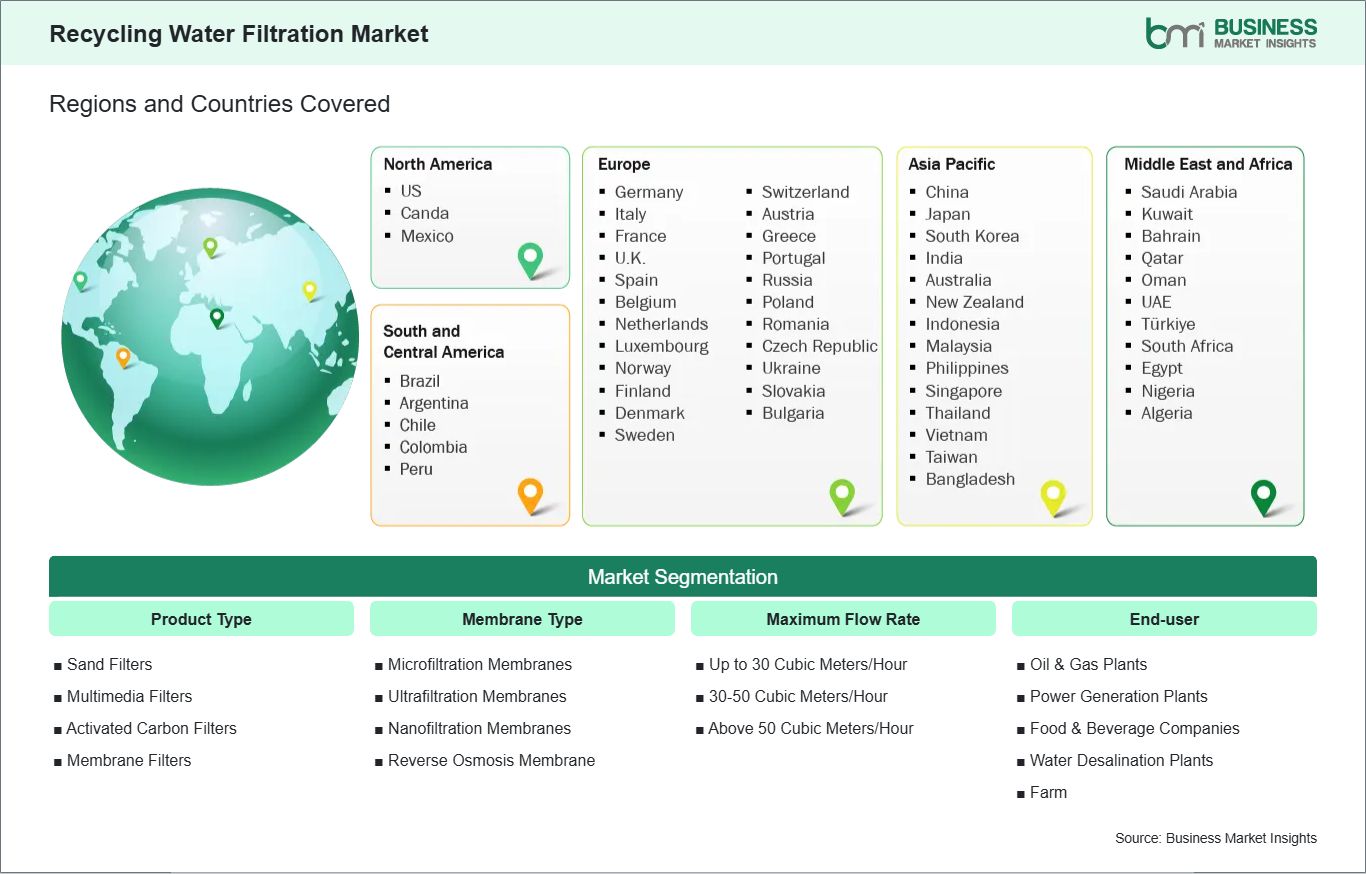
The recycling water filtration market is segmented based on product type, membrane type, maximum flow rate and end-user.
By Product Type
- Sand Filters: Provide cost-effective pre-treatment for suspended solids removal
- Multimedia Filters: Enable layered filtration for improved particulate separation efficiency
- Activated Carbon Filters: Remove organic contaminants and odor effectively
- Membrane Filters: Deliver high-precision filtration for dissolved and microscopic impurities
-
By Membrane Type
- Microfiltration (MF) Membranes – Handle larger particles through surface filtration mechanisms
- Ultrafiltration (UF) Membranes – Capture bacteria and macromolecules with enhanced retention
- Nanofiltration (NF) Membranes – Target divalent ions and smaller organic compounds
- Reverse Osmosis (RO) Membrane – Achieve near-complete dissolved solids removal
By Maximum Flow Rate
- Up to 30 Cubic Meters/Hour: Suitable for small-scale and decentralized systems
- 30-50 Cubic Meters/Hour: Support mid-sized industrial processing requirements
- Above 50 Cubic Meters/Hour: Address large-scale industrial and municipal operations
By End-user
- Oil & Gas Plants – Manage produced water treatment for reuse
- Power Generation Plants – Handle cooling water recycling efficiently
- Food & Beverage Companies – Ensure compliance with hygiene and reuse standards
- Water Desalination Plants – Integrate filtration for pre-treatment optimization
- Farm – Improve irrigation efficiency with recycled water usage
Market Forces
Recycling Water Filtration Market Drivers and Opportunities
Industrial Water Reuse Mandates Driving Implementation
Stringent environmental regulations governing wastewater discharge have intensified the need for advanced recycling systems. Industries face operational constraints requiring reduced water withdrawal and improved treatment capabilities. This creates a strong shift toward adopting filtration technologies that enable reuse within production cycles, thereby lowering dependency on external water sources while ensuring regulatory compliance.
This regulatory alignment promotes investment in filtration infrastructure across energy, manufacturing, and agriculture sectors. Organizations increasingly embed recycling systems into core operational frameworks to maintain compliance and cost efficiency. The requirement for continuous water quality monitoring further enhances the relevance of integrated filtration solutions in modern industrial settings.
Expansion of Decentralized Treatment Solutions
Emerging demand for localized water treatment systems is reshaping infrastructure development across industrial and rural settings. Decentralized filtration technologies allow on-site water reuse, reducing reliance on centralized treatment facilities. Compact and modular system designs support rapid deployment in remote or resource-constrained environments.
Future expansion potential lies in scalable solutions that integrate smart monitoring and automation capabilities. These systems support efficient water reuse in diverse applications such as agriculture and small industrial units. As demand for adaptable infrastructure increases, decentralized filtration solutions will reshape accessibility and sustainability across the sector.
Size and Share Analysis
Recycling Water Filtration Market Size and Share Analysis
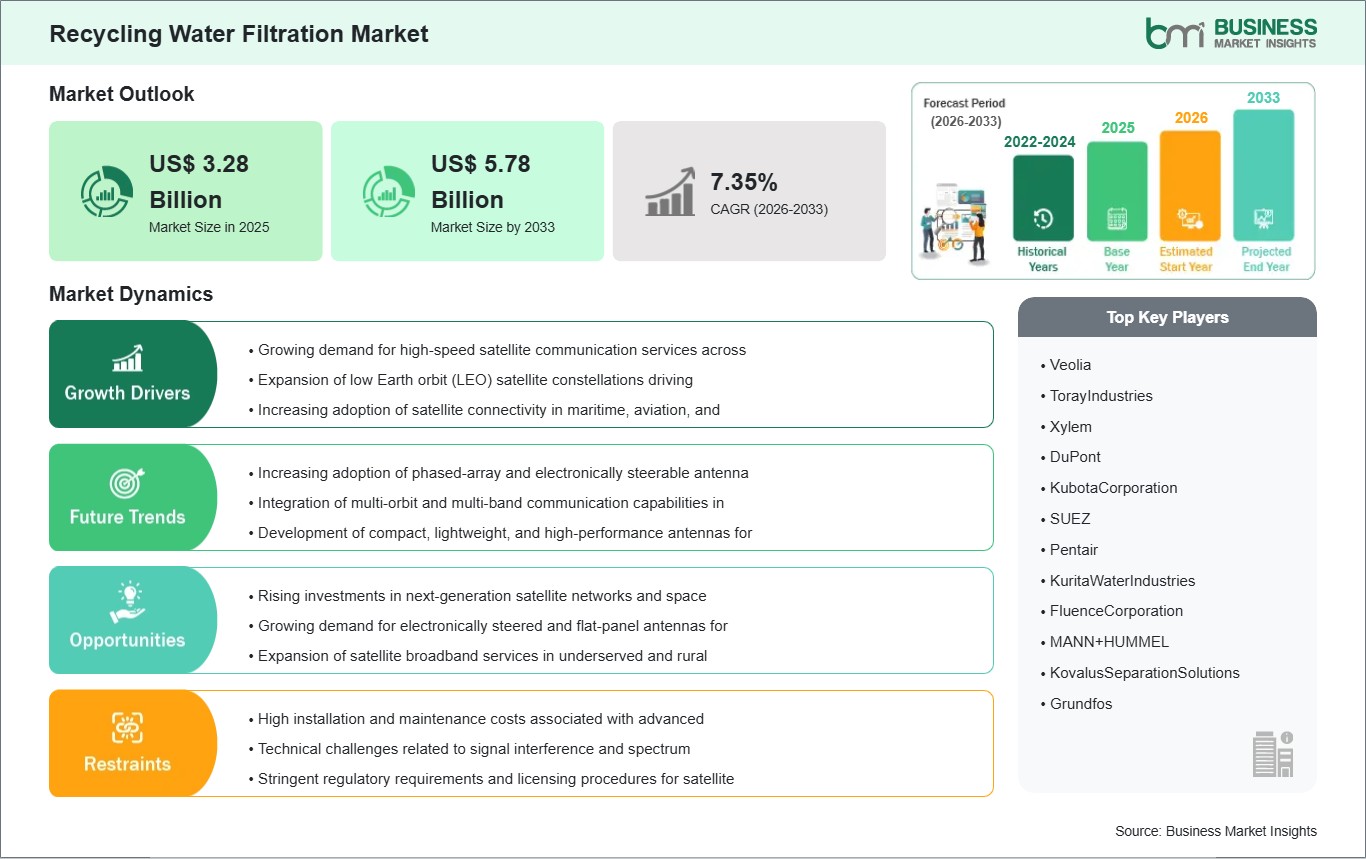
The Recycling Water Filtration Market was valued at USD 3.28 Billion in 2025 and is projected to reach USD 5.78 Billion by 2033, expanding at a CAGR of 7.35% from 2026 to 2033. This growth trajectory reflects rising utilization of sustainable water management systems and increasing industrial emphasis on resource optimization and environmental compliance.
Among membrane types, reverse osmosis and ultrafiltration systems demonstrate strong preference, supported by their ability to remove dissolved solids and microbial contaminants across industrial processes.
Oil and gas plants and power generation facilities represent leading application areas, given their intensive water consumption patterns. Food and beverage companies also show notable deployment, driven by strict hygiene regulations and the need for consistent water quality in processing operations.
Report Coverage
Recycling Water Filtration Market Report Coverage and Deliverables
The Recycling Water Filtration report provides a detailed analysis of the market covering the below areas:
- Market size and forecast at global, regional, and country levels for all the key market segments covered under the scope
- Market trends, as well as market dynamics such as drivers, restraints, and key opportunities
- Market analysis covering key market trends, global and regional framework, major players, regulations, and recent market developments
- Industry landscape and competition analysis covering market concentration, heat map analysis, prominent players, and recent developments for the market
- Detailed company profiles, including SWOT analysis
Geographic Insights
Recycling Water Filtration Market Geographic Insights
The Recycling Water Filtration market shows diverse regional adoption patterns influenced by regulatory frameworks, water availability constraints, and industrial infrastructure maturity. Global expansion reflects shifting priorities toward sustainable water management and increased emphasis on operational efficiency across industries reliant on continuous water supply.
North America demonstrates strong alignment with advanced filtration deployment, supported by strict discharge regulations and widespread industrial automation. Facilities integrate high-performance membrane systems to optimize operational continuity while reducing environmental impact. Investment patterns reflect preference for long-term efficiency gains over short-term cost reductions.
Asia Pacific exhibits accelerating infrastructure development, driven by industrial expansion and population-related water stress. Governments prioritize wastewater recycling projects, encouraging widespread implementation across manufacturing and agricultural sectors. Adoption patterns indicate growing reliance on compact and scalable filtration systems tailored for diverse operational environments.
Europe maintains a structured regulatory environment, fostering innovation in advanced filtration technologies and circular water systems. Emerging regions in the Middle East, Africa, and South America show progressive deployment, particularly within desalination and agricultural applications. These markets focus on enhancing water reuse capacity amid increasing resource constraints and climate variability.
Industry Activity
Recent Developments
The recycling water filtration market is evaluated by gathering qualitative and quantitative data post primary and secondary research, which includes important corporate publications, association data, and databases. Recent developments and news in the market include:
- In May 2026, Wyma Solutions, announced the launch of the Micron Filter XL at Hort Connections 2026. The Micron Filter XL has been developed to meet increasing demand across the horticultural industry for high‑capacity, reliable water filtration that supports water reuse, reduces waste, and improves overall wash‑line performance. Designed for medium to large produce wash lines and packhouses, the Micron Filter XL delivers efficient removal of fine solids from process water, helping growers and processors reduce water consumption while maintaining wash water quality
.
- In April 2026, Veolia is working with Amazon to reduce data center water use and advance water reuse in Amazon’s data center operations in Mississippi, contributing to local water resilience while supporting Amazon’s goal to be water positive across its direct data center operations by 2030. The first facility is expected to be operational in 2027, making it the first Amazon data center in Mississippi to use reclaimed water for cooling. The project is expected to reuse more than 83 million gallons of potable water per year once fully operational, equivalent to the annual water use of approximately 760 U.S. homes.
Trust & Transparency
Research Methodology
The market analysis combines proprietary research with secondary data from government agencies, company disclosures, regulatory filings, industry databases and expert interviews. Market estimates are validated through data triangulation, cross-market benchmarking and analyst
review.
View Full Research Methodology
Key Sources Referred:
Industry reports on water treatment and filtration technologies Government publications on water reuse regulations Peer-reviewed journals on membrane filtration systems Company annual reports and sustainability disclosures Academic research studies on wastewater recycling technologies Environmental agency datasets on water resource management