Market Summary
Executive Summary and Global Market Analysis
Recycling lithium-ion batteries helps recover valuable materials from used batteries in transportation, electronics, industrial equipment, and energy storage. This process extracts metals and reusable parts, cuts down on waste, and lessens the need for new raw materials. As battery use grows in electric vehicles and stationary power, managing batteries at the end of their life is becoming more important. Manufacturers and policymakers are adopting circular economy practices to secure key minerals and tackle battery waste. Better collection systems and stricter environmental rules are shaping recycling efforts worldwide. The market is diverse, with automotive battery recycling making up a large share because more electric vehicles are being retired and replaced. Hydrometallurgical methods are popular for their high recovery rates and lower emissions. Lithium nickel manganese cobalt batteries are a major driver of recycling demand because they are widely used in electric vehicles.
New technologies in recycling facilities are making operations more efficient and improving how much material can be recovered. Better separation systems, automated dismantling, and closed-loop recovery methods are helping to extract more lithium, nickel, cobalt, and graphite. Advanced physical and mechanical processes also make handling safer and allow for larger-scale operations. These improvements are leading to more investment in local recycling networks and integrated recovery systems. Competition in the industry now depends more on processing abilities, long-term supply deals, and local regulations. Companies are focusing on licensing technology, tracking materials, and working with car and battery makers to ensure a steady supply of used batteries. Mergers and partnerships are also helping to grow recycling capacity and connect different parts of the battery supply chain.
Segment Analysis
Lithium-ion Battery Recycling Market Segmentation
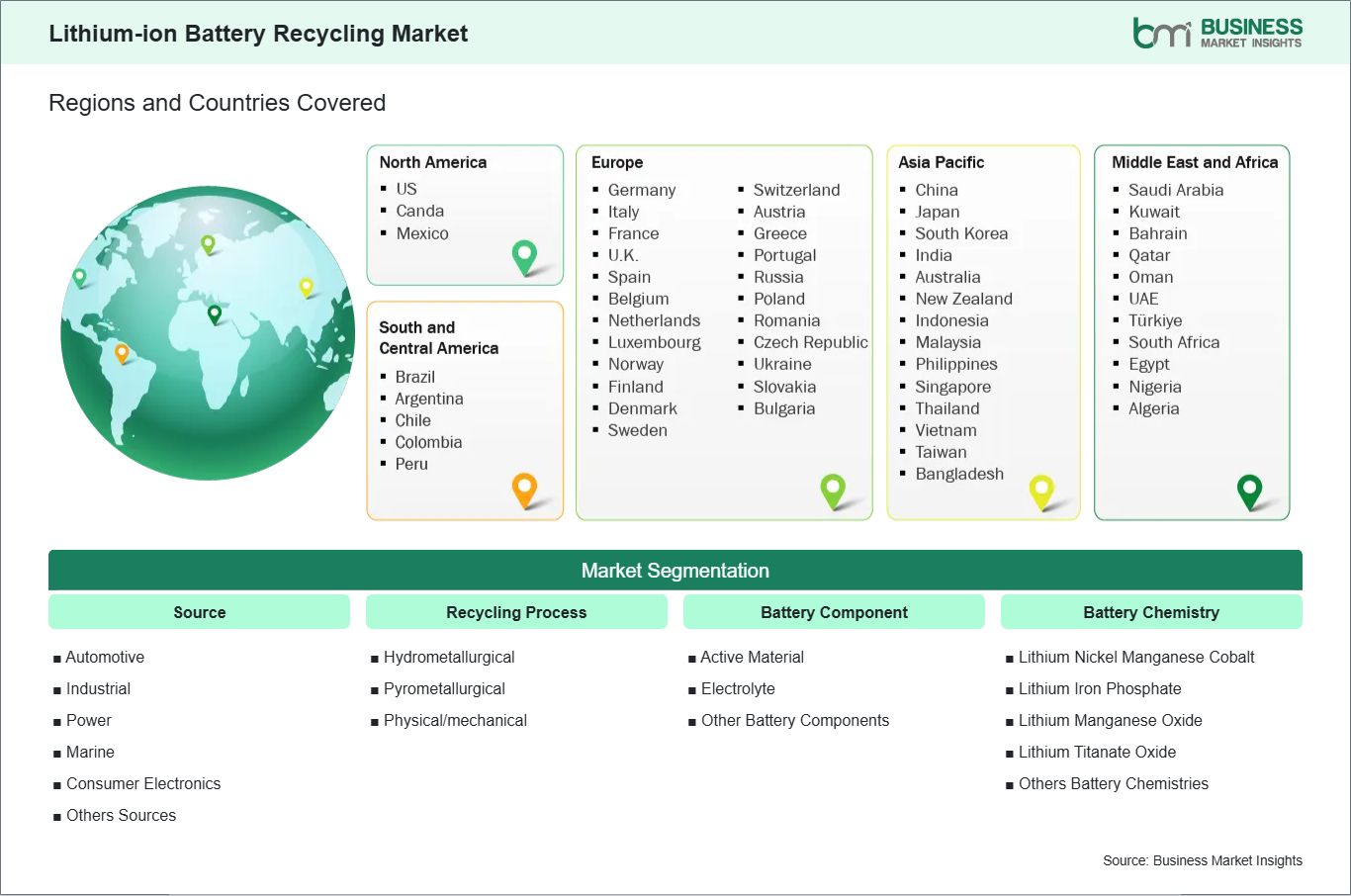
The Lithium-ion Battery Recycling market is segmented based on source, recycling process, battery component, and battery chemistry, demonstrating broad segmentation across battery sources, processing technologies, component recovery, and battery chemistry applications.
By Source
- Automotive – Generates substantial recycling volumes from electric vehicle battery retirements.
- Industrial – Supports recovery from heavy-duty equipment and backup power systems.
- Power – Addresses storage battery disposal from renewable energy installations.
- Marine – Encourages recycling of high-capacity batteries used in maritime operations.
- Consumer Electronics – Contributes consistent feedstock from portable electronic devices.
- Other Sources – Includes specialized batteries from niche commercial applications.
By Recycling Process
- Hydrometallurgical – Enables efficient metal extraction with lower environmental impact.
- Pyrometallurgical – Processes mixed battery waste through high-temperature recovery techniques.
- Physical/mechanical – Separates battery materials using shredding and sorting technologies.
By Battery Component
- Active Material – Recovers valuable cathode and anode materials for reuse.
- Electrolyte – Focuses on safe extraction and disposal of chemical compounds.
- Other Battery Components – Includes recovery of casings, separators, and conductive materials.
By Battery Chemistry
- Lithium Nickel Manganese Cobalt – Maintains strong recycling demand from electric mobility applications.
- Lithium Iron Phosphate – Gains processing attention due to expanding energy storage deployment.
- Lithium Manganese Oxide – Supports recycling from consumer and industrial battery systems.
- Lithium Titanate Oxide – Serves specialized applications requiring rapid charging performance.
- Other Battery Chemistries – Covers emerging and customized lithium-ion battery formulations.
Market Forces
Lithium-ion Battery Recycling Market Drivers and Opportunities
Expansion of Electric Vehicle Battery Disposal Volumes
As more electric vehicles are used worldwide, the number of old batteries needing disposal is rising. Battery replacements, expired warranties, and retired vehicles are increasing the need for organized recycling systems. Car makers are improving how they collect and recycle batteries to reuse materials and meet environmental rules for hazardous waste.
This shift is changing how companies get raw materials for batteries. Recovering lithium, nickel, cobalt, and manganese from old batteries means less reliance on mining and fewer supply risks. Recycling also helps battery makers find materials locally. As more electric vehicle factories open, there is a greater need for recycling systems that can grow with demand.
Advancements in Closed-Loop Material Recovery Systems
Closed-loop recycling systems help put recovered materials back into battery production. Technology companies are using better purification and separation methods to improve the quality and consistency of recovered metals. These advances make it possible to produce recycled materials that can be used directly in making new battery cathodes and for energy storage.
Growing investment in local recycling plants and integrated processing is helping to bring new recycling technologies to market. Partnerships between recyclers, manufacturers, and car makers are improving coordination across the supply chain. Better recycling practices and improved tracking are expected to support circular manufacturing and reduce the need for newly mined raw materials.
Size and Share Analysis
Lithium-ion Battery Recycling Market Size and Share Analysis
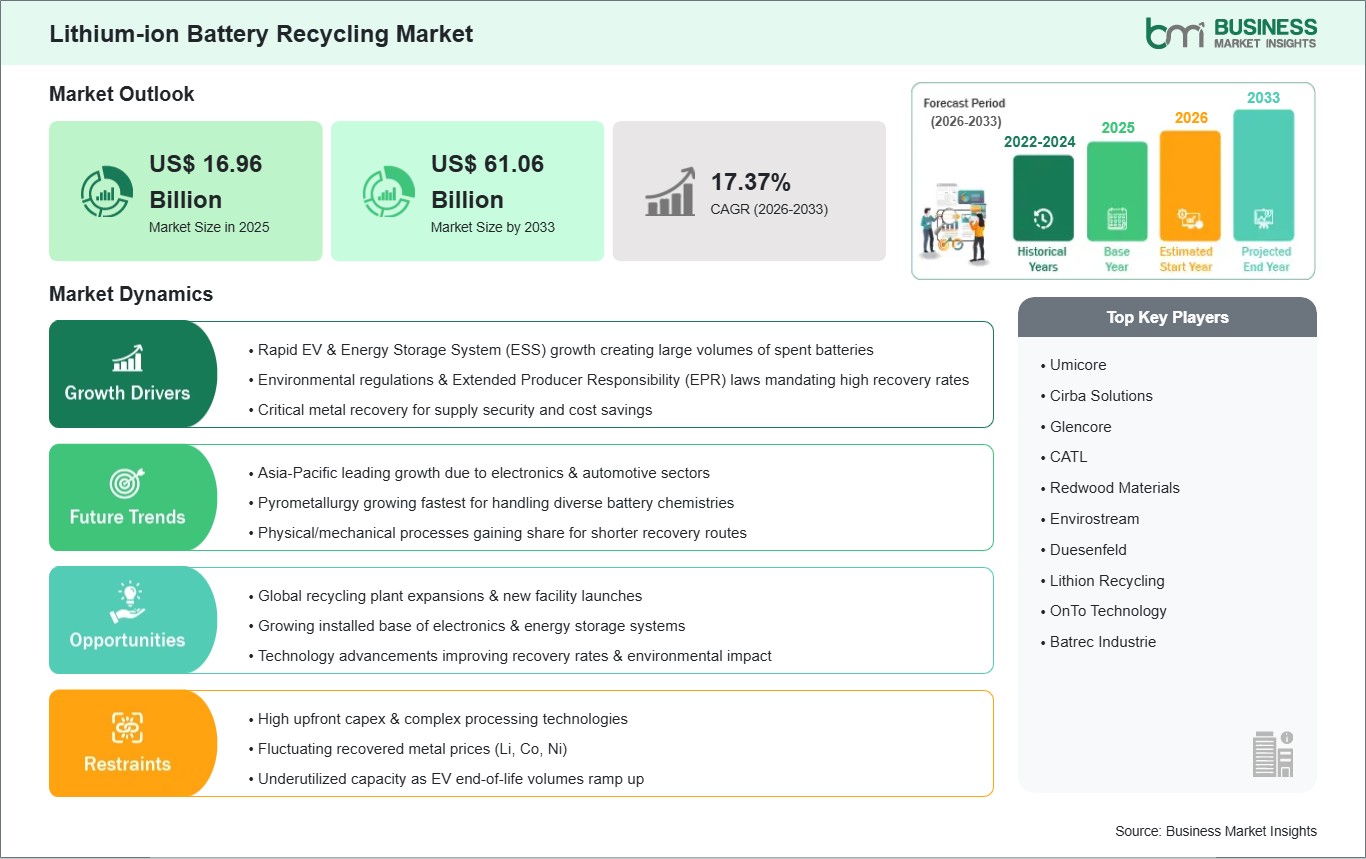
The Lithium-ion Battery Recycling Market is projected to grow from US$ 16.96 Billion in 2025 to US$ 61.06 Billion by 2033 , registering a CAGR of 17.37% from 2026 to 2033. This growth comes from more batteries being disposed of, better technology for recovering materials, and a stronger focus on using resources sustainably in transport and energy.
Automotive battery sources maintain a leading share within the market due to the extensive deployment of electric vehicles worldwide. Hydrometallurgical recycling processes continue to attract industry preference because of their ability to recover high-value metals with improved operational efficiency. Lithium nickel manganese cobalt battery chemistry also contributes to notable processing demand across recycling facilities.
Most of the market demand comes from electric vehicles, as more batteries are replaced and fleets are electrified. Recycling from consumer electronics provides a steady supply of materials, and energy storage systems are adding more long-term recycling needs. Industrial and marine uses are also increasing the demand for recycling in different regions.
Report Coverage
Lithium-ion Battery Recycling Market Report Coverage and Deliverables
The " Lithium-ion Battery Recycling Market Size and Forecast (2022-2033)" report provides a detailed analysis of the market covering below areas:
- Market size and forecast at global, regional, and country levels for all market segments covered under the scope
- Market trends, as well as drivers, restraints, and opportunities
- Market analysis covering key trends, global and regional framework, major players, regulations, and recent developments
- Industry landscape and competition analysis covering market concentration, heat map analysis, prominent players, and recent developments for the Lithium-ion Battery Recycling market
- Detailed company profiles, including SWOT analysis
Geographic Insights
Lithium-ion Battery Recycling Market Geographic Insights
The Lithium-ion Battery Recycling market demonstrates diverse regional adoption patterns influenced by electric mobility expansion, sustainability objectives, battery disposal regulations, and advancements in material recovery. Global market development is closely associated with the rising use of rechargeable battery systems in transportation, consumer electronics, and stationary storage. Recycling ecosystems are transitioning from fragmented collection networks to integrated recovery and material reuse operations.
North America has strong industry involvement, helped by more electric vehicle production and investment in local battery supply chains. Recycling companies are focusing on advanced recovery technologies and local processing to rely less on imported battery materials. New regulations for battery disposal and sustainable sourcing are also supporting long-term growth in recycling capacity.
Asia Pacific is a major center for battery recycling, thanks to large-scale battery manufacturing and the rapid growth of electric vehicles. Countries in the region are improving recycling to handle more used batteries from transport and electronics. Closer cooperation between battery makers, recyclers, and raw material suppliers is speeding up the creation of circular battery production systems in many Asian countries.
Europe is moving forward with environmental policies that encourage tracking batteries, efficient recovery, and using recycled materials. Manufacturers are using more recycled battery materials to support sustainability and make supply chains stronger. In the Middle East, Africa, and South and Central America, new infrastructure is slowly being built as electrification and energy storage projects grow.
Industry Activity
Recent Developments
The Lithium-ion Battery Recycling market is evaluated by gathering qualitative and quantitative data post-primary and secondary research, which includes important corporate publications, association data, and databases. A few of the key developments in the Lithium-ion Battery Recycling market are:
- In April 2026, Rocklink India, a subsidiary of the Rocklink Group, launched its first integrated recycling facility in Sikandrabad, Uttar Pradesh. This facility aims to enhance domestic capabilities in critical material recovery, focusing on lithium-ion batteries, rare earth magnets, and metal-bearing waste. It will initially recycle up to 10,000 tonnes of lithium-ion batteries annually and process rare earth magnets at a rate of 60 tonnes per month, with a rare earth chloride line expected to be operational by early 2026.
- In December 2025, Attero intends to invest US$ 15.7 million (INR 150 crore)renewb to establish five new recycling facilities, increasing its capacity by 1 lakh tonnes annually. This initiative will create 800–1,000 jobs and enhance its RandD Center using advanced robotics and automation. The new facilities will focus on e-waste, copper, and lithium-ion battery processing, with locations including Pune, Bengaluru, Faridabad, and Reengus in Rajasthan, alongside a strengthened RandD Center of Excellence in Greater Noida.
Trust & Transparency
Research Methodology
The market analysis combines proprietary research with secondary data from government agencies, company disclosures, regulatory filings, industry databases and expert interviews. Market estimates are validated through data triangulation, cross-market benchmarking and analyst
review.
View Full Research Methodology
Key Sources Referred:
European Commission
US Department of Energy
International Energy Agency
Company Websites
Company Annual Reports
Company Investor Presentations