
Water Chiller Market Outlook: Size, Share, Trends, Growth Analysis, Competitive Landscape & Forecast, 2022-2033

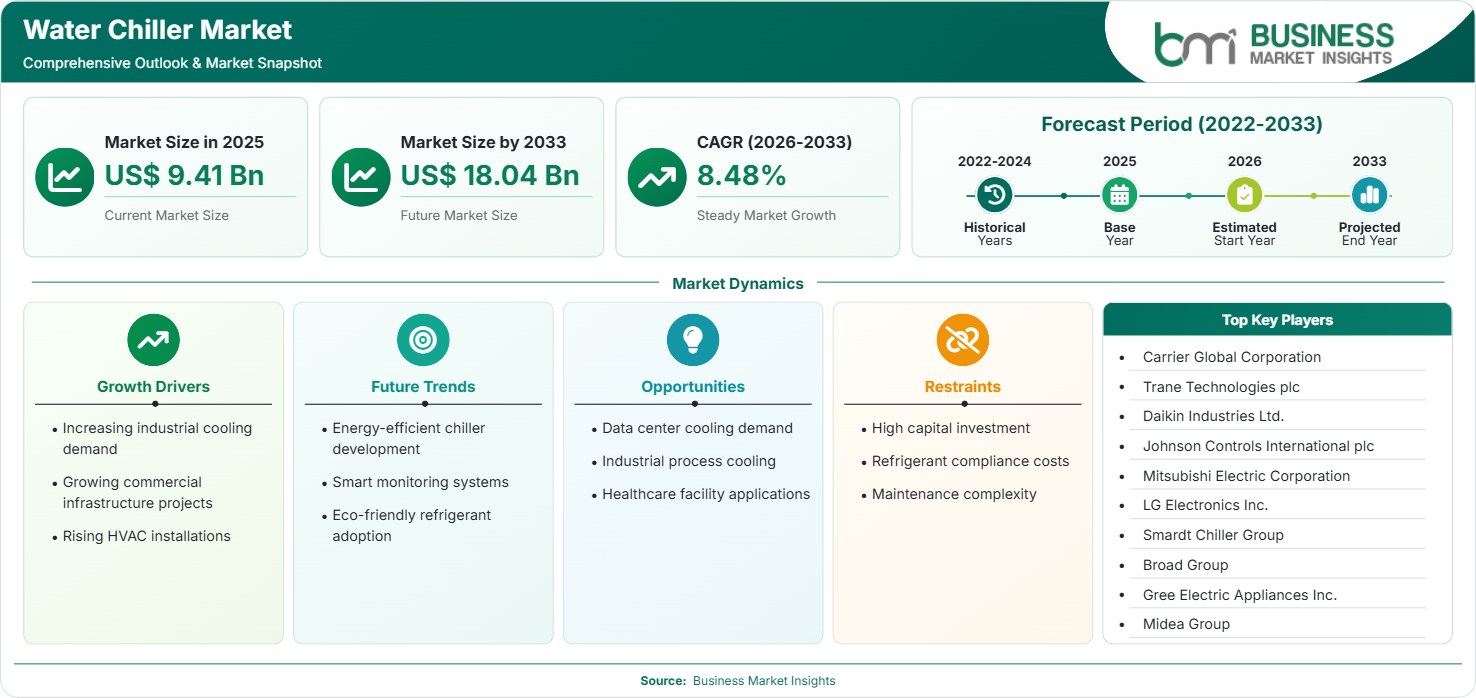
The Water Chiller Market size was valued at US$ 9.41 billion in 2025 and is projected to reach US$ 18.04 billion by 2033, growing at a CAGR of 8.48% during 2026–2033. Growing industrial cooling requirements, infrastructure construction projects in the commercial sector, and HVAC installations are expected to drive the market growth, and the expansion of data centers, healthcare infrastructure, and industrial cooling solutions provides significant future opportunities.

Report Coverage
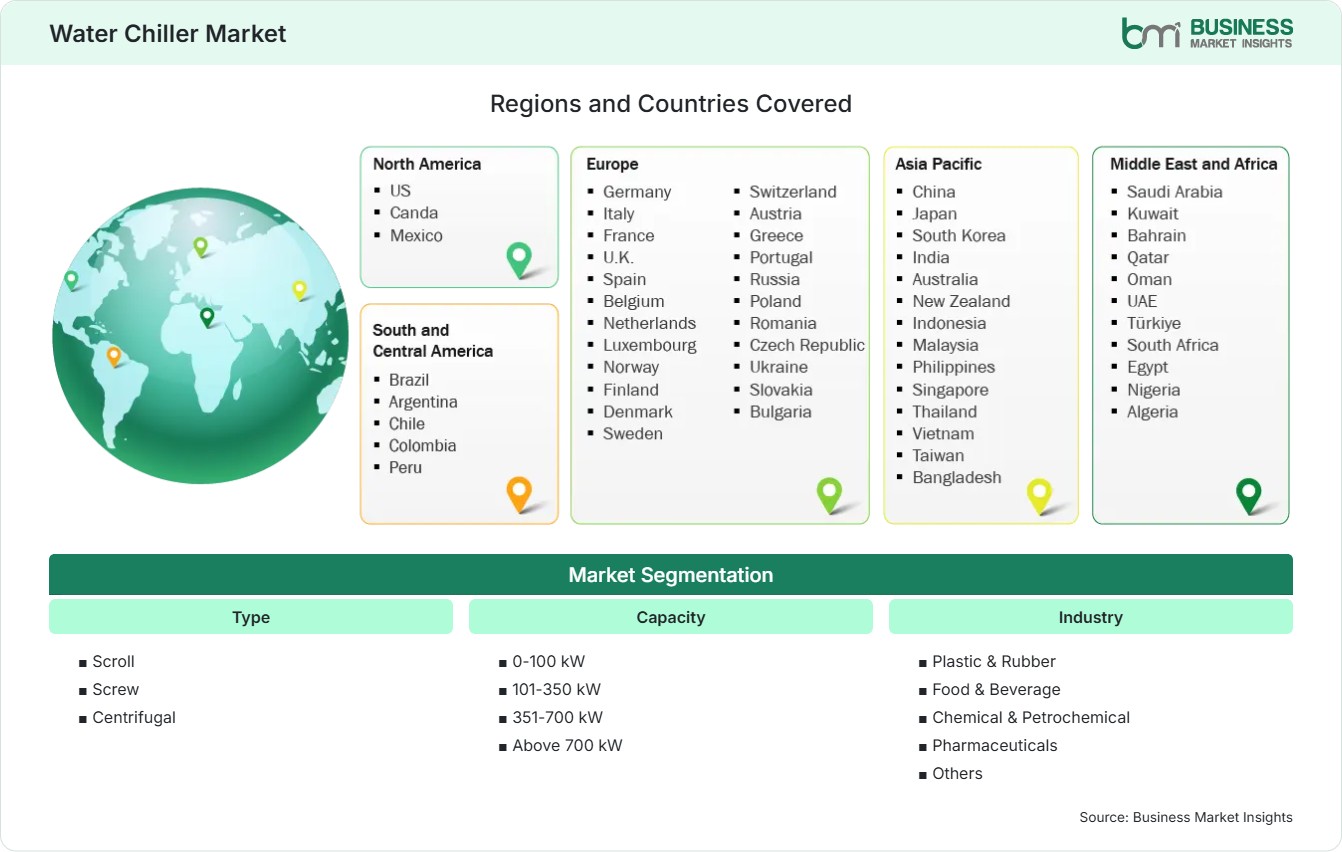
  • Type: Scroll, Screw, Centrifugal
  • Capacity: 0-100 kW, 101-350 kW, 351-700 kW, Above 700 kW
  • Industry: Plastic & Rubber, Food & Beverage, Chemical & Petrochemical, Pharmaceuticals, Others
US$ 9.41 Bn Market size in 2025
US$ 18.04 Bn Market Size by 2033
8.48% CAGR, 2026 - 2033
2026-2033 Forecast Period

AI Overview

Water Chiller Market Summary

  • North America Region: North America holds 34%–37% of the market share in 2025 and is projected to grow at a CAGR of 8.0%–8.7% during 2026–2033. Growth is supported by replacement demand, expanding commercial HVAC installations, and data center investments. The United States leads the regional market with a CAGR of 8.1%–8.8%, driven by energy-efficient cooling upgrades and industrial modernization.
  • Fastest Growing Region: Asia Pacific accounts for 30%–33% of market revenue in 2025 while registering the highest CAGR of 9.5%–10.2% during 2026–2033. Rapid industrialization, commercial construction, manufacturing expansion, and increasing investments in smart infrastructure continue accelerating regional demand.
  • Leading Segment: Scroll chillers account for 42%–45% of market revenue in 2025 and are expected to expand at a CAGR of 8.3%–9.0% through 2026–2033. High efficiency, compact design, lower maintenance requirements, and suitability for commercial HVAC systems support continued adoption.
  • High Growth Segment: Pharmaceuticals account for 13%–16% of market revenue in 2025 and are projected to register a CAGR of 10.2%–10.9% during 2026–2033. Expansion of pharmaceutical manufacturing, biotechnology facilities, and temperature-sensitive production processes continues driving investment.
  • Key Market Opportunity: Increasing deployment of high-efficiency chillers in hyperscale data centers, healthcare infrastructure, and advanced manufacturing facilities creates sustained opportunities for intelligent, environmentally compliant cooling systems.
  • Major Market Players: Carrier Global Corporation, Trane Technologies plc, Daikin Industries, Ltd., Johnson Controls International plc, Mitsubishi Electric Corporation, LG Electronics Inc., Smardt Chiller Group, Broad Group, Gree Electric Appliances, Inc., and Midea Group Co., Ltd.
Strategic Insights

Water Chiller Market: Strategic Insights

Water Chiller Market Strategic Framework
FREE PDF
Request your free sample
Request free sample
Stakeholder View

Key Takeaways

  • The industry ecosystem increasingly integrates compressor manufacturers, heat exchanger suppliers, refrigerant producers, HVAC system integrators, EPC contractors, and facility management providers to deliver energy-efficient cooling solutions.
  • Data centers, pharmaceutical manufacturing, semiconductor production, and healthcare facilities represent the strongest long-term opportunities due to rising requirements for precision temperature control.
  • Product innovation increasingly emphasizes inverter compressors, magnetic bearing technologies, environmentally friendly refrigerants, predictive maintenance software, and IoT-enabled system optimization.
  • Asia-Pacific is considered to be the best investment destination because of fast industrial development, development of infrastructure, shift in manufacturing base and large construction projects.
  • Strategic acquisitions, expanding manufacturing capacities and collaborations with intelligent buildings solutions providers enhance competitive position of global HVAC manufacturers..
Geographic Outlook

Water Chiller Market Regional Highlights

North America Water Chiller Market

North America accounted for 34%–37% of global revenue in 2025 and is projected to expand at a CAGR of 8.0%–8.7% during 2026–2033. Strong investments in commercial buildings, industrial modernization, healthcare infrastructure, and hyperscale data centers continue supporting regional leadership. The Water Chiller Market share remains the highest globally due to advanced HVAC adoption, replacement demand, and strict energy-efficiency regulations.

  • Data center expansion continues driving demand for high-capacity and energy-efficient chilled water systems supporting cloud computing and AI infrastructure.
  • Commercial office renovations increasingly prioritize low-energy HVAC equipment to comply with evolving sustainability and carbon reduction targets.
  • Industrial manufacturers continue replacing aging cooling equipment with intelligent, digitally connected chillers that improve operational efficiency.
  • Hospitals and healthcare facilities increasingly invest in reliable precision cooling systems supporting medical equipment and pharmaceutical storage.
  • Regulatory initiatives promoting environmentally friendly refrigerants continue accelerating adoption of next-generation chiller technologies.

US Water Chiller Market

The United States accounted for approximately 29%–32% of global revenue in 2025 while expanding at a CAGR of 8.1%–8.8% through 2026–2033. Continued investments in commercial infrastructure, industrial automation, pharmaceutical manufacturing, and cloud computing facilities remain primary contributors to market expansion.

  • Hyperscale data center construction continues generating significant demand for advanced cooling technologies.
  • Building owners increasingly replace conventional HVAC equipment with energy-efficient variable-speed chillers.
  • Pharmaceutical manufacturing investments continue strengthening demand for precision industrial cooling systems.
  • Federal and state energy-efficiency regulations encourage adoption of environmentally compliant refrigeration technologies.

Europe Water Chiller Market

Europe represented 26%–29% of global revenue in 2025 and is expected to register a CAGR of 7.8%–8.5% during 2026–2033. Strong environmental regulations, commercial retrofitting projects, and industrial modernization continue supporting market development. Germany remains the largest regional market, while Poland records the fastest growth.

  • Germany leads regional demand through advanced industrial manufacturing, commercial HVAC replacement, and smart building adoption.
  • Poland demonstrates strong expansion supported by manufacturing investments, logistics infrastructure, and industrial facility construction.
  • Adoption of low-GWP refrigerants continues accelerating across industrial and commercial applications.
  • Government incentives encourage energy-efficient HVAC modernization across commercial buildings.
  • Industrial automation supports increasing demand for advanced process cooling technologies.

Asia Pacific Water Chiller Market

Asia Pacific accounted for 30%–33% of global revenue in 2025 and is projected to register the fastest CAGR of 9.5%–10.2% through 2026–2033. The Water Chiller Market growth is driven by manufacturing expansion, commercial real estate development, semiconductor production, and increasing demand for industrial cooling. China leads regional demand, while India records the highest projected growth.

  • China continues dominating regional demand through manufacturing expansion, commercial construction, and extensive industrial cooling requirements.
  • India is projected to register a CAGR of 10.1%–10.8%, supported by pharmaceutical production, industrial investments, commercial infrastructure expansion, and growing HVAC adoption.
  • Semiconductor manufacturing facilities continue investing in precision cooling technologies.
  • Rapid urbanization strengthens commercial HVAC installations across office buildings, shopping centers, and mixed-use developments.
  • Smart factory initiatives accelerate deployment of digitally connected industrial cooling equipment.

Rest of World Water Chiller Market

The Rest of World represented 7%–9% of global revenue in 2025 and is projected to grow at a CAGR of 8.4%–9.1% through 2026–2033.

Industrial modernization and food processing continue to favor South & Central America, but the Middle East & Africa regions continue experiencing more commercial construction and district cooling projects. Brazil continues to be the most dominant market in the region, but Saudi Arabia shows the highest growth rate.

  • Brazil strengthens demand through industrial production, commercial real estate development, and food processing expansion.
  • Saudi Arabia is projected to register a CAGR of 9.2%–9.9%, supported by smart city developments, healthcare infrastructure, and large-scale commercial projects.
  • District cooling initiatives continue supporting deployment of high-capacity water chillers across urban developments.
  • Oil and gas facility modernization strengthens demand for industrial process cooling systems.
  • Hospitality, airport expansion, and mixed-use developments continue supporting commercial HVAC investments.
Global Market Geography
FREE PDF
Request your free sample
Request free sample
Segment Analysis

Water Chiller Market Segmentation

Type

The Type segment remains the primary determinant of system performance, energy efficiency, and lifecycle operating costs across industrial and commercial cooling applications. Scroll chillers accounted for 42%–45% of the market in 2025 and are expected to register a CAGR of 8.3%–9.0% during 2026–2033. The Water Chiller Market scope continues expanding as end users increasingly adopt compact, energy-efficient, and low-maintenance cooling systems for commercial buildings, healthcare facilities, and light industrial operations.

  • Scroll: Widely adopted across commercial buildings, hospitals, educational institutions, and retail facilities due to compact design, lower maintenance requirements, quiet operation, and high part-load efficiency.
  • Screw: Preferred for medium and large industrial facilities requiring continuous operation, high cooling capacity, superior reliability, and efficient process cooling across manufacturing environments.
  • Centrifugal: Increasingly deployed in large commercial complexes, airports, district cooling systems, and hyperscale data centers where maximum cooling capacity and superior energy efficiency are essential.

Capacity

Capacity selection depends on facility size, cooling demand, operational continuity, and application-specific thermal requirements. The 101–350 kW segment accounted for 36%–39% of global revenue in 2025 and is projected to expand at a CAGR of 8.6%–9.3% through the Water Chiller Market Forecast period, owing to widespread deployment across commercial buildings and medium-scale industrial facilities.

  • 0–100 Kw: Commonly installed in small commercial buildings, clinics, retail outlets, office spaces, and educational institutions requiring localized cooling solutions.
  • 101–350 Kw: Represents the largest installed base across office complexes, hotels, shopping malls, pharmaceutical facilities, and manufacturing plants due to operational flexibility.
  • 351–700 Kw: Supports large industrial operations, hospitals, food processing plants, and institutional facilities with demanding continuous cooling requirements.
  • >700 Kw: Primarily utilized in district cooling networks, petrochemical complexes, semiconductor fabrication facilities, airports, and hyperscale data centers requiring large-capacity chilled water systems.

Industry

Industrial demand continues expanding with increasing automation, process optimization, and stringent temperature control requirements. Chemical & Petrochemical accounted for 28%–31% of market revenue in 2025 and is projected to register a CAGR of 8.8%–9.5% through 2026–2033. Continuous investments in manufacturing modernization and energy-efficient cooling technologies support sustained market expansion.

  • Plastic & Rubber: Cooling systems maintain precise molding temperatures, improve production efficiency, reduce cycle times, and enhance finished product quality across manufacturing facilities.
  • Food & Beverage: Chillers support food processing, beverage production, dairy operations, and cold storage applications by maintaining stringent temperature control and product quality.
  • Chemical & Petrochemical: Extensive utilization for reactor cooling, process stabilization, equipment protection, and continuous industrial production under demanding operating environments.
  • Pharmaceuticals: High-growth demand is supported by biotechnology expansion, sterile manufacturing, vaccine production, laboratory cooling, and compliance with strict temperature control requirements.
Market Forces

Water Chiller Market Dynamics

Key Market Drivers

Increasing industrial cooling demand

The demand for high-end cooling technology remains on the rise owing to the growth of industrial automation, continuous manufacturing, and precision manufacturing processes in the pharmaceuticals, chemical industry, plastic, electronics, and food processing industries. Water chillers help increase machine uptime, minimize production downtimes, and maximize efficiency through the maintenance of constant temperatures in the process.

Growing commercial infrastructure projects

Faster development of office blocks, airports, hospitals, hotels, learning institutions, and mixed-use facilities continues to aid the installation of centralized systems of chilled water. The increasing use of green certification and stringent energy performance standards for buildings is encouraging property owners to install highly advanced HVAC systems which consume low energy and are environmentally friendly.

Rising HVAC installations

Urbanization, commercial real estate, and the upgrade of aged HVAC equipment have continued to drive the installation of highly efficient chillers. The variable speed compressors, building control systems, and environmental refrigerants not only boost performance but are also geared towards sustainability. The digital monitoring technologies increase equipment reliability.

Key Market Opportunities

Data center cooling demand

The fast growth in cloud computing, artificial intelligence infrastructure, hyperscale data center infrastructure, and edge computing infrastructure is gaining traction as a Water Chiller Market trend, thus creating huge demand for efficient cooling solutions. Investments in energy-efficient water chillers that feature intelligent controls, free cooling technology, and efficient heat rejection are now helping companies become more sustainable, energy-efficient, and address the rising thermal management needs of digital infrastructures.

Industrial process cooling

Manufacturing companies within the electronics industry, semiconductor, food processing, automobile, pharmaceuticals, and chemical sectors are becoming more reliant on accurate temperature regulation in order to enhance their productivity and the quality of their products. The development of sophisticated water chillers that have intelligent monitoring features, adjustable speeds, and predictive maintenance capabilities offers various long-term opportunities.

Healthcare facility applications

Increased investments in hospitals, diagnostic laboratories, biotechnology labs, pharmaceutical manufacturing facilities, and R&D facilities have further raised the demand for reliable cooling systems. The medical equipment used is sensitive to temperature changes; hence there is a need for high-reliability and high-efficiency chill water systems.

Market Restraints and Challenges

High capital investment

Factor: Advanced water chiller systems require substantial upfront expenditure for equipment procurement, engineering, installation, commissioning, and supporting infrastructure. Impact: High initial investment limits adoption among small and medium-sized enterprises while extending project payback periods. Organizations often delay replacement of older equipment despite higher operating costs, slowing market penetration in cost-sensitive industrial and commercial sectors.

Refrigerant compliance costs

Factor: Evolving environmental regulations governing refrigerants require manufacturers and facility owners to transition toward low-global-warming-potential alternatives while upgrading existing cooling systems. Impact: Compliance increases equipment redesign costs, certification expenses, maintenance complexity, and technician training requirements. Manufacturers continue investing in sustainable refrigeration technologies to meet environmental standards without compromising cooling performance, operational efficiency, or long-term system reliability.

Company Analysis

Competitive Landscape

Competition in the market is driven by energy efficiency, refrigerant innovation, digital monitoring capabilities, lifecycle service offerings, and global manufacturing presence. The Water Chiller Market analysis indicates that leading manufacturers are investing in low-global-warming-potential refrigerants, inverter compressor technologies, smart controls, predictive maintenance platforms, and high-capacity cooling solutions to strengthen their competitive positions across commercial and industrial applications.

Company Name

Overview

Products and Services Relevant to this Market

Carrier Global Corporation

Global HVAC and refrigeration technology company serving commercial, industrial, and residential markets worldwide.

Water chillers, HVAC systems, building automation, heat pumps, refrigeration equipment, and lifecycle maintenance services.

Trane Technologies plc

International climate technology company focused on sustainable cooling and energy-efficient building solutions.

Air-cooled chillers, water-cooled chillers, HVAC controls, energy management systems, and equipment servicing.

Daikin Industries, Ltd.

Leading global manufacturer specializing in advanced HVAC and refrigeration technologies.

Centrifugal chillers, screw chillers, scroll chillers, VRV systems, refrigerants, and intelligent building solutions.

Johnson Controls International plc

Global provider of smart buildings, HVAC equipment, and integrated energy management solutions.

Water chillers, YORK cooling systems, building automation, industrial HVAC, and predictive maintenance services.

Mitsubishi Electric Corporation

Diversified technology company delivering advanced air conditioning and industrial cooling solutions worldwide.

Commercial chillers, industrial cooling systems, HVAC controls, heat pumps, and energy-efficient climate technologies.

LG Electronics Inc.

Global electronics manufacturer offering commercial HVAC and energy-efficient cooling solutions.

Scroll chillers, inverter cooling systems, commercial HVAC equipment, smart building solutions, and remote monitoring technologies.

Smardt Chiller Group

Specialized manufacturer focused on oil-free magnetic bearing chiller technologies.

Oil-free centrifugal chillers, magnetic bearing compressors, energy-efficient cooling systems, and industrial process chillers.

Broad Group

Chinese engineering company specializing in energy-efficient central air conditioning technologies.

Absorption chillers, central cooling systems, industrial HVAC equipment, and energy-saving building solutions.

Gree Electric Appliances, Inc.

Global HVAC manufacturer with diversified commercial and industrial cooling equipment portfolio.

Water chillers, commercial air conditioners, industrial cooling equipment, inverter technologies, and intelligent HVAC systems.

Midea Group Co., Ltd.

International manufacturer of HVAC equipment and smart building climate control solutions.

Scroll chillers, centrifugal chillers, commercial HVAC systems, industrial cooling equipment, and building automation solutions.

Industry Activity

Recent Developments

July 2026

Trane Technologies launched the HSWE Magnetic Bearing Centrifugal Chiller, developed specifically for the Asia-Pacific market to address high-efficiency cooling requirements for data centers and other demanding applications, expanding its premium water chiller portfolio.

April 2026

Daikin Industries Ltd. announced that Daikin Holdings Singapore signed a memorandum of understanding with Delta Electronics to jointly develop next-generation data center cooling solutions, strengthening its advanced chiller and thermal management offerings in the Asia-Oceania region.

April 2026

Carrier Japan Corporation launched new inverter modular water-cooled chillers and heat recovery chillers in Japan, expanding its Universal Smart X (USX™) Series with compact, R32-based systems for commercial and industrial applications.

February 2026

Carrier Global Corporation introduced the AquaForce 23XW water-cooled screw chiller and 23XQ water-sourced heat pump, designed with low-GWP refrigerants and enhanced energy efficiency to meet modern commercial building cooling and heating requirements.

Trust & Transparency

Research Methodology

The market analysis combines proprietary research with secondary data from government agencies, company disclosures, regulatory filings, industry databases and expert interviews. Market estimates are validated through data triangulation, cross-market benchmarking and analyst review.

View Full Research Methodology

Questions Answered

Frequently Asked Questions

What opportunities will shape future market expansion?

Future opportunities include hyperscale data center cooling, pharmaceutical manufacturing, industrial automation, smart building integration, healthcare infrastructure development, and adoption of environmentally compliant refrigerants with intelligent energy management systems.

Which companies are included in the Market Report?

The Water Chiller Market Report profiles Carrier Global Corporation, Trane Technologies plc, Daikin Industries, Ltd., Johnson Controls International plc, Mitsubishi Electric Corporation, LG Electronics Inc., Smardt Chiller Group, Broad Group, Gree Electric Appliances, Inc., and Midea Group Co., Ltd.

Which type dominates the market?

Scroll chillers hold the largest market share owing to their compact design, energy efficiency, low maintenance requirements, quiet operation, and broad adoption across commercial buildings, healthcare facilities, and institutional applications.

Which region is expected to grow the fastest?

Asia Pacific is expected to experience the highest growth until 2033, owing to industrialization, real estate developments, semiconductor production, healthcare sector investment, and increasing use of energy-efficient HVAC solutions.

What factors are driving the Water Chiller Market?

Major growth drivers include increasing industrial cooling demand, expanding commercial infrastructure, rapid HVAC installations, growing pharmaceutical manufacturing, data center construction, and stricter energy-efficiency regulations encouraging replacement of conventional cooling equipment.

Access the Full Water Chiller Market Report

Get segment-level forecasts, regional estimates, competitive benchmarking, company profiles and downloadable Excel datasets.

Access the full Water Chiller Market Report
350 pages PDF & Excel | 2026-07-31