
Modular Chiller Market Outlook: Size, Share, Trends, Growth Analysis, Competitive Landscape & Forecast, 2026-2033

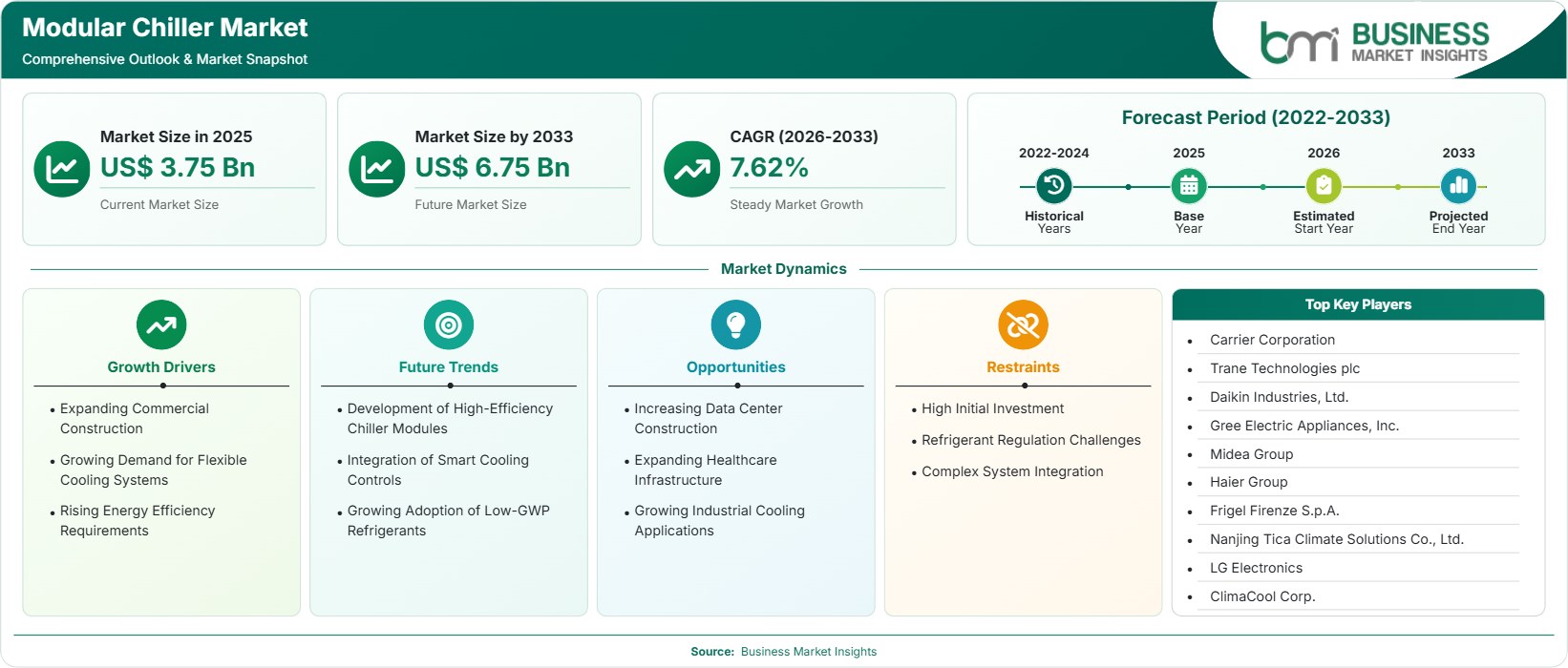
The Modular Chiller Market size was valued at US$ 3.75 Billion in 2025 and is projected to reach US$ 6.75 Billion by 2033, growing at a CAGR of 7.62% during 2026–2033, driven by commercial construction growth, energy-efficient cooling adoption, data center expansion, healthcare infrastructure development, and increasing demand for scalable climate-control solutions.

Report Coverage
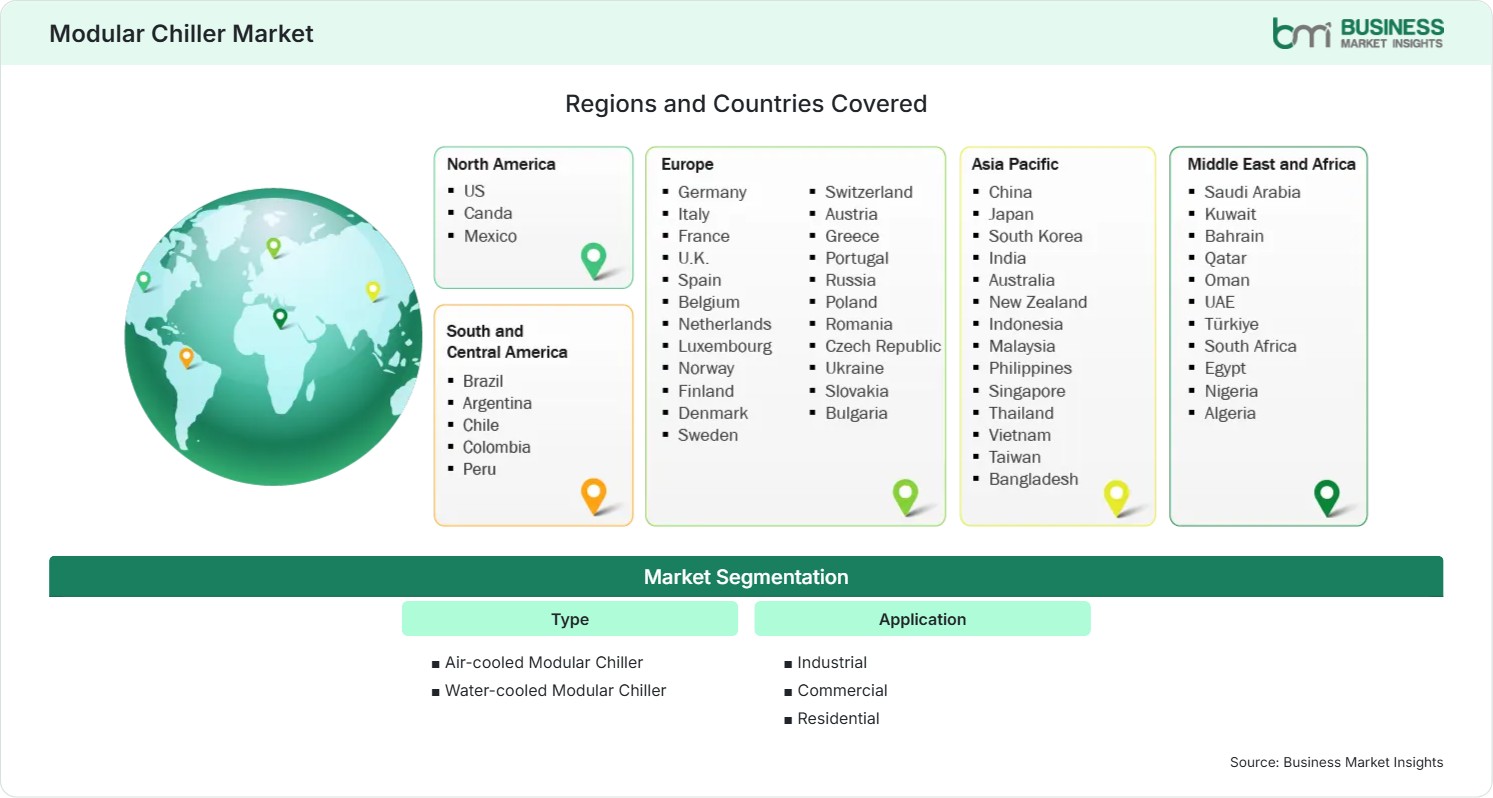
  • Type: Air-cooled Modular Chiller, Water-cooled Modular Chiller
  • Application: Industrial, Commercial, Residential
US$ 3.75 Bn Market size in 2025
US$ 6.75 Bn Market Size by 2033
7.62% CAGR, 2026 - 2033
2026-2033 Forecast Period

01 AI Overview

Modular Chiller Market Summary

  • North America Region: North America holds a market share of 34%–37% in 2025, growing at a CAGR of 7.0%–7.8% during 2026–2033, supported by data center investments, energy-efficient building retrofits, commercial infrastructure modernization, smart HVAC deployment, and stringent sustainability requirements. The US remains the leading market, expanding at a CAGR of 7.1%–7.9% due to continuous commercial construction activity.
  • Fastest Growing Region: Asia Pacific accounts for 29%–32% market share in 2025 and is projected to grow at a CAGR of 8.3%–9.1% during 2026–2033, driven by urbanization, industrial expansion, smart-city programs, growing commercial facilities, and increasing investment in energy-efficient cooling technologies.
  • Leading Segment: Air-cooled Modular Chiller represents 58%–62% market share in 2025 and advances at a CAGR of 7.4%–8.2% during 2026–2033, benefiting from easy installation, lower maintenance requirements, flexible deployment, and growing demand across commercial facilities.
  • High Growth Segment: Commercial applications account for 46%–50% share in 2025 and are anticipated to register a CAGR of 8.0%–8.8% during 2026–2033, supported by office developments, retail complexes, healthcare facilities, hospitality projects, and green-building initiatives.
  • Key Market Opportunity: Growing adoption of modular cooling systems in data centers, hospitals, mixed-use developments, and sustainable building projects creates long-term opportunities for manufacturers offering efficient scalable HVAC technologies.
  • Major Market Players: Carrier Corporation, Trane Technologies plc, Daikin Industries, Ltd., Gree Electric Appliances, Inc., Midea Group Co., Ltd., Haier Group Corporation, Frigel Firenze S.p.A., Nanjing TICA Climate Solutions Co., Ltd., LG Electronics Inc., ClimaCool Corp.
02 Strategic Insights

Modular Chiller Market: Strategic Insights

Modular Chiller Market Strategic Framework
FREE PDF
Request your free sample
Request free sample
03 Stakeholder View

Key Takeaways

  • The market value chain increasingly integrates component suppliers, HVAC manufacturers, building developers, engineering firms, and maintenance providers to deliver scalable cooling solutions across diverse end-use sectors.
  • Commercial buildings and data center facilities represent the strongest growth opportunities due to increasing cooling requirements, operational flexibility needs, and sustainability targets.
  • Technological innovation is centered on intelligent control systems, low-global-warming-potential refrigerants, variable-speed compressors, and IoT-enabled performance monitoring platforms.
  • Asia Pacific offers a compelling investment landscape, supported by urban infrastructure expansion, manufacturing growth, commercial construction activity, and rising energy-efficiency adoption.
  • Strategic partnerships, capacity expansions, and technology-focused acquisitions are strengthening competitive positioning among global HVAC equipment manufacturers.
  • Regulatory pressure to improve building energy performance is accelerating replacement of traditional cooling systems with modular, efficient, and scalable alternatives.
04 Geographic Outlook

Modular Chiller Market Regional Highlights

North America Modular Chiller Market

North America accounted for 34%–37% of global revenue in 2025 and is projected to expand at a CAGR of 7.0%–7.8% through 2033. The region maintains leadership due to strong commercial construction activity, widespread modernization of HVAC infrastructure, and growing deployment of advanced cooling systems in data centers and healthcare facilities. Modular Chiller Market share remains substantial because building owners increasingly prioritize energy-efficient cooling technologies capable of delivering operational flexibility. Adoption is further strengthened by sustainability mandates, retrofit projects, and investments in smart building management systems.

  • Data center operators are increasingly deploying modular cooling configurations to support scalable infrastructure expansion while maintaining energy efficiency and operational reliability requirements.
  • Commercial office developments continue generating demand for modular systems due to their flexibility, simplified installation processes, and lower operational disruption during expansion projects.
  • Healthcare facilities favor modular cooling solutions because redundancy capabilities improve reliability and support uninterrupted operation of critical environments.
  • Energy-efficiency regulations encourage facility owners to replace aging systems with advanced modular chillers capable of reducing electricity consumption.
  • Smart HVAC integration is improving performance monitoring, predictive maintenance capabilities, and lifecycle cost management.

US Modular Chiller Market

The United States represents approximately 79%–83% of regional demand and is forecast to expand at a CAGR of 7.1%–7.9% through 2033. Market demand is driven by ongoing commercial investments, increasing retrofit activity, and rapid growth of digital infrastructure projects. Modular Chiller Market growth benefits from strong adoption across healthcare facilities, educational institutions, manufacturing plants, and mission-critical facilities. The combination of sustainability objectives and rising cooling requirements continues supporting widespread deployment of modular HVAC technologies.

  • Data center expansion remains one of the most significant demand generators for modular cooling solutions across the country.
  • Commercial building owners increasingly adopt scalable systems to support phased capacity additions and reduce long-term operating expenses.
  • Government and institutional facilities continue investing in energy-efficient cooling technologies to achieve sustainability goals.
  • Advanced building management systems are encouraging wider implementation of intelligent modular HVAC platforms.

Europe Modular Chiller Market

Europe held 25%–28% of global market revenue in 2025 and is expected to register a CAGR of 7.2%–8.0% through 2033. Regional growth is influenced by stringent energy-efficiency regulations, decarbonization initiatives, and strong investment in sustainable building technologies. Germany, the United Kingdom, and France remain major markets due to extensive commercial and industrial infrastructure. Spain and Poland are emerging as comparatively high-growth markets driven by construction activity and modernization of cooling systems across multiple industries.

  • Germany remains a leading market supported by industrial modernization and adoption of high-performance HVAC technologies.
  • The United Kingdom continues witnessing demand from commercial development projects and energy-efficient building upgrades.
  • Spain is demonstrating strong growth through increasing investment in hospitality, healthcare, and mixed-use infrastructure projects.
  • Regulatory pressure to improve building sustainability supports replacement of conventional cooling systems across the region.
  • Industrial facilities increasingly adopt modular solutions to improve cooling efficiency and operational adaptability.

Asia Pacific Modular Chiller Market

Asia Pacific accounted for 29%–32% of global revenue in 2025 and is projected to expand at a CAGR of 8.3%–9.1% through 2033, making it the fastest-growing regional market. Rapid urbanization, industrial expansion, commercial development, and infrastructure investment continue driving demand. China dominates regional consumption owing to extensive construction activity and manufacturing capacity. India, Southeast Asia, and South Korea are also experiencing rising adoption as governments and businesses increasingly prioritize energy-efficient cooling systems for modern facilities.

  • China leads regional demand due to large-scale commercial construction projects and extensive industrial infrastructure development.
  • India is experiencing strong adoption supported by urban growth, data center investments, and commercial real estate expansion.
  • Manufacturing facilities increasingly deploy modular chillers to improve cooling reliability and production efficiency.
  • Smart-city initiatives across Asia Pacific encourage installation of energy-efficient HVAC technologies in new developments.
  • Growing sustainability awareness is stimulating investment in environmentally responsible cooling solutions.

Rest of World Modular Chiller Market

Rest of World represented 7%–9% of global revenue in 2025 and is expected to grow at a CAGR of 7.4%–8.2% through 2033. South & Central America continue benefiting from commercial construction growth and industrial facility upgrades. The Middle East & Africa are witnessing increased demand resulting from infrastructure development, hospitality projects, and expansion of healthcare facilities. Brazil remains a leading market within Latin America, while Saudi Arabia and the United Arab Emirates demonstrate strong growth potential through large-scale development initiatives.

  • Brazil continues generating demand through commercial real estate projects and modernization of industrial cooling infrastructure.
  • Mexico benefits from manufacturing expansion and increasing investment in energy-efficient building technologies.
  • Saudi Arabia is investing heavily in large-scale mixed-use developments and advanced climate-control systems.
  • The United Arab Emirates supports adoption through hospitality, healthcare, and data center infrastructure projects.
  • Regional infrastructure modernization programs continue creating opportunities for modular cooling technology providers.
Global Market Geography
FREE PDF
Request your free sample
Request free sample
05 Segment Analysis

Modular Chiller Market Segmentation

Type

The type segment accounts for approximately 58%–62% market revenue in 2025 and is anticipated to grow at a CAGR of 7.4%–8.2% through 2033. Modular Chiller Market scope continues expanding as end users prioritize scalable, energy-efficient, and easy-to-maintain cooling solutions. Demand is supported by increasing deployment across commercial, industrial, and institutional facilities requiring flexible capacity management and reliable temperature control systems.

  • Air-cooled Modular Chiller: Widely adopted due to simplified installation, lower maintenance requirements, reduced water dependency, and suitability for diverse commercial and industrial applications.
  • Water-cooled Modular Chiller: Preferred for large-scale facilities requiring higher cooling efficiency, optimized performance, and effective operation in demanding environments.

Application

The application segment represents 46%–50% market share in 2025 and is projected to register a CAGR of 8.0%–8.8% through 2033. Modular Chiller Market trends are increasingly shaped by rising demand from commercial developments, healthcare facilities, industrial plants, and data centers. Energy efficiency, operational flexibility, and sustainable cooling performance remain important purchasing considerations across application areas.

  • Industrial: Supports manufacturing processes, production environments, food processing activities, and facilities requiring precise temperature management and operational reliability.
  • Commercial: Includes office buildings, hospitals, retail complexes, hotels, educational institutions, and mixed-use developments requiring scalable cooling solutions.
  • Residential: Gains adoption in large residential complexes and premium housing projects that require centralized and energy-efficient climate control capabilities.
06 Market Forces

Modular Chiller Market Dynamics

Key Market Drivers

Expanding Commercial Construction

Commercial construction activity continues to increase across office complexes, healthcare facilities, educational institutions, retail developments, airports, and mixed-use infrastructure projects. Modular Chiller Market growth is closely related to this trend as manufacturers are increasingly looking for cooling solutions that are flexible in terms of installation, capacity, and energy consumption. Modular chillers allow for phased introduction and thus can help in balancing cooling needs in accordance with the growth in the number of inhabitants and building size. The small dimensions and simple integration of modular chillers make them especially popular with modern constructions.

Growing Demand for Flexible Cooling Systems

Companies need cooling systems that can adapt to any changes in operational needs without major alterations in the design of their systems. This is possible with modular chillers, which can increase the amount of cooling power through capacity increments, redundancy abilities, and easier maintenance procedures. The Modular Chiller Market trends show the rising tendency toward systems that will reduce downtime while ensuring the ability to meet future growth needs. Operators in different industries such as commercial, industrial, and institutional are focusing on equipment that enables operational flexibility and resource efficiency.

Rising Energy Efficiency Requirements

Building owners and operators are focusing on reducing energy consumption while maintaining reliable cooling performance. The use of regulatory compliance, sustainability considerations, and the increasing cost of energy are promoting the uptake of high-technology HVAC systems that provide better efficiency. The modular chillers fitted with variable speed compressors and load management systems help facilities meet energy performance standards. The capability to regulate the cooling process based on the demands lowers wastage of energy during partial loading operations. There is an increased need for sustainability in the management of buildings and carbon reduction strategies, which promote the adoption of modular chillers.

Key Market Opportunities

Increasing Data Center Construction

Rapid digitalization, cloud computing adoption, artificial intelligence deployment, and expanding storage requirements are generating substantial demand for data center infrastructure worldwide. The Modular Chiller Market Forecast offers many possibilities as organizations seek flexible cooling solutions that can be used to accommodate increasing computing loads. The need for reliable temperature management and operational flexibility makes modular chillers a for data centers. The fact that they provide options for expansion is ideal for data centers as they grow. There will be increased demand for manufacturers of high-quality modular cooling solutions as more money goes into the development of digital infrastructure.

Expanding Healthcare Infrastructure

Growth in hospitals, specialty clinics, diagnostic centers, and healthcare campuses is creating attractive opportunities for modular cooling solutions. Healthcare establishments need efficient environmental control systems for patients' comfort, safety, and continuity of operations. Modular chillers can provide reliability and maintenance features that are consistent with the needs of the healthcare sector. Both governments and private organizations keep investing in the expansion of healthcare establishments worldwide. The growth in healthcare construction, along with stringent requirements for indoor environments, will fuel the demand for advanced modular cooling solutions.

Growing Industrial Cooling Applications

Industrial facilities increasingly require efficient cooling systems to support manufacturing operations, process stability, and equipment performance. Industries like pharmaceuticals, food processing, chemicals, electronics, and semiconductors are adopting cooling systems that help in sustaining their efficiency and product quality. The use of modular chillers offers flexibility in terms of performance, efficiency, and fast installation that aligns with the changing needs of the industries. The growth in the capacity of industrial production along with the modernization trends, creates new opportunities for companies offering modular chillers solutions.

Market Restraints and Challenges

High Initial Investment

Factor: Deployment of modular chiller systems often requires substantial capital investment related to equipment procurement, installation, system integration, and supporting infrastructure. Advanced technologies, intelligent controls, and energy-efficient components can further increase acquisition costs. Impact: High upfront expenditures may discourage investment among cost-sensitive businesses and smaller facilities despite long-term operational savings. Budget limitations can delay replacement cycles and reduce adoption rates in certain end-user segments. While lifecycle benefits frequently justify the investment, initial financial considerations remain an important challenge influencing purchasing decisions and broader market penetration.

Refrigerant Regulation Challenges

Factor: Environmental regulations governing refrigerant usage continue evolving as governments seek to reduce greenhouse gas emissions and phase down high-global-warming-potential substances. Manufacturers and facility operators must comply with changing standards while maintaining cooling performance and operational efficiency. Impact: Regulatory transitions can increase costs associated with product redesign, compliance testing, refrigerant replacement, and system upgrades. Uncertainty regarding future requirements may also affect procurement planning and investment decisions. Successfully navigating evolving environmental regulations remains a critical challenge for stakeholders throughout the modular chiller value chain.

07 Company Analysis

Competitive Landscape

Modular Chiller Market analysis indicates competition is primarily centered on energy efficiency, smart HVAC integration, refrigerant innovation, scalable cooling architecture, and global after-sales service capabilities.

Company Name

Overview

Products and Services relevant to this market

Carrier Corporation

Global HVAC leader providing advanced climate-control technologies for commercial and industrial applications.

Modular chillers, air-conditioning systems, building controls, energy management solutions, and HVAC services.

Trane Technologies plc

Climate innovation company focused on sustainable cooling and energy-efficient building solutions.

Modular chillers, smart HVAC platforms, cooling equipment, controls, and maintenance services.

Daikin Industries, Ltd.

Major HVAC manufacturer with extensive global presence and advanced cooling technology portfolio.

Air-cooled chillers, water-cooled chillers, modular systems, refrigerant technologies, and controls.

Gree Electric Appliances, Inc.

International manufacturer of air-conditioning and commercial climate-control systems.

Modular chillers, commercial HVAC systems, energy-efficient cooling products, and support services.

Midea Group Co., Ltd.

Diversified technology company offering comprehensive commercial HVAC and cooling solutions.

Modular chillers, integrated building solutions, cooling systems, and smart energy technologies.

Haier Group Corporation

Global appliance and climate-control provider serving residential and commercial markets.

Chiller systems, smart cooling technologies, HVAC equipment, and building climate-control solutions.

Frigel Firenze S.p.A.

Specialist in industrial cooling technologies and process temperature-control systems.

Modular chillers, industrial cooling systems, process temperature management, and engineering services.

Nanjing TICA Climate Solutions Co., Ltd.

HVAC manufacturer focused on commercial and industrial cooling equipment.

Air-cooled modular chillers, water-cooled chillers, ventilation systems, and turnkey HVAC solutions.

LG Electronics Inc.

Global electronics and HVAC provider emphasizing energy-efficient building technologies.

Modular chillers, HVAC systems, smart controls, energy-management technologies, and cooling solutions.

ClimaCool Corp.

Cooling technology provider serving commercial and industrial climate-control applications.

Modular cooling equipment, chiller solutions, system optimization services, and maintenance support.

10 Trust & Transparency

Research Methodology

The market analysis combines proprietary research with secondary data from government agencies, company disclosures, regulatory filings, industry databases and expert interviews. Market estimates are validated through data triangulation, cross-market benchmarking and analyst review.

View Full Research Methodology

11 Questions Answered

Frequently Asked Questions

What information does a Modular Chiller Market Report provide?

A Modular Chiller Market Report typically includes market size evaluation, competitive benchmarking, regional trends, technology developments, application analysis, growth opportunities, and future industry outlook.

How do modular chillers support sustainability goals?

They improve energy efficiency through load optimization, intelligent controls, variable-speed technologies, and scalable operation that reduces unnecessary energy consumption.

Which application segment generates the highest demand?

Commercial applications generate the largest demand due to extensive deployment across office buildings, hospitals, retail centers, hotels, and educational facilities.

Why are air-cooled modular chillers widely adopted?

Air-cooled systems offer easier installation, reduced water requirements, simplified maintenance, and operational flexibility, making them suitable for a broad range of commercial applications.

What are modular chillers used for?

Modular chillers are used to provide scalable cooling for commercial buildings, industrial facilities, healthcare environments, data centers, educational institutions, and mixed-use infrastructure projects.

Access the Full Modular Chiller Market Report

Get segment-level forecasts, regional estimates, competitive benchmarking, company profiles and downloadable Excel datasets.

Access the full Modular Chiller Market Report
350 pages PDF & Excel | 2026-08-24