
Modular Construction Market Outlook: Size, Share, Trends, Growth Analysis, Competitive Landscape & Forecast, 2026-2033

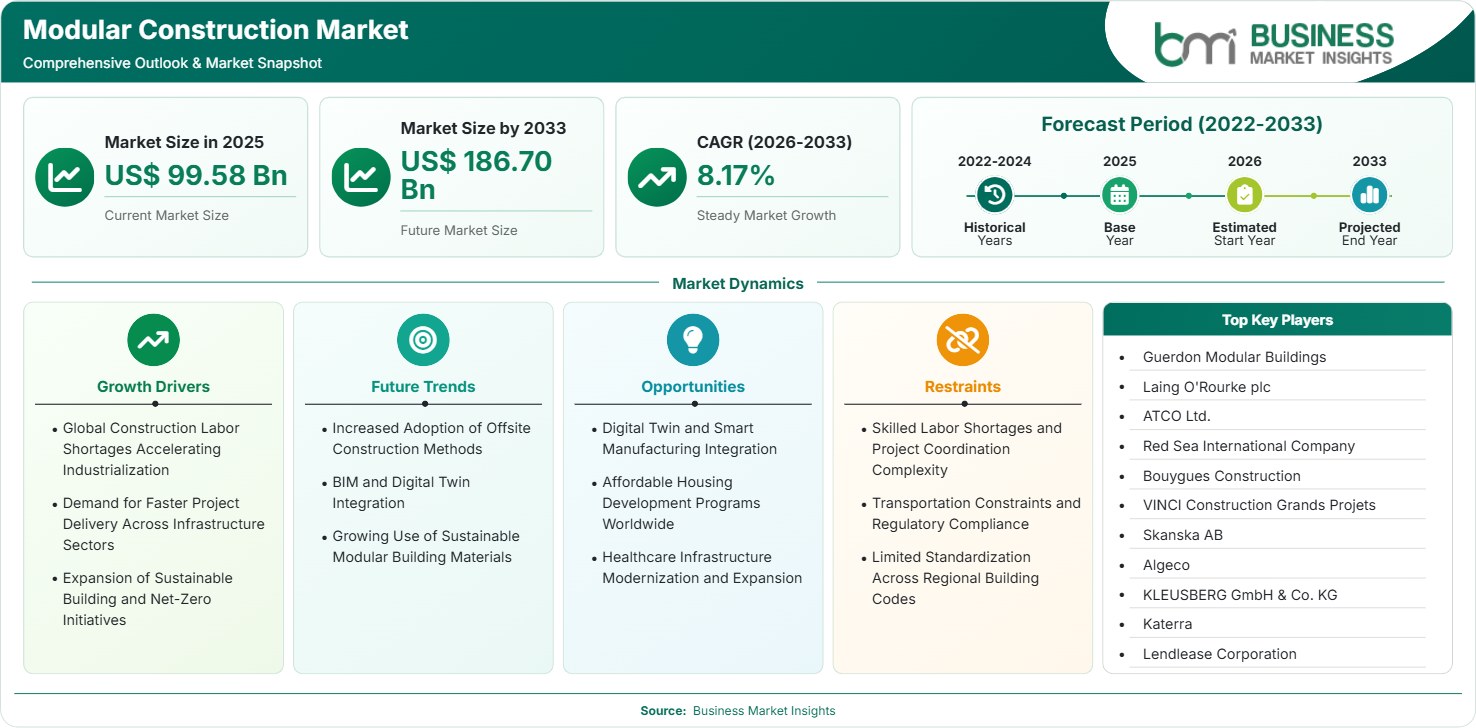
The Modular Construction Market size was valued at US$ 99.58 Billion in 2025 and is projected to reach US$ 186.7 Billion by 2033, growing at a CAGR of 8.17% during 2026–2033. Urbanization, construction worker shortages, sustainable construction, digital construction, and increased demand for speed in delivering projects present significant growth prospects in the residential, commercial, healthcare, and institutional segments.

Report Coverage
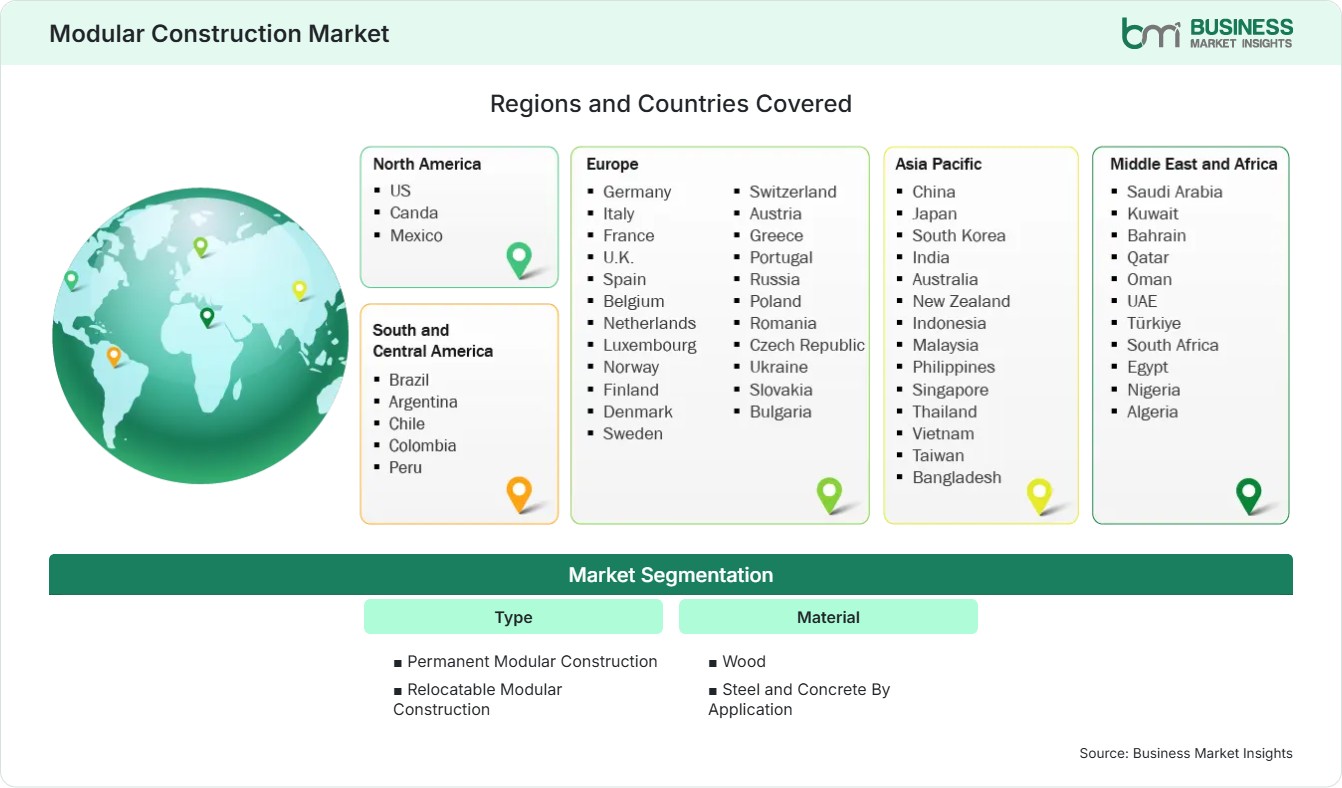
  • Type: Permanent Modular Construction, Relocatable Modular Construction
  • Material: Wood, Steel and Concrete) By Application (Commercial, Healthcare, Education & Institutional, Hospitality, Others
US$ 99.58 Bn Market size in 2025
US$ 186.70 Bn Market Size by 2033
8.17% CAGR, 2026 - 2033
2026-2033 Forecast Period

AI Overview

Modular Construction Market Summary

  • North America Region: North America holds a modular construction market share of 34%–37% in 2025, growing with a CAGR of 7.8%–8.5% during 2026–2033. Strong infrastructure investment, housing shortages, labor productivity challenges, digital construction integration, and increasing adoption of prefabricated building methods continue supporting market expansion opportunities.
  • Fastest Growing Region: Asia Pacific accounts for 28%–31% of the market in 2025 and is projected to expand at a CAGR of 8.9%–9.6% during 2026–2033. Rapid urbanization, smart city projects, industrial development, affordable housing programs, and construction modernization initiatives are accelerating modular building adoption.
  • Leading Segment: Permanent Modular Construction represents 61%–64% of market revenue in 2025 and is expected to register a CAGR of 8.0%–8.6% through 2033. Demand is driven by long-term infrastructure projects, educational facilities, healthcare buildings, and commercial developments requiring efficient delivery.
  • High Growth Segment: Healthcare accounts for 14%–17% of application demand in 2025 and is anticipated to grow at a CAGR of 9.2%–10.0% during 2026–2033. Expanding healthcare infrastructure investments, rapid facility deployment requirements, and increasing focus on operational efficiency support accelerated adoption.
  • Key Market Opportunity: Expansion of industrialized construction ecosystems integrating digital design, offsite manufacturing, automation, and sustainable building materials offers substantial opportunities for productivity improvement and cost optimization globally.
  • Major Market Players: Guerdon Modular Buildings, Laing O'Rourke plc, ATCO Ltd., Red Sea International Company, Bouygues Construction, VINCI Construction Grands Projets, Skanska AB, Algeco, KLEUSBERG GmbH & Co. KG, Katerra, and Lendlease Corporation.
Strategic Insights

Modular Construction Market: Strategic Insights

Modular Construction Market Strategic Framework
FREE PDF
Request your free sample
Request free sample
Stakeholder View

Key Takeaways

  • The value chain is becoming increasingly integrated, with manufacturers, engineering firms, logistics providers, and developers collaborating to improve project efficiency and reduce construction timelines.
  • Healthcare and institutional infrastructure projects represent attractive growth opportunities due to demand for rapid deployment, standardized quality, and scalable building solutions.
  • Innovation is increasingly centered on automation, digital twins, Building Information Modeling integration, and advanced manufacturing systems that improve precision and productivity.
  • Asia Pacific offers one of the strongest investment cases due to urban population growth, government-backed housing initiatives, and increasing acceptance of industrialized construction methods.
  • Strategic acquisitions, manufacturing facility expansions, and partnerships between construction firms and technology providers are accelerating industry consolidation and capability enhancement.
  • Sustainability-driven procurement policies are encouraging adoption of resource-efficient building systems that reduce waste, lower emissions, and improve lifecycle performance.
Geographic Outlook

Modular Construction Market Regional Highlights

North America Modular Construction Market

North America accounts for 34%–37% Modular Construction Market share in 2025 and is projected to expand at a CAGR of 7.8%–8.5% through 2033. Strong demand for multifamily housing, healthcare facilities, workforce accommodation, and educational infrastructure continues supporting adoption. Construction labor shortages, rising project costs, and pressure to shorten delivery schedules are encouraging developers to embrace offsite manufacturing.

  • Large-scale residential developments increasingly utilize factory-built modules to accelerate project completion while improving quality control and reducing labor dependency across urban housing markets.
  • Infrastructure modernization programs across the United States and Canada continue supporting adoption of industrialized construction approaches for public-sector projects requiring speed and cost efficiency.
  • Growing emphasis on sustainability and waste reduction encourages developers to adopt modular systems that optimize material utilization and lower environmental impact.
  • Healthcare providers increasingly deploy modular facilities for clinics, diagnostic centers, and specialized treatment units to meet growing patient demand rapidly.
  • Expansion of advanced manufacturing capabilities is enhancing regional production capacity and supporting large-scale project execution.

US Modular Construction Market

The U.S. represents approximately 74%–77% of North American revenue and is expected to grow at a CAGR of 8.0%–8.7% through 2033. Strong activity in multifamily housing, hospitality, healthcare, and workforce accommodation continues supporting demand. Federal infrastructure initiatives, population growth in major metropolitan regions, and increasing construction cost pressures are driving broader industry adoption.

  • Housing affordability challenges continue encouraging adoption of faster and more scalable building methodologies across residential developments.
  • Public-sector investments in education and healthcare infrastructure are expanding opportunities for modular building suppliers and engineering firms.
  • Growing interest in sustainable building certifications is strengthening demand for resource-efficient construction techniques.
  • Advanced Building Information Modeling adoption supports improved coordination between design, manufacturing, and on-site installation activities.

Europe Modular Construction Market

Europe holds 26%–29% of global revenue in 2025 and is forecast to grow at a CAGR of 7.9%–8.6% during the forecast period. Strong environmental regulations, labor shortages, and energy-efficient building requirements are accelerating adoption across the region. The United Kingdom remains the leading modular construction market with growth of 8.0%–8.7%, while Germany emerges as a high-growth market at 8.3%–9.0%.

  • Net-zero building objectives are encouraging developers to adopt construction methods capable of reducing emissions and material waste.
  • Labor availability constraints are increasing interest in offsite manufacturing and prefabrication technologies across multiple project categories.
  • Educational and healthcare infrastructure modernization programs continue supporting demand for rapid-deployment building systems.
  • Government initiatives promoting affordable housing are creating long-term opportunities for modular project developers and manufacturers.

Asia Pacific Modular Construction Market

Asia Pacific accounts for 28%–31% of global demand in 2025 and represents the fastest-growing region, with a CAGR of 8.9%–9.6% through 2033. Rapid urbanization, industrial expansion, and infrastructure development programs are driving widespread adoption. China remains the largest market with growth of 8.7%–9.4%, while India records the strongest expansion at 9.2%–10.1%. Significant investments in smart cities, transportation infrastructure, and affordable housing continue creating favorable conditions for industrialized building methods throughout the region.

  • Large-scale urban development projects require efficient construction methods capable of supporting population growth and infrastructure expansion.
  • Government-backed housing initiatives are increasing adoption of factory-built systems to address housing shortages quickly and economically.
  • Industrial facility construction is increasingly utilizing modular techniques to reduce project timelines and improve operational readiness.
  • Rising investments in digital manufacturing technologies are supporting modernization of regional construction ecosystems.

Rest of World Modular Construction Market

South & Central America are gradually increasing adoption of offsite construction technologies as governments prioritize affordable housing and public infrastructure development. Brazil remains the largest regional contributor, supported by investments in residential and institutional projects. The Middle East & Africa collectively account for 8%–11% of global demand in 2025 and are expected to expand at a CAGR of 7.4%–8.1% through 2033.

  • Mega-project developments across Gulf countries are driving demand for scalable construction methods capable of accelerating project delivery.
  • Tourism and hospitality investments continue creating opportunities for modular accommodation and support infrastructure projects.
  • Public-sector housing initiatives are supporting broader adoption of prefabricated building solutions across emerging economies.
  • Infrastructure expansion programs are increasing demand for educational, healthcare, and commercial modular facilities.
  • International construction partnerships are facilitating technology transfer and improving regional manufacturing capabilities.
Global Market Geography
FREE PDF
Request your free sample
Request free sample
Segment Analysis

Modular Construction Market Segmentation

Type

The type segment remains the foundation of industry development, reflecting varying project permanence requirements and investment priorities across end-use sectors. This segment accounted for approximately 61%–64% of total demand in 2025 and is expected to grow at a CAGR of 8.0%–8.6% through the forecast period. Increasing acceptance of industrialized construction methods, sustainability objectives, and faster project delivery cycles are expanding the Modular Construction Market scope across commercial, institutional, residential, and infrastructure applications. Continuous advancements in manufacturing precision and digital design integration further support long-term adoption.

  • Permanent Modular Construction: Widely utilized for schools, healthcare facilities, offices, residential buildings, and commercial developments where long-term occupancy, durability, and lifecycle cost efficiency remain primary project requirements.
  • Relocatable Modular Construction: Increasingly adopted for temporary classrooms, workforce accommodation, healthcare expansion units, construction-site facilities, and emergency response infrastructure requiring flexibility, mobility, and rapid deployment capabilities.

Material

Material selection plays a critical role in determining structural performance, sustainability outcomes, cost efficiency, and project suitability. The segment represented approximately 22%–26% of overall market activity in 2025 and is projected to register a CAGR of 8.2%–8.9% through 2033. Evolving design requirements, energy-efficiency regulations, and lifecycle performance expectations continue influencing material preferences. Emerging Modular Construction Market trends indicate increasing adoption of hybrid material systems that optimize strength, sustainability, and manufacturing efficiency.

  • Wood: Preferred in low-rise residential and institutional projects due to sustainability benefits, design flexibility, renewable sourcing potential, and growing acceptance of engineered timber technologies.
  • Steel: Extensively used in commercial, industrial, healthcare, and high-rise projects because of structural strength, durability, precision manufacturing compatibility, and scalability for complex building designs.
  • Concrete: Increasingly utilized where fire resistance, acoustic performance, structural stability, and long-term durability are essential requirements, particularly across infrastructure and institutional developments.

Application

Application diversity continues expanding as developers seek efficient construction alternatives capable of meeting varying operational requirements. This segment accounted for approximately 38%–42% of total market demand in 2025 and is forecast to grow at a CAGR of 8.3%–9.0% through the assessment period. Demand is supported by urbanization, infrastructure modernization, and increasing emphasis on sustainability. The expanding Modular Construction Market share across multiple sectors reflects growing confidence in modular delivery models and long-term building performance.

  • Commercial: Office buildings, retail developments, mixed-use projects, and industrial facilities increasingly utilize modular approaches to reduce project schedules and improve construction productivity.
  • Healthcare: Hospitals, clinics, laboratories, and specialized treatment centers benefit from accelerated deployment capabilities and consistent quality standards achievable through offsite manufacturing.
  • Education & Institutional: Schools, universities, government facilities, and public buildings increasingly adopt modular systems to address capacity needs while minimizing project disruption.
  • Hospitality: Hotels, resorts, workforce accommodation facilities, and tourism infrastructure projects leverage modular construction to improve speed-to-market and operational readiness.
Market Forces

Modular Construction Market Dynamics

Key Market Drivers

Global Construction Labor Shortages Accelerating Industrialization

Construction labor shortages continue affecting project execution across North America, Europe, Asia Pacific, and the Middle East. According to industry associations and workforce studies, aging labor forces and declining participation rates are constraining productivity in several major construction markets. Modular techniques reduce on-site labor dependency by shifting significant portions of project execution into controlled manufacturing environments. This structural shift supports greater schedule reliability, improved quality consistency, and lower exposure to workforce availability challenges. Modular Construction Market growth is increasingly linked to the industry's ability to address labor constraints through automation, standardized production processes, and factory-based assembly models. As workforce pressures intensify, developers and contractors are expected to accelerate adoption of modular building systems that improve operational efficiency while mitigating skilled labor shortages.

Demand for Faster Project Delivery Across Infrastructure Sectors

There is an increasing expectation for the completion of projects within short time frames by governments, healthcare facilities, educational establishments, and even private builders. Traditional ways of construction involve delays caused by unfavorable weather conditions, insufficient availability of laborers, and poor project management. Modular construction techniques drastically shorten the period of time that is required for a project, as construction is carried out simultaneously at the site and in a factory. There is a great need for shortening of the delivery times in cases of healthcare infrastructure enlargement, housing program realization, and other types of construction work.

Expansion of Sustainable Building and Net-Zero Initiatives

Sustainability objectives are gaining momentum in the procurement of construction activities. More governments around the world are tightening their standards of building efficiency, emission reduction, and waste management. Production environments of modular type will lead to effective material utilization and waste minimization, as well as efficient energy management in construction process. Efficient production processes will allow better accuracy and less consumption of resources as well. Increased interest in green buildings and infrastructure will help increase the popularity of modular systems. Also, increased interest of investors in sustainability of the companies will positively affect the demand for these systems.

Key Market Opportunities

Digital Twin and Smart Manufacturing Integration

The convergence of modular construction technologies with digital twins, advanced analytics, robotics, and smart manufacturing systems is creating promising prospects for the future. Digital models of projects make design more accurate, allow production planning and better management of asset life cycle. Companies that are willing to implement connected production systems may benefit from improved efficiency, quality control and transparency of their supply chains. Introduction of Industry 4.0 concepts in the construction manufacturing industry will contribute to increased competitiveness and decreased inefficiency. The Modular Construction Market forecast are already considering effects of digital transformation that can increase productivity and scalability of companies.

Affordable Housing Development Programs Worldwide

The shortage of housing continues to be one of the biggest problems faced by both developed and developing countries. There have been massive investments made in the form of affordable housing programs that aim at catering to population growth, urbanization, and increased housing costs. With its capability for scalability and rapid execution with cost control and quality, modular construction stands out as a viable solution. Standardizing the design of buildings and streamlining the manufacturing process makes it possible to scale up effectively. With the growing demand for housing in cities, there is a strong possibility that modular construction will become a major part of the strategy going forward.

Healthcare Infrastructure Modernization and Expansion

Healthcare providers all over the world are developing their facilities, specialized treatment centers, diagnostic laboratories, and facilities for emergencies. Modular design has several benefits, such as being fast, flexible, of high quality, and minimizing disruption of existing healthcare facilities' operations. Aging of the population, growing use of healthcare services, and increased funding of the infrastructure in healthcare will keep creating the positive conditions of demand. The hospitals need to have flexible facilities that can accommodate various types of healthcare models and technologies. Modular construction will enable quick installation in accordance with strict standards of healthcare buildings.

Market Restraints and Challenges

Skilled Labor Shortages and Project Coordination Complexity

Factor: The use of modular construction involves a need for specialized skills in designing, manufacturing, transporting and assembling the modules, which results in labor shortages and poor coordination.

Impact: Lack of qualified workers and experienced project teams may cause delays in production timelines, increased labor expenses, and low efficiency of installation. Coordination is an essential aspect, which makes project implementation difficult compared to conventional construction. Such factors may hinder the use of modular construction by developers with no previous experience in it.

Transportation Constraints and Regulatory Compliance

Factor: Size constraints in transport, permitting issues, and building code differences by region make the logistics more complex and costlier.

Impact: Large prefab modules can have transport restrictions due to size restrictions on roads, clearance restrictions on bridges, and permitting issues. Differences in local building codes can result in additional changes in design for a specific project, making it less standardized and longer to complete.

Company Analysis

Competitive Landscape

The competitive environment is characterized by investments in offsite manufacturing, digital engineering, design-for-manufacturing-and-assembly (DfMA), and sustainable building solutions. The Modular Construction Market analysis indicates that leading companies are expanding manufacturing capabilities, integrating BIM-enabled workflows, and strengthening project delivery ecosystems to improve efficiency and scalability. Increasing adoption of industrialized construction methods is encouraging collaboration between engineering firms, developers, and modular specialists worldwide.

Company Name

Overview

Products and Services Relevant to this Market

Guerdon Modular Buildings

U.S.-based modular building specialist serving multifamily housing, hospitality, workforce accommodation, and commercial construction sectors with large-scale volumetric solutions.

Permanent modular buildings, multifamily housing modules, hospitality structures, engineering support, and offsite manufacturing services.

Laing O'Rourke

International engineering and construction company recognized for advanced DfMA capabilities and industrialized construction technologies.

Offsite manufacturing, modular bridge systems, prefabricated components, digital engineering, and infrastructure construction solutions.

ATCO Ltd.

Canadian infrastructure and modular building provider serving industrial, workforce housing, education, and commercial markets globally.

Modular facilities, workforce accommodation, relocatable buildings, industrial infrastructure, and facility management services.

Red Sea International Company

Saudi Arabian provider of modular construction solutions supporting infrastructure, industrial, hospitality, and workforce accommodation projects.

Modular camps, prefabricated buildings, workforce housing, commercial structures, and engineering services.

Bouygues Construction

Global construction company leveraging modern construction techniques and industrialized building approaches across major projects.

Prefabricated building systems, infrastructure development, commercial construction, and sustainable engineering solutions.

VINCI Construction Grands Projets

International infrastructure and construction specialist delivering complex projects using advanced engineering and modular methodologies.

Infrastructure modules, engineered construction systems, industrialized building components, and project management services.

Skanska AB

Swedish construction and project development company focused on sustainable construction and industrialized building practices.

Modular construction solutions, commercial developments, sustainable buildings, and infrastructure delivery services.

Algeco

Leading modular space solutions provider serving education, healthcare, commercial, and public-sector requirements globally.

Modular classrooms, healthcare facilities, office buildings, temporary accommodation, and relocatable structures.

KLEUSBERG GmbH & Co. KG

German modular construction company specializing in flexible space solutions and permanent modular buildings.

Educational facilities, office modules, healthcare buildings, industrial structures, and turnkey modular projects.

Katerra

U.S.-based construction technology company recognized for integrating manufacturing and digital construction approaches.

Offsite manufacturing technologies, prefabricated components, design integration, and construction solutions.

Lendlease Corporation

Australian infrastructure and property group incorporating modern construction methods across global development projects.

Modular project delivery, urban development, commercial construction, sustainable building solutions, and infrastructure services.

Trust & Transparency

Research Methodology

The market analysis combines proprietary research with secondary data from government agencies, company disclosures, regulatory filings, industry databases and expert interviews. Market estimates are validated through data triangulation, cross-market benchmarking and analyst review.

View Full Research Methodology

Questions Answered

Frequently Asked Questions

Why is a Modular Construction Market Report valuable for investors?

The report helps investors evaluate adoption trends, technology developments, competitive positioning, manufacturing capacity expansion, regulatory drivers, and emerging opportunities across regional and application markets.

Can modular buildings meet sustainability objectives?

Yes. Factory-based production typically improves material utilization, reduces construction waste, lowers transportation of trades, and supports energy-efficient building design, contributing to broader sustainability and carbon-reduction goals.

Which industries are adopting modular construction most rapidly?

Healthcare, education, commercial real estate, hospitality, workforce accommodation, and multifamily housing sectors are among the most active adopters due to their need for rapid deployment and scalable infrastructure solutions.

What role does digital technology play in modular construction?

Digital technologies such as Building Information Modeling, digital twins, and manufacturing automation improve design coordination, production planning, logistics management, and lifecycle asset performance, enabling more efficient project delivery.

How is modular construction different from traditional construction?

Modular construction shifts a significant portion of building activities into factory-controlled environments where modules are manufactured and later assembled on-site. This approach improves schedule predictability, quality consistency, and resource efficiency while reducing site disruption.

Access the Full Modular Construction Market Report

Get segment-level forecasts, regional estimates, competitive benchmarking, company profiles and downloadable Excel datasets.

Access the full Modular Construction Market Report
350 pages PDF & Excel | 2026-08-18