
Autonomous Construction Equipment Market Outlook: Size, Share, Trends, Growth Analysis, Competitive Landscape & Forecast, 2026-2033

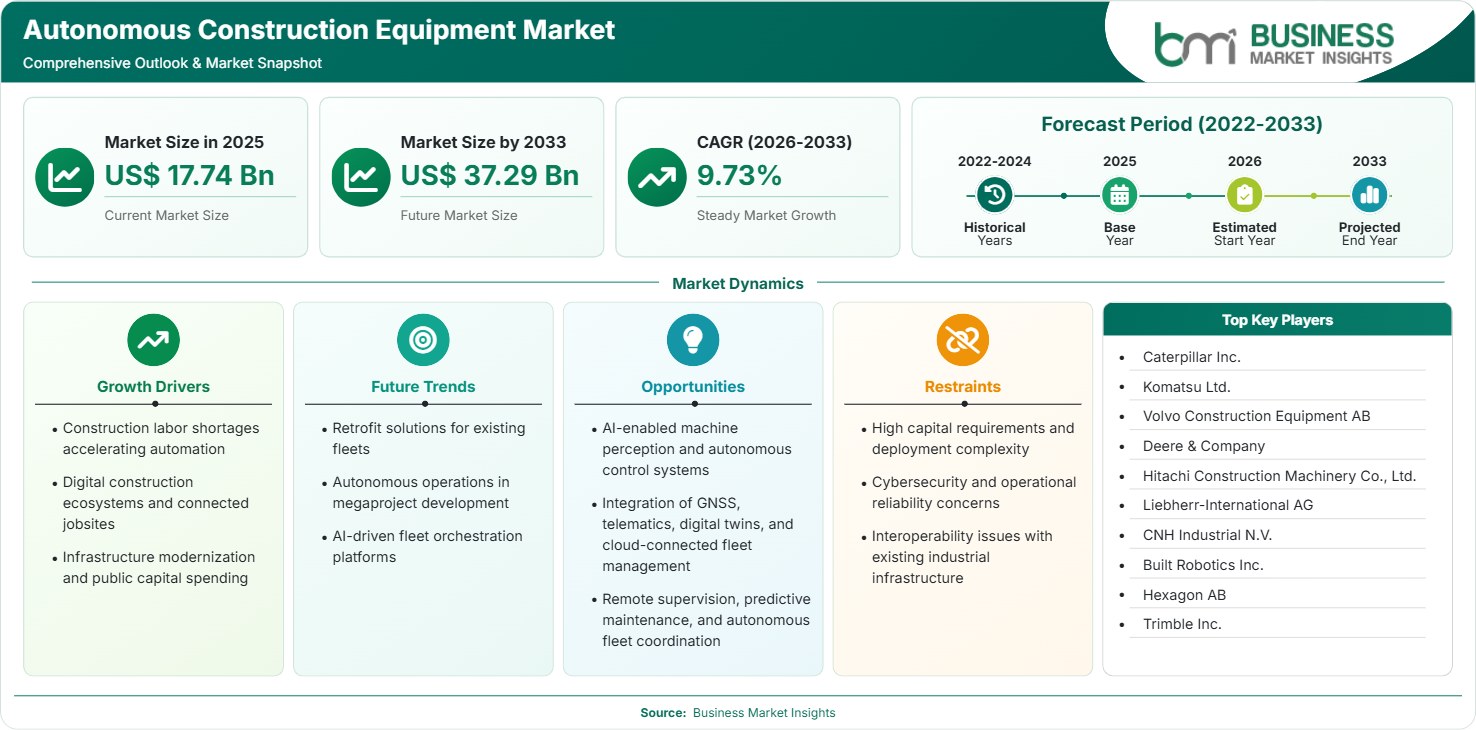
The Autonomous Construction Equipment Market size was valued at US$ 17.74 Billion in 2025 and is projected to reach US$ 37.29 Billion by 2033, growing at a CAGR of 9.73% during 2026–2033, driven by labor shortages, AI-enabled site automation, productivity optimization, safety requirements, smart infrastructure spending, and opportunities arising from digital construction ecosystems and autonomous fleet management.

Report Coverage
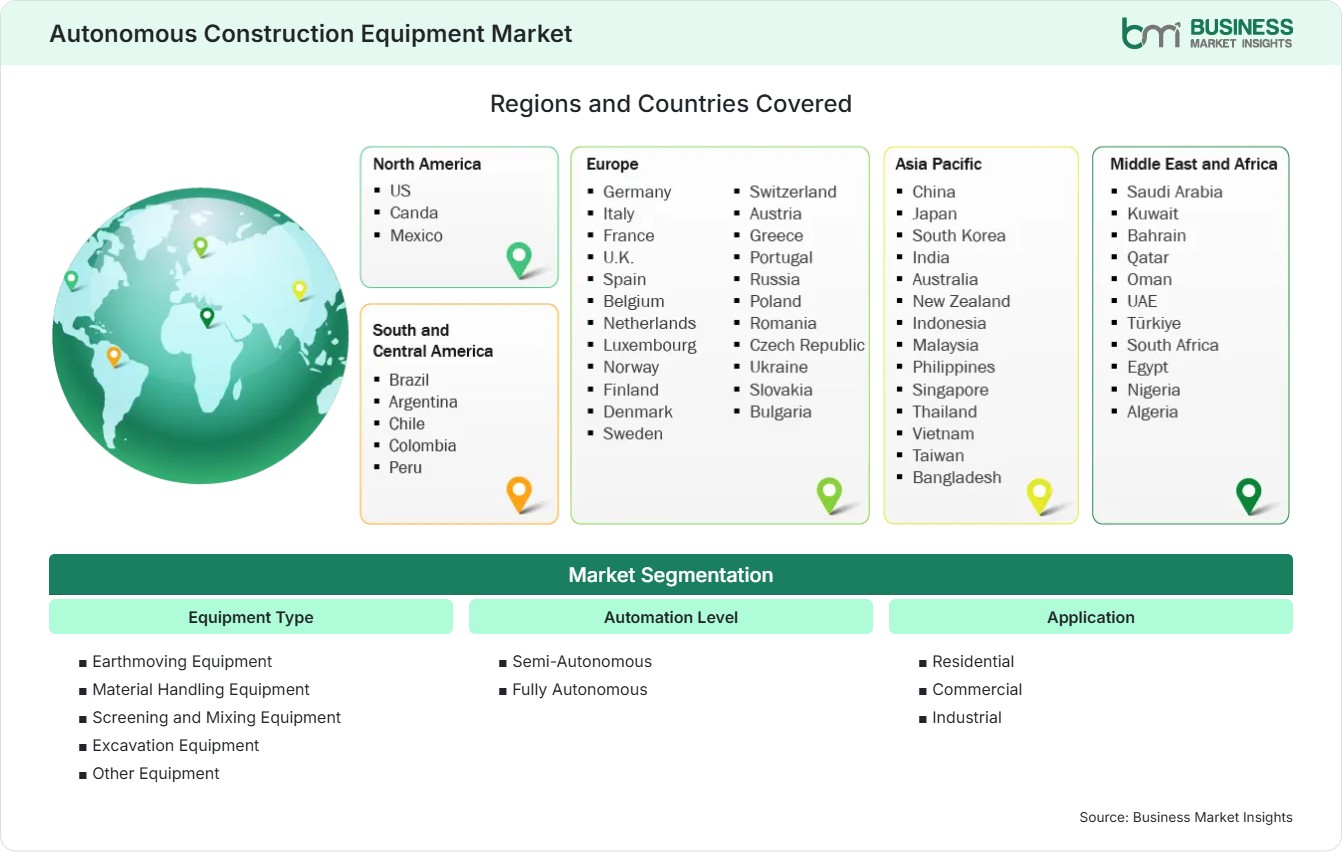
  • Equipment Type: Earthmoving Equipment, Material Handling Equipment, Screening and Mixing Equipment, Excavation Equipment, Other Equipment
  • Automation Level: Semi-Autonomous, Fully Autonomous
  • Application: Residential, Commercial, Industrial
US$ 17.74 Bn Market size in 2025
US$ 37.29 Bn Market Size by 2033
9.73% CAGR, 2026 - 2033
2026-2033 Forecast Period

AI Overview

Autonomous Construction Equipment Market Summary

  • North America Region: North America holds a market share of 36%–39% in 2025, growing at a CAGR of 8.8%–9.6% during 2026–2033. Key drivers include contractor digitization, labor constraints, connected equipment adoption, and federal infrastructure investment. Opportunities emerge from autonomous earthmoving deployments and teleoperation platforms. US demand benefits from large-scale infrastructure modernization, strong OEM presence, and growing autonomous equipment trials, advancing at approximately 9.0%–9.8% CAGR.
  • Fastest Growing Region: Asia Pacific holds 28%–31% share in 2025 and expands at 11.2%–12.0% CAGR. Growth is supported by urbanization, megaproject construction, smart-city investments, equipment digitization, infrastructure modernization programs, and increasing adoption of AI-enabled jobsite management platforms.
  • Leading Segment: Earthmoving Equipment accounts for 41%–44% share in 2025 and advances at 9.2%–10.0% CAGR. Adoption is encouraged by repetitive operational cycles, automation-ready workflows, high equipment utilization, productivity enhancement requirements, and operator availability constraints across projects.
  • High Growth Segment: Fully Autonomous equipment represents 24%–27% share in 2025 and records 11.8%–12.6% CAGR. Growth stems from AI advancements, machine perception technologies, workforce limitations, safety improvements, autonomous fleet coordination, and scalable remote operations capabilities.
  • Key Market Opportunity: Expansion of autonomous machinery in infrastructure corridors, mining-adjacent construction, utilities, and large industrial developments creates opportunities for software-driven fleet orchestration, predictive maintenance, and remotely supervised machine operations.
  • Major Market Players: Caterpillar Inc., Komatsu Ltd., Volvo Construction Equipment AB, Deere & Company, Hitachi Construction Machinery Co., Ltd., Liebherr-International AG, CNH Industrial N.V., Built Robotics Inc., Hexagon AB, and Trimble Inc.
Strategic Insights

Autonomous Construction Equipment Market: Strategic Insights

Autonomous Construction Equipment Market Strategic Framework
FREE PDF
Request your free sample
Request free sample
Stakeholder View

Key Takeaways

  • Autonomous adoption is increasingly linked to integrated software ecosystems connecting machines, geospatial data, project planning tools, and remote operations centers.
  • Industrial and infrastructure projects offer the strongest upside because repetitive activities support higher autonomy utilization and stronger return on investment.
  • AI-enabled perception systems, digital twins, machine learning, and predictive maintenance are becoming core innovation priorities across OEM product roadmaps.
  • Asia Pacific presents a compelling investment landscape owing to urban expansion, transportation infrastructure programs, and construction mechanization initiatives.
  • Strategic partnerships between equipment manufacturers, robotics specialists, mapping providers, and software companies are accelerating commercialization.
  • Retrofit solutions for existing fleets are widening market accessibility by reducing equipment replacement costs while enabling autonomous functionality.
Geographic Outlook

Autonomous Construction Equipment Market Regional Highlights

North America Autonomous Construction Equipment Market

North America accounted for 36%–39% of the Autonomous Construction Equipment Market share in 2025 and is projected to grow at 8.8%–9.6% CAGR through 2033. Strong infrastructure spending, contractor digitization, and advanced telematics deployment support regional leadership. Major OEM headquarters, extensive rental networks, and early autonomous project deployments strengthen adoption. Labor constraints remain a major catalyst for automation investment across earthmoving and material handling applications.

  • Federal infrastructure funding encourages deployment of advanced machinery and connected-site technologies across transportation and utility projects.
  • Contractors increasingly leverage autonomous grading and excavation systems to improve productivity and reduce project delays.
  • Mining automation expertise is transferring into general construction applications, accelerating commercialization.
  • Equipment rental providers are expanding fleets featuring semi-autonomous technologies and digital monitoring capabilities.

US Autonomous Construction Equipment Market

The United States represented 78%–82% of North American demand in 2025 and is expected to expand at 9.0%–9.8% CAGR. Adoption is supported by high capital expenditure, digital construction ecosystems, and widespread telematics integration. Large transportation projects, utility upgrades, and industrial developments create substantial opportunities for autonomous fleet deployment.

  • Infrastructure modernization programs stimulate demand for autonomous machines in earthmoving-intensive projects.
  • Labor shortages increase contractor interest in remotely managed and AI-assisted equipment.
  • Strong OEM innovation ecosystems accelerate commercialization and pilot deployment activity.
  • Construction technology investment continues expanding across software-enabled equipment solutions.

Europe Autonomous Construction Equipment Market

Europe captured a 25%–28% share in 2025 and is forecast to grow at 8.7%–9.5% CAGR. Sustainability objectives, safety regulations, and digital construction strategies support adoption. Germany leads regional revenue, while Nordic countries demonstrate strong automation penetration. Eastern European infrastructure programs contribute incremental demand for autonomous and semi-autonomous machinery.

  • Germany remains the leading market, supported by industrial automation expertise and equipment manufacturing strengths.
  • Sweden and Norway exhibit higher autonomous technology adoption rates due to innovation-focused construction sectors.
  • Emissions reduction policies encourage replacement of older fleets with digitally enabled equipment.
  • Public infrastructure funding strengthens demand across transportation and urban development projects.

Asia Pacific Autonomous Construction Equipment Market

Asia Pacific held a 28%–31% share in 2025 and is expected to record the fastest growth at 11.2%–12.0% CAGR. Rapid urbanization, industrial expansion, and extensive infrastructure programs support demand. China leads regional revenue generation, while India emerges as the highest-growth opportunity supported by transportation, energy, and smart-city developments.

  • Large-scale infrastructure investment programs continue increasing deployment of advanced construction machinery.
  • China remains the largest regional market due to extensive construction activity and manufacturing capabilities.
  • India demonstrates strong growth driven by transportation corridors and urban infrastructure initiatives.
  • Japan supports innovation through robotics expertise and automation-focused construction practices.
  • Smart-city development creates opportunities for autonomous project execution technologies.

Rest of World Autonomous Construction Equipment Market

Rest of World represents a 9%–11% share in 2025 and is forecast to grow at 9.5%–10.3% CAGR. The Middle East benefits from megaproject investments and smart infrastructure development. South and Central America show gradual adoption driven by mining-related construction and transport infrastructure programs.

  • Saudi Arabia leads Middle Eastern adoption through large-scale development projects and digital construction investments.
  • UAE promotes smart-construction initiatives supporting advanced equipment deployment.
  • Brazil remains the largest South American market supported by infrastructure modernization programs.
  • Mining-linked projects increase demand for autonomous-capable earthmoving equipment.
  • Technology partnerships are improving access to advanced construction automation solutions.
Global Market Geography
FREE PDF
Request your free sample
Request free sample
Segment Analysis

Autonomous Construction Equipment Market Segmentation

Equipment Type

Equipment Type accounted for the largest revenue contribution, with Earthmoving Equipment leading. The segment reflects approximately 41%–44% share in 2025 and is projected to expand at 9.2%–10.0% CAGR. Autonomous Construction Equipment Market scope continues broadening across grading, excavation, hauling, and site preparation workflows, supporting productivity gains.

  • Earthmoving Equipment: Most commercially advanced category due to repetitive operations, machine-control integration, and strong productivity benefits in grading and site-preparation activities.
  • Material Handling Equipment: Adoption is increasing in logistics-intensive construction environments where safety improvement and workflow optimization are critical priorities.
  • Screening and Mixing Equipment: Automation improves material consistency, operating efficiency, and process control across large construction projects.
  • Excavation Equipment: Strong adoption supported by AI-enabled digging precision, reduced rework, and digital project integration.
  • Other Equipment: Includes specialized autonomous construction machines supporting niche operational requirements across complex sites.

Automation Level

The Automation Level segment shows a growing trend toward full automation. The share of semi-autonomous systems ranged from 72% to 76% in 2025, whereas fully autonomous systems showed the highest CAGR, at 11.8% to 12.6%.

  • Semi-Autonomous: Widely deployed because operators remain involved while benefiting from automation-assisted productivity and safety enhancements.
  • Fully Autonomous: Increasingly attractive for large projects requiring continuous operation, workforce optimization, and minimal direct machine intervention.

Application

Application demand is driven by industrial and infrastructure projects. Autonomous Construction Equipment Market trends suggest growing use in projects that prioritize productivity, accuracy, and labor availability, driving investments.

  • Residential: Adoption remains selective but expands through site preparation, earthmoving, and grading activities.
  • Commercial: Growing use in business parks, urban redevelopments, and mixed-use construction requiring efficient project execution.
  • Industrial: Highest technology penetration owing to larger project scales, operational complexity, and emphasis on productivity optimization.
Market Forces

Autonomous Construction Equipment Market Dynamics

Key Market Drivers

Construction Labor Shortages Accelerating Automation

The construction sector in key economies persistently faces workforce shortages. Autonomous technology is increasingly used by contractors to maintain productivity despite worker shortages. Industry bodies in North America and Europe have often stated that labor availability is an important issue in the sector. Autonomous machinery ensures higher operating hours, better utilization, and reduced dependence on skilled workers who are difficult to find. The use of autonomous technology increases speed and minimizes productivity losses due to manpower constraints. There is particularly high demand for earthmoving, excavation, and material-handling applications where repetitive tasks are well-suited to automation and autonomous control systems.

Digital Construction Ecosystems and Connected Jobsites

The fusion of technologies, including GNSS, telematics, IoT sensors, digital twins, and cloud computing, has brought about a paradigm shift in equipment management. The analysis of the Autonomous Construction Equipment Market is currently centered on the connectivity of projects in which machines interact with each other on the same platform. The contractors can gain real-time insights into efficiency, fuel consumption, machine maintenance status, and project progress. These technologies assist in making decisions. With the rise of the digital construction environment, there is an increasing demand for machines that can integrate with the site management software as it grows, reinforcing technology adoption across large, complex construction programs.

Infrastructure Modernization and Public Capital Spending

Continued funding of transportation infrastructure, utilities, energy infrastructure, and urbanization projects by governments around the world remains consistent. Ongoing efforts to develop infrastructure further open up possibilities for autonomous machinery as it offers increased productivity, enhanced accuracy, and better consistency in performance in large construction sites. Over time, increasingly demanding deadlines make autonomous machines useful for managing projects without delays and improving resource allocation. On top of that, public bodies encourage digital construction technologies that increase efficiency and effectiveness while minimizing costs. These factors collectively support strong long-term demand for autonomous technologies across global infrastructure investments.

Key Market Opportunities

Retrofit Solutions for Existing Fleets

Retrofit solutions offer a cost-efficient way for contractors to move toward automation, as companies can implement sensors, machine control software, perception capabilities, and remote operations on their existing machinery without changing their entire fleet. This reduces the barrier to entry and broadens the potential customer base. The Autonomous Construction Equipment Market forecasts include implementations by midsize contractors who follow retrofit approaches. Vendors that can provide scalable upgrades will profit from a growing installed base of equipment requiring productivity enhancements and digital transformation capabilities.

Autonomous Operations in Megaproject Development

Transportation routes, industries, utility infrastructure, and energy development represent areas where the use of autonomous machines is highly promising. There is a high level of process repeatability, lots of earthmoving work to be done, and productivity needs to be very high. The use of autonomous technologies will help ensure uninterrupted operations, save on hard-to-find labor, boost safety, and increase project control. Investment in smart infrastructure supports the adoption of the latest machinery that fits into the digital construction ecosystem and data-driven project management ecosystems.

AI-Driven Fleet Orchestration Platforms

Future competitive differentiation in the construction equipment industry will increasingly depend on software capabilities rather than hardware performance alone. The AI-based fleet coordination software enables construction companies to increase efficiency and productivity through optimized machinery use, streamlined operations, enhanced maintenance scheduling, and remote monitoring and control. With more accurate, real-time information, productivity improves while downtime and costs are minimized. Companies that manage to combine autonomously operating equipment with powerful analytics and control systems will offer added value to their clients. With the spread of autonomously operated fleets at construction sites becoming a trend, the need for such solutions is expected to increase.

Market Restraints and Challenges

High Capital Requirements and Deployment Complexity

These advanced technologies require considerable investment in sensors, software applications, connectivity, and machine integration, resulting in high equipment costs. In this context, many small and medium-sized contractors refrain from adopting these advanced technologies due to financial constraints. Apart from the high cost of purchasing equipment, the successful adoption of these advanced technologies requires staff training, reliable network connectivity, workflow digitalization, and changes to operational processes. These factors make the adoption process difficult for contractors. Financial issues become even more problematic in developing countries, where access to capital and technology investment budgets remains relatively constrained

Cybersecurity and Operational Reliability Concerns

Autonomous technologies depend on software, interconnectivity, and constant exchange of data across different platforms and devices. However, while these advancements make the technology more efficient, they also bring security threats. The contractors engaged in such ventures need reliable equipment that will function under any conditions. Malfunctions in machine guidance, communication, and remote control systems can significantly reduce efficiency and even pose safety hazards. The increasing interconnectivity should prompt vendors to focus on data security, thorough testing, and product reliability to strengthen customer confidence and support broader industry adoption.

Company Analysis

Competitive Landscape

Autonomous Construction Equipment Market analysis indicates competition is increasingly shaped by software integration, autonomous control systems, AI capabilities, and strategic partnerships.

Company Name

Overview

Products and Services relevant to this market

Caterpillar Inc.

Global construction equipment leader with advanced autonomy and connected-jobsite solutions.

Autonomous haulage, machine control systems, excavators, dozers, telematics platforms.

Komatsu Ltd.

Major equipment manufacturer investing heavily in Smart Construction technologies.

Autonomous dozers, excavators, digital construction platforms, fleet management.

Volvo Construction Equipment AB

Focuses on automation, electrification, and intelligent jobsite solutions.

Autonomous concepts, excavators, loaders, connected equipment services.

Deere & Company

Expanding autonomous capabilities across construction and industrial equipment.

Autonomous machinery, precision guidance, construction technology systems.

Hitachi Construction Machinery Co., Ltd.

Develops digitally enabled heavy machinery for productivity enhancement.

Excavators, fleet monitoring, automation technologies.

Liebherr-International AG

Strong presence in advanced earthmoving and mining equipment technologies.

Intelligent equipment controls, excavators, autonomous-ready machinery.

CNH Industrial N.V.

Invests in construction innovation through connected equipment platforms.

Construction machinery, telematics, automation support systems.

Built Robotics Inc.

Specialist autonomous technology developer serving construction sites.

Retrofit autonomy solutions, autonomous excavator technologies.

Hexagon AB

Geospatial and digital reality technology provider supporting autonomy.

Machine control, positioning systems, construction analytics.

Trimble Inc.

Digital construction and positioning technology specialist.

GNSS guidance, machine automation, connected construction platforms.

Trust & Transparency

Research Methodology

The market analysis combines proprietary research with secondary data from government agencies, company disclosures, regulatory filings, industry databases and expert interviews. Market estimates are validated through data triangulation, cross-market benchmarking and analyst review.

View Full Research Methodology

Questions Answered

Frequently Asked Questions

What does the Autonomous Construction Equipment Market Report typically evaluate?

The Market Report assesses market dynamics, regional demand, technology evolution, competitive positioning, segment performance, investment trends, and future growth opportunities.

How do autonomous systems improve project economics?

They enhance equipment utilization, reduce rework, improve precision, extend operating hours, and lower dependence on scarce skilled operators, supporting stronger productivity outcomes.

Which region offers the strongest long-term growth potential?

Asia Pacific presents the strongest growth outlook due to rapid urbanization, major infrastructure programs, construction mechanization, and increasing investment in digital technologies.

What applications are most suitable for autonomous machinery?

Earthmoving, excavation, grading, hauling, and material handling activities are particularly suitable because they involve repetitive workflows that can be standardized and automated.

What factors are accelerating adoption of autonomous equipment in construction?

Labor shortages, productivity requirements, safety objectives, and digital construction adoption are the primary factors encouraging investment in autonomous machinery and connected jobsite technologies.

Access the Full Autonomous Construction Equipment Market Report

Get segment-level forecasts, regional estimates, competitive benchmarking, company profiles and downloadable Excel datasets.

Access the full Autonomous Construction Equipment Market Report
350 pages PDF & Excel | 2026-08-31