
Construction Equipment Market Outlook: Size, Share, Trends, Growth Analysis, Competitive Landscape & Forecast, 2026-2033

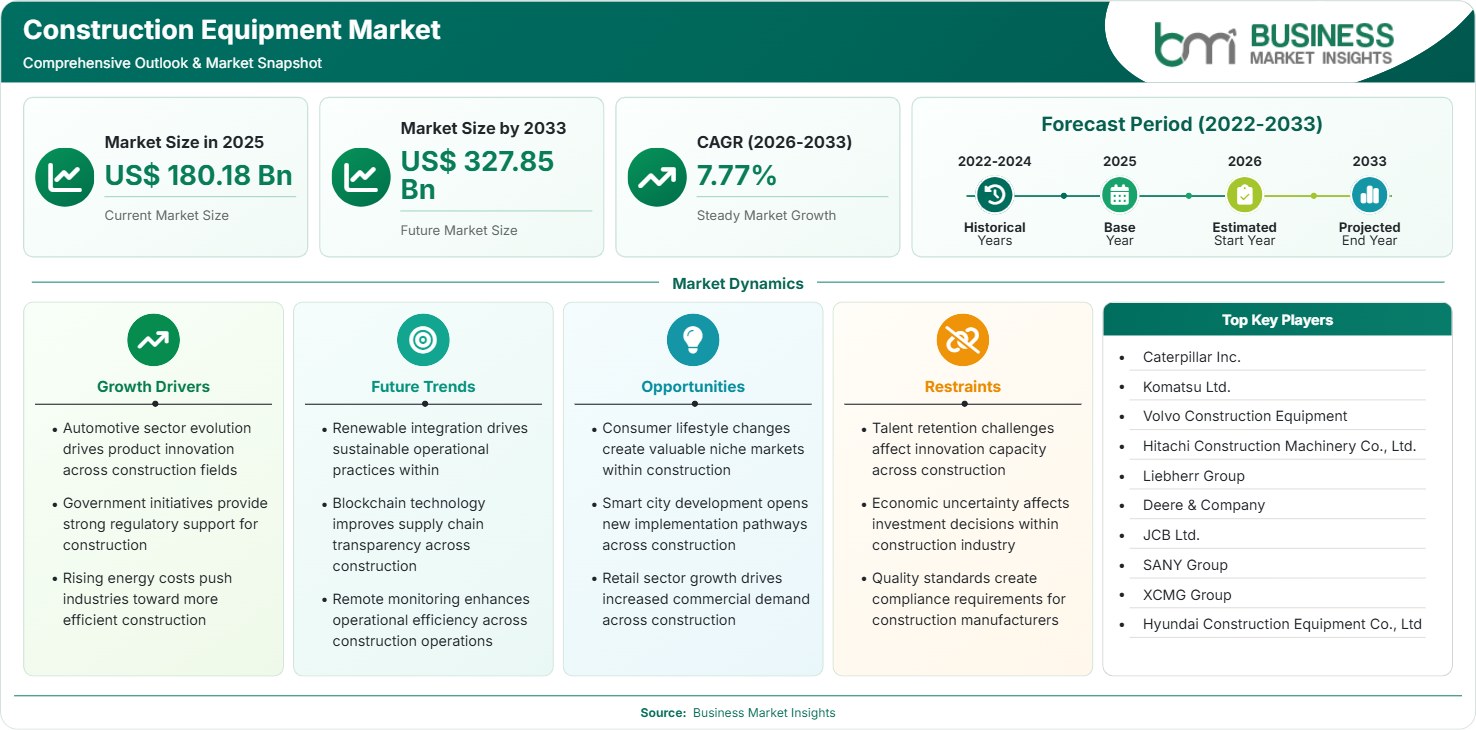
The Construction Equipment Market size was valued at US$ 180.18 Billion in 2025 and is projected to reach US$ 327.85 Billion by 2033, growing at a CAGR of 7.77% during 2026–2033, driven by infrastructure investment, urbanization, equipment modernization, electrification, automation, and rental demand.

Report Coverage
  • Equipment Type: Earthmoving Equipment, Material Handling Equipment & Cranes, Concrete Equipment, Road Building Equipment, Civil Engineering Equipment, Crushing and Screening Equipment, Others
  • Application: Residential, Commercial, Industrial
US$ 180.18 Bn Market size in 2025
US$ 327.85 Bn Market Size by 2033
7.77% CAGR, 2026 - 2033
2026-2033 Forecast Period

AI Overview

Construction Equipment Market Summary

  • North America Region: North America holds a 24%–27% construction equipment market share in 2025, growing at a 6.8%–7.4% CAGR, supported by infrastructure renewal, housing construction, fleet replacement, rental penetration, digitalization, and demand for productive low-emission equipment. US construction equipment demand is projected to expand at a 6.9%–7.5% CAGR through 2033, supported by infrastructure programs and resilient contractor investment.
  • Fastest Growing Region: Asia Pacific holds a 40%–44% share in 2025 and records an 8.3%–9.1% CAGR, driven by urban expansion, transport corridors, industrial facilities, housing demand, localization, mining development, and accelerated adoption of connected machinery.
  • Leading Segment: Earthmoving Equipment accounts for a 46%–50% share in 2025 and advances at a 7.5%–8.2% CAGR, supported by excavation, site preparation, road projects, mining, utilities, replacement cycles, and rental fleet expansion.
  • High Growth Segment: Civil Engineering Equipment represents a 7%–10% share in 2025 and expands at an 8.8%–9.6% CAGR, benefiting from complex infrastructure, tunneling, bridges, railways, utilities, specialized engineering requirements, and advanced project execution technologies.
  • Key Market Opportunity: Electrification, autonomous operation, telematics, equipment-as-a-service, predictive maintenance, and integrated fleet platforms create attractive revenue pools as contractors prioritize productivity, lower operating costs, emissions compliance, and asset utilization.
  • Major Market Players: Caterpillar Inc.; Komatsu Ltd.; Volvo Construction Equipment; Hitachi Construction Machinery Co., Ltd.; Liebherr Group; Deere & Company; JCB Ltd.; SANY Group; XCMG Group; Hyundai Construction Equipment Co., Ltd.
Strategic Insights

Construction Equipment Market: Strategic Insights

Construction Equipment Market Strategic Framework
FREE PDF
Request your free sample
Request free sample
Stakeholder View

Key Takeaways

  • The value chain is shifting from equipment-based transactions to ecosystem approaches incorporating machines, finance, dealers, software, servicing, replacement, renting, etc. For OEMs with well-developed dealership networks, there are additional monetizing opportunities arising from usage of the equipment after its sale.
  • Earthmoving Equipment is the leading opportunity sector as excavators, loaders, and other machines are necessary for excavation, site preparation, utilities, mining, roads, and buildings work. Civil Engineering Equipment has stronger growth potential due to complexity of modern projects.
  • Construction Equipment Market trend is characterized by transition from electric compact equipment to larger electric machines due to the progress of battery technology, charging infrastructure, energy management systems, and job-site power solutions. Hydrogen and other fuels will be important for longer operating cycles and high energy density of the equipment.
  • The region with the strongest investment potential is Asia Pacific due to intensive urbanization, transport infrastructure development, industrialization, and construction. The most interesting opportunities exist in India and Southeast Asia.
Geographic Outlook

Construction Equipment Market Regional Highlights

North America Construction Equipment Market

North America held a 24%–27% construction equipment market share in 2025 and is projected to expand at a 6.8%–7.4% CAGR through 2033. The region benefits from transportation renewal, utility modernization, data-center construction, housing requirements, industrial reshoring, and equipment replacement.

  • Infrastructural renewals increase the need for excavators, graders, loaders, cranes, and road construction machinery, especially when bridges, roads, utility infrastructure, and municipal buildings need renovation rather than new builds.
  • There is strategic importance of rental penetration as contractors can size up their machinery capacity to project timelines and save capital investment while getting newer machinery with better technologies like telematics and improved fuel economy.
  • There is growing interest in digital fleet management as contractors look to leverage usage data and remote monitoring tools to enhance project execution efficiencies.
  • The potential for electrification is high in compact or urban areas as noise, local emissions, inside operations, and regulations make electric machinery cost-effective.

US Construction Equipment Market

The US accounted for roughly 68%–72% of North American construction equipment market demand in 2025 and is estimated to grow at a 6.9%–7.5% CAGR through 2033. Federal infrastructure investment, semiconductor and manufacturing facilities, logistics construction, housing activity, and utility upgrades support equipment demand.

  • The public investment in infrastructure provides constant demand for earth-moving equipment, roads, material handling, concrete, and civil construction equipment.
  • The contractor’s fleet focuses on equipment availability and efficiency, thus providing higher demand for equipment rentals and replacement of old equipment with telematics equipped and fuel-efficient equipment.
  • Equipment manufacturing “reshoring” and data centers construction expand the demand for equipment beyond residential and commercial construction, providing more business to crane, loader, excavator, concrete, and other civil construction equipment.

Europe Construction Equipment Market

Europe represented a 20%–23% share in 2025 and is projected to grow at a 6.5%–7.2% CAGR through 2033. Construction Equipment market growth is supported by transport modernization, renewable-energy infrastructure, urban redevelopment, emissions regulation, and demand for compact electric machines. Volvo Construction Equipment's 2026 introduction of the EWR150 Electric demonstrates increasing commercialization of zero-emission equipment for European applications.

  • Germany is still a strong market for machinery and construction, due to industries, transport, urban investment, and the need for equipment upgrade with more efficient machinery.
  • In France and Italy, there are good prospects in the renewal of infrastructure, utilities, construction equipment, and rentals, where the demand for machinery is increasingly driven by fuel economy and lifecycle cost.
  • In Nordic countries, there is progress towards the use of lower-emission machinery, driven by sustainable practices, access to renewable energy, and construction customers’ interest in a path towards emission-free operations.

Asia Pacific Construction Equipment Market

Asia Pacific held a 40%–44% share in 2025 and is forecast to record an 8.3%–9.1% CAGR through 2033. China remains central to regional manufacturing and equipment supply, while Japan and South Korea contribute advanced technologies. Construction Equipment market share is supported by large installed fleets and expanding infrastructure requirements.

  • India represents a growing demand and manufacturing market owing to the fact that many road, rail, urban transit, industrial, renewable energy, and logistics infrastructure projects have need for excavators, loaders, cranes, concrete and road equipment.
  • China has a great deal of domestic demand along with manufacturing capacity, giving the OEMs there competitive advantage through the size of operations, range of products, export capability, and sophisticated technologies.
  • The potential in Southeast Asia is great in countries like Indonesia, Vietnam, Thailand, Malaysia, and Philippines as urbanization, port development, industrialization, mining, and transportation projects generate demand for construction equipment.
  • The technology-based potential of Japan and South Korea lies in automation, operator assistance, energy efficiency, and manufacturing.
  • Australia remains important for mining-linked construction activity, infrastructure, and specialized heavy machinery, with customers placing high value on durability, remote monitoring, and productivity.

Rest of World Construction Equipment Market

Rest of World represented approximately 9%–12% of global construction equipment market demand in 2025 and is estimated to grow at a 6.9%–7.8% CAGR through 2033. In the Middle East and Africa, Saudi Arabia, the United Arab Emirates, and South Africa lead demand, supported by mega-projects, mining, urban infrastructure, and energy development.

  • Brazil offers broad demand across roads, housing, agriculture-linked construction, mining, utilities, and industrial development, supporting a diversified equipment opportunity rather than dependence on one application.
  • Mexico benefits from manufacturing investment, nearshoring, logistics infrastructure, industrial parks, housing, and border-region development, strengthening requirements for earthmoving and material handling equipment.
  • Saudi Arabia and the United Arab Emirates remain attractive for large-scale urban, tourism, transportation, energy, and industrial projects requiring high-capacity cranes, earthmoving machinery, and specialized equipment.
  • South Africa provides opportunities through mining, transportation, utilities, and municipal projects, with equipment durability, service availability, and financing strongly influencing purchasing decisions.
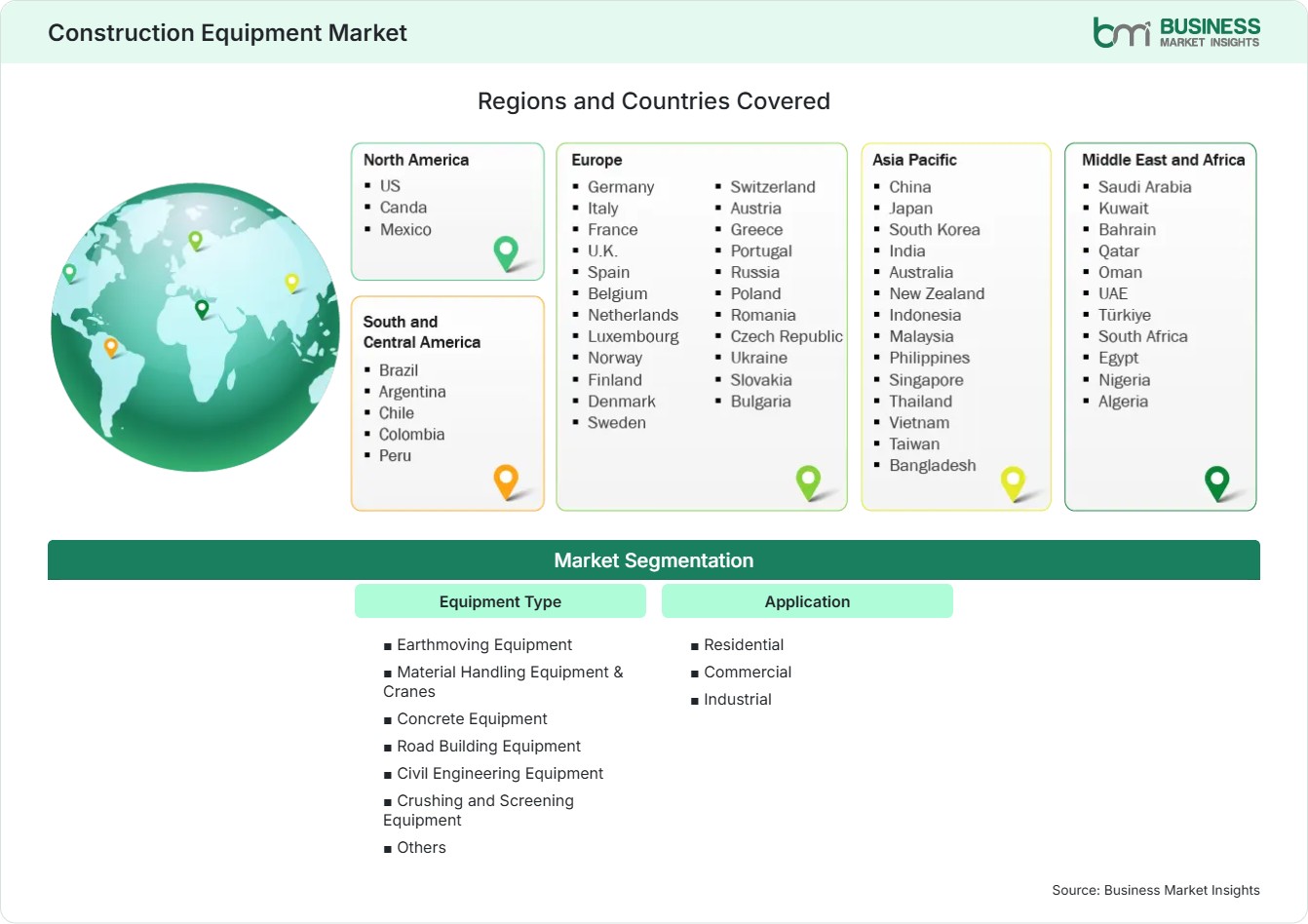
Global Market Geography
FREE PDF
Request your free sample
Request free sample
Segment Analysis

Construction Equipment Market Segmentation

Equipment Type

Equipment Type remains the principal segmentation framework, with Earthmoving Equipment representing a 46%–50% share in 2025 and a 7.5%–8.2% CAGR through 2033. The construction equipment market demand is supported by excavation, loading, site preparation, infrastructure, mining, utilities, and rental fleets. Digital controls, fuel efficiency, safety technologies, and alternative powertrains increasingly influence equipment selection across applications.

  • Earthmoving Equipment: Excavators, loaders, bulldozers, and graders remain essential for excavation and site preparation, while telematics, machine control, fuel efficiency, and operator-assistance technologies improve productivity and lifecycle economics.
  • Material Handling Equipment & Cranes: Cranes, forklifts, telehandlers, and lifting machinery support buildings, industrial facilities, logistics, infrastructure, and energy projects, with demand influenced by payload requirements, safety, mobility, and project complexity.
  • Concrete Equipment: Batching plants, concrete pumps, mixers, and related machinery support construction productivity, particularly on large infrastructure and commercial projects requiring consistent concrete quality and high-volume placement.
  • Road Building Equipment: Pavers, compactors, milling machines, and related equipment benefit from highway rehabilitation, urban roads, airport projects, and transportation investment, with automation and fuel efficiency becoming important purchasing criteria.
  • Civil Engineering Equipment: Specialized machinery serves tunneling, bridges, railways, utilities, foundations, and complex infrastructure, creating demand for high-performance equipment capable of operating under constrained and technically demanding conditions.
  • Crushing and Screening Equipment: Mobile crushers and screens support aggregates, quarrying, recycling, demolition, and infrastructure projects, with compact mobility, fuel efficiency, material throughput, and automated process control shaping adoption.

Application

Within the construction equipment market, application demand is led by infrastructure-intensive construction, while residential and commercial projects remain important equipment users. Equipment utilization increasingly depends on project scale, rental availability, contractor financing, labor productivity, and the need to complete projects within tighter schedules.

  • Residential: Housing construction requires excavators, loaders, compact equipment, concrete machinery, and material handling solutions, with urban projects favoring compact dimensions, lower noise, maneuverability, and increasingly electric powertrains.
  • Commercial: Offices, retail facilities, logistics centers, hotels, and mixed-use developments generate demand for lifting, earthmoving, concrete, and material handling machinery, especially where construction schedules require high productivity.
  • Industrial: Factories, warehouses, energy facilities, processing plants, and infrastructure-linked industrial sites require heavy earthmoving, cranes, concrete, road, and civil engineering equipment, creating demand for high-capacity and specialized machines.
Market Forces

Construction Equipment Market Dynamics

Key Market Drivers

Infrastructure Investment and Equipment Replacement

Demand due to infrastructure renewal is an essential source because roads, bridges, utility services, airports, railway, seaports, and public buildings need significant amounts of excavation, lifting, paving, compacting, and materials handling. Demand due to replacement is just as significant in developed countries because aged machinery is less productive and more costly to maintain. Rentals boost this trend even further since they renew their fleets more often than other businesses. The intersection of public infrastructure, industrial development, housing needs, and fleet renewal creates a solid basis for demand up to 2033, and availability and financing decide the speed of pipeline realization.

Connected Machinery and Productivity Optimization

Connectivity is shifting towards becoming a key aspect of equipment rather than just a supplementary function in light of productivity gains. Telematics will provide operational hours, location, fuel use, maintenance warnings, payload, and usage data, enabling managers to detect inefficiently used equipment and avoid unnecessary downtime. Construction Equipment innovations become increasingly focused not only on hardware but also on software, data analysis, remote diagnostics, and operator support. Komatsu is also growing its use of AI technologies in product design, manufacturing, sales, and service based on their existing equipment monitoring and Smart Construction systems. The resulting business model ensures the possibility for ongoing service provision and customer retention.

Electrification, Alternative Fuels, and Low-Emission Equipment

Decarbonization is resulting in a cycle of technology diversification as opposed to decarbonization being a replacement path for just one technology. The battery-electric technology has made rapid progress especially in smaller and urban applications where the time taken to charge, the hours of operation, and the amount of power required are reasonable. For bigger machinery, there is more interest in technologies such as hydrogen fuel cells, hydrogen combustion, hybrid technologies, renewable fuels, and trolleys. This is beneficial for Construction Equipment in terms of technology opportunities and flexibility in choosing power trains.

Key Market Opportunities

Integrated Electric Jobsite Solutions

The strongest electrification opportunity is moving beyond individual machines toward complete jobsite systems. Electric equipment requires charging capacity, power distribution, energy management, scheduling, and operational planning, creating opportunities for OEMs and technology partners to supply integrated solutions. Construction Equipment market Forecasts should therefore consider charging infrastructure, grid capacity, energy storage, and fleet software as adjacent opportunity pools rather than treating electrification as a machine-only transition. Suppliers capable of combining equipment and energy services can capture recurring revenue while improving customer confidence in zero-emission deployment.

Digital Fleet Services and Autonomous Operations

The digitization of services offers an opportunity for the entire lifespan of the installation of the equipment to be monetized. A fleet management system could link various pieces of machinery manufactured by different companies, monitor the use of the equipment, plan maintenance automatically, assess operator performance, and perform remote diagnostics of the machine. Autonomously running machines will help boost productivity in cases where tasks performed are repetitive and risky. Similar capabilities could transfer to the construction industry via machine control, remote operation, automatic grading, collision detection, and semi-autonomous processes.

Emerging-Market Manufacturing and Rental Ecosystems

Emerging markets offer manufacturers an opportunity to combine localized production with expanding rental networks. Regional manufacturing can reduce logistics exposure, shorten delivery times, improve parts availability, and tailor machines to local operating conditions. Rental companies can simultaneously expand access for small contractors that cannot justify high capital expenditure. Manufacturers can strengthen market penetration through local assembly, dealer financing, service training, remanufacturing, and parts distribution. Rental fleets also create recurring replacement demand because professional operators require reliable availability and predictable maintenance costs. This ecosystem approach can improve customer access while creating stronger aftermarket revenue and reducing the commercial barriers associated with high equipment acquisition costs.

Market Restraints and Challenges

High Acquisition Costs and Financing Sensitivity

Factor: construction machinery requires substantial upfront capital, while financing rates, currency movements, and contractor cash flow can materially influence purchasing decisions. Heavy equipment purchases are frequently discretionary within project budgets and can be postponed when project awards are delayed or financing becomes expensive.

Impact: slower order conversion can create volatility for manufacturers, dealers, rental companies, and component suppliers. The effect is especially pronounced among small contractors with limited balance-sheet capacity. Equipment-as-a-service and rental models provide alternative access mechanisms, allowing contractors to pay according to utilization rather than ownership. Manufacturers with strong residual-value management, financing capabilities, used-equipment channels, and aftermarket services are better positioned to protect demand when customers delay new-machine purchases.

Supply Chain, Tariff, and Skilled-Labor Constraints

Factor: construction equipment production depends on engines, hydraulics, electronics, steel, tires, transmissions, batteries, semiconductors, and specialized components sourced across multiple regions. Tariffs, logistics disruptions, currency movements, and supplier concentration can increase production costs or extend delivery schedules.

Impact: higher manufacturing costs can compress OEM margins and raise equipment prices, while delivery delays can reduce contractor productivity and rental-fleet availability. Caterpillar identified higher tariffs among factors contributing to unfavorable manufacturing costs in fourth-quarter 2025. A second operational pressure is skilled labor scarcity, which affects machine operators, technicians, mechanics, and digital-system specialists. Manufacturers are responding through operator-assistance technologies, remote diagnostics, training, and simplified service processes. Greater supply-chain localization and dual sourcing can reduce vulnerability, but component standardization and inventory discipline remain critical to maintaining resilience.

Company Analysis

Competitive Landscape

The Construction Equipment market analysis indicates that competitive differentiation is expanding from machine specifications toward lifecycle value, digital integration, financing, energy solutions, aftermarket coverage, and dealer reach. The ten profiled companies span North America, Europe, and Asia and compete across multiple equipment categories.

Company Name

Overview

Products and Services relevant to this market

Caterpillar Inc.

Global heavy-equipment manufacturer with a broad dealer ecosystem and extensive construction machinery portfolio.

Excavators, wheel loaders, dozers, graders, compactors, articulated trucks, digital fleet services, financing, rental, and aftermarket support.

Komatsu Ltd.

Japanese manufacturer focused on construction, mining, technology-enabled equipment, automation, and lifecycle services.

Excavators, wheel loaders, dozers, graders, intelligent machine control, Smart Construction, telematics, autonomy, financing, and services.

Volvo Construction Equipment

Global construction-equipment business emphasizing productivity, electrification, connectivity, safety, and sustainable jobsite solutions.

Excavators, wheel loaders, articulated haulers, compact equipment, electric machines, digital services, charging solutions, and support services.

Hitachi Construction Machinery Co., Ltd.

Japanese heavy-machinery manufacturer with strong capabilities in excavators, digital solutions, mining, and remote operations.

Hydraulic excavators, wheel loaders, mining machinery, fleet-management platforms, remote-operation technologies, parts, and lifecycle services.

Liebherr Group

Diversified European engineering group with strong construction machinery, cranes, earthmoving, and material-handling capabilities.

Mobile and crawler cranes, excavators, wheel loaders, material handlers, drilling equipment, concrete technology, and remanufacturing services.

Deere & Company

US manufacturer serving construction and forestry markets through equipment, technology, precision systems, and dealer networks.

Excavators, dozers, loaders, graders, compact construction equipment, digital fleet technologies, parts, financing, and dealer services.

JCB Ltd.

UK-based manufacturer with broad construction equipment coverage and strong international manufacturing and distribution capabilities.

Backhoe loaders, excavators, wheel loaders, telehandlers, compact equipment, hydrogen machinery, electric models, telematics, and support services.

SANY Group

Chinese equipment manufacturer with extensive construction machinery production and growing international market presence.

Excavators, cranes, concrete machinery, road machinery, piling equipment, ports machinery, digital systems, parts, and service support.

XCMG Group

Chinese heavy-equipment group with broad product coverage and substantial export capabilities across global construction markets.

Cranes, excavators, loaders, road machinery, concrete equipment, mining machinery, aerial platforms, digital solutions, and aftermarket services.

Hyundai Construction Equipment Co., Ltd.

South Korean manufacturer focused on excavators, wheel loaders, compact equipment, technology, and international dealer support.

Crawler excavators, wheel loaders, compact excavators, material handlers, attachments, telematics, parts, and maintenance services.

Trust & Transparency

Research Methodology

The market analysis combines proprietary research with secondary data from government agencies, company disclosures, regulatory filings, industry databases and expert interviews. Market estimates are validated through data triangulation, cross-market benchmarking and analyst review.

View Full Research Methodology

Questions Answered

Frequently Asked Questions

Why are digital services becoming strategically important to equipment manufacturers?

Digital services create recurring revenue while strengthening customer relationships throughout the machine lifecycle. Telematics, productivity analytics, and autonomous functions can increase equipment utilization and create opportunities for subscriptions, service contracts, financing products, and performance-linked commercial models.

What should investors monitor when evaluating the Construction Equipment market Report?

Investors should monitor infrastructure spending, commodity prices, dealer inventories, component costs, electrification adoption, and aftermarket revenue. These indicators provide a broader view of demand quality than equipment shipments alone.

How important will rental channels become for equipment manufacturers?

Rental channels can become increasingly important because they reduce upfront capital requirements and give contractors flexible access to newer machinery. Manufacturers can benefit through recurring replacement cycles, financing relationships, aftermarket services, fleet-management solutions, and stronger visibility into equipment utilization.

Which technologies could change construction machinery economics most rapidly?

Telematics, machine-control systems, predictive maintenance, and integrated energy management could materially change equipment economics. Their impact will depend on duty cycles, infrastructure availability, operator requirements, technology maturity, and the relative cost of conventional and alternative power.

What factors will most influence equipment purchasing decisions through 2033?

Contractors are likely to prioritize total cost of ownership, machine availability, fuel or energy consumption, residual value, emissions compliance, and digital capabilities. Purchase price will remain important, but lifecycle economics increasingly determine equipment selection for professional fleets.

Access the Full Construction Equipment Market Report

Get segment-level forecasts, regional estimates, competitive benchmarking, company profiles and downloadable Excel datasets.

Access the full Construction Equipment Market Report
350 pages PDF & Excel | 2026-09-02