
Construction Materials Market Outlook: Size, Share, Trends, Growth Analysis, Competitive Landscape & Forecast, 2026-2033

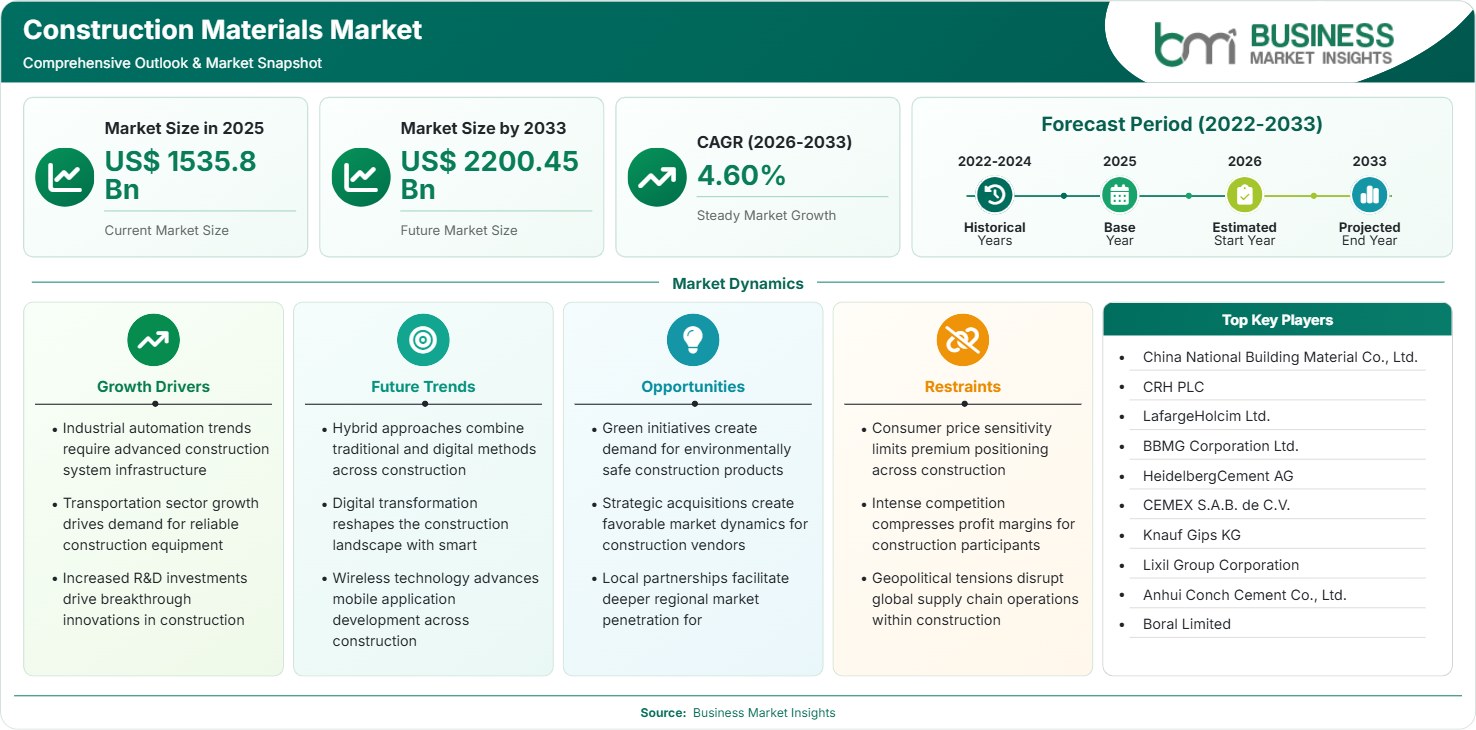
The Construction Materials Market size was valued at US$ 1535.8 Billion in 2025 and is projected to reach US$ 2200.45 Billion by 2033, growing at a CAGR of 4.60% during 2026–2033. Rising infrastructure modernization, urban housing demand, sustainable construction practices, and increasing investments in resilient transport, industrial, and commercial developments continue creating long-term opportunities for manufacturers and technology providers.

Report Coverage
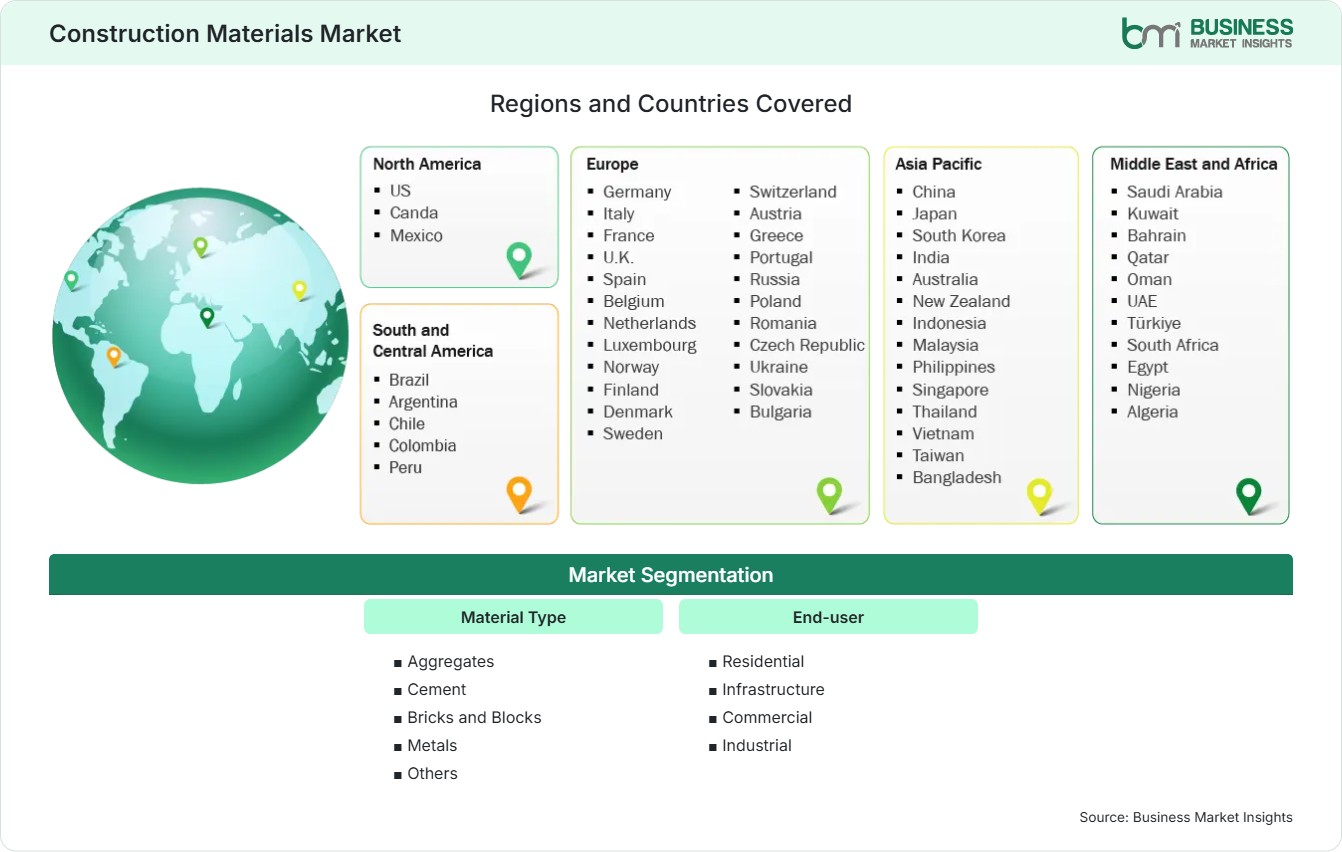
  • Material Type: Aggregates, Cement, Bricks and Blocks, Metals, Others
  • End-user: Residential, Infrastructure, Commercial, Industrial
US$ 1535.8 Bn Market size in 2025
US$ 2200.45 Bn Market Size by 2033
4.60% CAGR, 2026 - 2033
2026-2033 Forecast Period

AI Overview

Construction Materials Market Summary

  • North America Region: North America holds 22%–25% market share in 2025, expanding at a 4.2%–4.6% CAGR during 2026–2033, supported by infrastructure renewal, industrial reshoring, sustainable building materials, and public funding encouraging advanced manufacturing, circular construction practices, resilient transportation networks, energy-efficient buildings, and digital project delivery across residential and commercial developments. The U.S. market benefits from federal infrastructure funding, advanced prefabrication technologies, and sustainable construction initiatives, supporting a 4.3%–4.7% CAGR through 2033.
  • Fastest Growing Region: Asia Pacific accounts for 42%–45% market share in 2025 while advancing at a 5.2%–5.7% CAGR during 2026–2033, driven by rapid urbanization, industrial expansion, affordable housing investments, smart city projects, transportation corridors, renewable energy developments, manufacturing growth, and modernization of public infrastructure across emerging economies.
  • Leading Segment: Cement represents 30%–34% market share in 2025 and progresses at a 4.4%–4.8% CAGR during 2026–2033 as transportation corridors, housing developments, industrial construction, renewable energy installations, and infrastructure rehabilitation continue increasing consumption while sustainable cement technologies improve production efficiency and environmental performance.
  • High Growth Segment: Infrastructure contributes 33%–36% market share in 2025 while recording a 5.1%–5.6% CAGR during 2026–2033 because governments prioritize highways, railways, airports, ports, renewable energy facilities, water management systems, and resilient public infrastructure supporting long-term economic development and construction investments.
  • Key Market Opportunity: Accelerating adoption of low-carbon cement, recycled aggregates, digital construction platforms, modular building systems, and green infrastructure investments enables manufacturers to improve profitability while supporting environmental compliance, resource efficiency, and resilient urban development worldwide.
  • Major Market Players: China National Building Material Co., Ltd., CRH plc, Holcim Ltd., BBMG Corporation Co., Ltd., Heidelberg Materials AG, CEMEX, S.A.B. de C.V., Knauf Gips KG, LIXIL Corporation, Anhui Conch Cement Company Limited, and Boral Limited.
Strategic Insights

Construction Materials Market: Strategic Insights

Construction Materials Market Strategic Framework
FREE PDF
Request your free sample
Request free sample
Stakeholder View

Key Takeaways

  • Raw material suppliers, cement producers, aggregate processors, logistics providers, contractors, engineering firms, and technology companies are becoming increasingly interconnected, strengthening supply chain resilience while enabling greater transparency, procurement efficiency, and lifecycle value creation across complex infrastructure and building projects.
  • Infrastructure investment offers the strongest medium-term commercial opportunity as governments continue expanding transportation networks, renewable energy facilities, public utilities, and urban development projects requiring high-performance materials with improved durability, sustainability, and long operational lifespans.
  • Innovation is shifting toward low-carbon cement technologies, recycled aggregates, digital quality monitoring, artificial intelligence-enabled manufacturing optimization, modular construction systems, and advanced material formulations capable of reducing emissions without compromising structural performance or regulatory compliance.
  • Asia Pacific continues presenting the most compelling regional investment environment because expanding urban populations, industrialization, manufacturing relocation, smart city initiatives, and public infrastructure modernization collectively generate sustained demand across residential, commercial, and industrial construction applications.
  • Strategic mergers, acquisitions, and production capacity expansions remain central competitive strategies as manufacturers pursue regional diversification, sustainable product portfolios, operational efficiencies, digital manufacturing capabilities, and stronger distribution networks to enhance long-term profitability. The Construction Materials Market analysis increasingly emphasizes portfolio optimization alongside decarbonization investments.
  • Circular economy initiatives are reshaping procurement decisions as public authorities and private developers increasingly specify recycled materials, lower-carbon alternatives, and lifecycle-based performance standards, encouraging manufacturers to accelerate innovation while improving environmental credentials and long-term competitiveness.
Geographic Outlook

Construction Materials Market Regional Highlights

North America Construction Materials Market

North America accounts for 22%–25% of global demand in 2025 and is projected to expand at a 4.2%–4.6% CAGR during 2026–2033. Federal infrastructure modernization, resilient transportation investments, residential renovation, and industrial reshoring continue supporting consumption of cement, aggregates, metals, and engineered building products. The Construction Materials Market share in the region remains supported by sustainable construction mandates, digital project delivery, and increasing adoption of recycled materials. Stable institutional investments and modernization of public utilities further reinforce long-term market resilience.

  • Public infrastructure programs continue accelerating demand for cement, steel, and aggregates across highways, bridges, airports, and water systems, encouraging manufacturers to expand regional production while improving logistics efficiency and sustainable sourcing capabilities.
  • Green building certification programs increasingly prioritize lower-carbon materials, recycled aggregates, and energy-efficient building systems, encouraging continuous product innovation while strengthening supplier competitiveness across commercial and institutional construction applications.
  • Prefabricated construction techniques reduce project timelines, improve labor productivity, and minimize material waste, encouraging contractors to integrate advanced concrete systems and engineered building products into large-scale infrastructure developments.
  • Manufacturing reshoring across North America stimulates warehouse, industrial, and logistics facility construction, generating sustained demand for structural concrete, cement, reinforcing steel, insulation products, and specialized building materials supporting industrial expansion.
  • Digital construction technologies including Building Information Modeling, automated quality monitoring, and predictive supply chain planning improve procurement efficiency while reducing lifecycle costs across increasingly complex public and private construction projects.

US Construction Materials Market

The United States represents 78%–82% of North American Construction Materials Market demand in 2025 while advancing at a 4.3%–4.7% CAGR through 2033. Continued federal funding for transportation, water infrastructure, renewable energy, semiconductor manufacturing, and affordable housing sustains material consumption. Strong private investment in logistics facilities, commercial developments, and manufacturing plants complements public expenditure. Increasing adoption of low-carbon cement, recycled aggregates, and digitally enabled construction practices further enhances supply chain resilience and long-term market competitiveness.

  • Federal infrastructure legislation continues supporting highway rehabilitation, airport expansion, broadband deployment, and water system modernization, strengthening demand for high-performance construction materials throughout multiple engineering sectors.
  • Growing investments in semiconductor manufacturing, electric vehicle production, and renewable energy facilities stimulate industrial construction, increasing demand for structural concrete, specialty cement products, and engineered building systems across multiple states.
  • Commercial building renovation increasingly incorporates energy-efficient insulation, sustainable façades, and modular construction technologies, enabling developers to improve environmental performance while reducing operational costs over building lifecycles.
  • Rising adoption of recycled aggregates and supplementary cementitious materials helps manufacturers reduce carbon intensity while complying with evolving environmental regulations and procurement standards established by federal and state agencies.

Europe Construction Materials Market

Europe contributes 24%–27% of global revenue in 2025 and is expected to register a 3.8%–4.3% CAGR between 2026 and 2033. Carbon reduction targets, renovation initiatives, and circular economy regulations continue driving demand for sustainable construction materials throughout residential and commercial sectors. Germany maintains regional leadership through industrial construction and infrastructure modernization, while Eastern European economies demonstrate faster expansion supported by transport investments, housing developments, and European Union funding for resilient infrastructure projects.

  • Germany remains the largest regional market owing to industrial manufacturing capacity, transport infrastructure upgrades, and continuous investment in sustainable building technologies supporting long-term construction activity.
  • Poland records one of the fastest regional growth trajectories, supported by transportation infrastructure, logistics expansion, public investment, and modernization of residential developments financed through national and European funding initiatives.
  • Circular economy legislation encourages manufacturers to increase recycled content, reduce clinker usage, and expand alternative raw material adoption, strengthening sustainability performance while maintaining product quality across construction applications.
  • Commercial retrofitting and energy-efficient renovation projects generate sustained demand for insulation systems, lightweight materials, and advanced building envelopes supporting stricter environmental performance requirements across developed European economies.
  • Digital engineering platforms and lifecycle carbon assessment tools increasingly influence procurement decisions, encouraging manufacturers to provide transparent environmental performance data and certified sustainable construction products.

Asia Pacific Construction Materials Market

Asia Pacific commands 42%–45% of global revenue in 2025 and is forecast to expand at a 5.2%–5.7% CAGR during 2026–2033, representing the fastest-growing regional market. Rapid urbanization, industrialization, affordable housing programs, smart city initiatives, and manufacturing expansion continue supporting large-scale material consumption. China remains the dominant contributor through extensive infrastructure investment, while India demonstrates the strongest growth momentum driven by transportation corridors, industrial development, renewable energy facilities, and expanding urban construction activities.

  • China continues leading regional demand through extensive infrastructure modernization, urban redevelopment, renewable energy investments, and ongoing industrial expansion requiring substantial volumes of cement, aggregates, and engineered construction materials.
  • India records the highest regional expansion rate as national investments accelerate highway construction, railway modernization, affordable housing initiatives, logistics infrastructure, and industrial corridor development across multiple high-growth states.
  • Southeast Asian economies increasingly invest in airports, ports, industrial parks, and renewable energy projects, strengthening regional demand for structural materials supporting long-term economic and urban development objectives.
  • Smart city initiatives promote adoption of digitally monitored construction, prefabricated building systems, and environmentally responsible materials, encouraging technological advancement throughout regional manufacturing and construction ecosystems.
  • International manufacturers continue expanding production capacity and distribution networks across Asia Pacific to improve supply reliability, reduce logistics costs, and support growing domestic infrastructure investment requirements.

Rest of World Construction Materials Market

The Rest of World region accounts for 10%–13% of global revenue in 2025 while advancing at a 4.4%–4.9% CAGR during 2026–2033. South and Central America continue benefiting from transportation, mining, and residential developments, while Middle East and Africa experience increasing demand through urban expansion, industrial diversification, and megaproject investments. The Construction Materials Market growth across these regions is reinforced by population expansion, government infrastructure initiatives, and increasing participation from international construction companies.

Middle Eastern economies maintain strong infrastructure spending through urban development and tourism projects, whereas African countries continue prioritizing transport connectivity, housing accessibility, and public utility modernization to support long-term economic development and regional industrialization.

  • Brazil remains the leading South and Central American market owing to infrastructure rehabilitation, mining investments, and expanding residential construction supporting long-term domestic demand for cement and aggregates.
  • Saudi Arabia demonstrates the fastest Middle Eastern growth through large-scale urban development, tourism infrastructure, industrial diversification, and smart city investments requiring advanced construction materials and engineering solutions.
  • African economies increasingly prioritize road networks, public housing, renewable energy facilities, and water infrastructure, creating long-term opportunities for international and regional building material manufacturers.
  • International partnerships improve local manufacturing capabilities, technology transfer, and supply chain resilience, enabling regional producers to enhance product quality while supporting rapidly expanding infrastructure requirements.
  • Sustainability initiatives gradually increase recycled material utilization and resource-efficient manufacturing practices, improving environmental performance while strengthening competitiveness across emerging construction markets.
Global Market Geography
FREE PDF
Request your free sample
Request free sample
Segment Analysis

Construction Materials Market Segmentation

Material Type

Material Type accounts for approximately 62%–65% of the overall market in 2025 and is projected to expand at a 4.4%–4.8% CAGR through 2033. Growing investments in transportation infrastructure, commercial buildings, industrial facilities, and residential developments continue supporting material consumption worldwide. The Construction Materials Market scope continues expanding through sustainable manufacturing technologies, recycled raw materials, and performance-enhancing innovations that improve durability, efficiency, and lifecycle value across modern construction projects.

  • Aggregates: Aggregates remain indispensable for concrete production, road construction, railway ballast, and drainage systems. Infrastructure modernization, quarry optimization technologies, and recycled aggregate adoption continue strengthening long-term demand across public and private construction projects.
  • Cement: Cement remains the backbone of structural construction owing to its extensive application across buildings, transportation infrastructure, industrial facilities, and energy projects. Manufacturers increasingly invest in lower-carbon formulations and alternative binders to improve sustainability.
  • Bricks and Blocks: Bricks and blocks maintain steady adoption in residential and commercial developments because of durability, thermal insulation, structural reliability, and compatibility with both conventional and modular construction methods across urban expansion projects.
  • Metals: Structural metals support high-rise buildings, industrial facilities, bridges, transportation systems, and renewable energy installations. Advanced corrosion-resistant alloys and recycled steel increasingly enhance project sustainability while improving structural performance and lifecycle efficiency.

End-user

End-user applications contribute nearly 35%–38% Construction Materials Market Share through the Infrastructure segment in 2025 and are anticipated to record a 5.1%–5.6% CAGR during the forecast period. Urbanization, industrial expansion, transportation modernization, and government capital expenditure continue diversifying demand across construction categories. Increasing private investment in logistics facilities, manufacturing plants, healthcare infrastructure, and commercial real estate further supports balanced long-term industry expansion.

  • Residential: Residential construction continues benefiting from affordable housing initiatives, urban migration, demographic expansion, mortgage accessibility, and renovation projects that stimulate sustained demand for cement, aggregates, insulation materials, and structural building products.
  • Infrastructure: Infrastructure remains the fastest-growing application because transportation corridors, bridges, railways, airports, ports, water systems, and renewable energy developments require substantial volumes of durable, high-performance construction materials throughout project lifecycles.
  • Commercial: Commercial construction increasingly incorporates sustainable materials, modular building systems, digital engineering, and energy-efficient building envelopes, supporting office developments, healthcare facilities, educational institutions, retail complexes, and hospitality infrastructure.
  • Industrial: Industrial projects continue expanding through manufacturing reshoring, warehouse construction, logistics parks, semiconductor facilities, and renewable energy manufacturing, creating sustained demand for structural concrete, reinforced steel, and specialized engineering materials.
Market Forces

Construction Materials Market Dynamics

Key Market Drivers

Expanding Global Infrastructure Investment Accelerates Material Demand

Governments worldwide continue increasing investment in highways, railways, airports, ports, renewable energy facilities, and water infrastructure to strengthen long-term economic productivity. The development programs of infrastructure in the Asia-Pacific region, North America, and the Middle East constitute steady demand for construction materials including cement, aggregates, metals, and construction engineered materials. Financing for infrastructure projects offered by multilateral institutions including the World Bank continues steadily in developing nations. The Construction Materials Market trends are more indicative of increased consumption of durable and sustainable products, built to construct resilient infrastructure. This cycle of investment continues to promote manufacturing development, production innovation, and logistics improvement, contributing to better growth of the market on the whole.

Urbanization and Housing Development Sustain Long-Term Consumption

Rapid urban population growth continues creating significant demand for affordable housing, mixed-use developments, public utilities, and commercial facilities throughout emerging economies. For growing metropolitan areas, there is the constant need for investments in buildings, schools, hospitals, transport networks, and infrastructure. The increase in population and income levels results in greater demand for building materials that will facilitate sustainable development in cities. Manufacturers are beginning to offer lightweight concrete, pre-fab systems, and insulation materials that increase productivity in building processes without harming the environment. This means that urban expansion provides an opportunity for manufacturers of various building materials.

Decarbonization Technologies Transform Manufacturing Processes

Environmental regulations and corporate sustainability commitments continue encouraging investment in lower-carbon cement production, recycled aggregates, alternative binders, waste heat recovery, and energy-efficient manufacturing technologies. The producers are using digital technologies, artificial intelligence, and automatic quality controls not only to increase their performance but also to reduce pollution and minimize costs of production. The carbon capture demonstration, use of renewables and the circular economy strategy is becoming the competitive advantage for many companies around the globe. Such technical developments lead to more efficient use of resources and help the manufacturers to meet more stringent environmental requirements.

Key Market Opportunities

Low-Carbon Building Materials Create Premium Market Potential

Rising demand for sustainable construction presents manufacturers with many chances to market low carbon cement, recycled concrete aggregates, geopolymer products, and biomass based building materials.

Governments increasingly prioritize sustainable procurement standards for infrastructure and public buildings, encouraging adoption of certified low-emission construction products. The Construction Materials Market Forecasts indicate there will be increased spending on climate-resistant infrastructures, making it a favorable environment for companies that have innovations in their manufacturing processes to come up with solutions. Partnering with engineering firms and contractors makes the process of commercialization even faster.

Digital Construction Ecosystems Enhance Value Creation

Building Information Modeling, digital twins, predictive analytics, automated procurement, and intelligent logistics platforms continue transforming construction project execution. For material providers, there is an increasing tendency towards integration of their offerings with digital services. This provides added value through enhanced planning, inventory management, quality control, and tracking through the life cycle of the materials. This helps to develop better customer relationships and efficiency of operations for construction supply chains. As projects become more complex, the digital integration helps in gaining competitive advantages for material providers.

Emerging Economies Expand Industrial Manufacturing Capacity

Rapid industrialization across Asia, the Middle East, Africa, and Latin America creates significant opportunities for new manufacturing facilities, logistics parks, renewable energy infrastructure, and export-oriented industrial corridors. New investment incentives that favor domestic manufacturing and infrastructure upgrades are being put in place by governments. International companies have been increasingly setting up factories within their regions so as to cut down on transport costs, gain reliability in supply, and meet local market demands. These investments lead to wider distribution networks in high-growth construction market areas marked by increased urbanization and industrialization.

Market Restraints and Challenges

Raw Material and Energy Cost Volatility

Factor: Cement, steel, aggregates, fuel for transport, and electricity continue to be vulnerable to commodity prices and supply chain disruptions.

Impact: Margin pressures, uncertainties in procurement and manufacturing operations may cause companies to put off capital investments and negatively impact their profitability. Higher shipping rates and geopolitical events also impact the availability of materials in international markets. As a result, companies will keep making investments in supply chain diversification, long-term sourcing relationships, renewable energy usage and manufacturing efficiencies.

Stringent Environmental Compliance Increases Capital Requirements

Factor: Increasing emissions regulations, carbon pricing schemes, and sustainability reporting requirements will entail considerable expenditures on more environmentally friendly production technology and carbon reduction efforts.

Impact: While smaller and medium-sized enterprises might incur more expenses, have difficulties adapting to new technologies, and be at a competitive disadvantage relative to their bigger multinational counterparts, which have more finances at their disposal, such investments will increase the competitiveness of companies in the future. However, the transition process itself is quite costly and demanding as it involves changes and innovations.

Company Analysis

Competitive Landscape

The global competitive environment remains moderately consolidated, with multinational manufacturers focusing on capacity expansion, sustainability investments, digital manufacturing, and regional acquisitions. The Construction Materials Market analysis indicates that producers are increasingly investing in low-carbon cement technologies, recycled aggregates, alternative binders, and advanced production automation to strengthen competitiveness. Strategic partnerships with contractors, engineering firms, and infrastructure developers continue improving product innovation while expanding geographic reach across high-growth construction markets.

Company Name

Overview

Products and Services Relevant to this Market

China National Building Material Co., Ltd.

One of the world's largest building material manufacturers with diversified operations spanning cement, gypsum boards, fiberglass, and engineering solutions across international markets.

Cement, aggregates, gypsum products, glass fiber, engineering materials, industrial building solutions, and sustainable construction technologies.

CRH plc

Global building materials leader operating integrated production and distribution networks supporting infrastructure, commercial, and residential construction worldwide.

Aggregates, cement, asphalt, ready-mix concrete, paving solutions, and infrastructure construction materials.

Holcim Ltd.

Leading provider of sustainable building solutions emphasizing low-carbon products, circular construction practices, and innovative infrastructure materials.

Cement, ready-mix concrete, aggregates, roofing systems, recycled construction materials, and green building products.

BBMG Corporation Co., Ltd.

Major Chinese construction material producer serving residential, infrastructure, and commercial developments through integrated manufacturing operations.

Cement, concrete products, building components, prefabricated materials, and environmentally efficient construction solutions.

Heidelberg Materials AG

International manufacturer recognized for sustainable cement production and digital manufacturing investments supporting infrastructure and commercial construction.

Cement, aggregates, ready-mix concrete, asphalt, recycled aggregates, and carbon-reduced construction materials.

CEMEX, S.A.B. de C.V.

Global supplier with extensive operations across North America, Europe, Latin America, and Asia emphasizing innovation and sustainability.

Cement, ready-mix concrete, aggregates, urbanization solutions, and digital customer platforms.

Knauf Gips KG

International specialist in interior building systems with advanced gypsum technologies supporting residential and commercial construction.

Gypsum boards, insulation systems, plaster, ceiling systems, drywall solutions, and finishing materials.

LIXIL Corporation

Global building products manufacturer emphasizing innovation, water efficiency, and sustainable building technologies.

Windows, doors, façades, sanitaryware, housing products, and architectural building systems.

Anhui Conch Cement Company Limited

One of the world's largest cement producers with extensive manufacturing capacity serving infrastructure and urban development projects.

Cement, clinker, aggregates, environmentally optimized cement products, and construction materials.

Boral Limited

Leading supplier across Australia with diversified operations supporting infrastructure, commercial, and residential developments.

Cement, concrete, quarry products, asphalt, construction aggregates, and building materials.

Trust & Transparency

Research Methodology

The market analysis combines proprietary research with secondary data from government agencies, company disclosures, regulatory filings, industry databases and expert interviews. Market estimates are validated through data triangulation, cross-market benchmarking and analyst review.

View Full Research Methodology

Questions Answered

Frequently Asked Questions

What does the Construction Materials Market Report help stakeholders evaluate?

The report provides insights into market dynamics, competitive positioning, regional opportunities, segmentation trends, investment priorities, technological developments, sustainability strategies, and future growth prospects to support strategic business and investment decisions.

How are sustainability initiatives influencing industry competition?

Manufacturers are investing in low-carbon cement, recycled aggregates, alternative binders, energy-efficient production, and digital manufacturing technologies to reduce emissions while meeting increasingly stringent environmental regulations and customer sustainability expectations.

Which end-user segment offers the highest growth opportunities?

Infrastructure remains the fastest-growing application because governments worldwide continue investing in highways, railways, airports, ports, renewable energy facilities, and water infrastructure requiring high-performance construction materials.

Which region is expected to grow the fastest during the forecast period?

Asia Pacific is anticipated to record the highest growth due to expanding urban populations, smart city developments, manufacturing investments, transportation infrastructure projects, and government-supported housing programs across emerging economies.

What factors are driving the Construction Materials Market?

Infrastructure modernization, rapid urbanization, residential construction, industrial expansion, sustainable building regulations, and investments in renewable energy projects continue increasing demand for cement, aggregates, metals, and advanced construction materials across global markets.

Access the Full Construction Materials Market Report

Get segment-level forecasts, regional estimates, competitive benchmarking, company profiles and downloadable Excel datasets.

Access the full Construction Materials Market Report
350 pages PDF & Excel | 2026-08-17