
Autonomous Mining Equipment Market Outlook: Size, Share, Trends, Growth Analysis, Competitive Landscape & Forecast, 2026-2033

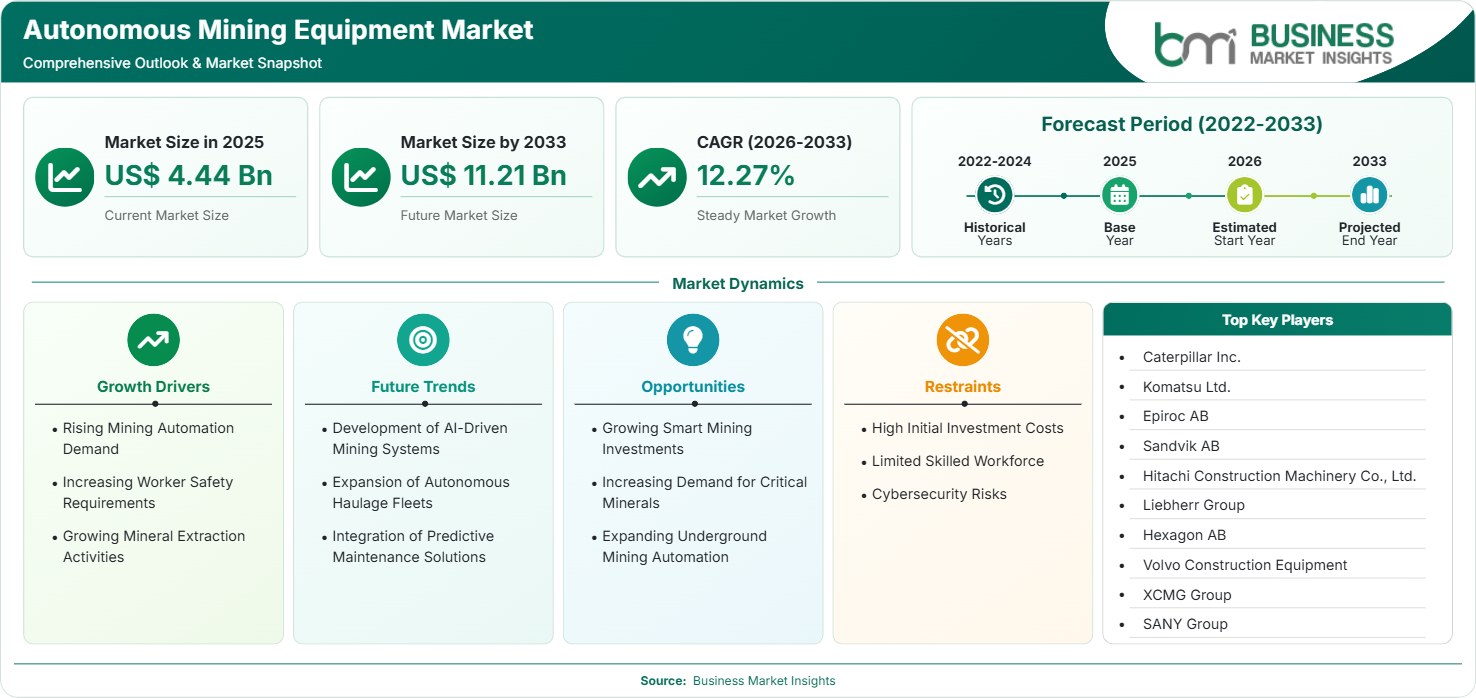
The Autonomous Mining Equipment Market size was valued at US$ 4.44 Billion in 2025 and is projected to reach US$ 11.21 Billion by 2033, growing at a CAGR of 12.27% during 2026–2033, driven by rising mining automation adoption, safety requirementsaca, critical mineral demand, and investments in smart mining technologies.

Report Coverage
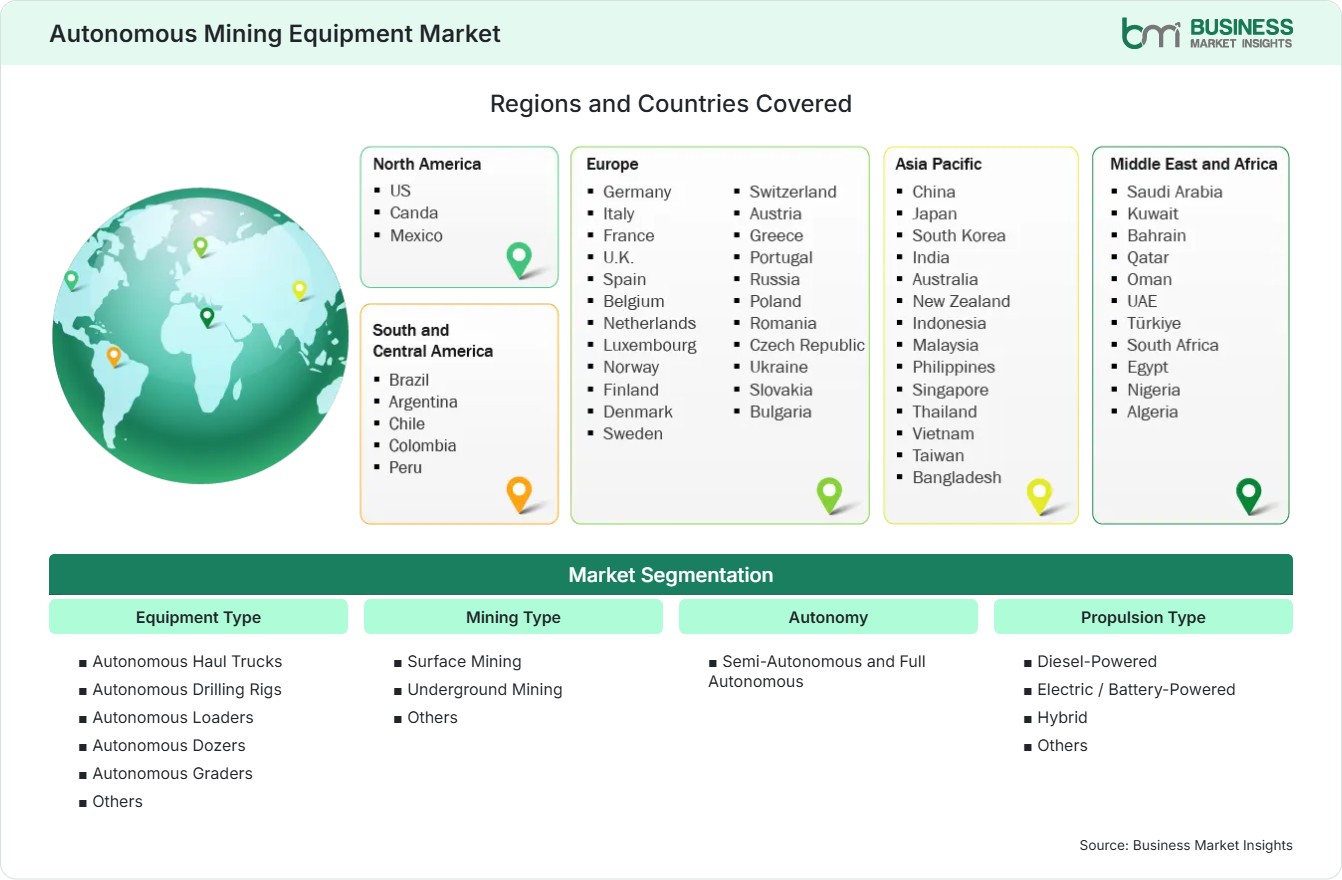
  • Equipment Type: Autonomous Haul Trucks, Autonomous Drilling Rigs, Autonomous Loaders, Autonomous Dozers, Autonomous Graders, Others
  • Mining Type: Surface Mining, Underground Mining, Others
  • Autonomy: Semi-Autonomous and Full Autonomous
  • Propulsion Type: Diesel-Powered, Electric / Battery-Powered, Hybrid, Others
  • Application: Material Handling, Drilling & Blasting, Site Preparation & Development, Inspection & Monitoring, Others
US$ 4.44 Bn Market size in 2025
US$ 11.21 Bn Market Size by 2033
12.27% CAGR, 2026 - 2033
2026-2033 Forecast Period

AI Overview

Autonomous Mining Equipment Market Summary

  • North America Region: North America holds a 34%–37% share in 2025, expanding at a CAGR of 11%–13% through 2026–2033. Advanced mining automation adoption, digital mine initiatives, autonomous fleet integration, and safety regulations support opportunities across large-scale operations. The US market demonstrates strong deployment momentum with a CAGR of 12%–14% from 2026–2033, supported by technology investments and modernization programs.
  • Fastest Growing Region: Asia Pacific accounts for a 28%–31% share in 2025, growing at a CAGR of 13%–15% during 2026–2033. Expanding mineral extraction, infrastructure development, automation investments, and increasing demand for efficient mining operations create significant growth opportunities across China, Australia, and India.
  • Leading Segment: Autonomous Haul Trucks represent a 38%–42% share in 2025, achieving a CAGR of 12%–14% during 2026–2033. Large-scale mining operators prioritize autonomous transportation solutions due to productivity improvements, reduced operational risks, fuel optimization, and enhanced fleet management capabilities.
  • High Growth Segment: Full Autonomous systems capture a 30%–34% share in 2025, registering a CAGR of 14%–16% through 2026–2033. Advanced artificial intelligence, machine learning, sensor technologies, and remote monitoring capabilities accelerate adoption across complex mining environments.
  • Key Market Opportunity: Autonomous mining adoption is expanding through smart mine investments, digital transformation programs, and demand for safer operations. Integration of AI, robotics, and electrification creates opportunities for equipment manufacturers and technology providers.
  • Major Market Players: Caterpillar Inc., Komatsu Ltd., Epiroc AB, Sandvik AB, Hitachi Construction Machinery Co., Ltd., Liebherr Group, Hexagon AB, Volvo Construction Equipment, XCMG Group, and SANY Group.
Strategic Insights

Autonomous Mining Equipment Market: Strategic Insights

Autonomous Mining Equipment Market Strategic Framework
FREE PDF
Request your free sample
Request free sample
Stakeholder View

Key Takeaways

  • Mining equipment ecosystems are shifting from standalone machinery toward integrated digital platforms combining autonomous vehicles, sensors, connectivity solutions, and centralized operational intelligence.
  • Surface mining operations provide substantial growth opportunities because large-scale mines require continuous material movement, predictable production cycles, and improved operational control.
  • Manufacturers are focusing on autonomous navigation, predictive maintenance capabilities, and real-time fleet optimization to improve machine performance in challenging environments.
  • Australia, China, and Canada represent attractive regional opportunities due to strong mining activities, technology adoption readiness, and demand for minerals supporting renewable energy infrastructure.
  • Strategic collaborations, technology acquisitions, and automation-focused investments are increasing as traditional equipment manufacturers compete with specialized technology providers.
  • Electrification integration represents an emerging strategic direction as mining companies seek lower emissions, improved energy efficiency, and compliance with sustainability objectives.
Geographic Outlook

Autonomous Mining Equipment Market Regional Highlights

North America Autonomous Mining Equipment Market

North America accounted for a 34%–37% share in 2025 and is projected to expand at a CAGR of 11%–13% from 2026–2033. Strong mining technology adoption in the US and Canada, established equipment manufacturers, and digital mine investments support regional expansion. The Autonomous Mining Equipment Market share remains concentrated among large operators implementing automated haulage, drilling, and monitoring solutions.

  • Canada demonstrates strong automation adoption through large mineral extraction projects, where autonomous vehicles improve productivity, reduce workforce risks, and support operations in remote mining locations with challenging environmental conditions.
  • The US mining sector is investing in connected equipment platforms, artificial intelligence systems, and autonomous fleet management solutions to enhance production consistency while addressing labor shortages and operational safety requirements.
  • Mining companies across North America are adopting integrated automation systems that combine machine control, data analytics, and remote supervision capabilities to optimize equipment utilization and reduce maintenance interruptions.
  • Technology partnerships between equipment manufacturers and software providers are accelerating autonomous deployment by improving interoperability, cybersecurity, and scalability across diverse mining operations throughout the region.

US Autonomous Mining Equipment Market

The US represented a 26%–29% share of the North American market in 2025 and is estimated to grow at a CAGR of 12%–14% during 2026–2033. The country benefits from advanced industrial infrastructure, mining automation expertise, and strong investments in digital transformation. The Autonomous Mining Equipment Market share in the US is supported by coal, copper, iron ore, and critical mineral producers seeking improved productivity.

  • US mining operators are deploying autonomous haulage and drilling systems to improve operational efficiency, particularly across large surface mines requiring continuous material movement and advanced fleet coordination.
  • Growing investments in critical mineral projects are increasing demand for intelligent mining solutions that provide improved safety performance, operational visibility, and resource management capabilities across extraction sites.
  • Equipment manufacturers are expanding technology offerings in the US through autonomous platforms, remote monitoring systems, and data-driven maintenance solutions designed for complex mining environments.

Europe Autonomous Mining Equipment Market

Europe captured a 20%–23% share in 2025 and is expected to register a CAGR of 10%–12% between 2026–2033. The region emphasizes sustainable mining practices, automation research, and advanced industrial technologies. Germany, Sweden, Finland, and Norway are leading adoption centers due to strong engineering capabilities and mining innovation programs. The Autonomous Mining Equipment Market growth is supported by electrification initiatives, environmental regulations, and demand for efficient resource extraction methods.

  • Sweden and Finland are advancing automated underground mining through technology development programs focused on autonomous drilling, remote operations, and sustainable mining equipment solutions.
  • Germany contributes through industrial automation expertise, supporting integration of robotics, artificial intelligence, and digital control systems into mining equipment ecosystems.
  • European mining operators are prioritizing low-emission autonomous machinery to align with climate objectives while maintaining operational productivity across resource extraction activities.
  • Partnerships between mining companies and technology developers are increasing as European firms seek advanced solutions for safer and more efficient mining operations.

Asia Pacific Autonomous Mining Equipment Market

Asia Pacific held a 28%–31% share in 2025 and is projected to achieve a CAGR of 13%–15% from 2026–2033. China, Australia, and India are major contributors, with Australia leading advanced autonomous mining deployments. The Autonomous Mining Equipment Market share in Asia Pacific is strengthened by mineral demand, workforce challenges, and modernization of mining operations.

  • Australia remains a global leader in autonomous mining adoption, with large iron ore producers implementing automated haulage fleets, remote operations centers, and advanced mine management systems.
  • China is increasing investment in intelligent mining technologies to improve production efficiency, reduce operational risks, and modernize coal and metal extraction activities.
  • India is gradually adopting automation solutions as mining companies focus on improving safety standards, operational reliability, and productivity across expanding mineral projects.
  • Japan and South Korea contribute through robotics expertise, advanced electronics, and technology integration capabilities supporting mining equipment innovation.

Rest of World Autonomous Mining Equipment Market

Rest of World accounted for a 10%–13% share in 2025 and is expected to grow at a CAGR of 9%–11% through 2026–2033. South America benefits from copper and lithium mining expansion, while the Middle East and Africa are investing in mineral exploration and modern mining infrastructure. Brazil, Chile, South Africa, and Saudi Arabia represent important growth locations.

  • Brazil and Chile are adopting automated mining technologies to improve efficiency in copper, iron ore, and lithium operations supporting global energy transition supply chains.
  • South Africa is exploring autonomous solutions for deep mining environments where improved worker safety and operational reliability remain key priorities for mining companies.
  • Middle Eastern countries are investing in mining diversification programs, creating opportunities for autonomous equipment deployment in newly developed mineral extraction projects.
  • African mining operators are increasingly considering automation technologies to address workforce challenges, improve safety standards, and optimize production from remote mining locations.
Global Market Geography
FREE PDF
Request your free sample
Request free sample
Segment Analysis

Autonomous Mining Equipment Market Segmentation

Equipment Type

Equipment Type represents a core segmentation area, with autonomous haul trucks leading adoption due to their extensive use in large surface mines. This segment accounted for a 38%–42% share in 2025 and is projected to grow at a CAGR of 12%–14% between 2026–2033. The Autonomous Mining Equipment Market scope continues expanding as operators prioritize productivity, safety, and operational automation.

  • Autonomous Haul Trucks: These systems support continuous material transportation, improving productivity through automated navigation, optimized routes, and reduced dependency on manual operators.
  • Autonomous Drilling Rigs: Automated drilling platforms enhance precision, improve blast preparation quality, and enable safer operations in challenging mining environments.
  • Autonomous Loaders (LHDs): Underground mining operators use autonomous loaders to improve material handling efficiency, increase equipment utilization, and reduce worker exposure.
  • Autonomous Dozers: These machines provide automated grading, pushing, and site preparation capabilities across surface mining operations requiring accurate earth movement.
  • Autonomous Graders: Automated graders improve road maintenance and site infrastructure management through precise machine control and digital monitoring technologies.

Mining Type

Mining Type influences adoption patterns because surface and underground operations require different automation approaches. Surface Mining accounted for a 55%–59% share in 2025 and is projected to grow at a CAGR of 11%–13% during 2026–2033. The Autonomous Mining Equipment Market trends indicate rising adoption across both environments as technology reliability improves.

  • Surface Mining: Large-scale open-pit operations extensively adopt autonomous trucks, drilling equipment, and fleet management platforms for productivity improvements.
  • Underground Mining: Underground automation improves worker safety, operational visibility, and equipment performance in confined mining environments.
  • Others: Specialized mining applications are gradually integrating autonomous solutions for niche extraction requirements and operational optimization.

Autonomy

Autonomy classification reflects the transition from assisted operations toward fully independent mining systems. Semi-Autonomous solutions maintained a dominant position with a 62%–66% share in 2025 due to easier integration with existing fleets. Full Autonomous systems are projected to expand faster with a CAGR of 14%–16% between 2026–2033 as artificial intelligence, connectivity, and sensor technologies mature. The Autonomous Mining Equipment Market trends indicate increasing preference for scalable automation approaches.

  • Semi-Autonomous: These systems combine human supervision with automated functions, enabling gradual adoption through existing mining equipment modernization programs.
  • Full Autonomous: Fully automated solutions utilize advanced navigation, artificial intelligence, and machine learning to perform mining tasks with limited human intervention.

Propulsion Type

Propulsion Type segmentation is influenced by sustainability objectives, operational efficiency requirements, and evolving mine electrification strategies. Diesel-Powered equipment accounted for a 65%–69% share in 2025 due to established infrastructure and high-power capabilities. Electric and hybrid solutions are gaining momentum as mining companies pursue emission reduction targets.

  • Diesel-Powered: Diesel equipment remains widely deployed because of reliability, high torque output, and suitability for large-scale mining environments.
  • Electric / Battery-Powered: Battery-powered autonomous equipment supports emission reduction goals, lower operating costs, and cleaner underground mining operations.
  • Hybrid: Hybrid propulsion combines conventional engines with electric systems to improve fuel efficiency and reduce environmental impact.

Application

Application-based adoption depends on operational priorities, mine complexity, and automation maturity. Material Handling represented the largest application area with a 42%–46% share in 2025, supported by continuous transportation requirements. The Autonomous Mining Equipment Market growth is supported by automation across drilling, inspection, and development activities. Increasing digital mine adoption is creating broader opportunities for intelligent equipment applications.

  • Material Handling: Automated transportation solutions improve productivity, reduce cycle times, and optimize movement of extracted materials.
  • Drilling & Blasting: Autonomous drilling technologies enhance accuracy, consistency, and safety during preparation activities.
  • Site Preparation & Development: Automated machines support efficient terrain management, grading, and infrastructure development processes.
  • Inspection & Monitoring: Digital monitoring systems enable predictive maintenance, remote supervision, and real-time equipment performance tracking.
Market Forces

Autonomous Mining Equipment Market Dynamics

Key Market Drivers

Rising Mining Automation Demand

The mining companies are embracing automation technology to increase productivity, minimize risks, and cope with difficult mining conditions. The Autonomous Mining Equipment Market expansion is driven by the increased use of autonomous mining vehicles and fleet management. According to the International Energy Agency, the demand for minerals used in clean energy technologies will keep rising, which necessitates effective extraction techniques. The market trends show an increase in the investment made in artificial intelligence, robotics, and mining vehicle platforms. Automation allows for better machine performance, reduced downtime, and increased visibility. Mining companies have realized that digital transformation is vital in sustaining competition amid staffing challenges and safety considerations.

Increasing Worker Safety Requirements

Safety regulations and workforce protection requirements are encouraging mining companies to deploy autonomous technologies in hazardous environments. Remote-controlled and automated equipment reduces human exposure to dangerous locations, unstable surfaces, and extreme operating conditions. Miners are using sensors, cameras, and real-time monitoring to gain better awareness of their processes. This automation gives operators the ability to control the machines from safer positions without affecting production. Automation has become a means for reducing accidents at workplaces and increasing reliability in mining operations.

Growing Mineral Extraction Activities

The rise in demand for copper, lithium, nickel, and other strategic minerals has led to an expansion of production capacities by mining companies. Transition to renewables necessitates a greater supply of minerals, and thus, the need for effective ways of extracting them. Autonomous mining equipment allows for increased production while dealing with challenging geological environments. The expansion of both surface and underground mining operations is leading to new opportunities for using autonomous mining equipment. Machinery producers have been able to develop solutions that can work 24/7 with greater accuracy.

Key Market Opportunities

Growing Smart Mining Investments

The investment in the development of smart mining infrastructure has created opportunity for autonomous mining equipment suppliers, software vendors, and technology integration companies. Investments are being made by mining firms into digital infrastructure, connectivity infrastructure, and intelligent equipment infrastructure. Autonomous Mining Equipment Market Forecasts predict that more opportunities will be created by means of comprehensive solutions that utilize automation technology along with analytical capabilities and remote mining management systems. The smart mining strategy enhances the effectiveness of resource utilization, efficiency of operations, and environmental sensing.

Increasing Demand for Critical Minerals

There is high demand for critical minerals required for batteries, renewable energy technologies, and advanced electronics, creating an opportunity for automation in mineral extraction. Governments are working on increasing their production capacity of minerals to reduce risk in the supply chain. The use of autonomous equipment helps increase efficiency in mineral extraction projects. Mining companies that are extracting lithium, copper, and rare earth elements are increasingly looking at the option of automation in the mine planning phase. Suppliers can benefit from this trend by offering flexible options suitable for varied geological settings.

Expanding Underground Mining Automation

Autonomous mining in the underground space presents a big opportunity for companies that wish to achieve safety and increased efficiency in extraction techniques. Autonomous loaders, drillers, and monitoring systems make the process more productive even in confined spaces. Companies are now creating remote operation centers and autonomous underground mining platforms. Increased reliability in the underground environment is achieved through advanced communication and sensor technology. The increasing trend towards deep mining has made necessary automation systems that will work in difficult conditions.

Market Restraints and Challenges

High Initial Investment Costs

Factor: High capital requirements for autonomous equipment acquisition, digital infrastructure development, and technology integration create financial barriers for smaller mining operators. Impact: Lack of financial capability can lead to slow adoption of automation technology as well as lack of access to sophisticated mining technology. The use of autonomous equipment will incur substantial costs from the installation of sensors, software platforms, connectivity technologies, and training. Firms will need to compare their returns to the cost of implementation in order to make a decision to use the technology. Smaller mines might take longer to adopt the technology due to financial constraints.

Limited Skilled Workforce

Factor: Shortages of professionals with expertise in automation systems, artificial intelligence, and digital mining technologies create operational challenges. Impact: Mining firms can have problems with implementing, managing, and optimizing their autonomous equipment efficiently. For the successful deployment, they need skilled staff who are able to control software, data analysis tools, and controls for sophisticated machinery. Training raises the complexity of implementation, especially when technology is poorly developed in a region. Companies develop programs for training employees in collaboration with providers of technology. Nevertheless, skilled personnel becomes one of the key issues concerning automation.

Company Analysis

Competitive Landscape

The Autonomous Mining Equipment Market analysis indicates a competitive environment shaped by established mining equipment manufacturers, automation technology providers, and digital solution developers. Leading companies are investing in autonomous vehicle platforms, artificial intelligence integration, remote monitoring systems, and connected mine management solutions to strengthen their market positioning.

Company Name

Overview

Products and Services relevant to this market

Caterpillar Inc.

Caterpillar is a global heavy equipment manufacturer providing advanced machinery and automation technologies for mining operations worldwide.

Offers autonomous haulage systems, mining trucks, machine control solutions, fleet management platforms, and digital mining services.

Komatsu Ltd.

Komatsu develops construction and mining equipment with strong capabilities in automation, remote operation, and intelligent mining technologies.

Provides autonomous haulage systems, automated trucks, mining equipment platforms, and integrated operational management solutions.

Epiroc AB

Epiroc specializes in mining equipment and technology solutions focused on productivity, safety, and sustainable mining operations.

Supplies autonomous drilling rigs, underground loaders, remote control systems, and digital mine optimization technologies.

Sandvik AB

Sandvik delivers engineering solutions for mining industries with expertise in automation, electrification, and advanced equipment development.

Provides autonomous underground loaders, drilling automation systems, battery-powered equipment, and mining software platforms.

Hitachi Construction Machinery Co., Ltd.

Hitachi Construction Machinery develops mining equipment integrating digital technologies for improved efficiency and operational performance.

Offers autonomous mining trucks, remote monitoring solutions, machine control systems, and mining automation technologies.

Liebherr Group

Liebherr manufactures mining machinery and develops technology solutions supporting efficient and automated resource extraction.

Provides autonomous haul trucks, mining excavators, fleet management systems, and automation-enabled equipment solutions.

Hexagon AB

Hexagon provides digital reality solutions, industrial software, and automation technologies for mining operations.

Delivers autonomous mining solutions, positioning technologies, mine planning software, and safety monitoring platforms.

Volvo Construction Equipment

Volvo Construction Equipment develops advanced construction and mining machinery emphasizing automation, sustainability, and efficiency.

Provides autonomous haulers, electric machinery, connected equipment platforms, and automated site solutions.

XCMG Group

XCMG Group is a Chinese machinery manufacturer expanding automation capabilities across mining and industrial equipment applications.

Supplies autonomous mining trucks, intelligent equipment systems, digital management platforms, and mining machinery solutions.

SANY Group

SANY Group develops heavy machinery and smart equipment solutions for mining, construction, and industrial applications.

Offers mining trucks, automated equipment technologies, intelligent control systems, and connected machinery platforms.

Trust & Transparency

Research Methodology

The market analysis combines proprietary research with secondary data from government agencies, company disclosures, regulatory filings, industry databases and expert interviews. Market estimates are validated through data triangulation, cross-market benchmarking and analyst review.

View Full Research Methodology

Questions Answered

Frequently Asked Questions

What role does electrification play in autonomous mining development?

Electrification supports cleaner mining operations by reducing emissions, improving energy efficiency, and enabling integration with battery-powered autonomous equipment.

How will this Autonomous Mining Equipment Market Report help industry participants?

This report provides insights into technology trends, competitive strategies, segment opportunities, regional developments, and adoption factors influencing future mining automation investments.

Why are mining companies investing in autonomous equipment solutions?

Mining companies are investing in automation to improve worker safety, address labor challenges, increase production efficiency, and support operations in remote or hazardous environments.

What technologies support autonomous mining adoption?

Artificial intelligence, machine learning, sensors, GPS positioning, industrial communication networks, and fleet management software are key technologies enabling autonomous mining deployment.

How does autonomous mining equipment improve operational efficiency?

Autonomous mining equipment improves efficiency by enabling continuous operation, optimized machine movement, reduced downtime, and improved resource utilization.

Access the Full Autonomous Mining Equipment Market Report

Get segment-level forecasts, regional estimates, competitive benchmarking, company profiles and downloadable Excel datasets.

Access the full Autonomous Mining Equipment Market Report
350 pages PDF & Excel | 2026-08-07