
Coal Mining Market Outlook: Size, Share, Trends, Growth Analysis, Competitive Landscape & Forecast, 2026-2033

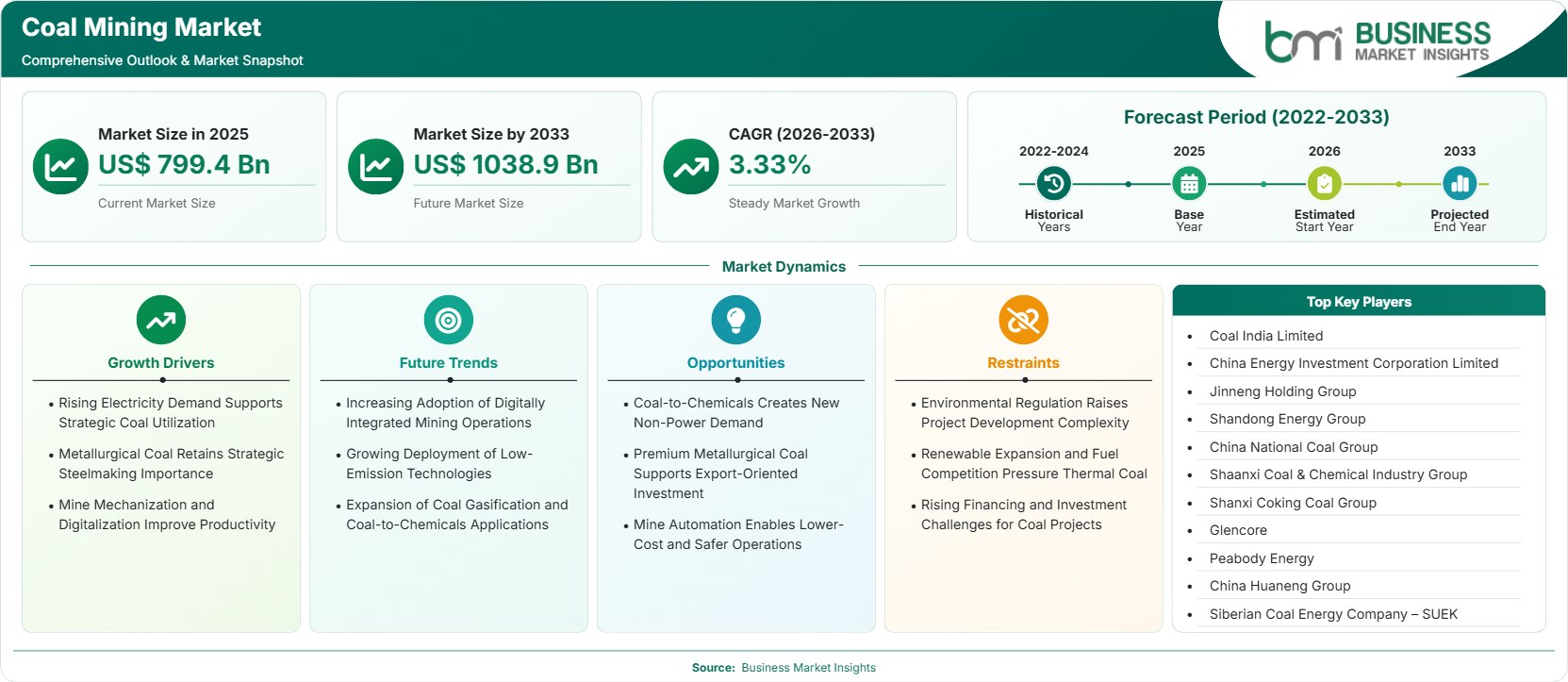
The Coal Mining Market size was valued at US$ 799.4 Billion in 2025 and is projected to reach US$ 1038.9 Billion by 2033, growing at a CAGR of 3.33% during 2026–2033, supported by electricity security, metallurgical coal demand, industrial consumption, mine modernization, and selective capacity expansion.

Report Coverage
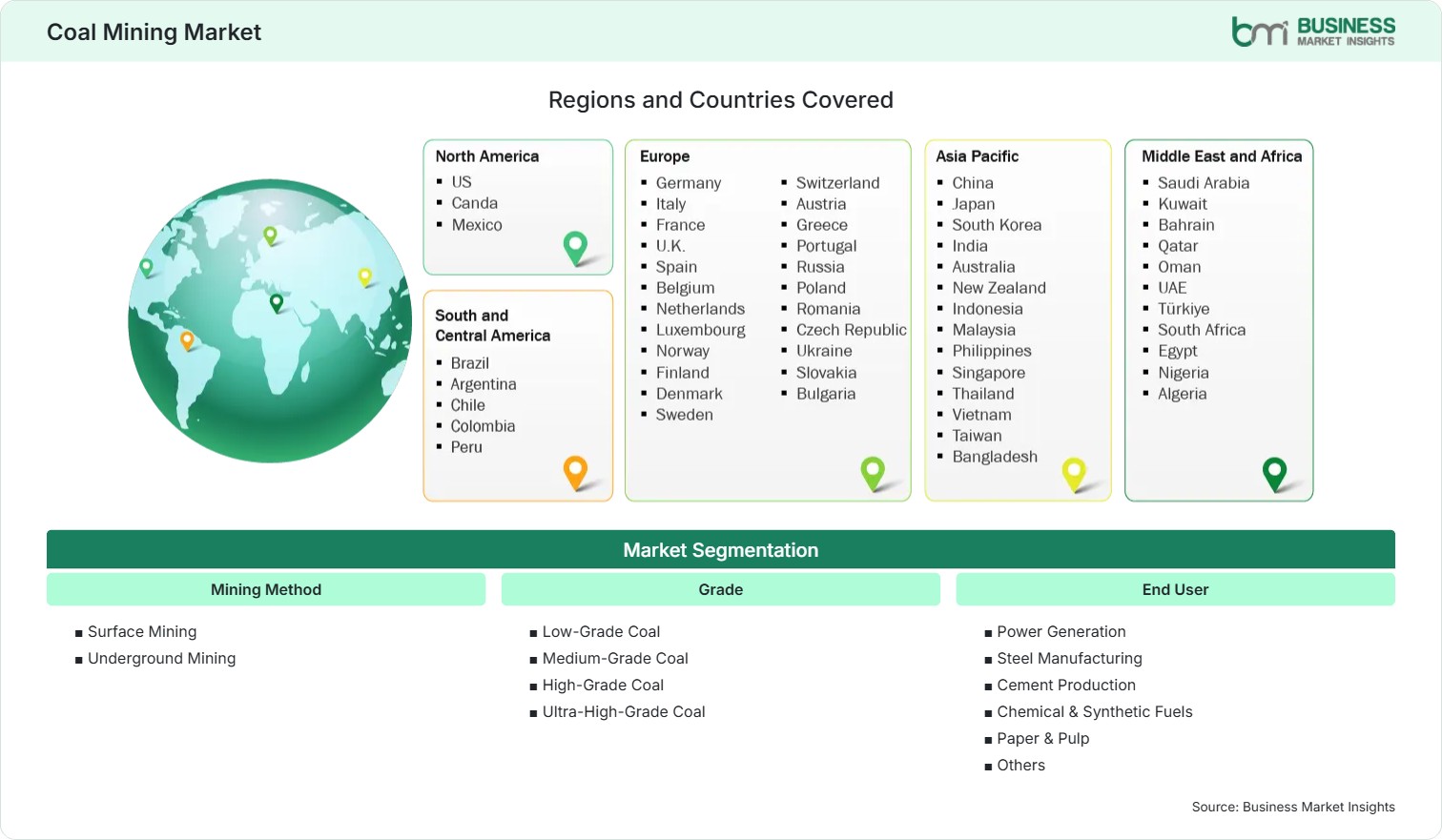
  • Mining Method: Surface Mining, Underground Mining
  • Grade: Low-Grade Coal, Medium-Grade Coal, High-Grade Coal, Ultra-High-Grade Coal
  • End User: Power Generation, Steel Manufacturing, Cement Production, Chemical & Synthetic Fuels, Paper & Pulp, Others
US$ 799.4 Bn Market size in 2025
US$ 1038.9 Bn Market Size by 2033
3.33% CAGR, 2026 - 2033
2026-2033 Forecast Period

AI Overview

Coal Mining Market Summary

  • North America Region: North America has a market share of 15%–18% in 2025, with a CAGR of 2.4%–3.0%, due to grid reliability needs, metallurgical coal exports, mining productivity upgrades, infrastructure needs, and life extension of select mines. US is the main market within the region, with government policies and strong demand for power resulting in a CAGR of 2.5%–3.2% till 2033.
  • Fastest Growing Region: Asia Pacific has a market share of 60%–64% in 2025, recording a CAGR of 3.8%–4.4%, owing to electricity demands, steel-making capacity, energy security, industrialization, mechanization of mines, and coal conversions across China, India, Indonesia, and Southeast Asia.
  • Leading Segment: Surface Mining holds 78%–82% market share in 2025, with a 3.2%–3.7% CAGR, driven by increased efficiency, large deposit sizes, mechanical overburden stripping, reduced costs, fleet automation, and favorable economics for large-scale open-pit mining.
  • High Growth Segment: Chemical & Synthetic Fuels holds a 7%–10% market share in 2025 with a CAGR of 4.4%–5.1% due to investment in coal to chemicals, gasification, diversified feedstocks, resources for domestic use, methanol, hydrogen in industries, and increased capacity of chemical manufacturing in Asia.
  • Key Market Opportunity: Coal producers can capture value through automated mines, premium metallurgical grades, mine-life extensions, coal-to-chemicals applications, operational digitalization, and lower-emission technologies while maintaining disciplined capital allocation amid transition risks.
  • Major Market Players: Coal India Limited; China Energy Investment Corporation Limited; China Shenhua Energy Company Limited; Shaanxi Coal and Chemical Industry Group Co., Ltd.; Yankuang Energy Group Company Limited; SUEK; Peabody Energy Corporation; Arch Resources, Inc.; PT Alamtri Resources Indonesia Tbk; Exxaro Resources Limited
Strategic Insights

Coal Mining Market: Strategic Insights

Coal Mining Market Strategic Framework
FREE PDF
Request your free sample
Request free sample
Stakeholder View

Key Takeaways

  • The value chain continues to be centered around mine ownership, contractors, equipment suppliers, rail and port operations, traders, utilities, steel mills, and end-users of the industrial sector. Competitive positioning becomes more about integration in logistics and coal quality than mine production alone.
  • Metallurgical coal retains its strategic importance as coke-based blast furnace steelmaking requires carbon-based reducing agents, and coal-to-chemicals use creates new pockets of demand for coal in China and India. Coal conversion emerges as an important source of incremental non-power usage as per IEA through 2030.
  • The automation process has shifted from mere implementation of machines to a coordinated mining system involving fleet management, predictive maintenance, geological modelling, haul truck automation, remote operation, and employee location.
  • The region providing the most compelling reasons for investing in coal is the Asia Pacific due to high levels of consumption in China and India, coupled with the emergence of new demand from industrialization and electrification in Indonesia, Viet Nam, and ASEAN countries. The Asia Pacific accounted for about 85% of coal imports globally in 2024.
  • Allocations of capital are becoming more selective. Companies are focusing on good quality deposits, metallurgical exposure, infrastructure tie-ins, increased efficiencies, and acquisitions which can provide geographic or product diversification.
  • The visibility of long-term demand is limited due to renewables, gas availability, efficiencies, and coal power plant retirements. Consequently, producers need to find the right balance between cash flow and reserve development.
Geographic Outlook

Coal Mining Market Regional Highlights

North America Coal Mining Market

North America held a 15%–18% share in 2025 and is projected to record a 2.4%–3.0% CAGR from 2026–2033. The region combines mature thermal coal operations with stronger metallurgical export exposure. US mine productivity, reliability requirements, and steelmaking demand support selected assets. The Coal Mining Market is constrained by retirements and declining domestic utility consumption. Canada contributes export-oriented metallurgical coal.

  • US operators are emphasizing metallurgical coal, productivity improvements, and strategically positioned mines as domestic utility demand becomes increasingly selective and export economics influence asset utilization and investment decisions.
  • Canada remains important for premium metallurgical coal, particularly where established rail and port infrastructure enables access to Asian and European steelmaking markets.
  • Mine automation is gaining importance because mature operations face labor constraints, safety requirements, equipment utilization pressures, and rising expectations for production consistency.
  • North American producers increasingly prioritize cost control, reserve quality, reclamation planning, and capital discipline when evaluating mine extensions or replacement projects.

US Coal Mining Market

The US represents approximately 65%–72% of North America's 2025 coal mining value and is projected to expand at a 2.5%–3.2% CAGR during 2026–2033. Thermal demand remains structurally challenged, but metallurgical coal and reliability considerations provide support. IEA data indicates US coal demand increased sharply in 2025 after prolonged declines, demonstrating the sensitivity of consumption to gas prices, electricity requirements, and policy conditions.

  • Appalachia retains strategic importance for high-quality metallurgical coal, while Central Appalachia faces greater geological and cost pressures than several western and northern producing areas.
  • Powder River Basin operations remain relevant to utilities seeking dependable fuel, although mine economics increasingly depend on plant-specific requirements and transportation costs.
  • Automation, predictive maintenance, and high-productivity equipment can improve competitiveness where labor availability and geological complexity increase operating costs.

Europe Coal Mining Market

Europe represented 10%–13% of global value in 2025, with a projected 1.5%–2.3% CAGR during 2026–2033. This region is structurally weak, as coal generation is falling and domestic mining activity has declined. Poland and certain other Central European markets remain relevant for industrial uses. The European Coal Mining Market share depends on import needs, industrial coal use, energy security concerns, and retirement of coal energy plants.

  • Poland remains the most significant coal-producing market in Europe, with domestic energy security and industrial employment supporting continued operational activity despite transition pressures.
  • Germany's coal trajectory remains dominated by decarbonization, while imported metallurgical coal continues serving steelmaking requirements that cannot immediately be replaced across existing production routes.
  • European producers face higher compliance costs associated with mine closure, land restoration, methane management, and environmental monitoring.
  • Investment is increasingly directed toward remediation, mine rehabilitation, infrastructure reuse, and transition-related activities rather than large new thermal coal developments.

Asia Pacific Coal Mining Market

Asia Pacific accounted for 60%–64% of global value in 2025 and is projected to grow at a 3.8%–4.4% CAGR through 2033, making it the fastest-growing regional market. China, India, Indonesia, and Australia anchor production and trade, while Southeast Asia adds incremental demand. China alone consumes substantially more coal than any other country, while Asia Pacific accounted for approximately 85% of global coal imports in 2024.

  • China remains the largest production and consumption center, with coal supporting electricity reliability, heavy industry, and chemical conversion while renewable generation increasingly changes utilization patterns.
  • India is a major growth market, with domestic production expansion supporting electricity, steel, cement, and industrial demand. The IEA expects Indian coal consumption to rise through 2030.
  • Indonesia remains a major export supplier and is also developing stronger domestic demand from power generation and metals processing.
  • Australia maintains a dual position as a major exporter of thermal and metallurgical coal, with premium grades supporting higher-value international trade.
  • Southeast Asia represents the strongest regional growth pocket, with IEA forecasts indicating coal demand growth above 4% annually through 2030.

Rest of World Coal Mining Market

Rest of World represented approximately 9%–12% in 2025 and is projected to advance at a 2.7%–3.5% CAGR through 2033. South and Central America are anchored by Colombia and selected regional exporters, while Brazil's industrial base creates metallurgical demand. Colombia's export infrastructure supports international trade, although logistics and policy developments influence investment.

Middle Eastern and African markets are more fragmented. South Africa remains the dominant African producer, while Botswana and Mozambique provide additional regional supply potential. Coal Mining Market share in these markets depends heavily on export logistics, domestic electricity demand, and infrastructure availability.

  • Colombia remains strategically positioned in Atlantic thermal coal trade, with mine-to-port logistics determining competitiveness against South African, Australian, and Indonesian supply.
  • South Africa combines domestic power-generation requirements with export exposure, although rail and port constraints can materially affect producer realization and utilization.
  • Brazil has a comparatively smaller production base but maintains relevance through steelmaking and industrial consumption, supporting selected metallurgical coal import requirements.
  • Mozambique and Botswana offer longer-term resource potential, but infrastructure investment remains a determining factor for commercial scalability and export competitiveness.
  • South Africa's established mining ecosystem supports technology deployment, contract mining, beneficiation, and equipment services across both established and developing operations.
Global Market Geography
FREE PDF
Request your free sample
Request free sample
Segment Analysis

Coal Mining Market Segmentation

Mining Method

Surface Mining represented approximately 78%–82% of 2025 Coal Mining Market share, with a 3.2%–3.7% CAGR during 2026–2033, supported by large reserves, mechanized extraction, and favorable productivity. Underground Mining accounts for the balance and remains strategically important where deposits are deep, seams are continuous, or surface extraction faces land constraints.

  • Surface Mining: Large-scale open-pit operations benefit from draglines, electric shovels, autonomous trucks, and continuous monitoring, enabling high throughput and improved unit-cost control across extensive deposits.
  • Underground Mining: Longwall systems, roof monitoring, automated shearers, and ventilation optimization support productive extraction where deep seams make surface mining economically or environmentally challenging.

Grade

Higher-grade coal represented approximately 55%–60% of 2025 market value, with a 3.5%–4.0% CAGR during 2026–2033, supported by demand from metallurgical and specialized industrial applications requiring consistent quality. Lower-grade coal accounts for the balance and remains important for power generation, domestic energy supply, and applications where local availability and cost advantages support continued use. The Coal Mining Market scope therefore spans differentiated coal qualities rather than a uniform commodity category, with grade-specific processing and blending increasingly influencing commercial outcomes.

  • Low-Grade Coal (Lignite): Lignite supports mine-mouth power generation because transportation costs can outweigh its lower energy density, encouraging integrated operations near thermal power facilities.
  • Medium-Grade Coal (Sub-bituminous): Sub-bituminous coal combines relatively low sulfur characteristics with suitable heating value, supporting utility applications where emissions requirements and fuel economics influence procurement.
  • High-Grade Coal (Bituminous): Bituminous coal serves major thermal and metallurgical applications, with higher energy density and suitable coking characteristics supporting premium industrial and export markets.
  • Ultra-High-Grade Coal (Anthracite): Anthracite occupies specialized applications requiring high fixed carbon and low volatile matter, including metallurgical, filtration, and selected industrial processes.

End User

Power Generation remains the largest end-user category, representing an estimated 55%–60% share in 2025, while its growth is constrained by renewable deployment and plant retirements. Chemical & Synthetic Fuels is modeled as the fastest-growing application at 4.4%–5.1% CAGR, supported by gasification and coal-conversion projects. End-use diversification is increasingly important as utilities reduce structural dependence on thermal coal.

  • Power Generation: Coal remains strategically important for grid reliability in several Asian markets, although utilization rates increasingly reflect renewable penetration, hydropower conditions, gas prices, and electricity demand.
  • Steel Manufacturing: Metallurgical coal remains essential to conventional blast-furnace steelmaking, creating premium demand for consistent coking properties and predictable impurity profiles.
  • Cement Production: Coal remains an important kiln fuel in several developing economies, although alternative fuels, efficiency programs, and environmental regulation constrain long-term volume growth.
  • Chemical & Synthetic Fuels: Coal gasification and coal-to-chemicals facilities create demand beyond conventional combustion, particularly in China where chemical production can offset declines in selected industrial coal applications.
  • Paper & Pulp: Industrial boilers and process heat applications provide localized coal demand, particularly where alternative fuel availability, energy infrastructure, and operating economics favor solid fuels.
Market Forces

Coal Mining Market Dynamics

Key Market Drivers

Rising Electricity Demand Supports Strategic Coal Utilization

Electricity demand remains a major driver of coal consumption, particularly in developing Asian economies. Growing power needs, industrial expansion, and grid development continue supporting coal use despite the rapid growth of renewable energy. These conditions support Coal Mining Market growth across India, Southeast Asia, and China, especially for producers serving domestic power markets. Flexibility of coal-fired facilities has also increased in response to greater use of renewable energy sources, thus requiring producers to provide high-quality coal in sufficient quantities and in a flexible manner. Overall, growing electricity consumption and the need for a steady energy supply ensure demand for coal.

Metallurgical Coal Retains Strategic Steelmaking Importance

Metallurgical coal continues to be an important driver of demand, especially in conventional steelmaking using blast furnaces. Other production techniques are still evolving, but their implementation will depend on several factors, including infrastructure, power, availability of scrap, and capital requirements, among others. India and Indonesia will create extra demand for metallurgical coal due to steel production. Coal Mining Market growth in the metallurgical segment is increasingly influenced by coal quality, blend compatibility, and steel industry investment rather than overall coal consumption. Premium, low-impurity coal can maintain stronger demand even when thermal coal markets weaken.

Mine Mechanization and Digitalization Improve Productivity

Technology is improving mining productivity by increasing equipment availability, reducing downtime, and improving worker safety. Autonomous haulage, fleet management, remote-controlled equipment, predictive maintenance, drone surveys, and digital geological models are becoming more common across mining operations. Surface mines continue to rely on large trucks and shovels, while underground mines are adopting automated longwall systems and improved ventilation controls. These developments support Coal Mining Market growth by helping operators improve output, control costs, and manage resources more efficiently. Digital tools also strengthen monitoring of dust, water, methane, blasting, and land rehabilitation, helping mining companies meet environmental and safety requirements.

Key Market Opportunities

Coal-to-Chemicals Creates New Non-Power Demand

Coal conversion offers an opportunity to expand demand beyond power generation and steelmaking. Gasification can produce syngas for methanol, ammonia, hydrogen-related processes, and other chemical products. China continues to be an important market for applications of coal to chemicals, whereas India, too is expanding its gasification and chemical applications projects. Companies situated near chemical complexes and transport links can capitalize on lower logistics costs and greater integration. Coal Mining Market Forecasts can thus be affected by demand for coal applications rather than just its use as thermal coal. Coal producers can also add value by providing grades appropriate for gasification and chemical processing purposes.

Premium Metallurgical Coal Supports Export-Oriented Investment

High-quality metallurgical coal remains relevant to steel manufacturers who need predictable coking properties. Australian, American, Canadian and other coal exporters will profit from the market’s demand for high-grade steelmaking coal. New investment opportunities will increasingly target mine-life extensions, improved production performance, processing, rail systems, and ports rather than big new mines. Another way to improve producer’s competitive position is to offer a diversified portfolio of coal including hard coking coal, semi-soft coal and PCI coal. Reserves with reliable deposits and good infrastructure remain profitable because they can reduce development costs and deliver better results.

Mine Automation Enables Lower-Cost and Safer Operations

Automation is creating new opportunities across surface and underground coal mines. Autonomous trucks, remote drilling, automated longwall systems, machine vision, surveying tools, and predictive maintenance can help address labor shortages, improve safety, and increase equipment efficiency. Large mines are particularly suited to automation because higher equipment utilization can support investment in digital systems. Centralized control centers can also improve monitoring, maintenance planning, and operational response. Technology providers can benefit from demand for software, sensors, communications, equipment analytics, and cybersecurity, creating opportunities for recurring services beyond traditional equipment sales.

Market Restraints and Challenges

Environmental Regulation Raises Project Development Complexity

Factor: Increased restrictions on mine permitting, land disturbance, water treatment, methane, dust, reclamation, and emissions compliance will add to project delays and compliance costs. Impact: Development expenses and delays could render the development of marginal resources uneconomical during periods of coal price fluctuations. Producers would also have to finance mine rehabilitation and mine closure. The different regulatory regimes across regions will make mining standardization difficult. This will favor experienced producers with permitted reserves and infrastructure.

Renewable Expansion and Fuel Competition Pressure Thermal Coal

Factor: Rapid growth in solar, wind, hydropower, nuclear, and liquefied natural gas facilities is increasing competition for coal. Impact: The use of coal can be reduced even when the total capacity of coal plants is quite large, resulting in decreased visibility regarding demand and pressure on mine economics. Increased capacity in renewables will likely reduce coal use in power generation, especially in advanced markets. The risk of volume for thermal coal miners will thus be higher, although diversification might help.

Company Analysis

Competitive Landscape

The Coal Mining Market analysis indicates a highly concentrated production structure in which national champions dominate large domestic resource bases while diversified private miners compete through export quality, operational efficiency, logistics, and metallurgical coal exposure.

Company Name

Overview

Products and Services relevant to this market

Coal India Limited

India's dominant coal producer, supplying major domestic power and industrial customers through an extensive mining portfolio.

Thermal coal extraction, mine development, coal beneficiation, logistics, and domestic supply to power and industrial users.

China Energy Investment Corporation Limited

Major Chinese energy enterprise with integrated coal, power, chemicals, and transportation operations.

Coal mining, coal-fired generation, coal-to-chemicals, logistics, and integrated energy production.

China Shenhua Energy Company Limited

Large integrated Chinese coal and energy producer combining mining, rail, ports, power, and chemicals.

Surface coal mining, railway logistics, power generation, coal chemicals, and coal trading.

Shaanxi Coal and Chemical Industry Group Co., Ltd.

Major Chinese coal producer with strong regional reserves and integrated industrial activities.

Coal extraction, coal chemicals, power generation, logistics, and industrial coal supply.

Yankuang Energy Group Company Limited

Diversified mining group with major Chinese and international coal operations and strong export exposure.

Thermal and metallurgical coal mining, coal chemicals, logistics, and energy-related operations.

SUEK

Russian energy company with significant coal mining, processing, logistics, and export capabilities.

Thermal coal mining, beneficiation, transportation, port logistics, and coal supply.

Peabody Energy Corporation

International coal producer with significant US and Australian operations and thermal and metallurgical exposure.

Thermal coal, metallurgical coal, mining operations, processing, logistics, and mine management.

Arch Resources, Inc.

US-based producer focused strongly on metallurgical coal and premium steelmaking markets.

Metallurgical coal mining, coal processing, blending, logistics, and export supply.

PT Alamtri Resources Indonesia Tbk

Indonesian natural-resource company with substantial coal operations and export-oriented production.

Thermal coal mining, processing, logistics, coal marketing, and resource development.

Exxaro Resources Limited

South African diversified resources company with important coal assets serving domestic and export markets.

Thermal coal mining, beneficiation, logistics, and domestic power-sector supply.

Trust & Transparency

Research Methodology

The market analysis combines proprietary research with secondary data from government agencies, company disclosures, regulatory filings, industry databases and expert interviews. Market estimates are validated through data triangulation, cross-market benchmarking and analyst review.

View Full Research Methodology

Questions Answered

Frequently Asked Questions

How can investors evaluate a Coal Mining Market Report?

Investors should assess reserve quality, mine life, production costs, coal grades, customer concentration, logistics, capital expenditure requirements, reclamation liabilities, regulatory exposure, and sensitivity to thermal versus metallurgical pricing.

What is the outlook for underground coal mining?

Underground mining will remain relevant where coal seams are deep, surface disturbance is constrained, or geological conditions make open-pit extraction uneconomic.

How is automation changing Coal Mining Market?

Automation enables remote operation, autonomous hauling, predictive maintenance, improved drilling precision, and continuous monitoring.

Why is metallurgical coal strategically different from thermal coal?

Metallurgical coal is primarily valued for its role in producing coke used by conventional blast-furnace steelmaking.

What determines the profitability of a coal mine?

Profitability depends on coal quality, geological conditions, stripping ratio, mine depth, labor productivity, equipment utilization, transportation costs, royalties, taxes, reclamation obligations, and realized selling prices.

Access the Full Coal Mining Market Report

Get segment-level forecasts, regional estimates, competitive benchmarking, company profiles and downloadable Excel datasets.

Access the full Coal Mining Market Report
350 pages PDF & Excel | 2026-09-01