Market Summary
Executive Summary and Global Market Analysis
Marine mining refers to the extraction of mineral-bearing deposits from the seafloor using subsea collection, sensing, and lifting systems. The activity targets polymetallic nodules, polymetallic sulphides, and cobalt-rich ferromanganese crusts that contain metals used in industrial and energy-linked value chains. This sector sits at the intersection of offshore engineering, resource security, and marine environmental management.
Interest in this market is advancing as manufacturers seek alternative mineral sources for electronics, automotive components, and specialized construction inputs. Pressure on terrestrial reserves, combined with the need for diversified supply channels, is supporting attention toward seabed resources. At the same time, progress in offshore robotics and mapping tools is improving the operational case for selective extraction campaigns.
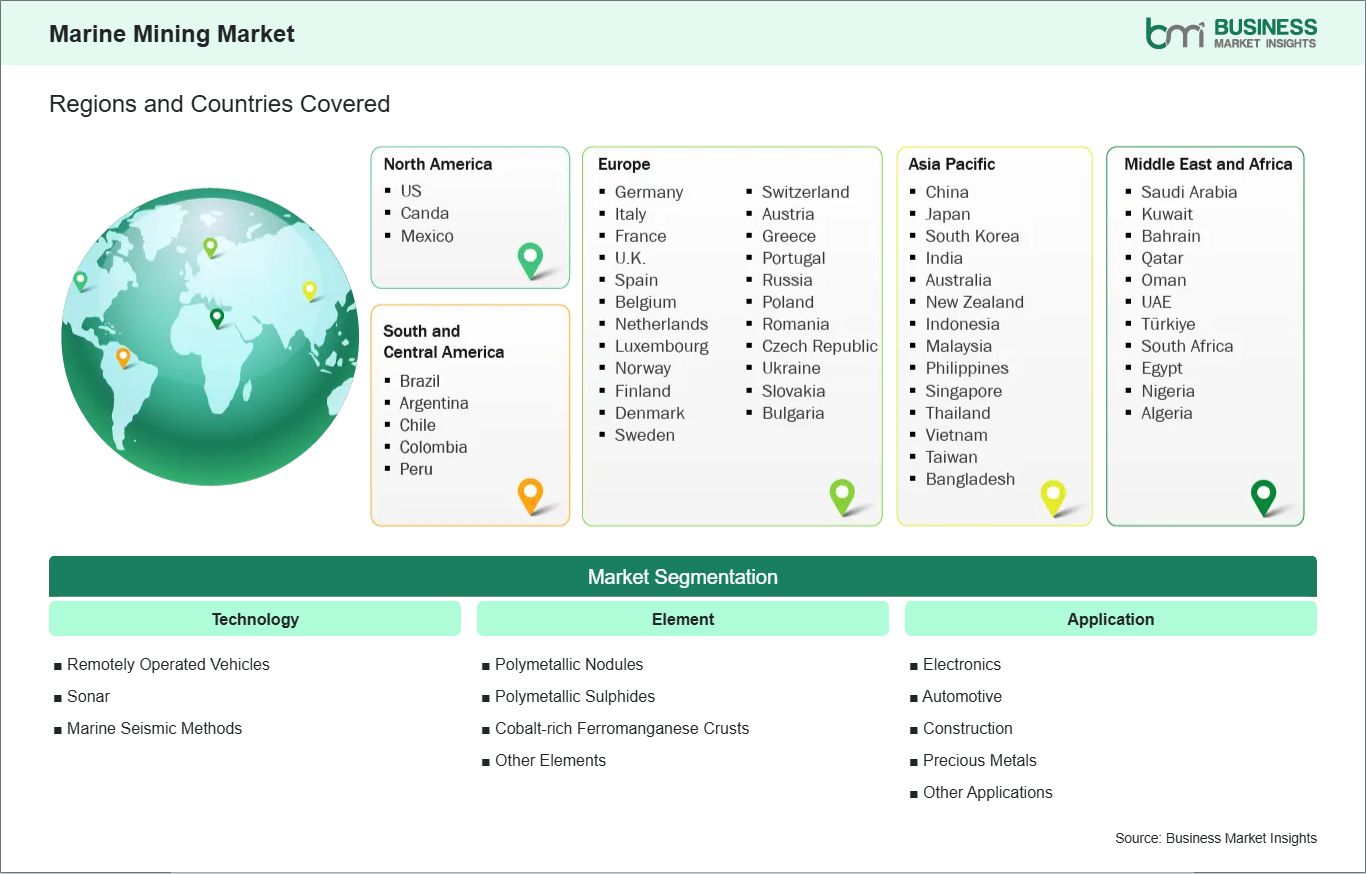
Segmentation patterns show a strong strategic focus on technology, element type, and end-use alignment. Remotely operated vehicles support intervention and collection tasks, while sonar and marine seismic methods improve seabed characterization and route planning. On the resource side, polymetallic nodules attract broad attention because of their metal mix, whereas application demand is shaped by electronics manufacturing, automotive systems, construction materials, and precious metal recovery.
Technology evolution is changing how operators assess, monitor, and retrieve subsea deposits. Better navigation accuracy, improved underwater sensing, and more capable vehicle control are supporting longer missions and clearer resource interpretation. These advances are also strengthening environmental observation, which is becoming an embedded requirement in project planning, equipment design, and site evaluation workflows.
Competitive conditions remain formative, with participation shaped by engineering capabilities, contract access, regulatory readiness, and seabed data depth. The field is defined less by broad commercialization and more by technical positioning, pilot preparation, and process validation. As a result, the market reflects a transition from exploration-led activity toward structured development pathways across selected offshore zones.
Segment Analysis
Marine Mining Market Segmentation
The marine mining market is segmented based on Technology, Element, and Application.
By Technology
- Remotely Operated Vehicles : Enable precision intervention and subsea material handling.
- Sonar : Improves deposit mapping and terrain interpretation accuracy.
- Marine Seismic Methods : Support sub-seafloor assessment and site delineation.
By Element
- Polymetallic Nodules : Offer multi-metal potential across battery and industrial supply chains.
- Polymetallic Sulphides : Attract attention for high-grade vent-associated mineralization.
- Cobalt-rich Ferromanganese Crusts : Present strategic appeal for cobalt-bearing seabed resources.
- Other Elements : Cover niche deposits with localized extraction interest.
By Application
- Electronics : Consumes refined metals used in conductive and component-intensive products.
- Automotive : Uses critical inputs for electrified systems and engineered assemblies.
- Construction : Requires mineral-derived materials for structural and specialty applications.
- Precious Metals : Supports selective recovery pathways for high-value outputs.
- Other Applications : Includes industrial uses with specialized material requirements.
Market Forces
Marine Mining Market Drivers and Opportunities
Need for Alternative Sources of Critical Minerals
Manufacturers are facing tighter sourcing conditions for metals used in electronics, transport systems, and industrial equipment. That pressure is increasing interest in seabed deposits as an additional resource pathway. Marine mining technologies are therefore gaining attention where long-term mineral access, supply diversification, and offshore extraction capability are becoming central to planning across mineral-dependent industries.
Its effect reaches beyond extraction economics because resource strategy now shapes investment timing, processing readiness, and procurement resilience. This gives marine mining greater relevance in discussions around future material availability. Where downstream industries seek more stable feedstock options, seabed resource development is emerging as a considered, though technically demanding, route within broader mineral supply planning.
Advances in Subsea Robotics and Seabed Mapping
Improved underwater vehicles, sensing platforms, and interpretation tools are expanding what operators can measure and recover beneath the surface. Better control systems and higher-resolution mapping support more informed site selection and equipment deployment. These innovations strengthen use cases for targeted mineral collection, especially where seabed complexity requires coordinated imaging, navigation, and remotely managed intervention.
Future scope is widening as offshore engineering integrates smarter monitoring, modular equipment, and more disciplined mission planning. This creates room for broader deployment across exploration and pre-extraction programs. As technical reliability improves, the market can extend into new contract areas, strengthen project confidence, and support more structured development models for marine mineral recovery.
Size and Share Analysis
Marine Mining Market Size and Share Analysis
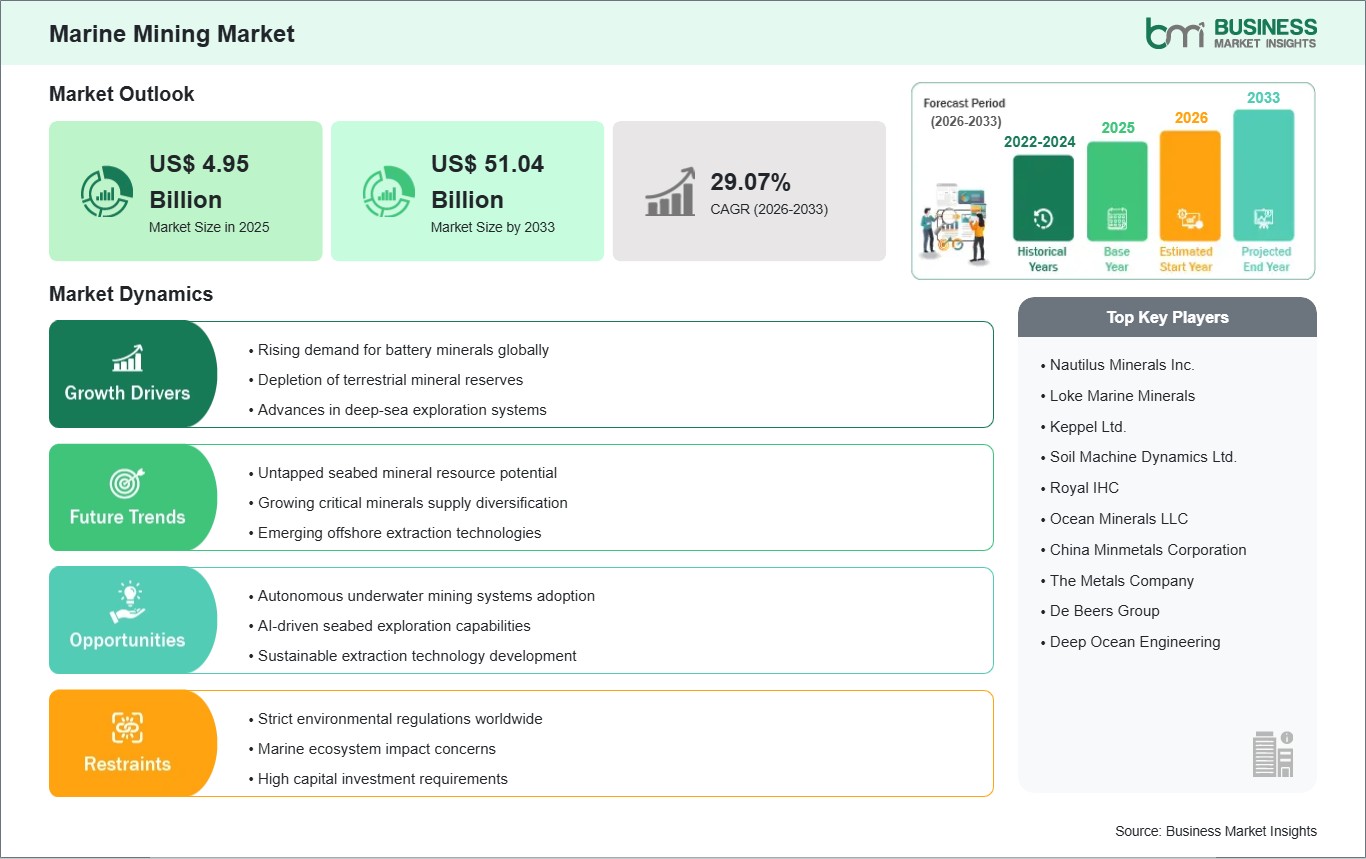
The marine mining market is projected to grow from US$ 4.95 billion in 2025 to US$ 51.04 billion by 2033, registering a CAGR of 29.07% from 2026 to 2033. This trajectory points to a market moving from exploratory positioning toward larger-scale commercial preparation, supported by stronger technical readiness and broader strategic interest in seabed mineral access.
Within the market structure, polymetallic nodules hold the leading position because they align with current interest in multi-metal recovery. On the technology side, remotely operated vehicles represent the most influential segment, reflecting their operational role in subsea observation, intervention, and collection support. Sonar and marine seismic methods remain essential as enabling systems for deposit identification and route design.
By application, electronics represents the dominant use case due to its persistent requirement for processed metal inputs across component manufacturing. Automotive follows closely as material requirements shift toward electrified platforms and advanced assemblies. Construction and precious metals contribute meaningful demand, yet electronics remains the central application lens through which marine mineral recovery is currently assessed.
Report Coverage
Marine Mining Market Report Coverage and Deliverables
The " Marine Mining Market Size and Forecast (2022-2033)" report provides a detailed analysis of the market covering below areas:
- Market size and forecast at global, regional, and country levels for all the key market segments covered under the scope
- Market trends, as well as market dynamics such as drivers, restraints, and key opportunities
- Market analysis covering key market trends, global and regional framework, major players, regulations, and recent market developments
- Industry landscape and competition analysis covering market concentration, heat map analysis, prominent players, and recent developments for the market
- Detailed company profiles, including SWOT analysis
Geographic Insights
Marine Mining Market Geographic Insights
The marine mining market shows diverse regional adoption patterns influenced by regulatory maturity, offshore engineering capabilities, mineral strategy, and access to exploration zones. Across the global landscape, progress remains uneven because project momentum depends on technical readiness and governance frameworks moving in parallel. Markets with stronger marine research infrastructure and seabed data programs are shaping early development priorities for this sector.
North America is gaining visibility through strategic interest in critical mineral security and subsea technology development. The region benefits from engineering depth, research capability, and active discussion around domestic and international seabed resource pathways. Its market stance is defined by technology validation and policy direction rather than broad extraction activity, which keeps commercial progress closely tied to permitting clarity and environmental review requirements.
Asia Pacific holds strong long-term relevance because industrial mineral demand, ocean technology programs, and state-backed research initiatives are closely aligned. Several countries in the region are advancing deep-ocean capabilities that support equipment trials, seabed surveys, and mineral assessment work. This creates a practical foundation for marine mining development, especially where electronics manufacturing and battery-linked material demand strengthen the strategic case for resource diversification.
Europe remains influential through regulatory engagement, environmental oversight, and specialized offshore engineering expertise. At the same time, emerging markets in parts of the Middle East, Africa, and South and Central America are watching the sector through a resource strategy lens, though activity remains selective. Together, these regions contribute to the market through policy experimentation, research partnerships, and gradual positioning around future seabed mineral opportunities.
Industry Activity
Recent Developments
Recent developments in the marine mining market reflect progress in permitting, pilot preparation, and strategic positioning across seabed mineral projects. Selected updates below highlight notable activity between 2023 and 2026.
- In June 2026, Deep Sea Minerals (CSE: SEAS) announced that its application filed under the Deep Seabed Hard Mineral Resources Act (DSHMRA) has been found compliant by the National Oceanic and Atmospheric Administration. According to the Canadian deep-sea mining company, this determination marks an important step in the U.S. federal review process for permits related to the exploration and commercial extraction of polymetallic nodules in international waters beyond national jurisdictions.
- In May 2025, The U.S. National Oceanic and Atmospheric Administration (NOAA) has determined that TMC USA's consolidated deep-seabed mining application fully complies with requirements under the Deep Seabed Hard Mineral Resources Act. The decision advances the project to the next regulatory stage, including environmental review and public consultation. TMC expects the permitting process for exploring and recovering polymetallic nodules in the Clarion Clipperton Zone to be completed by Q1 2027.
Trust & Transparency
Research Methodology
The market analysis combines proprietary research with secondary data from government agencies, company disclosures, regulatory filings, industry databases and expert interviews. Market estimates are validated through data triangulation, cross-market benchmarking and analyst
review.
View Full Research Methodology
Key Sources Referred:
World Bank : Global Trade Indicators World Trade Organization (WTO) International Monetary Fund (IMF) International Trade Administration (ITA) Company Websites Company Annual Reports Company Investor Presentations