Market Summary
Executive Summary and Global Market Analysis
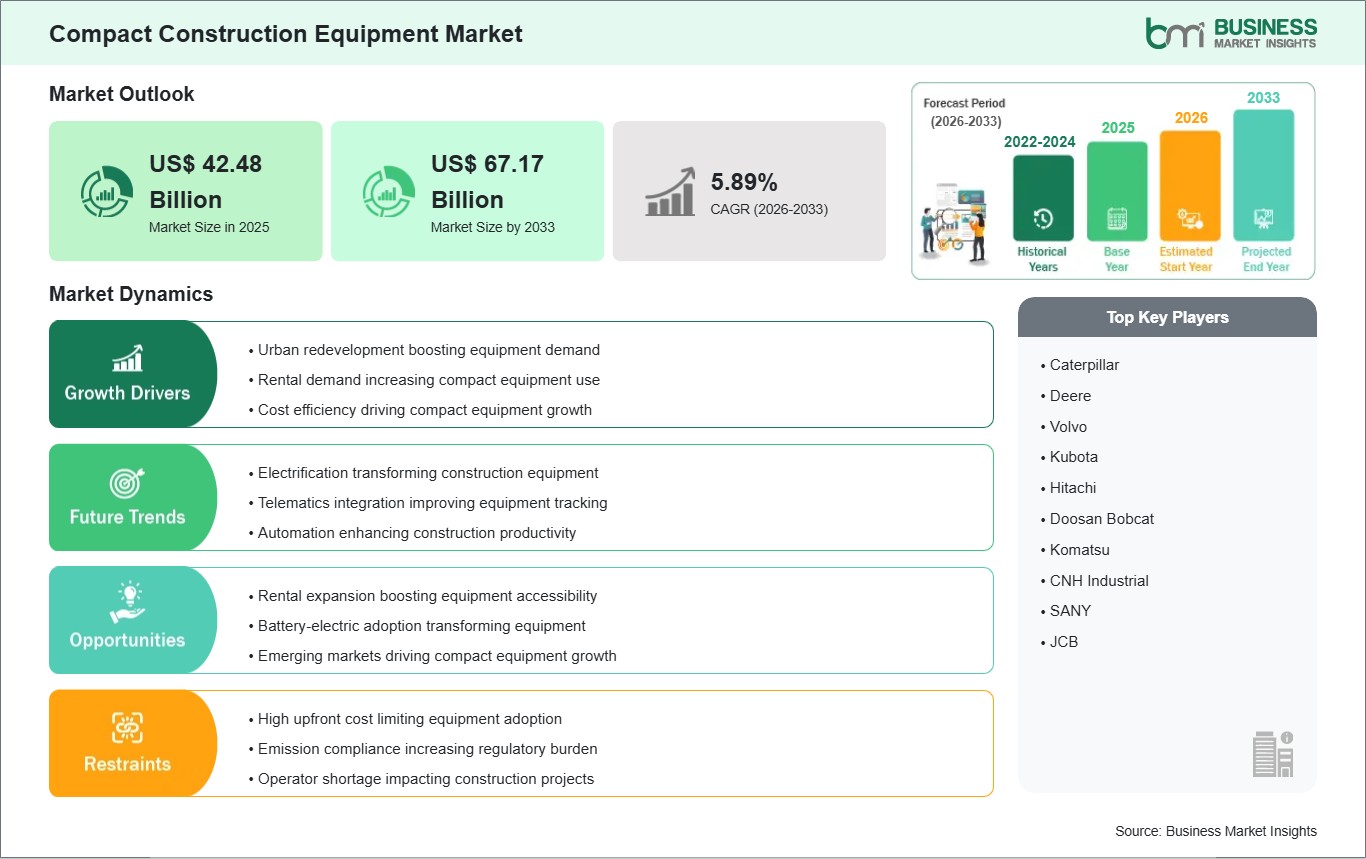
Compact construction equipment includes small-scale machinery such as excavators, loaders, skid steers, track loaders, compactors, and telehandlers designed for efficient operation in confined urban and industrial environments. These machines possess the advantage of both high maneuverability and versatility in function. Urban renovation projects and infrastructural renovation have led to an increased dependency on compact construction equipment. The increased use of such machines in residential and commercial developments emphasizes the need for precision, efficiency, and environmentally friendly machines.
Increased variation in the mode of propulsion, especially with the development of electric variants, is indicative of this trend. Insights at the segment level show the difference in use between different equipment types, with excavators and loaders being widely used because of their wide range of applicability. The power output segments less than 100 HP still play an important role for compact equipment, while the capacity of engines between 2-3.5 L provides a good combination of power and efficiency. Various industries, including residential construction and infrastructure redevelopment, generate stable demand.
In terms of technological development, the trend towards electrification and improved hydraulics stands out. Electric drive leads to zero emissions and low noise, making it possible usage in environmental projects related to urban redevelopment. The competitive environment reflects a shift toward rental accessibility and multi-functional equipment design. Market participants emphasize compliance with sustainability standards, adaptability across diverse end-use sectors, and alignment with urban redevelopment priorities. Compact equipment serves as a core enabler of modern construction ecosystems, bridging efficiency with regulatory compliance.
Segment Analysis
Compact Construction Equipment Market Segmentation
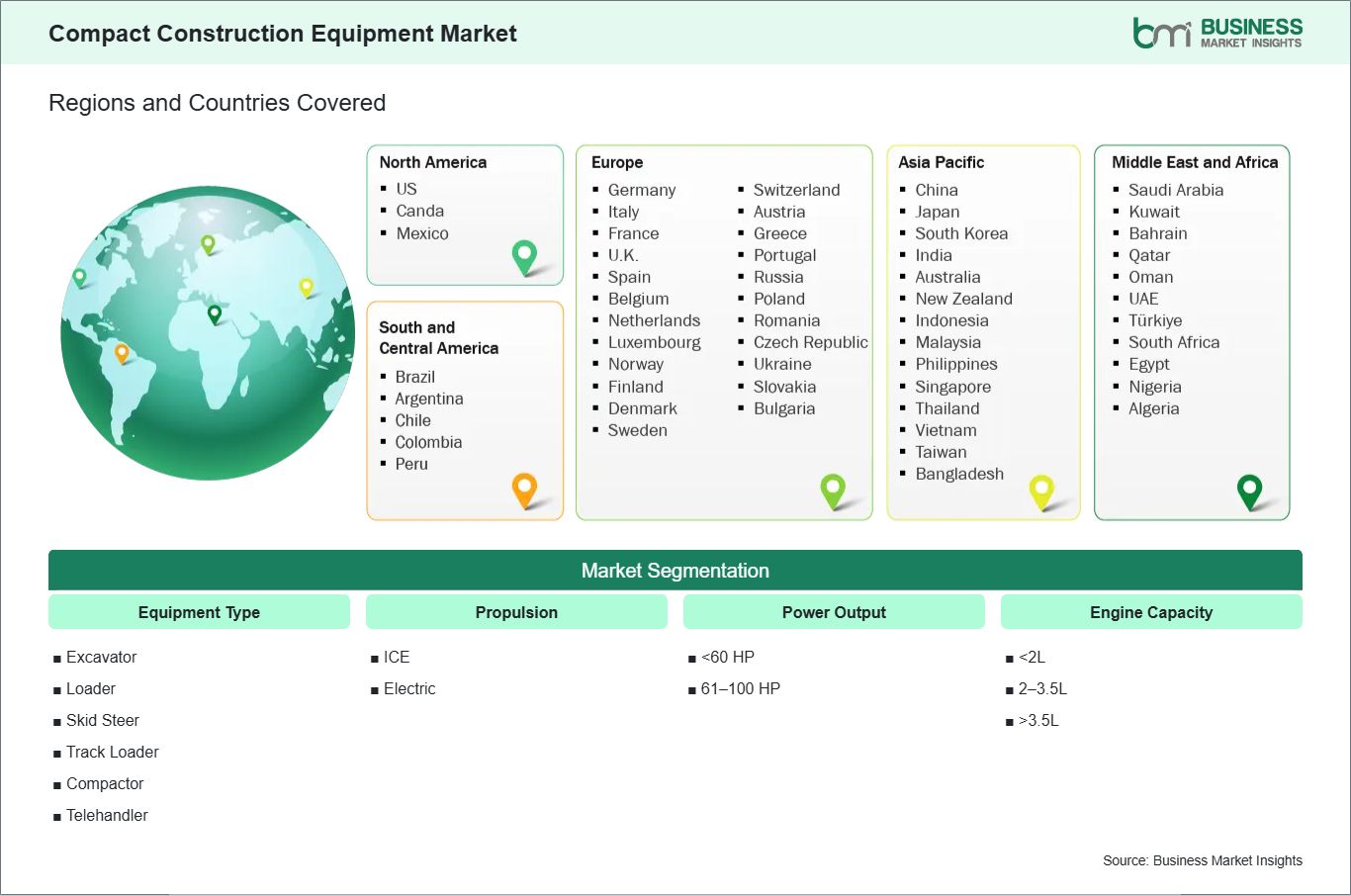
The compact construction equipment market is segmented by equipment type, propulsion, power output, engine capacity, and end-use, reflecting expanding deployment across residential, commercial, and infrastructure projects.
By Equipment Type
- Excavator: Dominates due to versatility in digging and site preparation.
- Loader: Widely used for material handling and transport efficiency.
- Skid Steer: Preferred for maneuverability in confined urban sites.
- Track Loader: Provides stability and traction in uneven terrain.
- Compactor: Essential for soil stabilization and road construction.
- Telehandler: Supports lifting and placement in vertical construction.
By Propulsion
- ICE: Maintains prevalence in heavy-duty applications requiring extended runtime.
- Electric: Gains traction in urban redevelopment projects with emission restrictions.
By Power Output
- <60 HP: Suitable for small-scale residential projects.
- 61-100 HP: Balances compact size with higher productivity for infrastructure tasks.
By Engine Capacity
- <2L: Serves lightweight applications with efficiency focus.
- 2-3.5L: Provides balanced performance across diverse tasks.
- >3.5L: Supports demanding operations requiring higher torque.
By End-use
- Residential: Expanding deployment in housing redevelopment.
- Commercial: Utilized for site preparation and facility upgrades.
- Infrastructure: Integral to roadworks and public utility projects.
Market Forces
Compact Construction Equipment Market Drivers and Opportunities
Urban redevelopment boosting equipment demand
Urban redevelopment initiatives across global cities have intensified reliance on compact construction equipment. As older infrastructure undergoes renewal and dense urban areas are restructured, machinery such as excavators, loaders, and skid steers becomes indispensable for maneuvering within confined spaces. Compact machines deliver agility and precision where larger equipment cannot operate effectively. Redevelopment projects often involve demolition, site clearing, and foundation preparation, all requiring versatile machinery capable of handling multiple tasks efficiently. The emphasis on sustainable urban planning further reinforces reliance on compact equipment, as projects prioritize reduced emissions and minimized disruption to surrounding communities.
From a business perspective, redevelopment projects translate into consistent demand across residential, commercial, and infrastructure sectors. Contractors benefit from equipment that reduces project timelines while ensuring compliance with environmental standards. Fleet operators enhance competitiveness by offering compact machinery tailored to urban environments, strengthening their market position. The operational impact extends to improved safety, reduced downtime, and enhanced productivity, positioning compact equipment as a structural necessity in modern redevelopment strategies.
Rental expansion boosting equipment accessibility
The growing trend of rental services is increasing access to compact construction equipment. This allows contractors to use heavy equipment, like excavators, loaders, and telehandlers, for short-term projects and seasonal-type applications, without the high upfront costs of owning the equipment. Access to rental equipment provides a contractor with the ability to closely match the usage of a particular piece of equipment to the project's needs. As a result, rental equipment availability offers an opportunity to accelerate the adoption of new technologies, such as electric-powered machinery, and reduce barriers to entry into certain markets by allowing smaller contractors to utilize rental companies to access these new technologies.
The future of rental equipment will also include the integration of digital technology with rental services (real-time availability, tracking of usage history, and predictive maintenance services). Additionally, the continued growth of rental companies into emerging markets will further increase access to rental equipment and enhance the ability to support infrastructure projects and urban renewal. Consequently, in the long run, rental equipment is expected to allow more contractors to access compact equipment and thus democratize the use of heavy equipment. As such, the growth and expansion of rental services is expected to fundamentally change the way equipment is accessed and used globally within the construction industry.
Size and Share Analysis
Compact Construction Equipment Market Size and Share Analysis
The Compact Construction Equipment Market is projected to grow from US$ 42.48 Billion in 2025 to US$ 67.17 Billion by 2033 , registering a CAGR of 5.89% from 2026 to 2033.
By equipment type, the excavator category accounts for a significant share due to its versatility in site preparation, demolition, and foundation work, making it indispensable across residential, commercial, and infrastructure projects.
By propulsion, ICE leads the market owing to its established reliability, extended runtime capacity, and suitability for demanding construction environments where continuous operation is critical.
Report Coverage
Compact Construction Equipment Market Report Coverage and Deliverables
The "Compact Construction Equipment Market Size and Forecast (2022-2033)" report provides a detailed analysis of the market covering below areas:
- The market size and forecast at the regional and country levels for segments covered under the scope
- The market trends, as well as drivers, restraints, and opportunities
- The market analysis covering key trends, regional framework, major players, regulations, and recent developments
- Industry landscape and competition analysis covering market concentration, heat map analysis, prominent players, and recent developments for the market
- Detailed company profiles, including SWOT analysis
Geographic Insights
Compact Construction Equipment Market Geographic Insights
The compact construction equipment market shows diverse regional adoption patterns influenced by urban redevelopment priorities, infrastructure investment, and technological readiness across construction ecosystems. Global deployment reflects the convergence of sustainability goals and operational efficiency, positioning compact machinery as a cornerstone of modern construction practices.
In North America, adoption is shaped by extensive urban renewal projects and infrastructure modernization. Compact equipment supports compliance with emission regulations while delivering efficiency in confined urban environments. Rental expansion further strengthens accessibility, enabling contractors to align equipment usage with project-specific requirements.
Asia Pacific demonstrates expanding deployment driven by rapid urbanization and industrial mechanization. Compact equipment is increasingly integrated into residential and infrastructure projects, reflecting the region emphasis on efficiency and operator safety. The transition toward electric propulsion is gaining traction in metropolitan areas, aligning with sustainability initiatives.
Europe maintains strong momentum through harmonized safety and environmental directives. Compact equipment adoption is reinforced by advanced engineering and integration of telematics for fleet optimization. Emerging markets in Latin America and the Middle East are gradually adopting compact machinery, prioritizing accessibility through rental services and modernization of construction practices.
Industry Activity
Recent Developments
The compact construction equipment market is evaluated by gathering qualitative and quantitative data post primary and secondary research, which includes important corporate publications, association data, and databases. A few of the key developments in the compact construction equipment market are:
- In January 2022, Bobcat Company announced the launch of the all-electric Bobcat T7X compact track loader at CES 2022, marking the industry first fully electric compact loader designed to eliminate hydraulic systems, reduce emissions, and improve sustainability in compact construction equipment operations.
- In May 2022, Caterpillar announced the introduction of its next-generation Cat 906, 907, and 908 compact wheel loaders, featuring upgraded hydraulics, improved operator controls, enhanced drivetrains, and new engine technology for compact construction applications.
- In October 2022, Caterpillar announced the expansion of its construction industries portfolio with four battery-electric machine prototypes, including the 906 compact wheel loader and 301.9 mini excavator, showcased at Bauma 2022 as part of its low-emission compact equipment strategy.
Trust & Transparency
Research Methodology
The market analysis combines proprietary research with secondary data from government agencies, company disclosures, regulatory filings, industry databases and expert interviews. Market estimates are validated through data triangulation, cross-market benchmarking and analyst
review.
View Full Research Methodology
Key Sources Referred:
Association of Equipment Manufacturers (AEM)
Construction Equipment Association (CEA)
European Construction Industry Federation (FIEC)
Japan Construction Equipment Manufacturers Association (CEMA)
China Construction Machinery Association (CCMA)
Indian Construction Equipment Manufacturers’ Association (ICEMA)
Company Websites
Company Annual Reports
Company Investor Presentations