
Compact Loader Market Outlook: Size, Share, Trends, Growth Analysis, Competitive Landscape & Forecast, 2026-2033

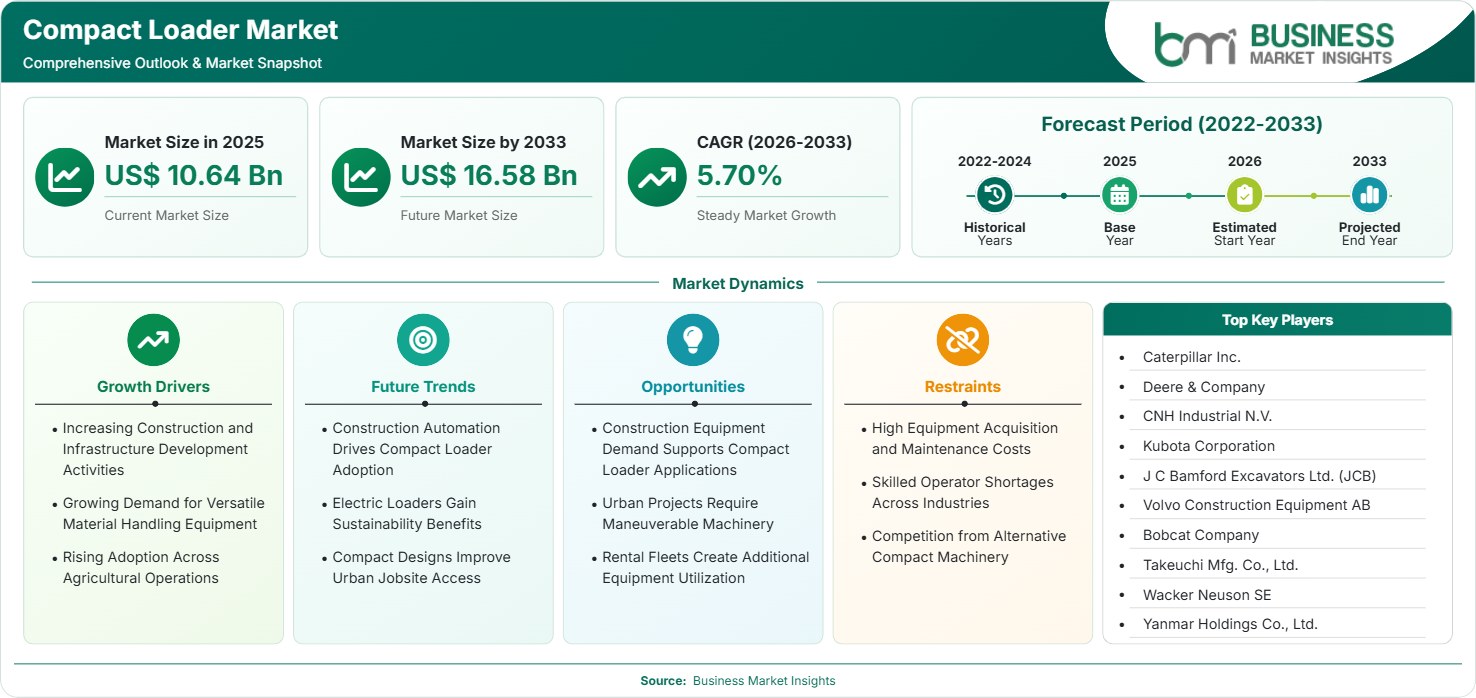
The Compact Loader Market size was valued at US$ 10.64 Billion in 2025 and is projected to reach US$ 16.58 Billion by 2033, growing at a CAGR of 5.7% during 2026–2033. Growth is supported by urban infrastructure development, equipment rental expansion, mechanization in agriculture, electrification initiatives, and rising demand for versatile machines able to operate in confined environments.

Report Coverage
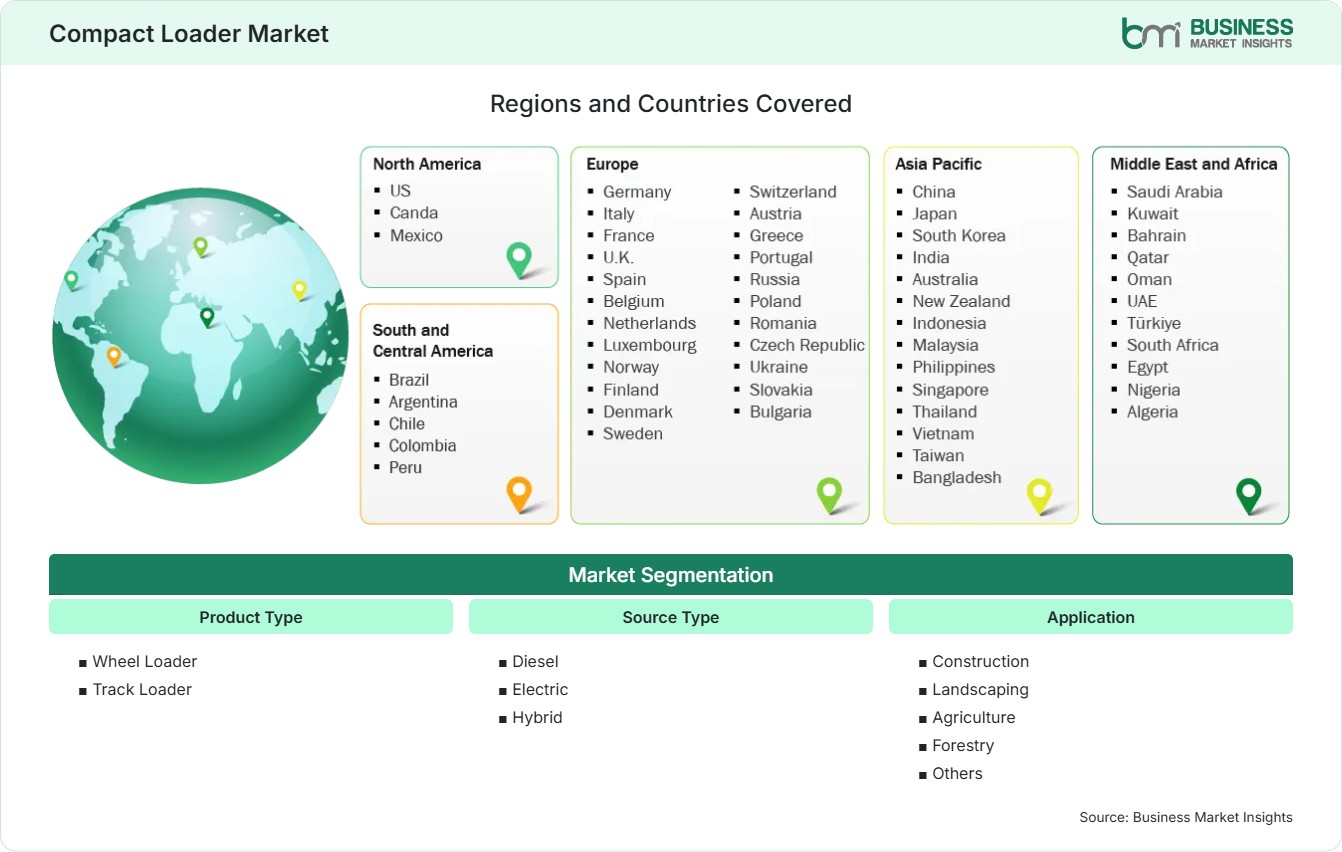
  • Product Type: Wheel Loader, Track Loader
  • Source Type: Diesel, Electric, Hybrid
  • Application: Construction, Landscaping, Agriculture, Forestry, Others
US$ 10.64 Bn Market size in 2025
US$ 16.58 Bn Market Size by 2033
5.70% CAGR, 2026 - 2033
2026-2033 Forecast Period

AI Overview

Compact Loader Market Summary

  • North America Region: Holds a market share of 34%–37% in 2025, growing at a CAGR of 5.0%–5.5% during 2026–2033, supported by rental fleet expansion, housing activity, municipal projects, and electrified machinery adoption. The U.S. benefits from contractor demand, fleet modernization, and infrastructure funding, with a CAGR of 5.1%–5.6%.
  • Fastest Growing Region: Asia Pacific accounts for 28%–31% share in 2025 and advances at 6.5%–7.1% CAGR through 2033, driven by urbanization, industrial development, public infrastructure spending, and increasing mechanization across emerging economies.
  • Leading Segment: Wheel Loader represents 56%–60% share in 2025 and expands at 5.2%–5.8% CAGR. Demand is supported by versatility, lower operating costs, contractor preference, and strong utilization across construction and agriculture.
  • High Growth Segment: Electric source type holds 8%–11% share in 2025 while recording 10.2%–11.5% CAGR. Growth reflects emission regulations, sustainability targets, lower maintenance requirements, and advances in battery technologies.
  • Key Market Opportunity: Electrification, connected fleet management, and equipment-as-a-service models are creating opportunities for manufacturers to improve lifecycle value, reduce ownership costs, and penetrate environmentally regulated construction and municipal applications.
  • Major Market Players: Caterpillar Inc., Deere & Company, CNH Industrial N.V., Kubota Corporation, J C Bamford Excavators Ltd. (JCB), Volvo Construction Equipment AB, Bobcat Company, Takeuchi Mfg. Co., Ltd., Wacker Neuson SE, Yanmar Holdings Co., Ltd.
Strategic Insights

Compact Loader Market: Strategic Insights

Compact Loader Market Strategic Framework
FREE PDF
Request your free sample
Request free sample
Stakeholder View

Key Takeaways

  • The value chain is increasingly centered on component suppliers, telematics providers, attachment manufacturers, rental companies, and OEMs operating within integrated service ecosystems.
  • Landscaping, municipal works, and compact urban construction projects offer some of the strongest growth potential due to demand for versatile and maneuverable equipment.
  • Product innovation is shifting toward battery-powered drivetrains, autonomous assistance functions, remote diagnostics, and productivity-enhancing machine connectivity.
  • India, Indonesia, Vietnam, and Gulf economies present compelling investment opportunities because of rapid infrastructure development and growing equipment utilization rates.
  • Strategic acquisitions continue strengthening dealer networks, technology capabilities, and aftermarket offerings as manufacturers seek recurring revenue streams.
  • Attachment diversification is enhancing machine utilization, allowing operators to perform excavation, grading, material handling, and maintenance functions with a single platform.
Geographic Outlook

Compact Loader Market Regional Highlights

North America Compact Loader Market

North America maintains the largest position, accounting for 34%–37% of global demand in 2025 and advancing at 5.0%–5.5% CAGR through 2033. Strong rental penetration, residential construction, infrastructure modernization, and replacement demand support regional performance. Compact Loader Market share remains concentrated in the United States, while Canada benefits from municipal and utility investments. Fleet modernization and adoption of telematics-enabled machines continue influencing procurement decisions across contractors and rental companies.

  • Large rental companies prioritize connected equipment improving utilization and maintenance scheduling.
  • Infrastructure upgrades support sustained demand across transportation and utility applications.
  • Electrified compact machinery adoption increases in municipalities and indoor projects.
  • Labor shortages encourage investment in productive and easy-to-operate equipment.

US Compact Loader Market

The United States represents 78%–82% of regional demand and expands at 5.1%–5.6% CAGR. Contractor investment, infrastructure legislation, suburban development, and strong equipment financing availability underpin market activity. Compact Loader Market growth remains strongest across construction and landscaping applications where versatility and attachment compatibility are critical operational considerations.

  • Compact track and wheel loaders remain preferred solutions for urban construction projects.
  • Fleet digitization improves machine productivity and operating efficiency.
  • Equipment replacement cycles support steady OEM revenues.
  • Growing adoption of low-emission machinery aligns with sustainability goals.

Europe Compact Loader Market

Europe captures 24%–27% market share in 2025 and records 4.8%–5.4% CAGR through 2033. Environmental regulations, renovation activities, and advanced rental ecosystems support demand. Germany leads regional revenue generation, while Eastern European countries represent faster-growing opportunities with CAGRs above regional averages due to infrastructure development and industrial investments.

  • Stage V emission regulations stimulate equipment replacement demand.
  • Electric loader deployments expand across urban construction environments.
  • Germany remains the largest national contributor to regional revenues.
  • Poland and Romania exhibit above-average growth supported by infrastructure funding.

Asia Pacific Compact Loader Market

Asia Pacific accounts for 28%–31% of demand in 2025 and achieves the fastest expansion at 6.5%–7.1% CAGR. China remains the dominant market, while India shows the highest growth trajectory due to infrastructure spending and mechanization. Rising urban populations, industrial parks, logistics investments, and construction activity continue strengthening adoption trends.

  • China leads regional sales through extensive infrastructure activity.
  • India demonstrates rapid adoption supported by public investment programs.
  • Construction mechanization increases across Southeast Asian markets.
  • Smart city projects encourage procurement of compact equipment.
  • Agricultural modernization supports diversified equipment utilization.

Rest of World Compact Loader Market

The Rest of World holds a 10%-13% share and grows at 5.8%-6.4% CAGR. A construction boom and agricultural investments drive growth in South and Central America, whereas commercial and transport developments and industrial diversification propel growth in the Middle East and Africa. Brazil and Saudi Arabia are important sources of revenue, and the UAE is experiencing rapid growth.

  • Brazil supports demand through agriculture and infrastructure development.
  • Saudi Arabia benefits from large-scale construction megaprojects.
  • UAE investment programs encourage equipment fleet expansion.
  • Mining and material-handling activities support additional demand streams.
Global Market Geography
FREE PDF
Request your free sample
Request free sample
Segment Analysis

Compact Loader Market Segmentation

Product Type

Product Type accounts for the largest revenue contribution. The segment holds approximately 56%–60% share in 2025 and advances at 5.2%–5.8% CAGR. The Compact Loader Market scope continues expanding as contractors seek multipurpose equipment capable of supporting diverse applications while maintaining operational efficiency and minimizing project costs.

  • Wheel Loader: Widely adopted across construction and agriculture due to speed, maneuverability, operating efficiency, and compatibility with multiple attachment systems.
  • Track Loader: Preferred for uneven terrain, enhanced traction, reduced ground disturbance, and projects requiring superior stability under challenging site conditions.

Source Type

Source Type is getting influenced by sustainability objectives and technological development. Diesel engines rule, but electric power gains momentum very fast. The market receives support from emissions standards, life-cycle cost reductions, and a growing charging network infrastructure in urban and municipal areas.

  • Diesel: Continues leading deployment across heavy-duty applications requiring extended operating hours and established fueling infrastructure.
  • Electric: Compact Loader Market trends increasingly favor electric platforms because of lower noise levels, reduced emissions, and improving battery performance.
  • Hybrid: Provides balanced performance through fuel savings and operational flexibility, especially in transitional fleets.

Application

Application requirements continue to vary across sectors, including construction, agriculture, landscaping, and forestry. Construction is the largest revenue generator, accounting for 42%-46% of revenue, with a CAGR of 5.8%-6.4%, driven by the growing needs of infrastructure and urbanization.

  • Construction: Driven by infrastructure projects, residential development, urban renewal, and attachment-driven equipment versatility.
  • Landscaping: Benefits from municipal maintenance, property development, and demand for compact and maneuverable machinery.
  • Agriculture: Increasing mechanization and labor efficiency needs support equipment adoption.
  • Forestry: Utilized for material handling, land clearing, and maintenance operations in difficult terrain.
Market Forces

Compact Loader Market Dynamics

Key Market Drivers

Infrastructure Modernization Expanding Equipment Demand

Government funding for transportation, utilities, and urban development projects continues to drive demand for construction equipment. According to information from the OECD, the IMF, and national infrastructure development initiatives, there will be continued investment in construction equipment in the medium term. Smaller construction equipment is increasingly chosen for work in environments where maneuverability is important. Multiple tasks performed by construction equipment using attachment systems have become the primary choice for contractors. These factors collectively improve equipment utilization rates, support production volumes, and create favorable conditions for long-term market expansion.

Rental Fleet Expansion Supporting Adoption

Rental companies still rank as the most important buyers of equipment. Contracting firms are now opting for rentals over ownership due to improved capital effectiveness and enhanced flexibility. Major rental firms continue to acquire technologically advanced loader equipment with telemetry systems, low maintenance requirements, and attachment capabilities. The analysis of fleet usage improves these machines' performance and supports the need for replacements. Medium- and small-sized contracting companies enjoy lower costs and better equipment.

Technology Integration Increasing Productivity

Telematics systems, GPS-based tracking technology, predictive maintenance solutions, and operator assistance systems have become commonplace in construction equipment. Internet connectivity enables better machine monitoring, more effective service planning, and a reduced risk of machine downtime. Diagnostics done remotely lead to shorter service intervals and better machine lifecycle performance. Investments by the OEMs in automation and machine intelligence are constantly growing. These developments strengthen value propositions across both mature and emerging markets.

Key Market Opportunities

Electrification of Compact Equipment Fleets

Electric machines have remained an essential investment trend in the compact equipment segment. Governments, utility companies, and construction contractors are increasingly concerned with minimizing their carbon footprints, achieving sustainability objectives, and reducing operational expenses. With technological innovations in batteries, better runtime, performance, and fast charging are being realized. Moreover, tightening laws in urban environments, alongside low-noise-emission demands, are boosting uptake. The Compact Loader Market forecasts provides great opportunities for OEMs that provide charging stations, batteries, and energy management systems. There are many competitive benefits for pioneers in this field.

Growth of Smart City Projects

The rise of smart city projects has increased demand for small, efficient, and technologically sophisticated construction equipment. The development of infrastructure such as mass transportation systems, public facilities, utilities, green energy power plants, and connectivity initiatives requires equipment capable of working in tight spaces with minimal disruption. Companies manufacturing equipment that includes automation, telematics, remote monitoring, and improved safety technologies are likely to prosper through the increased municipal spending, sustainable urban planning programs, and infrastructure projects globally.

Emerging Market Mechanization

Many developing economies are steadily transitioning from labor-intensive construction and agricultural practices toward greater mechanization. Rising household incomes, improved access to financing, and increasing government investments in infrastructure projects are driving demand for modern equipment and machinery. Market penetration can be achieved by expanding the dealer network, building localized production capacity, and expanding aftermarket service capacity. This will ensure affordability, availability, and after-sales support. In the long run, there are good growth prospects in many markets, especially those in South Asia, Southeast Asia, and certain Middle Eastern countries.

Market Restraints and Challenges

High Equipment Acquisition Costs

State-of-the-art construction machines with telematics, electric engines, automation capabilities, and advanced driver-assist systems usually cost much more than regular machines. Such high initial investments might become a stumbling block for financially constrained customers, who would be hesitant to buy new machines and instead try to prolong the lifespan of their existing machines or purchase second-hand ones. While new technology helps increase machine productivity and efficiency and provides better safety and performance throughout the entire lifespan, high initial costs remain a critical obstacle for small and medium-sized companies.

Supply Chain and Component Availability Risks

The dependence of global supply chains on critical components such as electronics, batteries, engines, and hydraulic systems poses risks to equipment suppliers. Disruptions may occur due to geopolitical issues, material shortages, logistics problems, or supplier issues, leading to production delays, increased costs, and delivery delays. It can affect customer decisions and hamper their competitive edge. In addition, fluctuating raw material prices and logistics costs put pressure on profit margins, while poor inventory management undermines the company's efficiency and market growth.

Company Analysis

Competitive Landscape

Compact Loader Market analysis indicates competition is concentrated among global construction equipment manufacturers emphasizing technology, dealer networks, and attachment ecosystems.

Company Name

Overview

Products and Services relevant to this market

Caterpillar Inc.

Global construction equipment leader with extensive dealer network and strong compact machinery portfolio.

Compact track loaders, wheel loaders, telematics, maintenance services, financing solutions.

Deere & Company

Major agricultural and construction machinery manufacturer with advanced machine technologies.

Compact loaders, precision systems, fleet management, aftermarket services.

CNH Industrial N.V.

Parent of CASE Construction Equipment with broad earthmoving equipment offerings.

Compact loaders, attachments, connected equipment services, rental support.

Kubota Corporation

Strong presence in compact equipment and agricultural machinery markets globally.

Compact wheel loaders, engines, service solutions, equipment support.

J C Bamford Excavators Ltd. (JCB)

Leading manufacturer recognized for innovation in compact construction equipment.

Compact loaders, electric equipment, attachments, maintenance solutions.

Volvo Construction Equipment AB

Focuses on sustainability, productivity, and connected equipment technologies.

Compact wheel loaders, electric equipment, telematics, support services.

Bobcat Company

Established compact equipment specialist with broad global dealer network.

Compact loaders, attachments, telematics, operator technologies.

Takeuchi Mfg. Co., Ltd.

Specialized compact equipment manufacturer with strong track loader presence.

Compact track loaders, excavators, support solutions, replacement parts.

Wacker Neuson SE

Equipment supplier serving construction, landscaping, and municipal sectors.

Wheel and track loaders, electrification technologies, maintenance services.

Yanmar Holdings Co., Ltd.

Industrial equipment provider expanding compact machinery capabilities.

Compact loaders, engines, fleet support, equipment services.

Trust & Transparency

Research Methodology

The market analysis combines proprietary research with secondary data from government agencies, company disclosures, regulatory filings, industry databases and expert interviews. Market estimates are validated through data triangulation, cross-market benchmarking and analyst review.

View Full Research Methodology

Questions Answered

Frequently Asked Questions

What does a Compact Loader Market Report typically include?

It generally covers market sizing, competitive benchmarking, regional trends, segmentation analysis, technology developments, regulatory factors, and forecast assessments.

Which region offers the strongest long-term opportunity?

Asia Pacific provides the strongest long-term opportunity due to urbanization, industrialization, infrastructure development, and increasing construction equipment penetration.

How is electrification influencing industry development?

Electric models reduce emissions, operating noise, and maintenance requirements, making them attractive for municipalities, indoor construction sites, and sustainability-focused contractors.

What application generates the highest revenue?

Construction remains the leading application because loaders are extensively used for material handling, site preparation, grading, and infrastructure-related activities.

What factors are driving demand for compact loaders?

Infrastructure projects, landscaping activity, equipment rental growth, mechanized agriculture, and increasing preference for versatile machines capable of supporting multiple tasks are key demand drivers.

Access the Full Compact Loader Market Report

Get segment-level forecasts, regional estimates, competitive benchmarking, company profiles and downloadable Excel datasets.

Access the full Compact Loader Market Report
350 pages PDF & Excel | 2026-09-28
Similar Research

Related Market Reports