
Loaders Market Outlook: Size, Share, Trends, Growth Analysis, Competitive Landscape & Forecast, 2026-2033

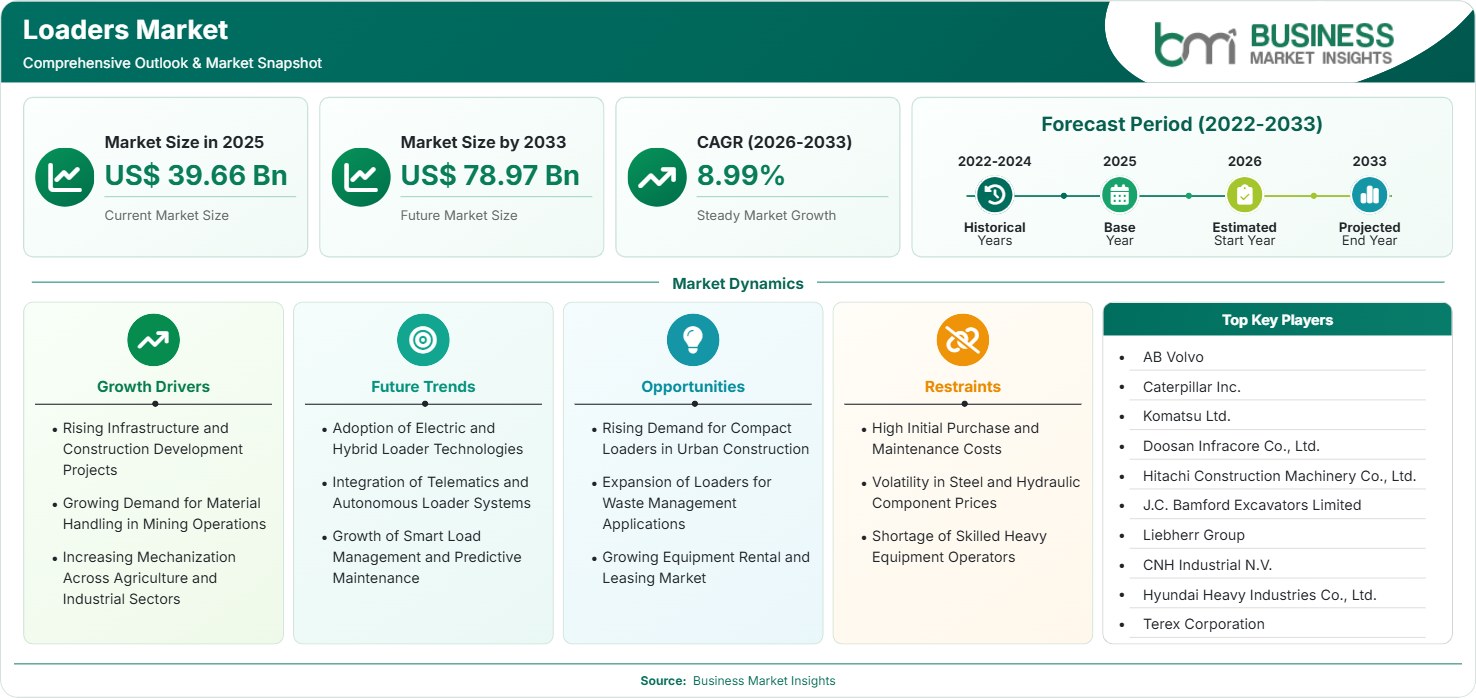
The Loaders Market size was valued at US$ 39.66 Billion in 2025 and is projected to reach US$ 78.97 Billion by 2033, growing at a CAGR of 8.99% during 2026–2033. Rising infrastructure development projects, increasing mining investments, growing urbanization, and expanding adoption of advanced construction equipment are creating substantial opportunities for loader manufacturers across global markets.

Report Coverage
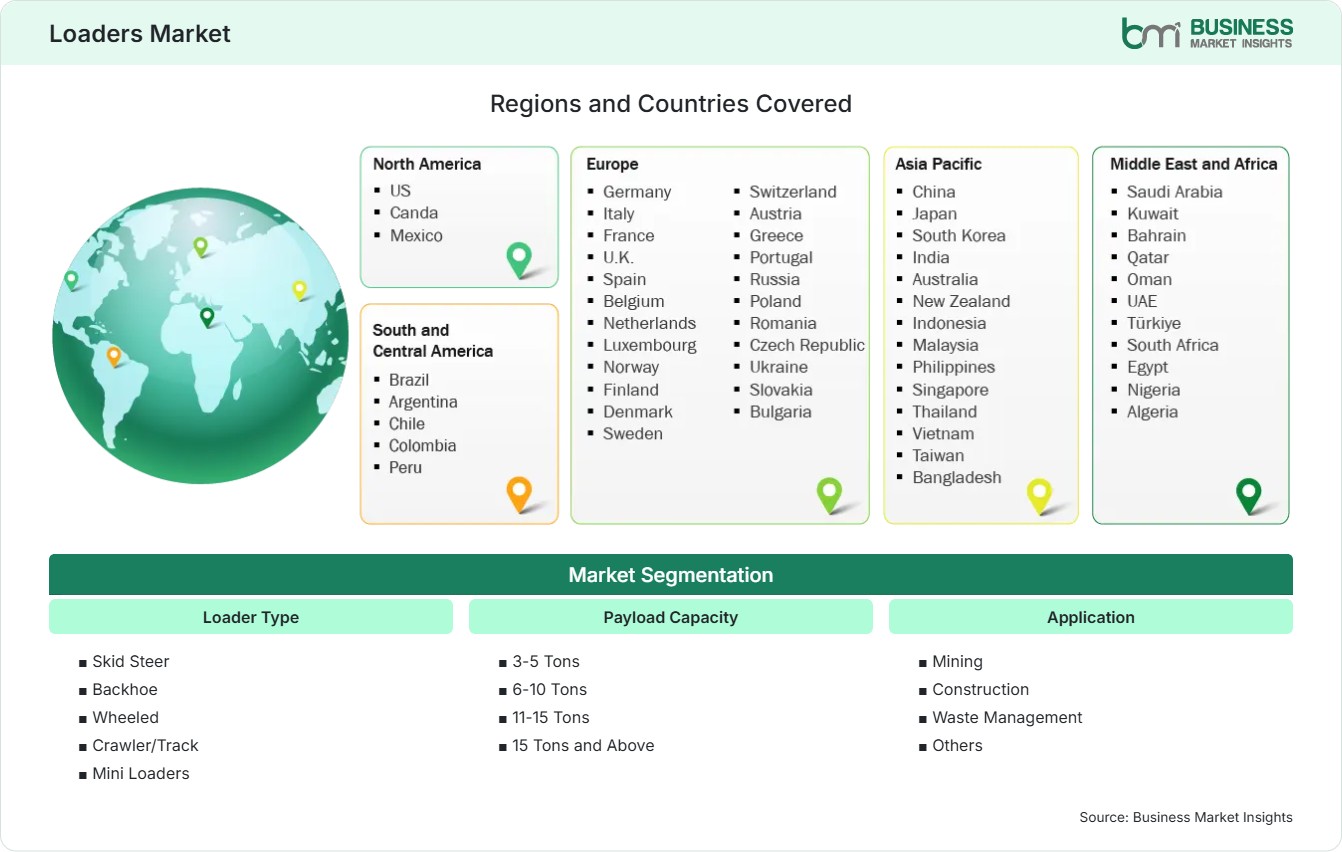
  • Loader Type: Skid Steer, Backhoe, Wheeled, Crawler/Track, Mini Loaders
  • Payload Capacity: 3-5 Tons, 6-10 Tons, 11-15 Tons, 15 Tons and Above
  • Application: Mining, Construction, Waste Management, Others
US$ 39.66 Bn Market size in 2025
US$ 78.97 Bn Market Size by 2033
8.99% CAGR, 2026 - 2033
2026-2033 Forecast Period

01 AI Overview

Loaders Market Summary

  • North America Region: North America holds 28%–31% loaders market share in 2025 and is projected to expand at a 8.3%–8.8% CAGR during 2026–2033. Infrastructure modernization, construction activity growth, mining equipment replacement, and adoption of advanced machine technologies continue supporting demand. The United States dominates regional growth through large-scale infrastructure programs, residential construction investments, and mining operations, advancing at approximately 8.5%–9.0% CAGR through 2033.
  • Fastest Growing Region: Asia Pacific accounts for 39%–42% market share in 2025 and is expected to register the fastest 9.5%–10.1% CAGR during the forecast period. Rapid urbanization, industrial development, mining expansion, and strong government investments in transportation and public infrastructure continue accelerating regional growth.
  • Leading Segment: Wheeled Loaders account for 34%–38% market share in 2025 and are anticipated to grow at a 8.9%–9.4% CAGR through 2033. High versatility, operational efficiency, ease of mobility, and widespread deployment across construction and mining sites continue supporting segment dominance.
  • High Growth Segment: Mini Loaders hold 10%–13% market share in 2025 while expanding at a 10.2%–10.8% CAGR during 2026–2033. Increasing use in urban construction projects, landscaping activities, compact job sites, and rental equipment fleets continues driving demand.
  • Key Market Opportunity: Growing integration of telematics, autonomous machine capabilities, predictive maintenance systems, and electrified loader platforms is creating long-term growth opportunities for equipment manufacturers and technology providers.
  • Major Market Players: AB Volvo, Caterpillar Inc., Komatsu Ltd., Doosan Infracore Co., Ltd., Hitachi Construction Machinery Co., Ltd., J.C. Bamford Excavators Limited, Liebherr Group, CNH Industrial N.V., Hyundai Heavy Industries Co., Ltd., and Terex Corporation.
02 Strategic Insights

Loaders Market: Strategic Insights

Loaders Market Strategic Framework
FREE PDF
Request your free sample
Request free sample
03 Stakeholder View

Key Takeaways

  • Infrastructure development remains the primary demand generator, with governments and private developers increasing investments in transportation networks, urban construction, industrial facilities, and public utilities that require versatile loading equipment.
  • Mini Loaders present the strongest growth opportunity due to increasing demand for compact equipment capable of operating efficiently within urban construction sites, landscaping projects, and confined work environments.
  • Innovation is increasingly focused on electrification, autonomous operation, telematics integration, predictive maintenance systems, advanced hydraulics, and operator-assistance technologies that improve productivity and machine utilization.
  • Asia Pacific offers the most attractive investment environment owing to rapid urbanization, mining expansion, industrial development, and large-scale infrastructure spending across major economies.
  • The loaders market forecast suggest that the strategic partnerships between equipment manufacturers, rental companies, technology providers, and construction contractors are becoming increasingly important as digitization reshapes fleet management practices.
  • The growing adoption of rental equipment fleets and smart construction technologies is creating additional opportunities for manufacturers offering connected, fuel-efficient, and low-maintenance loader platforms.
04 Geographic Outlook

Loaders Market Regional Highlights

North America Loaders Market

North America accounts for 28%–31% of the Loaders Market share in 2025 and is projected to grow at a 8.3%–8.8% CAGR through 2033. Infrastructure modernization, mining investments, equipment replacement demand, and adoption of advanced construction technologies continue supporting market expansion. Contractors and fleet operators increasingly prioritize connected machinery, fuel efficiency, and productivity-enhancing features to improve operational performance across construction and mining applications.

  • Infrastructure development projects continue supporting procurement of advanced loading equipment across transportation, utilities, and commercial construction activities.
  • Mining operators are increasingly adopting high-productivity loaders equipped with automation and fleet management capabilities.
  • Rental equipment demand remains strong as contractors seek flexible and cost-effective access to machinery.
  • Telematics and predictive maintenance solutions continue improving fleet efficiency and reducing equipment downtime.
  • Sustainability initiatives encourage adoption of low-emission and fuel-efficient construction equipment technologies.

US Loaders Market

The United States contributes 82%–85% of North American revenue and is anticipated to register a 8.5%–9.0% CAGR through 2033. Growth is supported by infrastructure upgrades, residential construction activity, industrial development projects, and increasing investment in mining operations. Contractors continue modernizing equipment fleets to improve productivity, safety, and operational efficiency across diverse project environments.

  • Federal and state infrastructure programs continue generating demand for construction and material-handling equipment.
  • Residential and commercial construction growth supports purchases of compact and mid-sized loaders.
  • Advanced fleet management technologies are increasingly adopted to improve machine utilization and maintenance planning.
  • Mining and quarrying operations continue investing in high-capacity loaders to enhance productivity.

Europe Loaders Market

Europe represents 24%–27% market share in 2025 and is expected to expand at a 8.5%–9.0% CAGR through 2033. Demand is supported by infrastructure renovation projects, sustainability initiatives, and modernization of construction equipment fleets. Germany leads the regional loaders market, while Poland records the fastest growth with a 9.2%–9.8% CAGR driven by industrial expansion and construction activity.

  • Construction firms increasingly adopt fuel-efficient and low-emission loading equipment to align with environmental standards.
  • Infrastructure rehabilitation projects continue supporting equipment demand across transportation and utility sectors.
  • Equipment rental companies remain significant purchasers of versatile wheeled and compact loader models.
  • Digitization initiatives are encouraging adoption of connected equipment and fleet monitoring platforms.
  • Industrial development projects continue generating demand for material handling and earthmoving equipment.

Asia Pacific Loaders Market

Asia Pacific accounts for 39%–42% market share in 2025 and is forecast to register the fastest 9.5%–10.1% CAGR during 2026–2033. Rapid urbanization, mining activities, industrial growth, and government-backed infrastructure investments continue driving regional leadership. China remains the largest regional market, while India is projected to witness the fastest growth with a 10.1%–10.7% CAGR through 2033.

  • Large-scale infrastructure development programs continue supporting significant demand for loaders across construction projects.
  • Mining expansion activities are generating sustained demand for heavy-duty loading equipment.
  • Urban development projects increasingly utilize compact and mini loaders in space-constrained environments.
  • Manufacturing growth and industrial investments continue supporting demand for material handling machinery.
  • Government investments in transportation and logistics infrastructure strengthen equipment procurement activity.

Rest of World Loaders Market

The Rest of World region represents 7%–9% Loaders Market share in 2025 and is projected to expand at a 8.0%–8.5% CAGR through 2033. South & Central America continue benefiting from mining and infrastructure investments, while the Middle East & Africa are witnessing increasing demand from construction, energy, and industrial development projects. Brazil leads regional demand, whereas Saudi Arabia demonstrates the fastest growth with a 8.8%–9.4% CAGR.

  • Mining projects continue supporting demand for high-capacity loaders throughout resource-rich regions.
  • Construction activity associated with urban development remains a major market driver.
  • Industrial expansion projects continue creating opportunities for material handling equipment deployment.
  • Government infrastructure initiatives are increasing equipment procurement across transportation networks.
  • Fleet modernization efforts support adoption of technologically advanced loader platforms.
Global Market Geography
FREE PDF
Request your free sample
Request free sample
05 Segment Analysis

Loaders Market Segmentation

Loader Type

Loader type selection varies according to application requirements, operating environment, payload demands, and productivity objectives. Wheeled Loaders account for approximately 34%–38% share in 2025 and are projected to grow at an 8.9%–9.4% CAGR through 2033. The Loaders Market scope continues to expand as construction contractors, mining operators, and industrial users increasingly invest in versatile equipment capable of improving productivity, efficiency, and operational flexibility.

  • Skid Steer: Widely utilized across landscaping, agriculture, construction, and material handling applications due to maneuverability and multi-attachment compatibility.
  • Backhoe: Maintains strong demand through utility projects, road construction, excavation activities, and municipal infrastructure development.
  • Wheeled: Represents the leading segment because of superior mobility, high productivity, fuel efficiency, and suitability for large-scale earthmoving activities.
  • Crawler/Track: Preferred in challenging terrain and soft-ground environments where enhanced traction, stability, and pushing power are required.
  • Mini Loaders: Fastest-growing category driven by urban construction projects, landscaping operations, and increased adoption within rental fleets.

Payload Capacity

Payload capacity remains a critical purchasing consideration as contractors and operators select equipment based on project scale, material type, and productivity requirements. The 6–10 tons category accounts for approximately 31%–35% share in 2025 and is anticipated to expand at an 8.8%–9.3% CAGR through 2033 due to its broad applicability across construction, mining, and industrial material handling operations.

  • 3–5 tons: Commonly deployed in compact construction projects, municipal works, landscaping, and utility maintenance activities.
  • 6–10 tons: Dominates demand because it provides an effective balance between capacity, versatility, operating efficiency, and project applicability.
  • 11–15 tons: Increasingly utilized in large-scale construction, quarrying, and infrastructure development projects requiring higher productivity.
  • 15 tons and above: Primarily used in mining operations, bulk material handling, and heavy-duty industrial applications where maximum capacity is essential.

Application

Application demand is closely linked to infrastructure spending, mining investments, industrial development, and urbanization trends. The Loaders Market trends indicate growing adoption of automation, telematics, and fuel-efficient equipment across major end-use sectors. Construction represents the largest application segment with approximately 45%–49% share in 2025 and is projected to grow at an 8.9%–9.4% CAGR through 2033.

  • Mining: Demand is supported by expansion of mineral extraction activities, quarry operations, and bulk material handling requirements.
  • Construction: Represents the dominant application due to rising infrastructure investments, residential development, commercial projects, and transportation network expansion.
  • Waste Management: Increasingly adopting loaders for material movement, recycling operations, landfill management, and municipal waste handling activities.
  • Others: Includes agriculture, forestry, logistics, industrial manufacturing, and port operations requiring specialized material handling capabilities.
06 Market Forces

Loaders Market Dynamics

Key Market Drivers

Rising Infrastructure and Construction Development Projects

The world has seen increasing amounts of investments in the infrastructure of transportation systems, smart cities, housing projects, industries, and utility sectors. Loader equipment plays an essential role in the site development, earth moving, material handling, and construction works of such projects. Developing economies are expanding their infrastructure at a very fast pace to cope with urbanization and economic development, while the advanced countries are focused on upgrading and revitalizing their existing infrastructure. The complex nature of construction work is forcing construction companies to invest in new machines.

Growing Demand for Material Handling in Mining Operations

The demand for minerals, metals, aggregates, and construction materials globally is ensuring mining operations in important producing regions. The mining companies now need loaders that are high capacity and can help improve their productivity as well as reduce the time cycles. Loader equipment is now becoming automated with telematics and predictive maintenance features. Growing mineral extraction for use in renewable energy and EV manufacturing are adding to the growth in equipment demand. This ensures that mining is an important growth driver in the global loaders market.

Increasing Mechanization Across Agriculture and Industrial Sectors

Agricultural and industrial producers are now increasingly resorting to the use of mechanized machinery in order to achieve increased efficiency, minimize labor dependency, and increase productivity in general. Loader machinery is extensively used for material handling, storage, site maintenance, and logistical tasks. Technological developments have resulted in greater functionality of loaders through the incorporation of various attachments and multifunctional operating systems. Increased labor costs and need for increased productivity are some of the factors that are driving more extensive use of equipment.

Key Market Opportunities

Rising Demand for Compact Loaders in Urban Construction

In urban construction projects, one will find that there is limited space, making it important to have loaders that can maneuver well. Compact and mini loaders have become common in use due to their ability to multitask and operate in such space-restricted areas. More funds are being invested in urban development projects, utilities projects, building houses and other construction projects in the municipalities, which have set up ideal circumstances for the usage of compact loaders. Advanced loaders are being introduced with better visibility and operator comfort.

Expansion of Loaders for Waste Management Applications

For waste management companies, there has been an increased need for machinery that will enable them to carry out sorting, recycling, landfill activities, and transportation of materials. In this regard, loaders have become very important machines in the waste management industry because of their efficiency. The current focus on recycling, sustainability, and circular economy is driving investments in more sophisticated material handling machines. Governments as well as private firms have been increasing the infrastructure for waste management due to an increase in the amount of waste.

Growing Equipment Rental and Leasing Market

Rental and leasing models are becoming increasingly popular among contractors seeking flexible access to modern equipment without significant upfront capital expenditures. Rental providers continue expanding fleets to meet growing demand from construction firms, infrastructure developers, and industrial operators. Equipment users benefit from lower ownership risks, improved fleet flexibility, and access to technologically advanced machinery. Long-term Loaders Market Forecasts remain favorable as rental penetration continues increasing across both developed and emerging economies. Manufacturers that maintain strong relationships with rental companies are expected to benefit from recurring demand and higher fleet replacement activity.

Market Restraints and Challenges

High Initial Purchase and Maintenance Costs

Factor: The current generation of loader machines has engines, hydraulic, telematic system, automation technology, and safety elements that make their costs of acquisition expensive. Maintenance and repairs, as well as costs associated with replacement of parts, continue to add to total costs of ownership.

Impact: High capital needs may dissuade users from making purchases due to their small nature as operators. It might lead to postponement of machine modernization or continued use of outdated machines by some users. This increases pressure on manufacturers to be innovative yet cost-effective.

Volatility in Steel and Hydraulic Component Prices

Factor: Loader manufacturing requires heavy use of materials such as steel and hydraulics, electronics, and engineered materials that might be subject to price changes because of issues related to the supply chain, geopolitics, and changes in the commodity markets.

Impact: Volatility in prices for raw materials and parts might have an effect on manufacturing costs and pricing strategies, as well as profit margins of manufacturers. The problem of supply chain uncertainty might also lead to delivery delays and problems managing the inventory.

07 Company Analysis

Competitive Landscape

The Loaders Market analysis indicates a competitive environment driven by product innovation, fleet modernization, automation technologies, fuel-efficiency improvements, and expansion of intelligent construction equipment solutions. Leading manufacturers are investing in telematics systems, electrified equipment platforms, autonomous operating capabilities, and predictive maintenance technologies to improve machine productivity and reduce lifecycle costs. Strategic expansion across construction, mining, waste management, and rental equipment markets continues shaping competitive dynamics across the global loaders industry.

Company Name

Overview

Products and Services Relevant to this Market

AB Volvo

Global construction equipment manufacturer offering advanced earthmoving and material-handling solutions for infrastructure, mining, and industrial applications.

Wheeled loaders, compact loaders, electric construction equipment, telematics solutions, fleet management platforms, and productivity services.

Caterpillar Inc.

Leading manufacturer of construction and mining equipment with a strong global presence across heavy machinery segments.

Wheeled loaders, track loaders, compact loaders, mining loaders, autonomous equipment technologies, and fleet management solutions.

Komatsu Ltd.

Construction and mining equipment producer focused on productivity enhancement and digital equipment technologies.

Wheeled loaders, crawler loaders, autonomous systems, smart construction technologies, telematics solutions, and mining equipment.

Doosan Infracore Co., Ltd.

Heavy equipment manufacturer providing construction and material-handling machinery for global markets.

Wheeled loaders, compact loaders, construction equipment, fleet monitoring systems, and productivity enhancement technologies.

Hitachi Construction Machinery Co., Ltd.

Construction equipment supplier specializing in advanced machinery and digital solutions for earthmoving applications.

Wheeled loaders, mining loaders, telematics platforms, equipment management systems, and intelligent machine solutions.

J.C. Bamford Excavators Limited

Global construction equipment company known for versatile machinery serving construction, agriculture, and industrial sectors.

Backhoe loaders, skid steer loaders, compact loaders, telematics systems, and construction equipment solutions.

Liebherr Group

International equipment manufacturer providing heavy-duty machinery and advanced material-handling technologies.

Wheeled loaders, mining loaders, construction equipment, automation technologies, and fleet optimization systems.

CNH Industrial N.V.

Industrial equipment manufacturer serving construction, agriculture, and infrastructure development markets worldwide.

Compact loaders, track loaders, construction equipment, fleet management technologies, and equipment support services.

Hyundai Heavy Industries Co., Ltd.

Heavy machinery producer offering construction and industrial equipment with advanced operating technologies.

Wheeled loaders, construction machinery, fleet monitoring systems, material-handling equipment, and productivity solutions.

Terex Corporation

Equipment manufacturer focused on material handling, construction, infrastructure, and industrial applications.

Compact loaders, material-handling equipment, utility machinery, equipment support solutions, and fleet technologies.

10 Trust & Transparency

Research Methodology

The market analysis combines proprietary research with secondary data from government agencies, company disclosures, regulatory filings, industry databases and expert interviews. Market estimates are validated through data triangulation, cross-market benchmarking and analyst review.

View Full Research Methodology

11 Questions Answered

Frequently Asked Questions

What does the Loaders Market Report cover?

The report provides comprehensive insights into market size, share, segmentation, regional analysis, competitive landscape, growth drivers, opportunities, restraints, and future market outlook through 2033.

Which region is expected to grow the fastest?

Asia Pacific is projected to register the fastest growth owing to rapid urbanization, industrial development, mining expansion, and substantial investments in transportation and public infrastructure projects.

Why are mini loaders experiencing rapid growth?

Mini loaders are gaining popularity because they can operate effectively in confined urban construction sites, landscaping projects, utility maintenance applications, and rental equipment fleets where compact dimensions are critical.

Which loader type dominates the market?

Wheeled Loaders remain the leading segment due to their versatility, operational efficiency, mobility advantages, and widespread use across construction, mining, material handling, and infrastructure applications.

What is driving growth in the Market?

Growth is primarily driven by rising infrastructure development projects, increasing mining activity, growing mechanization across industrial and agricultural sectors, and rising adoption of advanced construction equipment technologies.

Access the Full Loaders Market Report

Get segment-level forecasts, regional estimates, competitive benchmarking, company profiles and downloadable Excel datasets.

Access the full Loaders Market Report
350 pages PDF & Excel | 2026-08-06