
Modular Flooring Market Outlook: Size, Share, Trends, Growth Analysis, Competitive Landscape & Forecast, 2026-2033

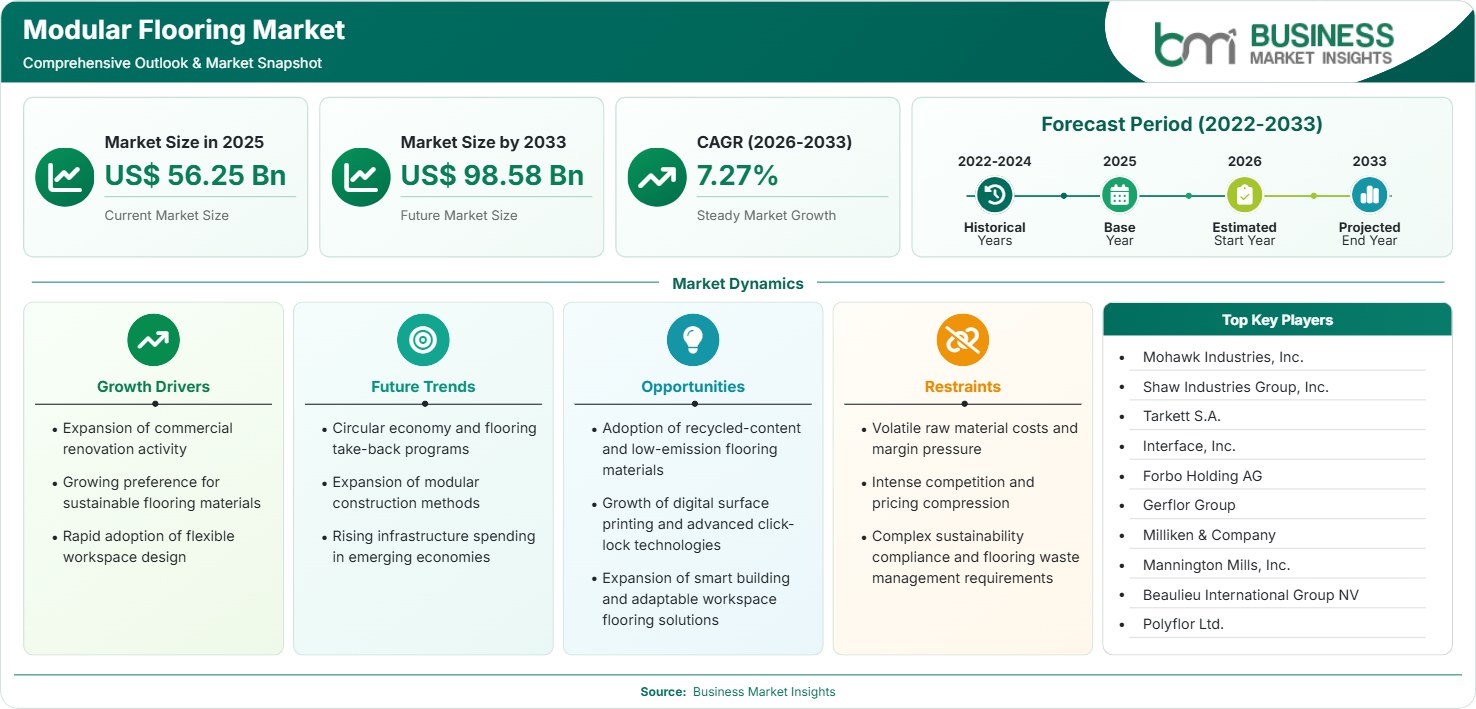
The Modular Flooring Market size was valued at US$ 56.25 Billion in 2025 and is projected to reach US$ 98.58 Billion by 2033, growing at a CAGR of 7.27% during 2026–2033. Key drivers include renovation activity, demand for sustainable flooring, rapid commercial fit-outs, and low-maintenance surfaces. Opportunities are emerging from circular flooring solutions, modular construction growth, and smart building adoption.

Report Coverage
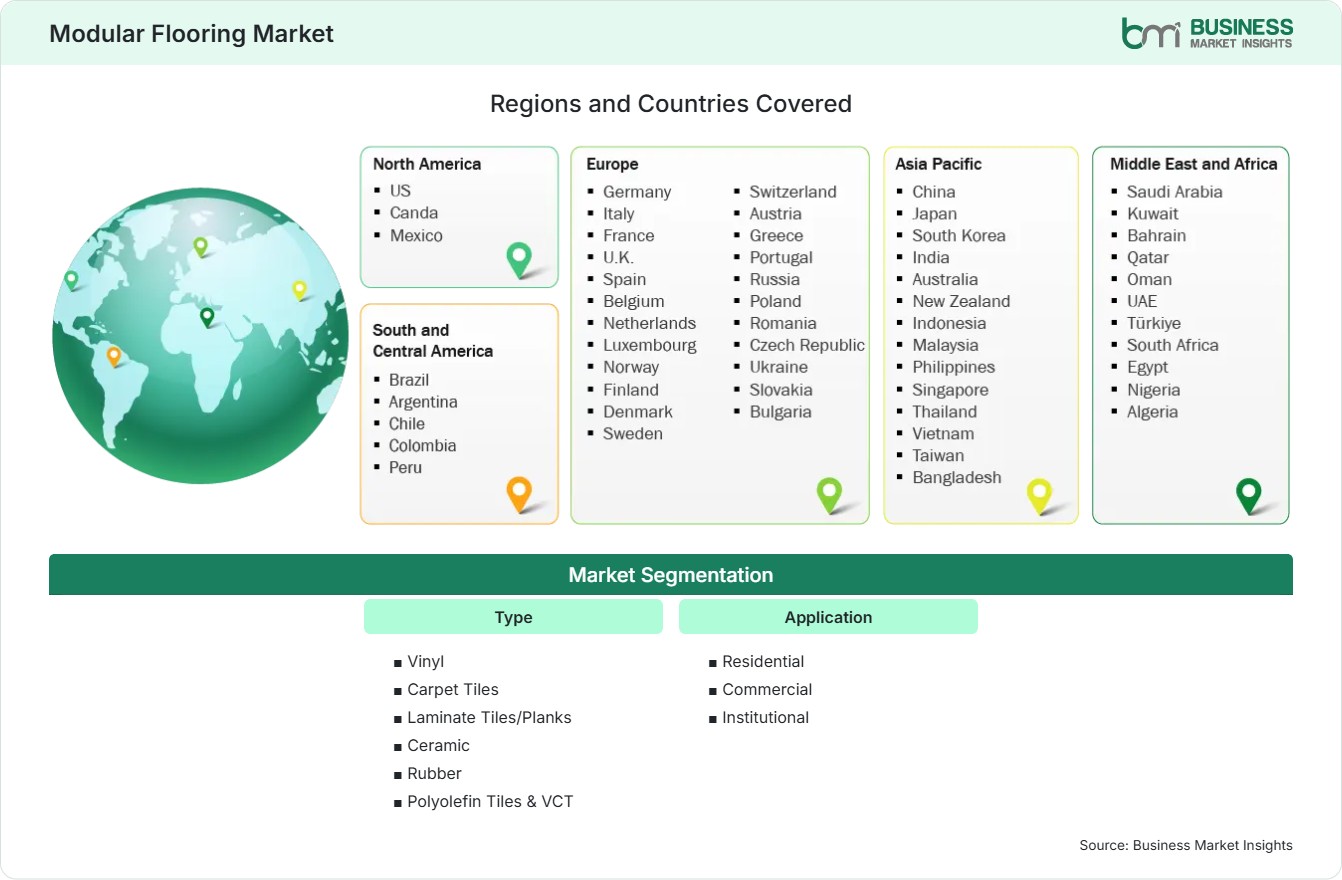
  • Type: Vinyl, Carpet Tiles, Laminate Tiles/Planks, Ceramic, Rubber, Polyolefin Tiles & VCT
  • Application: Residential, Commercial, Institutional
US$ 56.25 Bn Market size in 2025
US$ 98.58 Bn Market Size by 2033
7.27% CAGR, 2026 - 2033
2026-2033 Forecast Period

01 AI Overview

Modular Flooring Market Summary

  • North America Region: North America holds a market share of 34%–37% in 2025, growing at a CAGR of 6.4%–6.8% during 2026–2033. Demand is supported by renovation spending, corporate workspace modernization, healthcare flooring upgrades, and sustainability certifications. US market benefits from commercial refurbishment pipelines and flexible workplace investments, recording a CAGR of 6.5%–6.9%.
  • Fastest Growing Region: Asia Pacific holds a market share of 26%–29% in 2025, growing at a CAGR of 8.5%–9.0% during 2026–2033. Urban construction, office expansion, hospitality projects, and manufacturing investments accelerate demand for easy-installation and durable flooring systems.
  • Leading Segment: Vinyl holds a market share of 32%–35% in 2025, growing at a CAGR of 7.4%–7.8% during 2026–2033. Waterproof performance, design flexibility, affordability, and increasing luxury vinyl tile adoption continue supporting replacement and new-construction applications.
  • High Growth Segment: Commercial application holds a market share of 38%–42% in 2025, growing at a CAGR of 7.8%–8.3% during 2026–2033. Office refurbishment, hospitality expansion, healthcare investments, and rapid installation requirements support strong procurement activity.
  • Key Market Opportunity: Circular flooring programs incorporating recycled content, take-back schemes, and low-carbon manufacturing create new value pools while helping users meet environmental reporting standards and green-building requirements.
  • Major Market Players: Mohawk Industries, Inc.; Shaw Industries Group, Inc.; Tarkett S.A.; Interface, Inc.; Forbo Holding AG; Gerflor Group; Milliken & Company; Mannington Mills, Inc.; Beaulieu International Group NV; Polyflor Ltd.
02 Strategic Insights

Modular Flooring Market: Strategic Insights

Modular Flooring Market Strategic Framework
FREE PDF
Request your free sample
Request free sample
03 Stakeholder View

Key Takeaways

  • The market ecosystem increasingly integrates material suppliers, flooring manufacturers, contractors, distributors, and recycling partners, creating value through lifecycle management and circular procurement models.
  • Commercial building renovations and healthcare facilities present the most attractive demand pockets due to durability requirements, rapid replacement capabilities, and operational downtime reduction.
  • Innovation is shifting toward phthalate-free materials, recycled content, digital printing technologies, acoustic performance enhancements, and take-back programs that improve sustainability credentials.
  • Asia Pacific offers a compelling investment case because of accelerating urbanization, expanding office stock, hospitality developments, and rising institutional infrastructure spending.
  • Competitive activity is increasingly focused on acquisitions, distribution partnerships, capacity additions, and sustainability-led product launches to strengthen market positioning.
  • Green-building certifications are becoming a major purchasing criterion, influencing product design, material sourcing strategies, and procurement specifications across commercial projects.
04 Geographic Outlook

Modular Flooring Market Regional Highlights

North America Modular Flooring Market

North America accounted for 34%–37% Modular Flooring Market share in 2025 and is projected to grow at 6.4%–6.8% CAGR through 2033. Strong commercial renovation expenditures, healthcare facility upgrades, educational infrastructure modernization, and corporate sustainability targets support demand. The region benefits from established distribution networks and rapid adoption of luxury vinyl tiles, carpet tiles, and recyclable flooring systems. Growing emphasis on indoor air quality standards and low-VOC materials continues influencing procurement decisions across institutional and commercial sectors.

  • Corporate office redesigns drive replacement demand for modular carpet and resilient flooring systems.
  • Healthcare projects prioritize hygiene, maintenance efficiency, and rapid installation characteristics.
  • Sustainability certifications encourage procurement of products containing recycled and circular materials.
  • Distribution maturity supports product availability, project delivery reliability, and replacement services.
  • Digital printing innovations improve aesthetic versatility across commercial applications.

US Modular Flooring Market

The US represented 78%–82% of North American revenue in 2025 and is anticipated to expand at 6.5%–6.9% CAGR. Commercial refurbishment projects, educational campus investments, and healthcare construction remain primary growth contributors. Businesses increasingly prioritize flooring products with sustainability declarations and lifecycle transparency. Adoption of luxury vinyl tile formats continues rising across office, multifamily, retail, and hospitality developments due to durability and design flexibility.

  • Strong remodeling expenditures support recurring replacement demand across aging commercial assets.
  • Hospitality and mixed-use developments create substantial procurement opportunities for suppliers.
  • Circular flooring initiatives increasingly influence institutional purchasing specifications.
  • Growing hybrid workplaces require adaptable and easily replaceable flooring configurations.

Europe Modular Flooring Market

Europe held 28%–31% share in 2025 and is forecast to grow at 6.8%–7.2% CAGR. Environmental regulations, carbon-reduction initiatives, and mature renovation markets underpin adoption. Germany remains the leading country, while Poland and selected Eastern European markets exhibit faster expansion rates above regional averages. Demand is particularly strong in commercial offices, healthcare facilities, and education projects requiring durable, recyclable, and low-emission flooring products.

  • Germany leads regional demand through commercial renovation and institutional infrastructure projects.
  • Poland demonstrates higher growth supported by industrial and office development activity.
  • Circular economy regulations encourage recyclable flooring system adoption.
  • Demand for acoustic performance supports carpet tile deployment across offices.
  • Public-sector sustainability procurement standards strengthen premium product penetration.

Asia Pacific Modular Flooring Market

Asia Pacific accounted for 26%–29% share in 2025 and is expected to grow at 8.5%–9.0% CAGR, making it the fastest-growing region. Rapid urbanization, commercial construction, industrial investment, and expanding hospitality infrastructure fuel demand. China remains the largest market, while India records the highest regional growth pace. Increasing adoption of modular construction methodologies and modern workspace concepts further accelerates market expansion across key economies.

  • China maintains leadership through extensive commercial and public infrastructure pipelines.
  • India records rapid expansion supported by office, healthcare, and education investments.
  • Manufacturing growth stimulates demand for resilient and maintainable flooring products.
  • Hospitality developments increase consumption of design-oriented modular flooring solutions.
  • Urban transit and public infrastructure projects support institutional demand.

Rest of World Modular Flooring Market

Rest of World represented 9%–12% share in 2025 and is projected to grow at 7.0%–7.6% CAGR. South & Central America benefit from commercial modernization and retail development. In the Middle East & Africa, hospitality, healthcare, and premium real-estate projects drive adoption. Brazil leads regional demand in Latin America, while Saudi Arabia and the UAE demonstrate strong momentum through large-scale infrastructure and tourism investments.

  • Brazil remains the largest Latin American market supported by commercial refurbishment.
  • Saudi Arabia benefits from gigaproject developments and hospitality construction activity.
  • UAE commercial real estate investments strengthen premium flooring demand.
  • Healthcare infrastructure expansion supports hygienic flooring product deployment.
  • International supplier partnerships improve product availability and technical support.
Global Market Geography
FREE PDF
Request your free sample
Request free sample
05 Segment Analysis

Modular Flooring Market Segmentation

Type

Type accounted for the largest revenue contribution, with vinyl products leading adoption. The segment reflects evolving preferences toward ease of installation, durability, and lifecycle value. The Modular Flooring Market scope within this category continues expanding across commercial and residential applications. Type segment represented approximately 54%–57% share in 2025 and is expected to grow at 7.2%–7.7% CAGR.

  • Vinyl: Waterproof performance, visual versatility, and maintenance advantages support adoption across residential renovations, offices, healthcare environments, and retail applications.
  • Carpet Tiles: Strong acoustic properties and selective replacement benefits make carpet tiles attractive for workplaces, schools, and hospitality facilities.
  • Laminate Tiles/Planks: Cost-effectiveness, wood-look designs, and durability appeal to residential and light-commercial users seeking aesthetic flexibility.
  • Ceramic: High durability, moisture resistance, and extended service life support demand in institutional and commercial environments.
  • Rubber: Safety characteristics, slip resistance, and shock absorption drive installation in healthcare, sports, and educational settings.
  • Polyolefin (PP) Tiles & VCT: Industrial durability and low maintenance requirements support deployment in warehouses, utility spaces, and institutional facilities.

Application

Application trends indicate accelerating commercial adoption due to renovation cycles and workplace modernization. The Modular Flooring Market trends within end-use categories increasingly favor adaptable flooring systems that reduce installation time and maintenance costs. Application segment generated 43%–46% share in 2025 and is anticipated to register 7.5%–8.0% CAGR.

  • Residential: Home improvement spending and preference for easy-to-install flooring support sustained consumption across renovation activities.
  • Commercial: Office, retail, hospitality, and mixed-use developments generate strong replacement and new-installation demand.
  • Institutional: Schools, hospitals, public buildings, and government facilities prioritize durability, hygiene, and lifecycle performance.
06 Market Forces

Modular Flooring Market Dynamics

Key Market Drivers

Expansion of Commercial Renovation Activity

Flooring improvements for commercial buildings are now giving preference to those that reduce the interruption of operations but enhance appearance and sustainability. Offices, hotels, health care facilities, and educational institutions need their floorings repositioned due to the stability of demand. The trend in the industry continues to point toward significant renovation spending in the developed world, thus encouraging the use of modular systems that can enable selective replacement along with easy installation. Moreover, innovations in product technology contribute to improved life cycle economics with reduced maintenance requirements and increased longevity. Another factor contributing to market fundamentals is the growing preference for flooring systems that facilitate green-building certifications.

Growing Preference for Sustainable Flooring Materials

Sustainability considerations increasingly influence purchasing decisions among institutional, commercial, and government buyers. The manufacturers have been increasing their options of products with recycled content, low VOCs, and take-back schemes in order to meet the environmental compliance needs. Certification systems for green building, such as LEED and BREEAM, encourage the use of materials that have known sustainability characteristics. With the setting up of carbon reduction goals by companies, circularity and performance of the flooring during the entire lifecycle become key elements of the buying decision process. This creates room for premium flooring products.

Rapid Adoption of Flexible Workspace Design

Organizations continue redesigning workplaces to accommodate hybrid work models, collaborative spaces, and evolving occupancy patterns. Modular flooring products make it easy for facility managers to rearrange interior space without having to incur substantial costs for demolition and replacement. Improved acoustics, durability, and design capabilities increase the appeal of modular flooring systems within the commercial setting. This trend allows for lengthy replacement cycles since companies have the ability to rearrange their flooring space whenever need be. Modular floors also benefit from flexible workspace trends and innovations in material technology.

Key Market Opportunities

Circular Economy and Flooring Take-Back Programs

Increasing focus on resource efficiency is creating substantial opportunities for manufacturers that offer product recovery, recycling, and reuse programs. Customers increasingly seek suppliers capable of supporting sustainability reporting requirements. As regulations tighten around waste management and embodied carbon, take-back initiatives are expected to become stronger competitive differentiators. These programs improve customer retention and generate secondary material supply streams. Long-term Modular Flooring Market Forecasts indicate rising demand for flooring solutions incorporating recycled content, especially within public procurement projects and environmentally certified commercial buildings where sustainability disclosures influence purchasing decisions.

Expansion of Modular Construction Methods

Modular and off-site construction approaches are gaining traction because they improve project efficiency and reduce construction timelines. Flooring systems that complement prefabricated building modules will directly benefit from this development. Companies that create standardized, fast-to-install flooring systems have greater opportunities to become involved in emerging building ecosystems. This possibility spans across hospitals, hotels, dormitories, and commercial properties. Compatibility with current building techniques provides another way to specify and grow their business in the future.

Rising Infrastructure Spending in Emerging Economies

Investment in hospitals, schools, airports, government buildings, and transportation infrastructure creates a substantial addressable market. For the developing countries, the focus is on the development of assets and cities, resulting in a growing demand for floors that will have high durability at affordable costs. Products that have good durability, easy maintenance, and compliance with the environment become the preferred products among procurement institutions. There will be additional benefits from increasing production locally and forming partnerships with regional distributors.

Market Restraints and Challenges

Volatile Raw Material Costs Impact: Margin Pressure

Factor: Raw material pricing fluctuations affecting polymers, additives, and specialty components create uncertainty throughout manufacturing operations.

Impact: Fluctuations in costs may lead to reduced margins if producers are unable to pass on cost increases to consumers. Planning processes become increasingly difficult, especially in cases of large-scale projects where there is a commitment to prices for some period of time. Producers deal with such fluctuations by diversifying suppliers, achieving efficiencies in operations, and changing the formulations of products. Prolonged inflation may result in reduced purchases from the price-sensitive sectors.

Intense Competition Impact: Pricing Compression

Factor: The industry remains highly competitive, with multinational manufacturers, regional specialists, and low-cost suppliers competing across diverse segments.

Impact: The intense competition puts the pressure on pricing and limits opportunities for differentiation in mature categories of products. Consumers often consider the supplier based on cost, environmental friendliness, longevity, and installation efficiency. With increasing competitive intensity, the producer needs to allocate funds for innovation, brand management, and logistics support. Such expenses may lead to unprofitability in case of inability to charge high prices.

07 Company Analysis

Competitive Landscape

The competitive environment reflects ongoing product innovation, sustainability investments, and distribution expansion. This Modular Flooring Market analysis highlights major participants active across commercial, residential, and institutional flooring categories.

Company Name

Overview

Products and Services relevant to this market

Mohawk Industries, Inc.

Global flooring leader with manufacturing and distribution operations across multiple continents.

Luxury vinyl tiles, laminate flooring, carpet tiles, resilient flooring systems.

Shaw Industries Group, Inc.

Major flooring manufacturer serving residential and commercial customers worldwide.

Carpet tile, resilient flooring, commercial flooring solutions, installation services.

Tarkett S.A.

International flooring company focused on sustainable flooring innovation.

Vinyl tiles, carpet tiles, rubber flooring, sports and commercial surfaces.

Interface, Inc.

Specialist in commercial modular flooring and circular flooring programs.

Carpet tiles, resilient flooring, sustainability solutions, recycling programs.

Forbo Holding AG

Global manufacturer known for resilient and commercial flooring solutions.

Vinyl flooring, modular tiles, commercial flooring systems and accessories.

Gerflor Group

Resilient flooring specialist with strong healthcare and institutional presence.

Vinyl tiles, PVC flooring, sports flooring and technical flooring products.

Milliken & Company

Diversified manufacturer with strong flooring and material science capabilities.

Carpet tiles, commercial flooring products and sustainability-focused solutions.

Mannington Mills, Inc.

Family-owned flooring company serving residential and commercial segments.

Luxury vinyl tile, laminate, resilient flooring and commercial surfaces.

Beaulieu International Group NV

International flooring and material solutions supplier.

Carpet tiles, vinyl flooring and commercial flooring systems.

Polyflor Ltd.

Specialist resilient flooring manufacturer with broad global presence.

Vinyl tiles, safety flooring and commercial flooring solutions.

10 Trust & Transparency

Research Methodology

The market analysis combines proprietary research with secondary data from government agencies, company disclosures, regulatory filings, industry databases and expert interviews. Market estimates are validated through data triangulation, cross-market benchmarking and analyst review.

View Full Research Methodology

11 Questions Answered

Frequently Asked Questions

What does the Modular Flooring Market Report emphasize for investors?

The report highlights regional growth pockets, commercial renovation demand, sustainability-led innovation, circular economy opportunities, and competitive positioning among leading manufacturers.

How does sustainability influence purchasing decisions?

Buyers increasingly evaluate recycled content, environmental certifications, low-emission materials, and end-of-life recycling options when selecting flooring products.

Why are vinyl products widely adopted?

Vinyl flooring combines durability, moisture resistance, design flexibility, affordability, and relatively low maintenance costs, making it suitable for diverse environments.

What application area offers the strongest long-term opportunity?

Commercial buildings provide the strongest opportunity due to recurring refurbishment cycles, evolving workplace layouts, and increasing sustainability requirements.

What factors are supporting demand for modular flooring systems?

Rapid installation, selective replacement capabilities, sustainability requirements, and strong renovation activity across commercial, healthcare, and educational facilities are key demand drivers.

Access the Full Modular Flooring Market Report

Get segment-level forecasts, regional estimates, competitive benchmarking, company profiles and downloadable Excel datasets.

Access the full Modular Flooring Market Report
350 pages PDF & Excel | 2026-08-26