Market Summary
Executive Summary and Global Market Analysis
Portable filtration systems are mobile fluid-cleaning units designed to remove contaminants, water, gases, and particulates from industrial oils and process fluids at the point of need. Their value lies in operational flexibility, as they allow maintenance teams to service equipment, storage reservoirs, and fluid circuits without relying on fixed purification infrastructure. These systems are widely used where fluid cleanliness directly influences equipment life, process reliability, and unplanned downtime exposure. Their role is expanding as industrial users place greater emphasis on preventive maintenance and asset efficiency.
Market momentum is being shaped by a stronger focus on contamination control across mobile and stationary industrial equipment. Operators in manufacturing, power generation, oil and gas, and petrochemical facilities are prioritizing compact filtration solutions that can be moved quickly between machines, reservoirs, and remote operating points. This preference supports portable systems because they combine maintenance convenience with targeted fluid management. The market is therefore gaining relevance as industries shift from reactive servicing toward condition-based maintenance and fluid life extension practices.
Segment demand varies according to contamination profile, desired portability, and required throughput. Pressure filtration remains highly practical for general industrial maintenance due to its ease of deployment and broad compatibility, while vacuum filtration is favored where dehydration and degassing are important. Centrifugal filtration holds appeal in applications targeting ultra-fine contaminant removal with lower recurring filter consumption. Across flow ranges, mid-capacity systems are particularly suited to routine maintenance tasks that require a balance between transportability and operational coverage.
Technology development is shifting toward improved efficiency, sustainability, and lower operating resistance. Suppliers are refining filter media, offline hydraulic filtration platforms, and portable purification architectures to improve reliability while reducing service burden. Attention is also moving toward systems that lower differential pressure, enhance dirt-holding capacity, and support longer fluid service life in demanding conditions. These advances are strengthening the position of portable filtration within predictive maintenance strategies.
Competitive conditions are influenced by product durability, application breadth, and support for industrial maintenance programs. Market participants are differentiating through mobile-friendly system design, fluid-specific performance, and broader contamination-control portfolios serving heavy equipment and industrial processing users. The sector therefore reflects a transition toward more engineered, service-oriented filtration solutions rather than basic mobile cleaning devices.
Segment Analysis
Portable Filtration System Market Segmentation
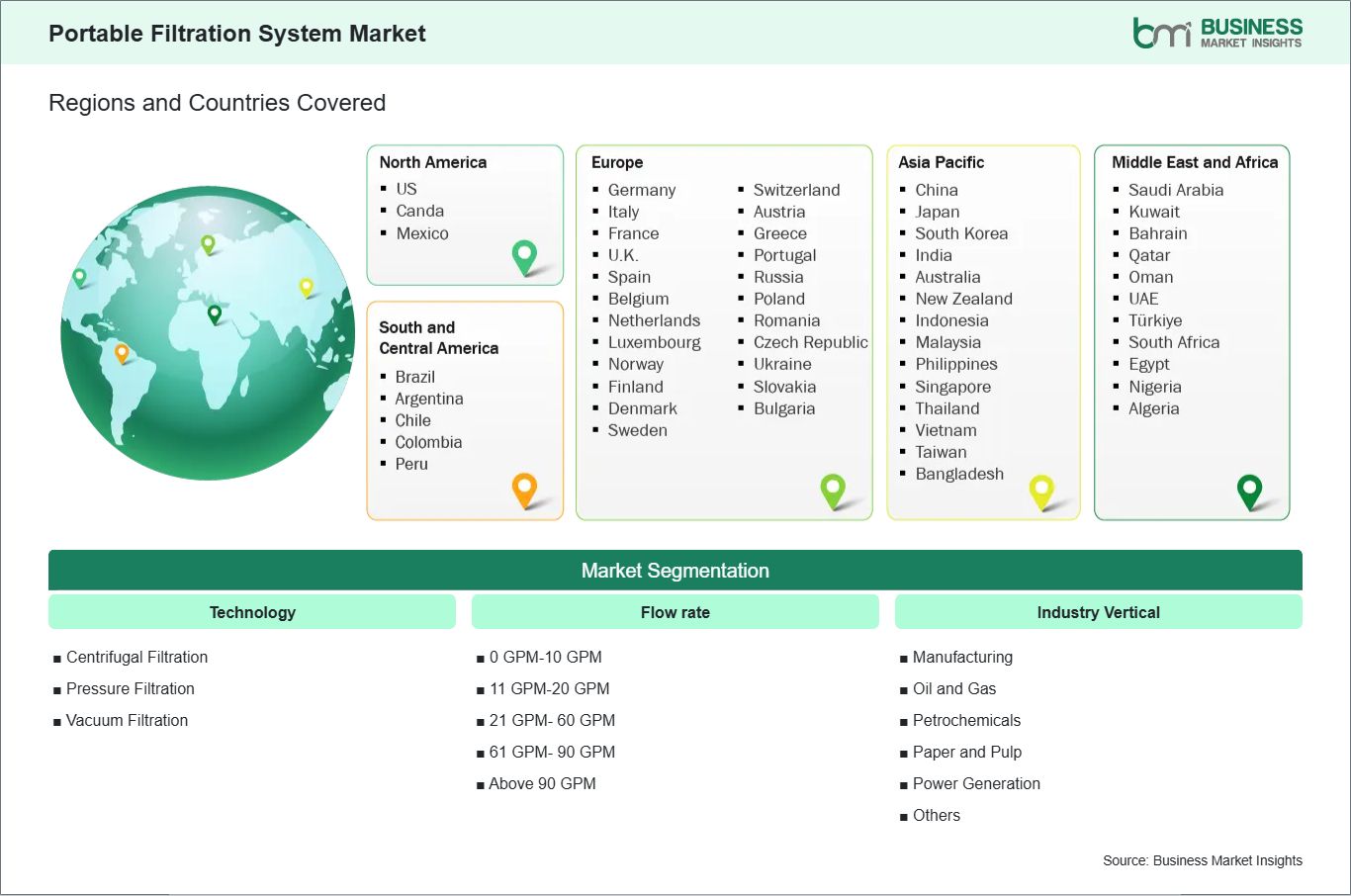
The Portable Filtration System Market is segmented based on Technology, Flow Rate, and Industry Vertical, highlighting distinct operational priorities and evolving deployment strategies across various end uses.
By Technology
- Centrifugal Filtration: Targets fine contaminant removal with low consumable dependence.
- Pressure Filtration: Fits routine industrial maintenance with practical deployment flexibility.
- Vacuum Filtration: Supports dehydration, degassing, and impurity removal in critical fluids.
By Flow Rate
- Up to 10 GPM: Serves small equipment reservoirs and localized maintenance tasks.
- 11 GPM-20 GPM: Balances mobility with steady service capability for plant operations.
- 21 GPM- 60 GPM: Matches mid-scale industrial use requiring broader maintenance coverage.
- 61 GPM- 90 GPM: Handles larger systems needing faster fluid turnover on site.
- Above 90 GPM: Addresses heavy-duty operations with high-volume purification needs.
By Industry Vertical
- Manufacturing: Uses portable systems to maintain hydraulic oils and machine reliability.
- Oil and Gas: Requires mobile filtration for remote equipment and fluid contamination control.
- Petrochemicals: Prioritizes fluid quality management in harsh operating environments.
- Paper and Pulp: Applies portable cleaning units to protect process and hydraulic systems.
- Power Generation: Employs filtration for turbine, hydraulic, and insulating fluid upkeep.
- Others: Covers additional industries with mobile fluid maintenance requirements.
Market Forces
Portable Filtration System Market Drivers and Opportunities
Greater Emphasis on Predictive Maintenance and Fluid Cleanliness
Industrial operators are placing more attention on fluid condition as a measurable indicator of equipment health and maintenance performance. Contaminated oils and process fluids can accelerate component wear, reduce system efficiency, and increase shutdown risk in hydraulic and lubrication-intensive environments. Portable filtration systems respond to this challenge by allowing maintenance teams to clean fluids on demand without permanent installation constraints. Their mobility makes them particularly useful in facilities where multiple assets require periodic treatment across dispersed locations.
The impact of this maintenance shift is especially clear in sectors where equipment reliability and fluid quality are tightly linked. Manufacturing plants, power facilities, and hydrocarbon operations increasingly favor service tools that extend oil life while reducing contamination-related failures. This improves the business case for portable systems because they support targeted intervention with lower infrastructure commitment. As maintenance models become more preventive and data-informed, portable filtration becomes more relevant as an operational asset rather than a secondary service accessory.
High-Efficiency Mobile Filtration for Remote and Critical Applications
A significant opportunity lies in portable systems that combine stronger contaminant removal with easier field deployment. Users increasingly seek mobile units capable of handling dehydration, degassing, ultra-fine particle removal, and broader fluid restoration within a single service platform. Advances in vacuum purification, centrifugal separation, and sustainable filter design are making that combination more achievable. This creates practical value in remote oil and gas locations, power infrastructure maintenance, and industrial plants that need rapid fluid treatment without interrupting wider operations.
Future scope is strengthened by the shift toward lower-resistance and longer-life filtration technologies that improve system efficiency in demanding environments. Portable solutions with better dirt-holding capacity, improved purification depth, and adaptable service architecture can move beyond routine maintenance into higher-value reliability programs. That opens room for broader deployment across industries managing critical assets, transformer oils, hydraulic systems, and process fluids under variable field conditions.
Size and Share Analysis
Portable Filtration System Market Size and Share Analysis
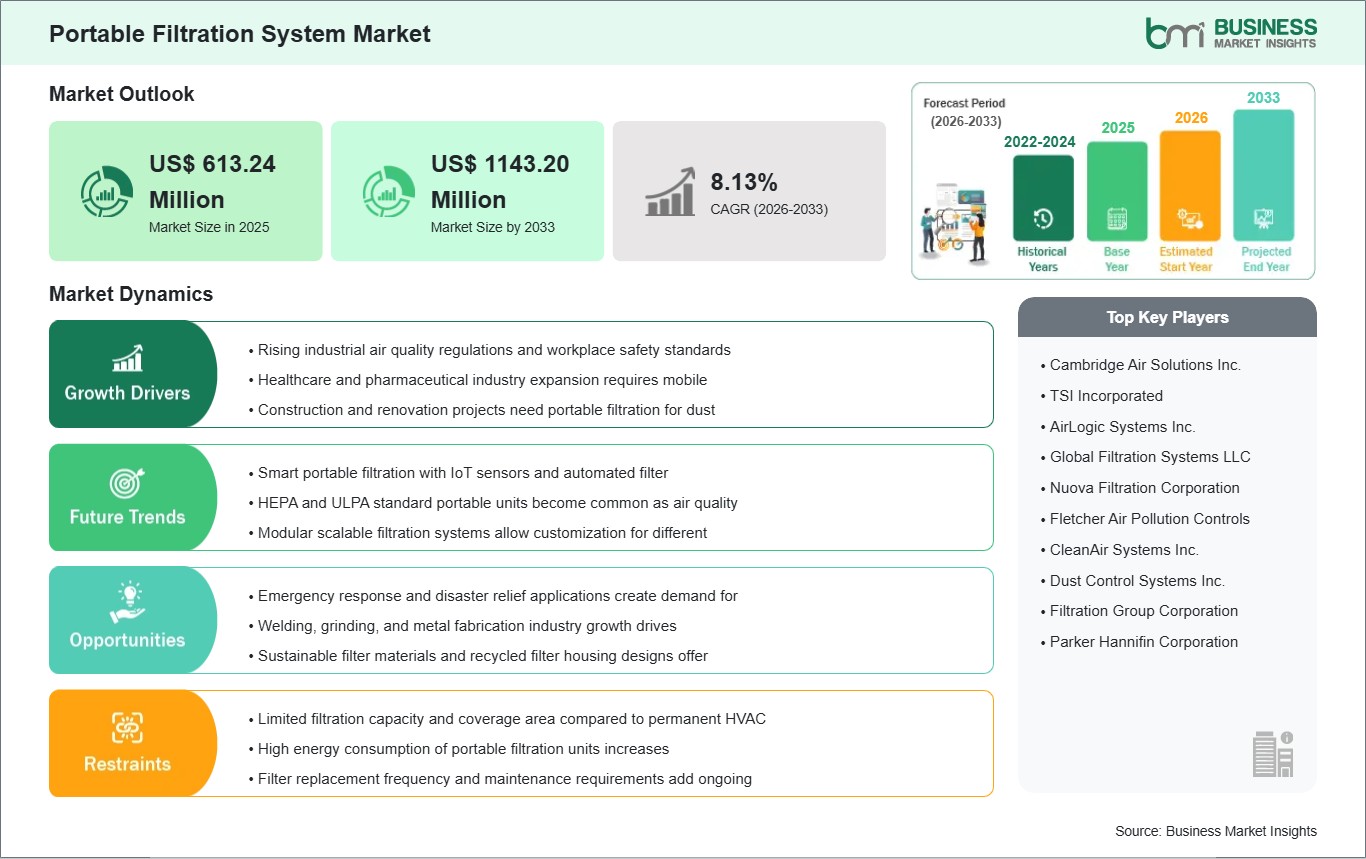
The Portable Filtration System Market is projected to grow from US$ 0.61 billion in 2025 to US$ 1.14 billion by 2033. The market is estimated to record a CAGR of 8.13% from 2026 to 2033.
This trajectory indicates a market benefiting from stronger industrial maintenance discipline, wider fluid management requirements, and the appeal of mobile service equipment. Growth reflects the sector’s alignment with preventive maintenance and on-site contamination control practices.
By technology, pressure filtration remains broadly applicable because it suits a wide range of industrial maintenance routines and operating conditions. Vacuum filtration also holds a strong role where users require moisture and gas removal in addition to particulate control. Centrifugal filtration remains particularly relevant for users prioritizing fine contaminant separation with reduced recurring consumable use.
By industry vertical, manufacturing represents a substantial demand center due to the extensive use of hydraulic and lubrication systems across plant equipment. Oil and gas, petrochemicals, and power generation also maintain strong importance because fluid quality directly affects critical asset reliability and field service planning. Paper and pulp adds further opportunity where continuous operations depend on effective contamination control.
Report Coverage
Portable Filtration System Market Report Coverage and Deliverables
The "Portable Filtration System Market Size and Forecast (2022–2033)" report provides a detailed analysis of the market covering below areas:
- Market size and forecast at global, regional, and country levels for all the key market segments covered under the scope
- Market trends, as well as market dynamics such as drivers, restraints, and key opportunities
- Market analysis covering key market trends, global and regional framework, major players, regulations, and recent market developments
- Industry landscape and competition analysis covering market concentration, heat map analysis, prominent players, and recent developments for the market
- Detailed company profiles, including SWOT analysis
Geographic Insights
Portable Filtration System Market Geographic Insights
The Portable Filtration System market shows diverse regional adoption patterns influenced by industrial maintenance maturity, fluid-intensive equipment usage, field service practices, and investment in reliability-centered operations. Across the global landscape, demand is tied to sectors where oil cleanliness, contamination control, and on-site fluid service affect equipment performance and downtime exposure. Regional variation reflects differences in industrial mix, maintenance sophistication, and the prevalence of remote or distributed operating assets.
North America reflects a technically mature market where operators emphasize equipment reliability, offline filtration, and structured maintenance programs. Demand is reinforced by manufacturing, power generation, and heavy equipment applications that require portable fluid service capability across diverse asset bases. Users in the region also show stronger interest in solutions that combine filtration performance with easier field deployment and lower service disruption.
Asia Pacific presents a broad industrial opportunity shaped by expanding manufacturing capacity, energy infrastructure development, and more active asset maintenance practices. Portable filtration systems are particularly relevant where plants operate mixed fleets and need flexible service tools across dispersed maintenance points. The region’s industrial diversity supports demand across manufacturing, power, petrochemicals, and process sectors that value mobile fluid management solutions.
Europe displays a more efficiency-oriented pattern, supported by strong industrial engineering standards, energy management priorities, and maintenance-led process optimization. Demand in the region favors filtration systems that improve fluid life, reduce service waste, and support sustainable operating practices. Beyond these established regions, emerging markets create selective opportunities where industrial expansion and infrastructure maintenance increase the need for mobile contamination-control equipment.
Industry Activity
Recent Developments
The Portable Filtration System Market is evaluated by gathering qualitative and quantitative data post primary and secondary research, which includes important corporate publications, association data, and databases. Recent developments and news in the market include:
- In June 2026, Parker Hannifin introduced the GLFTrolley, a portable filtration unit designed to remove free water and particulate contamination from hydraulic and lubrication fluids. The system targets maintenance operations across marine, mining, gas, forestry, and industrial plants, supporting preventive maintenance and offline fluid cleaning.
- In February 2025, LG Electronics (LG) is introducing the LG PuriCare™ AeroHit, an advanced air care solution designed to seamlessly integrate into any living space while delivering superb indoor air quality. Boasting advanced purification capabilities, convenient features and a modern, minimalist aesthetic, the AeroHit brings both comfort and style at home.
Trust & Transparency
Research Methodology
The market analysis combines proprietary research with secondary data from government agencies, company disclosures, regulatory filings, industry databases and expert interviews. Market estimates are validated through data triangulation, cross-market benchmarking and analyst
review.
View Full Research Methodology
Key Sources Referred:
World Bank – Global Trade Indicators World Trade Organization (WTO) International Monetary Fund (IMF) International Energy Agency (IEA) International Trade Administration (ITA) Company Websites Company Annual Reports Company Investor Presentations