
Desalination Technologies Market Outlook: Size, Share, Trends, Growth Analysis, Competitive Landscape & Forecast, 2026-2033

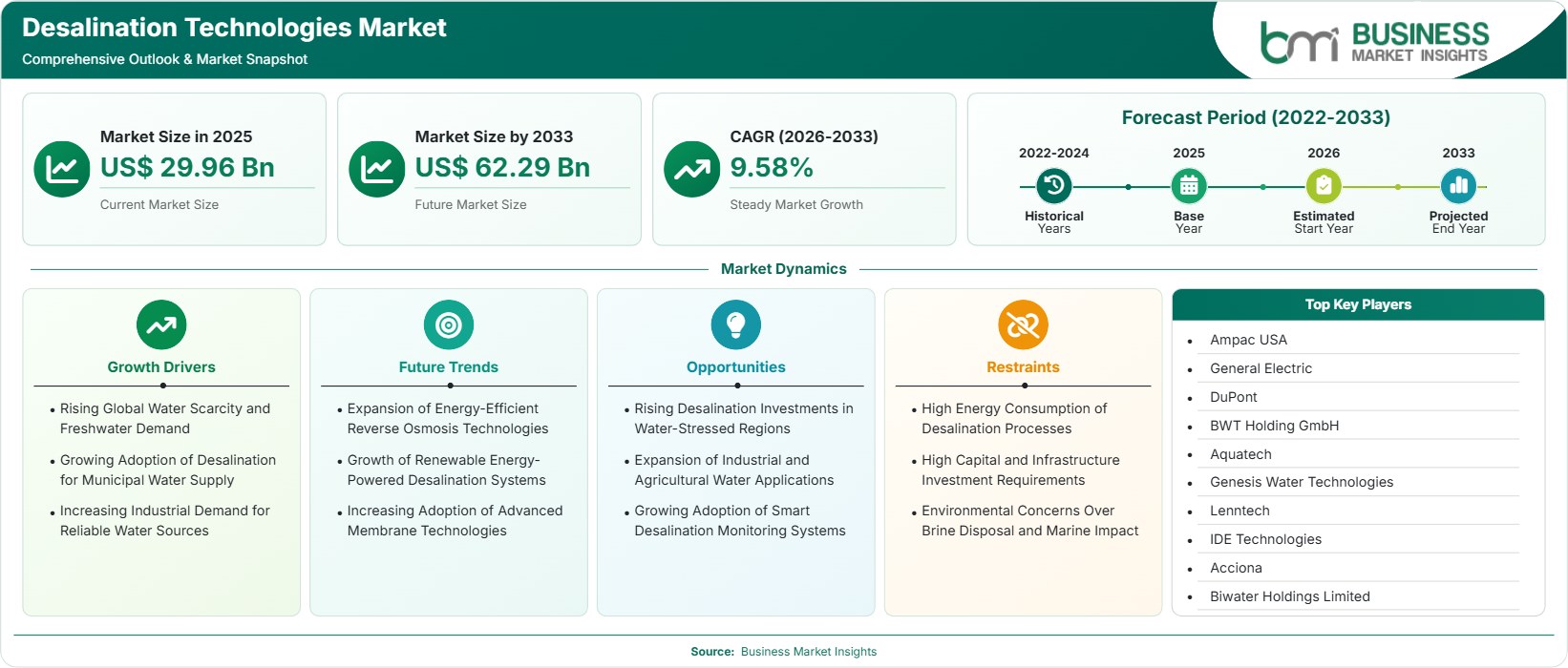
The Desalination Technologies Market size was valued at US$ 29.96 Billion in 2025 and is projected to reach US$ 62.29 Billion by 2033, growing at a CAGR of 9.58% during 2026–2033. Rising freshwater scarcity, increasing investments in water infrastructure, growing industrial water demand, expanding urban populations, and advancements in energy-efficient desalination processes are driving substantial market growth worldwide.

Report Coverage
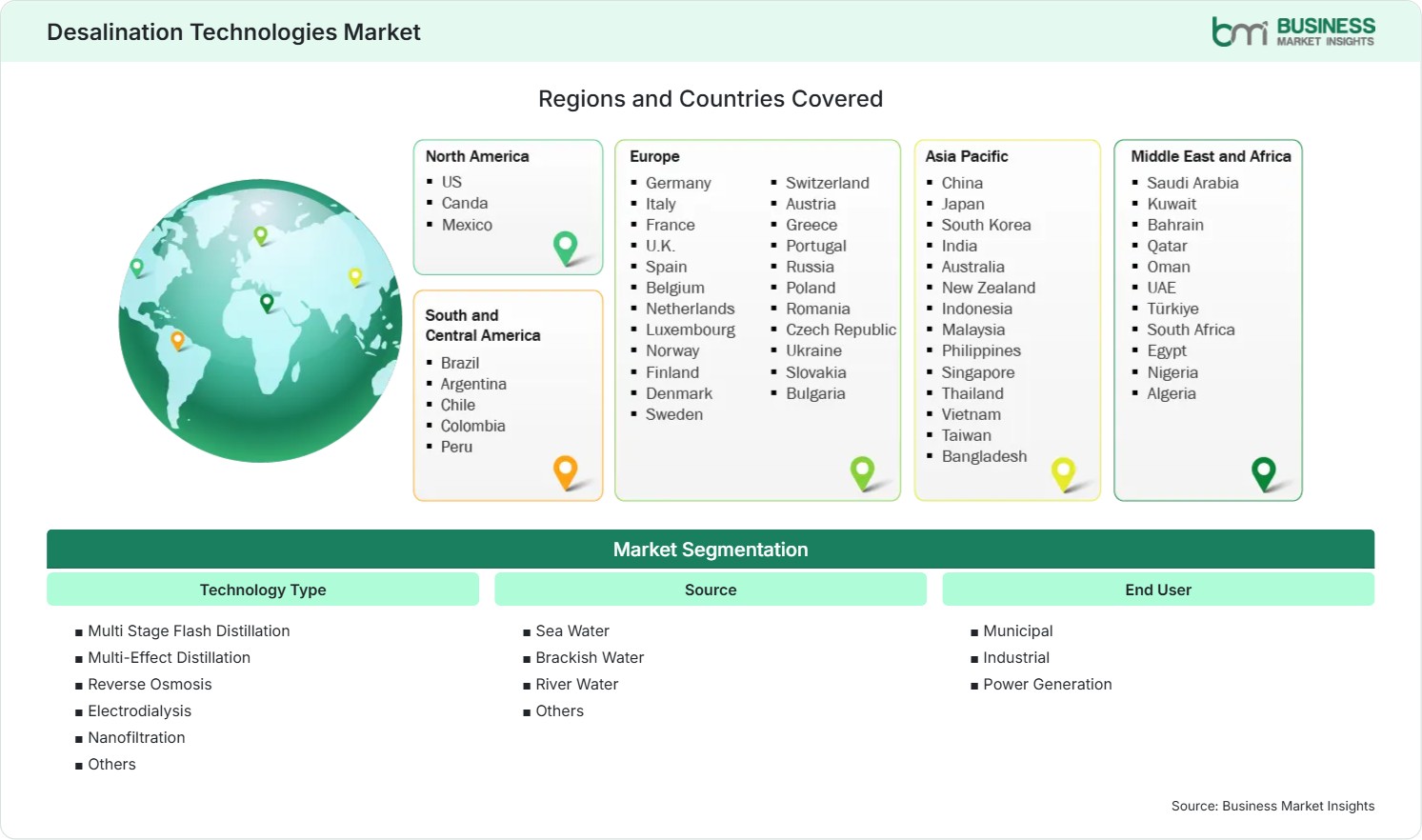
  • Technology Type: Multi Stage Flash Distillation, Multi-Effect Distillation, Reverse Osmosis, Electrodialysis, Nanofiltration, Others
  • Source: Sea Water, Brackish Water, River Water, Others
  • End User: Municipal, Industrial, Power Generation
US$ 29.96 Bn Market size in 2025
US$ 62.29 Bn Market Size by 2033
9.58% CAGR, 2026 - 2033
2026-2033 Forecast Period

01 AI Overview

Desalination Technologies Market Summary

  • North America Region: North America holds a desalination technologies market share of 24%–28% in 2025 and is projected to grow at a CAGR of 8.8%–9.4% during 2026–2033. Growth is supported by increasing water stress, expansion of municipal desalination projects, industrial water recycling initiatives, technological modernization, rising investments in water treatment infrastructure, growing demand from coastal regions, increasing adoption of membrane technologies, regulatory focus on water security, and sustainable resource management initiatives. The U.S. remains the dominant market owing to growing investments in advanced water treatment systems and desalination facilities, advancing at a CAGR of 8.9%–9.5%.
  • Fastest Growing Region: Asia Pacific accounts for 30%–34% share in 2025 and is expected to register a CAGR of 10.5%–11.2% through 2033. Growth is fueled by rapid urbanization, industrial expansion, rising water scarcity concerns, increasing government investments in water security, infrastructure development, population growth, expanding manufacturing sectors, growing municipal water demand, and increasing adoption of advanced desalination technologies.
  • Leading Segment: Reverse Osmosis (RO) represents 48%–52% share in 2025 and is anticipated to grow at a CAGR of 10.0%–10.8% through 2033. Demand is supported by lower operating costs, energy efficiency advantages, technological improvements in membranes, scalability, reduced maintenance requirements, expanding municipal applications, industrial water treatment demand, and increasing project deployment worldwide.
  • High Growth Segment: Municipal captures 42%–46% share in 2025 and is forecast to expand at a CAGR of 10.3%–11.0% during 2026–2033. Expansion is driven by rising urban populations, increasing drinking water demand, government investments in water infrastructure, water security concerns, growing desalination plant construction, public utility modernization, and long-term water management initiatives.
  • Key Market Opportunity: Growing investments in energy-efficient desalination systems, renewable energy-powered water treatment facilities, smart water management solutions, and large-scale municipal desalination projects are creating significant opportunities across the industry.
  • Major Market Players: Ampac USA, General Electric, DuPont, BWT Holding GmbH, Aquatech, Genesis Water Technologies, Lenntech, IDE Technologies, Acciona, and Biwater Holdings Limited.
02 Strategic Insights

Desalination Technologies Market: Strategic Insights

Desalination Technologies Market Strategic Framework
FREE PDF
Request your free sample
Request free sample
03 Stakeholder View

Key Takeaways

  • The desalination technologies market is increasingly becoming a critical component of global water security strategies as governments and industries seek reliable alternatives to conventional freshwater resources.
  • Reverse Osmosis remains the dominant technology due to its lower energy consumption, cost efficiency, scalability, and broad applicability across municipal and industrial desalination projects.
  • Municipal applications continue to drive significant demand as urban populations expand and governments invest in long-term drinking water infrastructure development.
  • Asia Pacific represents the most attractive growth opportunity due to increasing water stress, industrialization, population growth, and substantial public investments in water treatment projects.
  • Technology providers are focusing on advanced membrane systems, energy recovery devices, and renewable-energy-powered desalination facilities to improve efficiency and sustainability.
  • Increasing adoption of digital monitoring systems, smart water management solutions, and automation technologies is enhancing operational performance and reducing lifecycle costs.
04 Geographic Outlook

Desalination Technologies Market Regional Highlights

North America Desalination Technologies Market

North America accounted for 24%–28% of global revenue in 2025 and is projected to grow at a CAGR of 8.8%–9.4% through 2033. The region benefits from increasing water scarcity concerns, growing demand for alternative water resources, and continuous investments in advanced water treatment infrastructure. The Desalination Technologies Market share remains strong due to the presence of advanced technology providers and increasing adoption of membrane-based desalination systems.

  • Rising freshwater shortages across several coastal and drought-prone regions are encouraging municipalities to invest in large-scale desalination facilities to strengthen long-term water security.
  • Industrial sectors are increasingly adopting desalination technologies to secure reliable process water supplies, reduce dependency on freshwater resources, and support sustainability initiatives.
  • Technological advancements in reverse osmosis membranes and energy recovery systems are improving operational efficiency while reducing overall desalination costs.
  • Government agencies continue supporting water infrastructure modernization projects aimed at improving resilience against climate-related water stress and supply disruptions.
  • Growing emphasis on water reuse, resource conservation, and environmental sustainability is accelerating deployment of advanced desalination solutions.

US Desalination Technologies Market

The United States represents 82%–86% of North American demand and is expected to grow at a CAGR of 8.9%–9.5% through 2033. Growth is supported by increasing drought conditions, expanding municipal demand, and growing investments in advanced water treatment facilities.

  • Water-stressed states are actively investing in desalination infrastructure to diversify water sources and improve long-term supply reliability.
  • Industrial facilities increasingly deploy desalination technologies to improve water management, maintain production continuity, and reduce environmental impacts.
  • Technological innovation continues enhancing membrane performance, system efficiency, and operational sustainability across desalination facilities.
  • Public and private sector investments are supporting expansion of water infrastructure and advanced treatment technologies nationwide.

Europe Desalination Technologies Market

Europe held 22%–26% of global revenue in 2025 and is expected to register a CAGR of 9.0%–9.8% through 2033. Growing water scarcity concerns, stringent environmental regulations, and increasing demand for sustainable water management solutions continue supporting desalination technologies market growth. Spain remains the leading market, while Greece represents a high-growth market with a CAGR of 10.0%–10.8%.

  • Governments are investing in desalination projects to support water security objectives and reduce dependence on vulnerable freshwater resources.
  • Spain continues to expand desalination capacity to address regional water shortages and support agricultural, municipal, and industrial water demand.
  • Sustainability initiatives are encouraging adoption of energy-efficient desalination technologies and renewable-energy-integrated facilities.
  • Advanced membrane and process technologies are improving plant performance while lowering operational energy requirements.
  • Strong regulatory frameworks continue promoting efficient water resource management and long-term infrastructure development.

Asia Pacific Desalination Technologies Market

Asia Pacific accounted for 30%–34% of global revenue in 2025 and is expected to record the fastest CAGR of 10.5%–11.2% through 2033. Rapid urbanization, industrial development, increasing water demand, and government investments in water infrastructure are supporting regional growth. China and India remain leading markets, while Australia is projected to register a CAGR of 11.0%–11.8%.

  • Rapid population growth and urban expansion are increasing pressure on freshwater resources, driving demand for large-scale desalination projects.
  • Industrial development is creating significant requirements for treated water across sectors such as manufacturing, chemicals, mining, and power generation.
  • Governments are implementing long-term water security strategies that include desalination capacity expansion and infrastructure modernization.
  • Rising adoption of advanced reverse osmosis systems is improving efficiency, reducing costs, and supporting wider technology deployment.
  • Increasing integration of renewable energy sources with desalination facilities is supporting sustainability goals and reducing operating expenses.

Rest of World Desalination Technologies Market

Rest of World accounted for 16%–20% of global revenue in 2025 and is forecast to grow at a CAGR of 9.2%–10.0% through 2033. Market growth is primarily driven by severe water scarcity challenges, infrastructure development programs, and rising demand for secure water supplies. The Middle East remains a major adoption hub due to extensive desalination deployment.

  • Water scarcity challenges are encouraging governments and utilities to invest heavily in desalination infrastructure and advanced treatment technologies.
  • Large-scale desalination projects are being developed to support growing municipal, industrial, and agricultural water requirements.
  • Economic diversification initiatives are supporting investments in sustainable water infrastructure and resource management programs.
  • International technology partnerships are accelerating adoption of advanced desalination systems and operational best practices.
  • Increasing focus on energy efficiency and sustainability is encouraging upgrades to existing facilities and deployment of modern desalination technologies.
Global Market Geography
FREE PDF
Request your free sample
Request free sample
05 Segment Analysis

Desalination Technologies Market Segmentation

Technology Type

Reverse Osmosis (RO) accounts for 48%-52% share in 2025 and is expected to grow at a CAGR of 10.0%-10.8% through 2033. The segment dominates due to its lower energy requirements, cost-effectiveness, scalability, and continuous advancements in membrane technology. The Desalination Technologies Market scope continues to expand as governments, utilities, and industrial operators increasingly invest in advanced water treatment infrastructure and sustainable freshwater generation solutions.

  • Multi Stage Flash Distillation (MSF): Utilized in large-scale desalination projects, particularly in regions with abundant energy resources and extensive water demand requirements.
  • Multi-Effect Distillation (MED): Benefits from improved thermal efficiency and lower operational costs compared with traditional thermal desalination processes.
  • Reverse Osmosis (RO): Widely deployed across municipal and industrial sectors due to superior efficiency, lower operating costs, modularity, and technological maturity.
  • Electrodialysis (ED): Primarily used for brackish water treatment applications where lower salinity levels improve process effectiveness and cost efficiency.
  • Nanofiltration: Increasingly adopted for selective contaminant removal and pre-treatment applications that enhance overall desalination performance.
  • Others: Include emerging desalination technologies focused on improving energy efficiency, water recovery rates, and operational sustainability.

Source

Sea Water accounts for 62%–66% share in 2025 and is projected to grow at a CAGR of 9.8%–10.5% through 2033. The segment maintains dominance due to abundant availability, increasing coastal desalination installations, and growing municipal demand for reliable freshwater supplies.

  • Sea Water: Represents the primary feedwater source for large-scale desalination projects supporting municipal and industrial water needs.
  • Brackish Water: Gains adoption due to lower treatment costs and reduced energy requirements compared with seawater desalination.
  • River Water: Utilized in select regions requiring advanced treatment solutions to address contamination and water quality challenges.
  • Others: Include wastewater, groundwater, and alternative water sources integrated into advanced desalination and resource recovery systems.

End-User

Municipal accounts for 42%-46% share in 2025 and is expected to register the highest CAGR of 10.3%-11.0% through 2033. Growth is driven by rising urban populations, increasing water security concerns, and expanding public investments in sustainable water infrastructure. Current Desalination Technologies Market trends indicate growing deployment of large-scale municipal desalination facilities to address long-term freshwater shortages and support population growth.

  • Municipal: Driven by increasing demand for potable water, urban population growth, infrastructure modernization efforts, and government-supported water security initiatives.
  • Industrial: Supported by water-intensive industries including chemicals, oil & gas, mining, manufacturing, and food processing that require reliable water supplies.
  • Power Generation: Utilizes desalinated water for cooling systems, boiler feedwater applications, and operational efficiency improvements across energy facilities.
06 Market Forces

Desalination Technologies Market Dynamics

Key Market Drivers

Rising Global Water Scarcity and Freshwater Demand

Growing population levels, rapid urbanization, climate variability, and depletion of freshwater resources are intensifying water scarcity challenges worldwide. Many regions are experiencing increasing pressure on traditional water sources, forcing governments and utilities to seek alternative supply solutions. Desalination technologies provide a dependable method of converting saline water into potable water, helping address long-term water security concerns. As freshwater demand continues to rise across residential, industrial, and agricultural sectors, desalination is becoming a critical component of national water management strategies.

Growing Adoption of Desalination for Municipal Water Supply

Municipal authorities are increasingly investing in desalination infrastructure to ensure reliable access to drinking water for expanding urban populations. Coastal cities and water-stressed regions are particularly dependent on desalination facilities to supplement conventional freshwater resources. Technological advancements have improved operational efficiency and reduced treatment costs, making desalination more economically attractive for public utilities. The growing need for water resilience and supply diversification continues to drive municipal adoption across global markets.

Increasing Industrial Demand for Reliable Water Sources

Industries such as power generation, chemicals, oil & gas, food processing, and mining require large volumes of consistent and high-quality water to maintain operations. Dependence on limited freshwater supplies can create operational risks and sustainability challenges. Desalination technologies help industries secure reliable water access while reducing competition with municipal water users. As industrial activity expands and environmental regulations become stricter, demand for desalination systems continues increasing across water-intensive sectors.

Key Market Opportunities

Rising Desalination Investments in Water-Stressed Regions

Regions facing chronic water shortages are significantly increasing investments in desalination infrastructure to strengthen water security and reduce reliance on limited freshwater sources. Governments are allocating substantial funding to large-scale desalination projects that support population growth and economic development. Desalination Technologies Market Forecasts indicate strong investment opportunities in the Middle East, Asia Pacific, and other water-scarce regions where long-term water demand continues rising. These developments create favorable conditions for technology providers, engineering firms, and infrastructure developers.

Expansion of Industrial and Agricultural Water Applications

Beyond municipal water supply, desalination is increasingly being utilized to support industrial operations and agricultural irrigation requirements. Growing food production needs and water-intensive industrial activities are creating demand for alternative water resources that reduce stress on freshwater systems. Improved desalination efficiency and declining treatment costs are making these applications more economically feasible. Expansion into non-traditional end-use sectors is creating new revenue opportunities across the desalination value chain.

Growing Adoption of Smart Desalination Monitoring Systems

Digitalization is transforming desalination plant operations through real-time monitoring, predictive maintenance, remote asset management, and process optimization technologies. Smart monitoring systems improve operational efficiency, reduce downtime, lower maintenance costs, and enhance water recovery performance. Operators increasingly adopt advanced analytics and automation tools to maximize plant productivity and sustainability. Growing investment in digital water management solutions is expected to create attractive growth opportunities across the market.

Market Restraints and Challenges

High Energy Consumption of Desalination Processes

Factor: Desalination processes, particularly large-scale facilities, require substantial energy inputs for water treatment, pumping, and system operations.

Impact: High energy consumption can increase operating expenses and affect overall project economics, particularly in regions facing elevated energy costs. Energy requirements may also raise environmental concerns where electricity generation relies heavily on fossil fuels. These challenges encourage continued investment in energy-efficient technologies and renewable-energy-powered desalination systems.

High Capital and Infrastructure Investment Requirements

Factor: Development of desalination facilities requires significant capital expenditures associated with plant construction, distribution infrastructure, intake systems, treatment equipment, and long-term maintenance requirements.

Impact: High upfront investment costs may limit project implementation, particularly in developing regions with constrained financial resources. Long project development timelines and funding challenges can delay deployment of new facilities. These financial barriers remain one of the key challenges affecting broader desalination adoption.

07 Company Analysis

Competitive Landscape

The Desalination Technologies Market analysis highlights a competitive landscape characterized by water treatment technology providers, engineering companies, membrane manufacturers, and infrastructure developers focused on energy efficiency, sustainability, and advanced desalination solutions.

Company Name

Overview

Products and Services Relevant to this Market

Ampac USA

Water treatment company serving residential, commercial, and industrial water purification applications.

Reverse osmosis systems, desalination units, water filtration solutions, and purification technologies.

General Electric

Industrial technology company with expertise in water treatment and process solutions.

Water treatment systems, membrane technologies, desalination equipment, and industrial water solutions.

DuPont

Global materials and technology company with advanced membrane technology capabilities.

Reverse osmosis membranes, filtration systems, ion exchange technologies, and water purification solutions.

BWT Holding GmbH

Water technology company focused on sustainable water treatment solutions.

Desalination systems, filtration technologies, water treatment equipment, and process optimization solutions.

Aquatech

Global provider of water purification and desalination technologies.

Desalination plants, water recycling systems, zero liquid discharge solutions, and industrial water treatment systems.

Genesis Water Technologies

Water treatment technology provider serving municipal and industrial applications.

Desalination technologies, membrane systems, filtration solutions, and water management services.

Lenntech

Engineering and water treatment solutions provider with international operations.

Desalination equipment, membrane technologies, industrial water treatment systems, and purification solutions.

IDE Technologies

Leading desalination company specializing in large-scale water infrastructure projects.

Reverse osmosis plants, thermal desalination systems, water treatment technologies, and turnkey desalination solutions.

Acciona

Infrastructure and sustainable solutions company active in water treatment markets.

Desalination facilities, water treatment projects, infrastructure services, and engineering solutions.

Biwater Holdings Limited

Water infrastructure company serving municipal and industrial clients globally.

Desalination plants, water treatment systems, project development services, and utility infrastructure solutions.

10 Trust & Transparency

Research Methodology

The market analysis combines proprietary research with secondary data from government agencies, company disclosures, regulatory filings, industry databases and expert interviews. Market estimates are validated through data triangulation, cross-market benchmarking and analyst review.

View Full Research Methodology

11 Questions Answered

Frequently Asked Questions

What does this Desalination Technologies Market Report evaluate?

The market report evaluates technology adoption trends, end-user demand, regional opportunities, competitive dynamics, growth drivers, investment prospects, and industry challenges through 2033.

How are smart monitoring systems influencing desalination operations?

Smart monitoring systems improve plant efficiency through real-time performance tracking, predictive maintenance, automated process control, and optimized resource utilization.

Why is Asia Pacific the fastest-growing region?

Asia Pacific benefits from rapid urbanization, growing industrial activity, increasing water stress, expanding government investments in water infrastructure, and rising demand for reliable freshwater sources.

Which technology segment dominates the market?

Reverse Osmosis (RO) dominates the market due to its lower operating costs, high efficiency, scalability, and widespread adoption across municipal and industrial desalination projects.

What is driving growth in the desalination technologies market?

Growth is driven by increasing water scarcity, rising freshwater demand, expanding municipal water infrastructure projects, industrial water requirements, and advancements in energy-efficient desalination technologies.

Access the Full Desalination Technologies Market Report

Get segment-level forecasts, regional estimates, competitive benchmarking, company profiles and downloadable Excel datasets.

Access the full Desalination Technologies Market Report
350 pages PDF & Excel | 2026-08-20