
Wave Energy Converters Market Outlook: Size, Share, Trends, Growth Analysis, Competitive Landscape & Forecast, 2026-2033

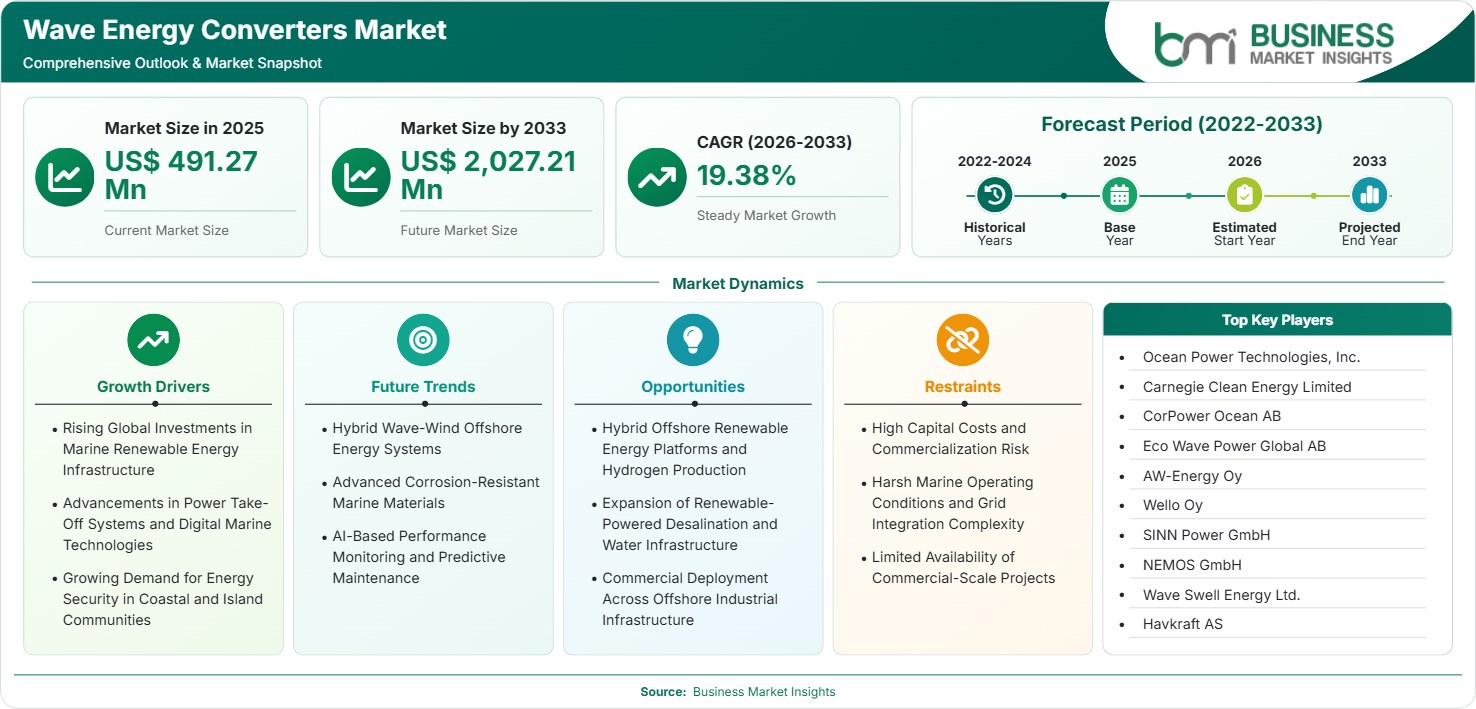
The Wave Energy Converters Market size was valued at US$ 491.27 Million in 2025 and is projected to reach US$ 2,027.21 Million by 2033, growing at a CAGR of 19.38% during 2026–2033. Rising investments in marine renewable energy, supportive decarbonization policies, increasing offshore infrastructure, and technological innovation in wave energy harvesting are creating substantial commercialization opportunities across global coastal economies.

Report Coverage
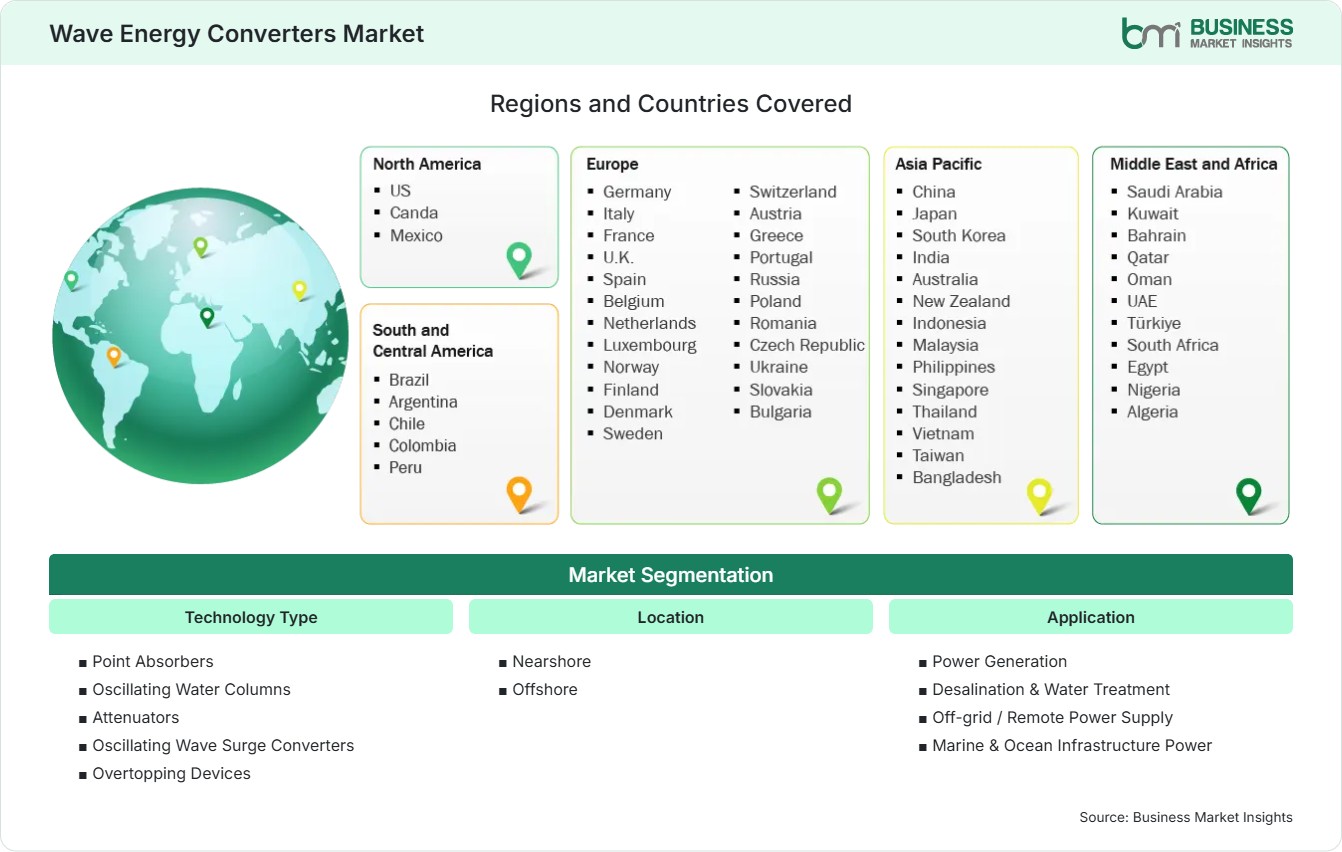
  • Technology Type: Point Absorbers, Oscillating Water Columns , Attenuators, Oscillating Wave Surge Converters , Overtopping Devices
  • Location: Nearshore, Offshore
  • Application: Power Generation, Desalination & Water Treatment, Off-grid / Remote Power Supply, Marine & Ocean Infrastructure Power
US$ 491.27 Mn Market size in 2025
US$ 2,027.21 Mn Market Size by 2033
19.38% CAGR, 2026 - 2033
2026-2033 Forecast Period

AI Overview

Wave Energy Converters Market Summary

  • North America Region: North America holds a 34%–37% wave energy converters market share in 2025 and is expected to grow at a 17.5%–18.5% CAGR during 2026–2033, supported by federal clean-energy funding, advanced ocean research, demonstration projects, and expanding blue economy investments accelerating commercial deployment across coastal regions.
  • Fastest Growing Region: Asia Pacific accounts for approximately 22%–25% market share in 2025 while expanding at a 21.5%–22.8% CAGR through 2033, driven by rising electricity demand, island electrification programs, offshore renewable investments, favorable government initiatives, and expanding domestic marine engineering capabilities.
  • Leading Segment: Point Absorbers represent 34%–37% of revenue in 2025 and are projected to register a 19.5%–20.5% CAGR, supported by modular construction, deployment flexibility, high scalability, simplified maintenance, and suitability for both nearshore and offshore installations globally.
  • High Growth Segment: Offshore installations contribute 56%–59% market share during 2025 while advancing at a 20.5%–21.5% CAGR, encouraged by stronger wave resources, increasing utility-scale renewable projects, hybrid offshore energy systems, and improving marine engineering technologies reducing operational risks.
  • Key Market Opportunity: Expanding hybrid renewable offshore platforms integrating wave, wind, floating solar, desalination, hydrogen production, and marine monitoring systems offer diversified revenue streams while improving infrastructure utilization and long-term investment attractiveness worldwide.
  • Major Market Players: Ocean Power Technologies, Inc.; Carnegie Clean Energy Limited; CorPower Ocean AB; Eco Wave Power Global AB; AW-Energy Oy; Wello Oy; SINN Power GmbH; NEMOS GmbH; Wave Swell Energy Ltd.; Havkraft AS.
Strategic Insights

Wave Energy Converters Market: Strategic Insights

Wave Energy Converters Market Strategic Framework
FREE PDF
Request your free sample
Request free sample
Stakeholder View

Key Takeaways

  • The wave energy converters market trend suggest that the market ecosystem is transitioning from research-focused pilot deployments toward commercially scalable value chains involving marine engineering firms, offshore construction contractors, digital monitoring providers, utilities, equipment manufacturers, and government-backed renewable infrastructure developers.
  • Offshore power generation and remote island electrification represent the strongest medium-term commercial opportunities because they address grid reliability challenges while maximizing energy extraction from higher wave intensity environments.
  • Innovation increasingly focuses on intelligent control systems, advanced composite materials, predictive maintenance using artificial intelligence, modular converter architecture, and digital twins to improve operational availability while lowering maintenance expenditure.
  • Europe continues leading technology commercialization, whereas Asia Pacific offers one of the most attractive investment environments through expanding renewable capacity targets, coastal industrialization, and increasing public support for marine energy research.
Geographic Outlook

Wave Energy Converters Market Regional Highlights

North America Wave Energy Converters Market

North America maintains the largest regional position with approximately 34%–37% Wave Energy Converters Market share during 2025 while expanding at a projected 17.5%–18.5% CAGR through 2033. Government research funding, advanced marine engineering expertise, supportive renewable policies, and collaboration between universities, utilities, and technology developers continue strengthening commercialization. Increasing resilience requirements for coastal communities, offshore renewable integration, and military energy applications further reinforce regional demand across both pilot and pre-commercial projects.

  • The U.S. Department of Energy continues financing marine energy demonstration initiatives supporting technology validation, efficiency improvements, and commercialization pathways that reduce investment uncertainty while strengthening domestic manufacturing capabilities.
  • Canada's Atlantic coastline offers significant wave resource potential, encouraging collaboration between research institutions and clean-energy developers to evaluate grid-connected marine renewable solutions supporting remote coastal communities.
  • Offshore renewable integration with floating wind, battery storage, and hydrogen production is expanding investment opportunities while improving infrastructure utilization and long-term economic feasibility for utility-scale projects.
  • Digital monitoring technologies, predictive maintenance platforms, and corrosion-resistant engineering materials continue improving converter reliability, reducing operational downtime, and lowering total lifecycle operating costs.

US Wave Energy Converters Market

The United States represents approximately 72%–75% of the North American wave energy converters market and is projected to expand at a 18.0%–19.0% CAGR through 2033. Increasing investment in resilient coastal infrastructure, offshore renewable integration, and energy security initiatives further strengthens long-term deployment prospects across multiple coastal states.

  • Federal marine energy research centers continue advancing next-generation converter technologies through testing facilities, simulation platforms, and ocean demonstration programs that improve technology readiness for commercial deployment.
  • Pacific Coast states increasingly evaluate wave energy for grid diversification, offshore renewable integration, and resilient coastal electricity infrastructure supporting long-term decarbonization objectives.
  • Collaboration between utilities, defense organizations, and research institutions accelerates commercialization by validating operational performance under diverse marine conditions while reducing project development risks.

Europe Wave Energy Converters Market

Europe accounts for approximately 30%–33% market share in 2025 while advancing at a projected 19.0%–20.0% CAGR during 2026–2033. Strong climate commitments, established marine research infrastructure, supportive European Union funding, and extensive offshore renewable experience continue positioning the region as the global technology leader.

  • Portugal continues supporting ocean renewable demonstration projects through favorable regulatory frameworks and dedicated marine testing facilities encouraging technology commercialization.
  • Norway leverages offshore engineering expertise from the oil and gas sector to accelerate marine renewable infrastructure development and commercialization activities.
  • Finland strengthens converter innovation through advanced mechanical engineering, power optimization technologies, and collaborative research partnerships involving industrial manufacturers.
  • European Union funding programs continue reducing commercialization barriers through research grants, demonstration financing, and cross-border technology collaboration initiatives.

Asia Pacific Wave Energy Converters Market

Asia Pacific contributes approximately 22%–25% of global revenue during 2025 and is anticipated to register the highest regional CAGR of 21.5%–22.8% through 2033. Japan, Australia, South Korea, China, and India are strengthening marine renewable research while pursuing long-term energy diversification and coastal sustainability objectives.

  • Australia remains the regional technology leader through strong commercial demonstration activities and collaboration between research organizations and renewable energy companies.
  • Japan invests heavily in marine renewable innovation to strengthen domestic energy security while supporting carbon neutrality and resilient coastal infrastructure.
  • China expands investment in offshore renewable engineering capabilities, supporting large-scale demonstration programs integrated with broader marine economic development strategies.
  • South Korea strengthens research into advanced floating renewable systems combining offshore wind and wave technologies for higher infrastructure utilization.
  • India explores marine renewable deployment supporting island electrification, coastal resilience, and sustainable energy diversification through government-backed research initiatives.

Rest of World Wave Energy Converters Market

The Rest of World region represents approximately 10%–13% of global revenue during 2025 and is projected to expand at a 18.5%–19.5% CAGR through 2033. South and Central America increasingly evaluate marine renewable projects supporting coastal electricity diversification, while Middle Eastern and African nations investigate desalination-powered renewable systems improving freshwater availability and long-term energy sustainability.

  • Chile demonstrates growing interest in marine renewable technologies supporting national renewable electricity expansion and coastal industrial energy requirements.
  • Brazil evaluates offshore renewable integration opportunities leveraging extensive Atlantic coastlines and expanding clean-energy investment programs.
  • Gulf countries increasingly investigate wave-powered desalination infrastructure supporting sustainable freshwater production alongside renewable energy diversification.
  • South Africa strengthens marine renewable research through academic collaboration, offshore engineering capabilities, and national clean-energy innovation programs.
Global Market Geography
FREE PDF
Request your free sample
Request free sample
Segment Analysis

Wave Energy Converters Market Segmentation

Technology Type

Technology Type accounted for approximately 61%–64% of the global market revenue in 2025 and is projected to expand at a 19.5%–20.5% CAGR through 2033. The Wave Energy Converters Market scope continues expanding through modular engineering, digital monitoring systems, and advanced power take-off technologies that improve long-term operational reliability.

  • Point Absorbers: These systems remain the most commercially advanced technology because of compact design, modular scalability, simplified installation, and compatibility with multiple offshore environments, supporting pilot projects and early commercial deployments worldwide.
  • Oscillating Water Columns (OWC): OWC technology benefits from mature engineering principles, shoreline deployment capability, relatively low maintenance requirements, and compatibility with coastal infrastructure supporting reliable electricity generation from oscillating air pressure.
  • Attenuators: Floating attenuator devices capture energy across longer wave fronts, making them suitable for offshore applications where consistent wave resources improve annual electricity production and project economics.
  • Oscillating Wave Surge Converters (OWSC): These seabed-mounted systems efficiently utilize horizontal wave motion while offering strong performance in shallow coastal waters with predictable wave characteristics and favorable maintenance accessibility.
  • Overtopping Devices: Overtopping technologies generate electricity by capturing seawater in elevated reservoirs before releasing it through low-head turbines, providing opportunities for integration with coastal infrastructure and desalination facilities.

Location

Location-based deployment represents nearly 56%–59% of wave energy converters market revenue in 2025 and is expected to register a 20.5%–21.5% CAGR during the forecast period. Offshore installations increasingly dominate investment due to stronger and more consistent wave resources, while nearshore projects remain attractive for lower installation costs, easier maintenance, and proximity to existing transmission infrastructure supporting early-stage commercialization.

  • Nearshore: Nearshore deployments reduce installation complexity, improve maintenance accessibility, and enable utilities to connect renewable generation with existing coastal transmission infrastructure while lowering overall project development expenditure.
  • Offshore: Offshore systems benefit from higher wave intensity, larger electricity generation potential, compatibility with floating renewable platforms, and opportunities for hybrid integration with offshore wind farms and hydrogen production facilities.

Application

Power generation applications account for approximately 66%–69% of global revenue in 2025 while expanding at a projected 19.0%–20.0% CAGR through 2033. Commercial interest continues increasing as governments and utilities pursue renewable electricity diversification beyond conventional wind and solar resources. The segment also benefits from improving converter efficiency, expanding offshore infrastructure, and favorable marine renewable policy support.

  • Power Generation: Utility-scale electricity production remains the dominant application as national renewable energy strategies increasingly recognize marine resources for long-term grid diversification and carbon reduction objectives.
  • Desalination & Water Treatment: Renewable-powered desalination facilities offer attractive opportunities for coastal regions experiencing freshwater scarcity while reducing dependence on fossil-fuel-powered treatment infrastructure.
  • Off-grid / Remote Power Supply: Remote islands, offshore research stations, military facilities, and telecommunications infrastructure increasingly utilize wave-powered systems to improve energy resilience and reduce diesel fuel consumption.
  • Marine & Ocean Infrastructure Power: Autonomous navigation systems, offshore sensors, aquaculture facilities, ocean monitoring platforms, and marine communications increasingly adopt wave-powered electricity solutions supporting continuous low-carbon operation.
Market Forces

Wave Energy Converters Market Dynamics

Key Market Drivers

Rising Global Investments in Marine Renewable Energy Infrastructure

Both the government and private sectors are increasingly providing support for marine renewable energy sources to enhance options for generating clean power other than wind and solar. As mentioned by the International Energy Agency (IEA), capacity additions of renewable electricity continue to be at their highest points to date, and this has created an environment that is conducive for emerging ocean renewable technologies. Programs from public financing in the European Union, U.S., Australia, and Japan are helping with testing prototypes, demonstrations arrays, and commercial efforts. The Wave Energy Converters Market growth is also being supported by the growing partnership among researchers, utilities, offshore engineering firms, and technology developers.

Advancements in Power Take-Off Systems and Digital Marine Technologies

Constant advancements in technology have been enhancing the efficiency of the converters, reliability of their operations, and maintenance. The modern power take-off systems, use of composite materials, digital twin models, predictive maintenance using artificial intelligence, and the monitoring platforms allow designers to maximize generation of electricity and at the same time ensure minimal downtime. With advancements in the use of corrosion resistant material and modularity in engineering, there will be reduced need for maintenance throughout the life span of the converters in marine conditions.

Growing Demand for Energy Security in Coastal and Island Communities

Despite this, many nations along the coastline are still reliant on imported oil for their fuel needs, making them susceptible to fuel price variations and interruptions in fuel supply. With wave energy, it becomes easier to have a locally sourced renewable energy source that can sustain resilient microgrids and electricity generation. In combination with hybrid renewable sources, wave energy can increase efficiency while minimizing the use of diesel and emissions of greenhouses gases.

Key Market Opportunities

Hybrid Offshore Renewable Energy Platforms and Hydrogen Production

Integrating wave energy converters with offshore wind farms, floating solar systems, battery storage solutions, and hydrogen production plants becomes one of the most promising investments in the long run. Hybrid plants help take advantage of the existing offshore resources while maximizing the production of energy in various weather conditions. According to Wave Energy Converters Market Forecasts, the investor community is becoming more interested in hybrid projects that can provide constant electricity production during the whole year. Hydrogen production on the offshore site also improves the profitability of the project while providing additional revenue sources and helping companies pursue decarbonization policies. There is an increasing number of government initiatives aimed at funding hybrid renewable projects in Europe, Australia, and Asia Pacific.

Expansion of Renewable-Powered Desalination and Water Infrastructure

The increasing shortage of fresh water in coastal areas provides many prospects for using renewable energy to power desalination and water purification plants. Traditional desalination processes involve large amounts of energy that usually come from fossil fuel electricity sources. The wave-powered desalination process is a green solution which helps to decrease operational emissions and ensure water security. Coastal communities, island countries, and industries start considering combined energy-water infrastructure. Technological innovations in the field of converter systems make it possible to apply these solutions at any scale.

Commercial Deployment Across Offshore Industrial Infrastructure

The offshore industries need dependable renewable energy supply to run autonomous monitoring systems, sub-sea sensors, communication systems, fish farming plants, and navigational systems. Wave-powered energy systems minimize the dependence on battery recharging and diesel-driven generators. Monitoring of the oceans digitally, offshore environment monitoring, maritime security, and research activities have been contributing towards the increase in the demand for standalone marine energy systems. Developers of technology are designing their devices such that they can operate in more than one application at the same time, which improves the economics of the projects and promotes commercialization. Long-lasting use of equipment with minimum maintenance is a strong competitive edge offered by the wave-powered offshore structures.

Market Restraints and Challenges

High Capital Costs and Commercialization Risk

Factor: Capital cost is much higher than mature renewable energy technologies due to low volume production and commercialization channels that are yet to be established.

Impact: Higher costs lead to greater difficulties in raising finance, longer payback times, and dissuade private investors from implementing large projects without any form of government or public funds. Insurance expenses and permits along with environmental impact assessment also add to the cost of the project.

Harsh Marine Operating Conditions and Grid Integration Complexity

Factor: The continuous interaction of components with the aggressive marine environment hastens their deterioration rate while also making it necessary to conduct inspections and maintain them frequently.

Impact: Increased maintenance and downtimes are costlier to projects and also make planning investments difficult. Besides, incorporating energy produced by varying waves into the existing electricity network needs sophisticated forecasting techniques and transmission systems. Also, remote offshore facilities require expensive sub-sea power transmission systems.

Company Analysis

Competitive Landscape

Competition is becoming stiff as a result of increasing commercial projects, funding initiatives and strategic technological collaboration. The Wave Energy Converters Market analysis indicates firms are making huge investments in demonstration projects, modular converter technologies, digital monitoring systems, hybrid renewable energy integration and international partnerships to facilitate commercialization and establish a global market presence.

Company Name

Overview

Products and Services Relevant to this Market

Ocean Power Technologies, Inc.

U.S.-based marine renewable technology company specializing in autonomous offshore power systems and intelligent ocean monitoring solutions for defense, energy, and research sectors.

PB3 PowerBuoy systems, autonomous offshore power platforms, ocean monitoring technologies, remote communications, marine data services, and renewable offshore energy solutions.

Carnegie Clean Energy Limited

Australian renewable energy developer recognized for commercial wave energy innovation and integrated offshore renewable engineering capabilities.

CETO wave energy technology, offshore renewable systems, desalination integration, engineering services, and marine renewable project development.

CorPower Ocean AB

Swedish clean-energy company focused on high-efficiency wave energy technologies using advanced control systems and compact modular converter designs.

Point absorber wave converters, intelligent control technologies, power take-off systems, digital monitoring, and offshore renewable engineering solutions.

Eco Wave Power Global AB

Developer of shoreline wave energy technologies designed for ports, breakwaters, and existing coastal infrastructure with simplified maintenance requirements.

Shore-based wave energy conversion systems, coastal renewable infrastructure, monitoring software, engineering services, and grid-connected renewable solutions.

AW-Energy Oy

Finnish marine renewable technology company developing commercial-scale wave energy systems for offshore electricity generation applications.

WaveRoller technology, subsea energy converters, offshore engineering, maintenance services, and renewable electricity generation systems.

Wello Oy

Finland-based innovator developing floating wave energy devices emphasizing operational reliability and modular deployment.

Penguin wave energy converters, offshore renewable platforms, engineering consulting, monitoring technologies, and commercial deployment services.

SINN Power GmbH

German renewable engineering company providing modular ocean energy technologies supporting decentralized renewable electricity generation.

Modular wave energy systems, hybrid renewable platforms, floating infrastructure, solar integration, and distributed renewable power solutions.

NEMOS GmbH

German technology developer focused on compact offshore wave energy systems optimized for commercial marine applications.

Offshore wave converters, mechanical drive systems, engineering support, testing services, and marine renewable technologies.

Wave Swell Energy Ltd.

Australian company commercializing oscillating water column technologies for sustainable electricity generation from ocean waves.

Oscillating water column systems, shoreline renewable installations, engineering support, project development, and marine infrastructure services.

Havkraft AS

Norwegian clean-energy company specializing in floating wave energy technologies supporting offshore renewable electricity production.

Floating wave energy converters, offshore engineering, hybrid renewable integration, marine power generation systems, and project consulting.

Trust & Transparency

Research Methodology

The market analysis combines proprietary research with secondary data from government agencies, company disclosures, regulatory filings, industry databases and expert interviews. Market estimates are validated through data triangulation, cross-market benchmarking and analyst review.

View Full Research Methodology

Questions Answered

Frequently Asked Questions

Why is the Wave Energy Converters Market Report important for investors and industry participants?

The report provides strategic insights into technology evolution, regional opportunities, competitive positioning, investment trends, regulatory developments, emerging applications, and commercialization prospects, enabling stakeholders to make informed long-term business and investment decisions.

What are the major commercial applications for wave energy converters?

Power generation remains the largest application, followed by desalination and water treatment, off-grid power supply for remote facilities, and electricity generation for marine infrastructure including offshore monitoring systems, aquaculture facilities, and navigation equipment.

Which region is expected to witness the fastest expansion?

Asia Pacific is projected to record the highest growth through 2033, supported by increasing renewable energy investments, expanding offshore infrastructure, favorable government policies, and growing marine engineering capabilities.

Which technology segment currently dominates the market?

Point absorber technology currently leads commercial adoption because of its modular design, deployment flexibility, relatively simple maintenance, scalability, and suitability for both nearshore and offshore installations across diverse marine environments.

What are the primary factors driving the Wave Energy Converters Market?

The market is driven by increasing investments in marine renewable energy, government decarbonization initiatives, expanding offshore renewable infrastructure, and rising demand for resilient electricity solutions across coastal and island regions.

Access the Full Wave Energy Converters Market Report

Get segment-level forecasts, regional estimates, competitive benchmarking, company profiles and downloadable Excel datasets.

Access the full Wave Energy Converters Market Report
350 pages PDF & Excel | 2026-08-18