
Offshore Energy Storage Market Outlook: Size, Share, Trends, Growth Analysis, Competitive Landscape & Forecast, 2026-2033

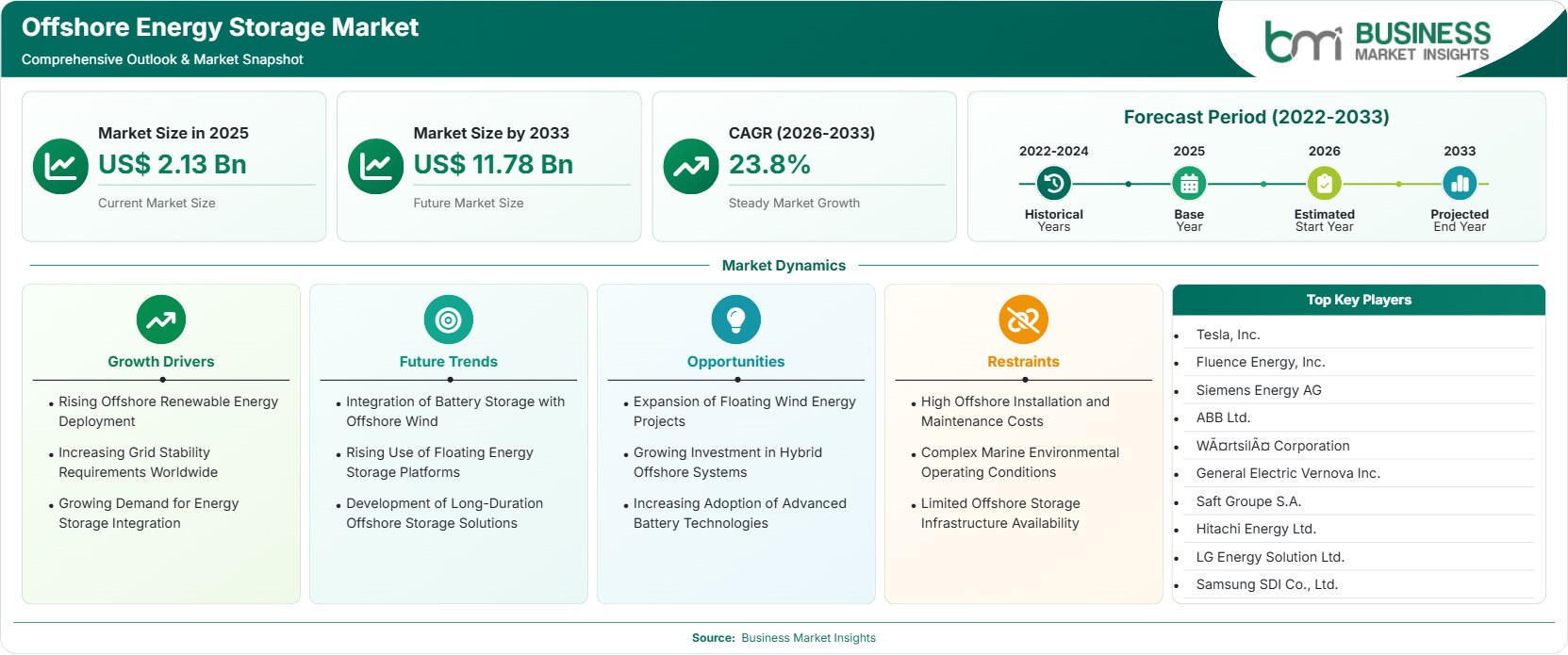
The Offshore Energy Storage Market size was valued at US$ 2.13 Billion in 2025 and is projected to reach US$ 11.78 Billion by 2033, growing at a CAGR of 23.8% during 2026–2033. Rising offshore renewable energy deployment, increasing grid stability requirements, and growing integration of energy storage with offshore power generation are driving market expansion. Investments in floating wind projects, hybrid offshore energy systems, and advanced battery technologies continue creating substantial long-term opportunities.

Report Coverage
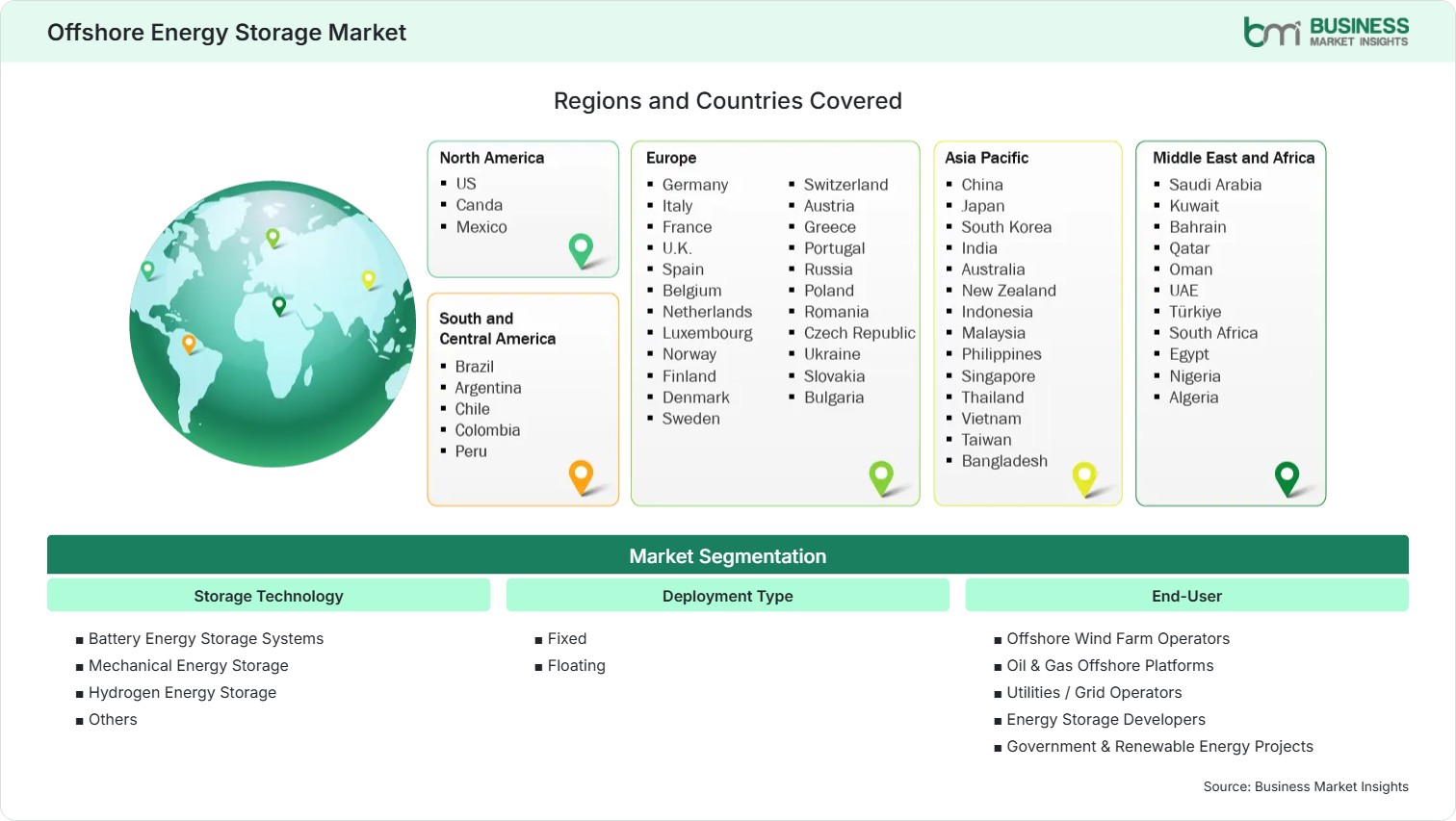
  • Storage Technology: Battery Energy Storage Systems, Mechanical Energy Storage, Hydrogen Energy Storage, Others
  • Deployment Type: Fixed, Floating
  • End-User: Offshore Wind Farm Operators, Oil & Gas Offshore Platforms, Utilities / Grid Operators, Energy Storage Developers, Government & Renewable Energy Projects
US$ 2.13 Bn Market size in 2025
US$ 11.78 Bn Market Size by 2033
23.8% CAGR, 2026 - 2033
2026-2033 Forecast Period

AI Overview

Offshore Energy Storage Market Summary

  • North America Region: North America accounted for 19%–22% of the global market in 2025 and is projected to register a CAGR of 22.9%–23.4% during 2026–2033. Expanding offshore wind developments, grid modernization initiatives, and increasing investments in utility-scale battery storage continue supporting market growth. The U.S. market is expected to grow at a CAGR of 23.1%–23.6%, driven by offshore renewable energy projects along the Atlantic coast and increasing deployment of battery energy storage systems.
  • Fastest Growing Region: Asia Pacific held 41%–44% of the global market in 2025 and is projected to expand at the fastest CAGR of 24.6%–25.1% through 2026–2033. Rapid offshore wind capacity expansion, large-scale renewable energy investments, and strong government support across China, Japan, South Korea, and Taiwan continue accelerating regional demand.
  • Leading Segment: Battery Energy Storage Systems (BESS) accounted for 56%–59% of market revenue in 2025 and is projected to grow at a CAGR of 24.2%–24.7%, driven by increasing deployment alongside offshore wind farms, high energy efficiency, and continuous advancements in battery technologies.
  • High Growth Segment: Floating Deployment accounted for 31%–34% of the market in 2025 and is expected to register the fastest CAGR of 25.4%–25.9%, supported by expanding floating offshore wind projects and increasing investments in deep-water renewable energy infrastructure.
  • Key Market Opportunity: Expansion of floating offshore wind farms, hybrid renewable energy systems, and next-generation battery technologies continues creating significant opportunities for offshore energy storage providers.
  • Major Market Players: Tesla, Inc., Fluence Energy, Inc., Siemens Energy AG, ABB Ltd., Wartsila Corporation, GE Vernova Inc., Saft Groupe S.A., Hitachi Energy Ltd., and LG Energy Solution Ltd.
Strategic Insights

Offshore Energy Storage Market: Strategic Insights

Offshore Energy Storage Market Strategic Framework
FREE PDF
Request your free sample
Request free sample
Stakeholder View

Key Takeaways

  • Battery Energy Storage Systems (BESS) remain the dominant technology due to high efficiency, scalability, and growing integration with offshore wind farms.
  • Floating offshore deployment represents the fastest-growing segment as developers increasingly invest in deep-water renewable energy projects.
  • Asia Pacific continues leading the global market through extensive offshore wind expansion and government-backed clean energy investments.
  • Hybrid offshore energy systems combining wind, battery storage, and hydrogen technologies are becoming major investment areas.
  • Continuous advancements in battery chemistry, digital energy management, and marine-grade storage technologies are strengthening long-term market opportunities.
Geographic Outlook

Offshore Energy Storage Market Regional Highlights

North America Offshore Energy Storage Market

North America accounted for 19%–22% of the global market in 2025 and is projected to expand at a CAGR of 22.9%–23.4% during 2026–2033. Expanding offshore wind projects, increasing utility-scale battery deployments, and investments in grid modernization continue supporting regional market growth. The Offshore Energy Storage Market share remains strong due to rising renewable energy integration and growing demand for resilient offshore power infrastructure.

  • The United States remains the largest regional market owing to expanding offshore wind developments along the Atlantic coast and increasing battery energy storage investments.
  • Grid operators continue deploying offshore storage systems to improve renewable energy integration, frequency regulation, and grid resilience.
  • Increasing public and private investments in offshore renewable infrastructure continue supporting deployment of marine energy storage solutions.
  • Technological advancements in lithium-ion and hybrid energy storage systems are improving operational efficiency in offshore environments.
  • Energy developers continue investing in digital monitoring and predictive maintenance technologies for offshore storage assets.

US Offshore Energy Storage Market

The United States represented 15%–17% of the global market in 2025 and is anticipated to grow at a CAGR of 23.1%–23.6% through 2026–2033. Expanding offshore wind capacity, federal clean energy initiatives, and increasing deployment of utility-scale battery systems continue driving Offshore Energy Storage Market growth.

  • Offshore wind developers increasingly integrate battery energy storage systems to improve grid reliability and maximize renewable power utilization.
  • Growing investments in hybrid offshore renewable projects continue accelerating demand for advanced energy storage technologies.
  • Utility companies are adopting intelligent energy management systems to optimize offshore power generation and storage operations.
  • Increasing domestic battery manufacturing investments further strengthen long-term market expansion.

Europe Offshore Energy Storage Market

Europe held 31%–34% of global revenue in 2025 and is expected to register a CAGR of 23.3%–23.8% during 2026–2033. Strong offshore wind deployment, ambitious carbon neutrality targets, and supportive renewable energy policies continue driving regional growth. Germany remains the leading regional market, while Poland is projected to register the fastest growth.

  • Germany leads the regional market through extensive offshore wind capacity expansion and advanced energy storage integration.
  • Poland is projected to register a CAGR of 24.4%–24.9%, supported by increasing offshore wind investments and expanding renewable energy infrastructure.
  • The United Kingdom, Denmark, and the Netherlands continue investing in hybrid offshore renewable energy systems and battery storage technologies.
  • European energy companies continue adopting digital energy management platforms to optimize offshore power transmission and storage efficiency.
  • Government support for offshore renewable projects continues encouraging deployment of advanced energy storage systems.

Asia Pacific Offshore Energy Storage Market

Asia Pacific accounted for 41%–44% of global Offshore Energy Storage market revenue in 2025 and is projected to register the fastest CAGR of 24.6%–25.1% during 2026–2033. Rapid offshore wind expansion, large-scale battery manufacturing, and increasing renewable energy investments continue driving regional demand. China remains the largest market, while India is projected to witness the fastest growth.

  • China dominates regional demand through aggressive offshore wind deployment, battery manufacturing leadership, and renewable energy expansion.
  • India is projected to register a CAGR of 25.3%–25.8%, supported by emerging offshore wind projects, grid modernization initiatives, and increasing clean energy investments.
  • Japan and South Korea continue investing in floating offshore wind farms integrated with advanced battery storage technologies.
  • Taiwan remains a major offshore wind development hub supporting increasing deployment of offshore energy storage systems.
  • Regional manufacturers continue expanding production capacity for marine-grade battery systems and energy management technologies.

Rest of World Offshore Energy Storage Market

The Rest of the World accounted for 5%–7% of global market revenue in 2025 and is expected to expand at a CAGR of 22.2%–22.7% during 2026–2033. Offshore Energy Storage Market growth is supported by increasing offshore renewable energy projects, expanding clean energy investments, and modernization of marine power infrastructure across the Middle East, Africa, and South America.

Growing investments in offshore wind, green hydrogen production, and renewable energy storage continue creating new opportunities for offshore energy storage providers across emerging economies.

  • Brazil continues investing in offshore wind and renewable energy infrastructure to diversify its energy portfolio.
  • Saudi Arabia is expanding offshore renewable energy initiatives as part of its long-term energy diversification strategy.
  • The United Arab Emirates continues investing in advanced clean energy technologies, including offshore renewable integration.
  • Emerging offshore renewable projects across Africa continue supporting demand for reliable marine energy storage systems.
  • Increasing government support for low-carbon energy infrastructure is creating favorable long-term market opportunities.
Global Market Geography
FREE PDF
Request your free sample
Request free sample
Segment Analysis

Offshore Energy Storage Market Segmentation

Storage Technology

The Battery Energy Storage Systems (BESS) segment accounted for 56%–59% of the market in 2025 and is projected to expand at a CAGR of 24.2%–24.7% during 2026–2033. High energy efficiency, rapid response capability, scalability, and increasing deployment alongside offshore wind farms continue driving segment growth. The Offshore Energy Storage Market scope continues expanding as battery manufacturers introduce marine-grade energy storage systems with improved durability, safety, and digital energy management capabilities.

  • Battery Energy Storage Systems (BESS): BESS dominates the market due to its high round-trip efficiency, fast response time, and widespread integration with offshore wind farms and grid stabilization projects.
    • Lithium-ion Batteries: Lithium-ion technology remains the leading battery chemistry owing to its high energy density, long cycle life, and declining manufacturing costs.
    • Sodium-based Batteries: Sodium-based batteries are gaining attention as cost-effective alternatives offering improved raw material availability and enhanced sustainability.
    • Flow Batteries: Flow batteries continue witnessing increasing adoption for long-duration offshore energy storage due to their scalability, extended operational life, and improved safety.
    • Others: Other battery technologies include solid-state batteries and hybrid battery systems designed for specialized offshore energy storage applications.
  • Mechanical Energy Storage: Mechanical storage technologies continue expanding in offshore applications requiring long-duration storage and operational reliability.
    • Compressed Air Energy Storage (CAES): CAES systems utilize compressed air reservoirs to provide large-scale offshore energy balancing and grid support.
    • Flywheel Energy Storage: Flywheel systems provide high-power, short-duration energy storage for frequency regulation and grid stabilization applications.
    • Gravity-based Storage: Gravity energy storage technologies are emerging as sustainable solutions for long-duration offshore renewable energy storage.
  • Hydrogen Energy Storage: Hydrogen storage is increasingly deployed alongside offshore wind farms to convert surplus renewable electricity into green hydrogen for long-term storage and industrial applications.
  • Others: Other technologies include thermal energy storage and hybrid integrated offshore storage systems combining multiple storage technologies.

Deployment Type

The Fixed deployment segment accounted for 66%–69% of global revenue in 2025 and is projected to expand at a CAGR of 23.2%–23.7% during 2026–2033. Extensive deployment across fixed offshore wind farms, offshore substations, and oil & gas platforms continues supporting market leadership.

  • Fixed: Fixed offshore installations dominate due to their established infrastructure, operational stability, and compatibility with existing offshore wind farms and energy facilities.
  • Floating: Floating deployment represents the fastest-growing segment with a projected CAGR of 25.4%–25.9%, driven by rapid expansion of floating offshore wind farms in deep-water locations.

End User

The Offshore Wind Farm Operators segment accounted for 43%–46% of the market in 2025 and is projected to register the fastest CAGR of 24.5%–25.0% during 2026–2033. Increasing offshore wind installations, growing renewable energy investments, and rising grid balancing requirements continue accelerating demand for offshore energy storage systems.

  • Offshore Wind Farm Operators: This segment remains the largest end user due to increasing integration of battery storage systems for renewable energy balancing, frequency regulation, and power optimization.
  • Oil & Gas Offshore Platforms: Offshore oil and gas operators increasingly deploy energy storage systems to improve operational efficiency, reduce fuel consumption, and support decarbonization initiatives.
  • Utilities / Grid Operators: Utilities continue investing in offshore storage systems to improve renewable energy integration, stabilize transmission networks, and enhance grid reliability.
  • Energy Storage Developers: Independent developers continue expanding hybrid offshore renewable energy projects combining battery storage, hydrogen systems, and offshore wind generation.
  • Government & Renewable Energy Projects: Government-backed renewable infrastructure initiatives continue supporting deployment of large-scale offshore energy storage solutions to accelerate clean energy transitions.
Market Forces

Offshore Energy Storage Market Dynamics

Key Market Drivers

Rising Offshore Renewable Energy Deployment

Rapid expansion of offshore wind farms and marine renewable energy projects worldwide continues driving demand for advanced offshore energy storage solutions. Energy storage enables efficient utilization of intermittent renewable power, enhances grid reliability, and improves energy availability during fluctuating generation conditions. These developments continue supporting market growth, while evolving Offshore Energy Storage Market trends indicate increasing integration of battery storage, hydrogen technologies, and intelligent energy management systems across offshore renewable energy infrastructure.

Increasing Grid Stability Requirements Worldwide

Growing renewable energy penetration is increasing the need for advanced energy storage systems capable of balancing electricity supply and demand while maintaining grid frequency and voltage stability. Offshore storage systems help utilities manage intermittent renewable generation, reduce curtailment, and improve overall grid resilience. Continuous investments in smart grid infrastructure further strengthen demand for offshore energy storage technologies.

Growing Demand for Energy Storage Integration

Utilities, offshore wind developers, and industrial operators are increasingly integrating energy storage systems with renewable energy assets to maximize power utilization, improve operational flexibility, and reduce dependence on conventional generation. Advancements in battery technologies, digital monitoring platforms, and hybrid energy systems continue accelerating deployment of integrated offshore energy storage solutions across global energy markets.

Key Market Opportunities

Expansion of Floating Wind Energy Projects

The rapid expansion of floating offshore wind farms is creating substantial opportunities for offshore energy storage providers. Floating wind technologies enable renewable energy generation in deep-water locations with stronger and more consistent wind resources, increasing the need for integrated energy storage systems capable of stabilizing power output and ensuring reliable electricity transmission. Favourable Offshore Energy Storage Market Forecasts continue encouraging investments in marine-grade battery systems, hydrogen storage, and intelligent energy management platforms specifically designed for floating offshore installations.

Growing Investment in Hybrid Offshore Systems

Energy developers are increasingly investing in hybrid offshore energy systems that combine offshore wind farms, battery energy storage, hydrogen production, and smart grid technologies. These integrated systems improve renewable energy utilization, reduce curtailment losses, enhance grid flexibility, and provide continuous power supply under varying operating conditions. Growing government support for decarbonization and offshore renewable infrastructure continues creating long-term growth opportunities for advanced offshore energy storage technologies.

Increasing Adoption of Advanced Battery Technologies

Continuous advancements in lithium-ion batteries, sodium-based batteries, solid-state batteries, and long-duration flow batteries are improving the performance, safety, lifespan, and cost-effectiveness of offshore energy storage systems. Manufacturers are developing marine-grade battery solutions capable of operating under harsh offshore environmental conditions while delivering higher energy density and improved reliability. These technological innovations continue accelerating adoption across offshore renewable energy projects worldwide.

Market Restraints and Challenges

High Offshore Installation and Maintenance Costs

Factor: Offshore energy storage systems require specialized installation vessels, corrosion-resistant materials, marine engineering expertise, and regular maintenance under harsh ocean conditions, significantly increasing project costs. High capital expenditure and operational costs can delay project implementation, particularly for large-scale offshore renewable developments. Consequently, developers continue focusing on modular system designs, predictive maintenance technologies, and durable storage solutions to reduce lifecycle costs and improve project economics.

Complex Marine Environmental Operating Conditions

Factor: Offshore energy storage systems are exposed to saltwater corrosion, high humidity, strong winds, wave motion, temperature fluctuations, and extreme weather events, creating significant engineering and operational challenges. Harsh marine conditions increase equipment degradation, maintenance requirements, and operational risks, encouraging manufacturers to develop highly durable marine-certified energy storage systems with advanced protective enclosures, remote monitoring capabilities, and enhanced environmental resilience.

Company Analysis

Competitive Landscape

The competitive landscape is characterized by rapid investments in marine-grade battery technologies, hybrid offshore energy systems, digital energy management platforms, and strategic partnerships with offshore renewable developers. The Offshore Energy Storage Market analysis indicates that leading companies are expanding manufacturing capacity, advancing long-duration storage technologies, and integrating AI-enabled monitoring systems to improve grid reliability and renewable energy integration across offshore environments.

Company Name

Overview

Products and Services Relevant to this Market

Tesla, Inc.

Global energy technology company specializing in battery energy storage and grid-scale solutions.

Megapack, Powerpack, lithium-ion battery systems, energy management software, and grid storage solutions.

Fluence Energy, Inc.

Global provider of utility-scale energy storage systems and digital optimization software.

Battery energy storage systems (BESS), Fluence IQ software, grid services, and renewable energy integration solutions.

Siemens Energy AG

Global energy technology company delivering power infrastructure and energy storage solutions.

Battery energy storage systems, hybrid energy solutions, grid technologies, offshore power systems, and digital energy management.

ABB Ltd.

Leading provider of electrification and automation technologies for energy infrastructure.

Energy storage integration, power conversion systems, microgrids, marine electrification, and grid automation solutions.

Wärtsilä Corporation

Global technology company providing energy storage and flexible power generation solutions.

Grid-scale battery storage, GEMS energy management platform, hybrid energy systems, and offshore energy solutions.

GE Vernova Inc.

Global energy company focused on renewable power generation and grid modernization.

Battery energy storage systems, offshore wind integration, grid solutions, hybrid renewable energy systems, and power electronics.

Saft Groupe S.A.

Global manufacturer of advanced industrial batteries and energy storage technologies.

Lithium-ion battery systems, marine batteries, industrial energy storage, and renewable integration solutions.

Hitachi Energy Ltd.

Global technology leader in power grids and sustainable energy infrastructure.

Battery energy storage systems, grid automation, digital substations, energy management systems, and HVDC technologies.

LG Energy Solution Ltd.

Global manufacturer of advanced lithium-ion batteries for mobility and energy storage applications.

Lithium-ion batteries, grid-scale energy storage solutions, battery modules, battery packs, and renewable energy storage technologies.

Industry Activity

Recent Developments

March 2026

Aikido Technologies introduced its floating offshore wind platform concept integrating battery energy storage with offshore renewable generation. The AO60DC platform combines floating wind generation, energy storage, and offshore infrastructure for large-scale renewable power applications.

January 2026

Daiwa Energy & Infrastructure Co., Ltd. invested in energy storage projects in Texas as part of its broader renewable infrastructure strategy, expanding its portfolio of storage assets supporting renewable energy integration.

November 2025

Adani Group announced entry into the battery energy storage sector with a 1,126 MW/3,530 MWh BESS project, strengthening its renewable energy portfolio and supporting integration of large-scale renewable power generation.

June 2025

RWE AG commissioned its first battery energy storage system as part of the OranjeWind offshore wind integration project in the Netherlands. The 35 MW/41 MWh BESS supports grid balancing by storing renewable power and improving flexibility of offshore wind generation.

Trust & Transparency

Research Methodology

The market analysis combines proprietary research with secondary data from government agencies, company disclosures, regulatory filings, industry databases and expert interviews. Market estimates are validated through data triangulation, cross-market benchmarking and analyst review.

View Full Research Methodology

Questions Answered

Frequently Asked Questions

Why is the Offshore Energy Storage Market Report valuable for stakeholders?

The Market Report provides comprehensive insights into technology trends, regional opportunities, competitive developments, investment outlook, and future market dynamics, enabling stakeholders to make informed strategic decisions.

Which deployment type is expected to witness the fastest growth?

Floating deployment is expected to witness the fastest growth due to rapid expansion of floating offshore wind farms and increasing investments in deep-water renewable energy infrastructure.

Which storage technology holds the largest market share?

Battery Energy Storage Systems (BESS) hold the largest market share due to their high efficiency, scalability, rapid response capabilities, and widespread deployment alongside offshore renewable energy projects.

Which region dominates the Market?

Asia Pacific dominates the market owing to large-scale offshore wind developments, strong battery manufacturing capabilities, supportive government policies, and increasing renewable energy investments across China, Japan, South Korea, and Taiwan.

What is driving the Offshore Energy Storage Market?

The market is driven by rising offshore renewable energy deployment, increasing global demand for grid stability, growing investments in battery energy storage systems, and expanding integration of offshore wind farms with advanced storage technologies.

Access the Full Offshore Energy Storage Market Report

Get segment-level forecasts, regional estimates, competitive benchmarking, company profiles and downloadable Excel datasets.

Access the full Offshore Energy Storage Market Report
350 pages PDF & Excel | 2026-07-28
Similar Research

Related Market Reports