
Stationary Energy Storage Market Outlook: Size, Share, Trends, Growth Analysis, Competitive Landscape & Forecast, 2026-2033

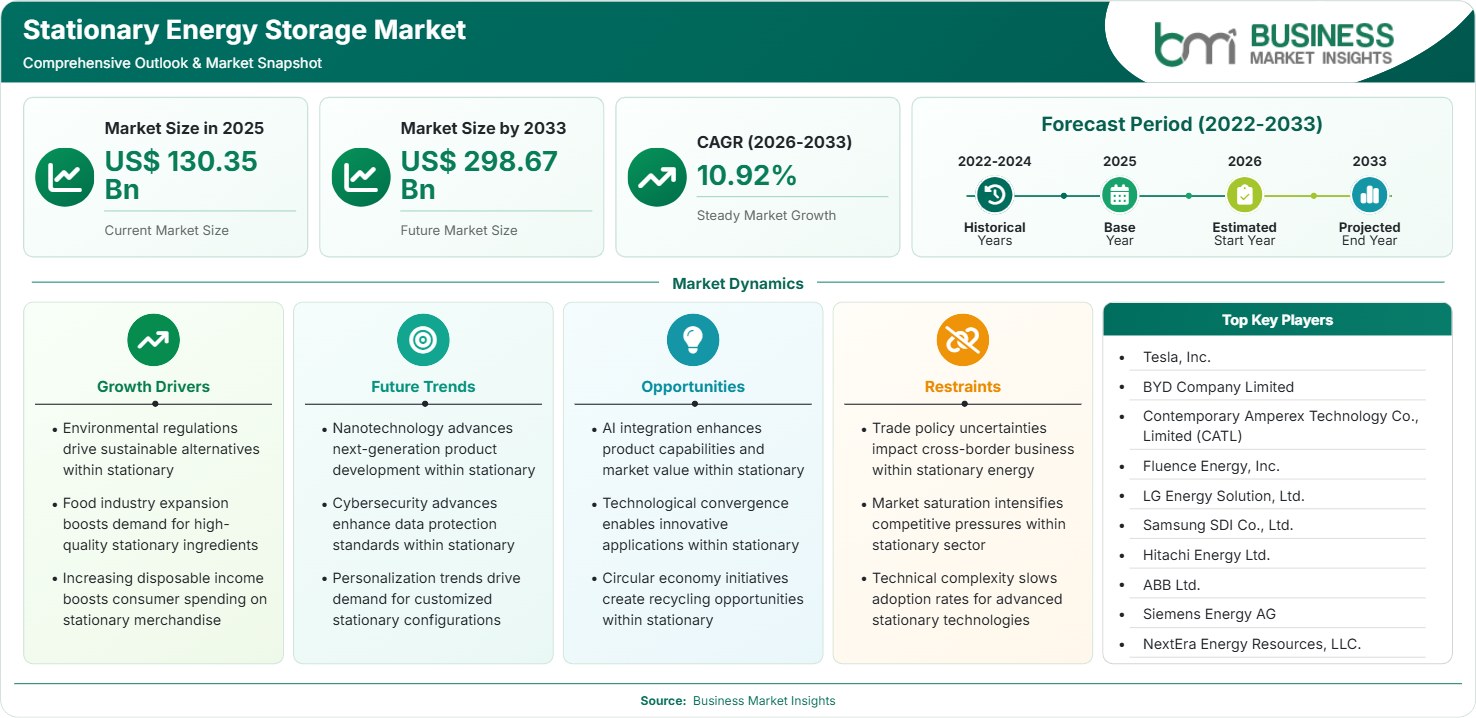
The Stationary Energy Storage Market size was valued at US$ 130.35 Billion in 2025 and is projected to reach US$ 298.67 Billion by 2033, growing at a CAGR of 10.92% during 2026–2033. Key drivers include renewable energy integration, grid modernization, declining battery costs, and energy security initiatives, while opportunities arise from AI-driven energy management, long-duration storage deployment, and distributed energy systems.

Report Coverage
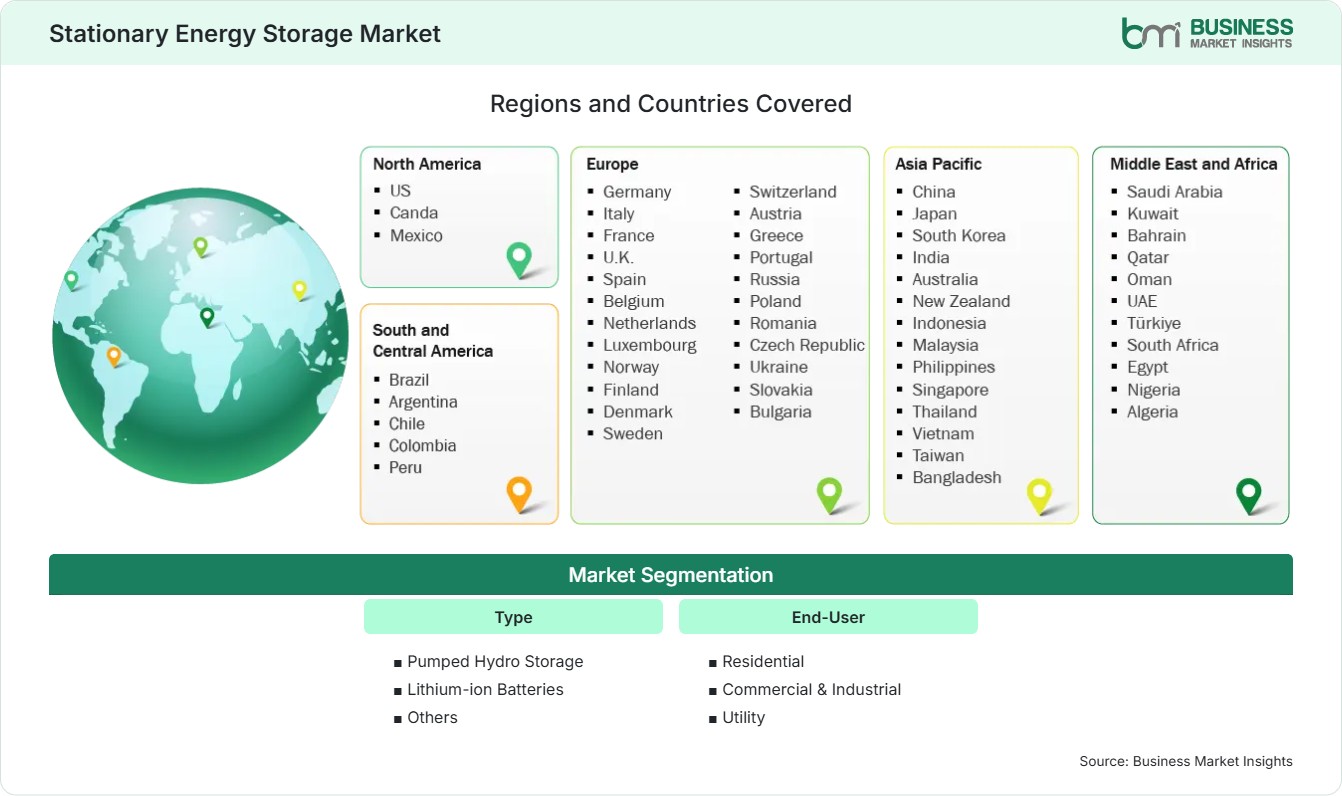
  • Type: Pumped Hydro Storage, Lithium-ion Batteries, Others
  • End-User: Residential, Commercial & Industrial, Utility
US$ 130.35 Bn Market size in 2025
US$ 298.67 Bn Market Size by 2033
10.92% CAGR, 2026 - 2033
2026-2033 Forecast Period

AI Overview

Stationary Energy Storage Market Summary

  • North America Region: North America holds a market share range of 34%–37% in 2025, growing with a CAGR of 10.1%–11.0% influenced by utility-scale battery deployment, grid resilience programs, renewable integration mandates, transmission constraints, electrification demand, energy security initiatives, capacity market participation, and digital grid investments. US market benefits from large-scale battery installations and renewable integration projects, advancing at a CAGR of 10.3%–11.2%.
  • Fastest Growing Region: Asia Pacific holds a market share range of 27%–30% in 2025, growing with a CAGR of 12.4%–13.4% driven by solar expansion, manufacturing scale advantages, grid flexibility requirements, policy incentives, industrial electrification, rural energy access, rising power demand, and storage localization investments.
  • Leading Segment: Lithium-ion Batteries hold a market share range of 58%–62% in 2025, growing with a CAGR of 11.3%–12.2% supported by declining cell costs, high efficiency, scalable deployment, utility procurement programs, renewable energy pairing, improved safety systems, manufacturing expansion, and technology standardization.
  • High Growth Segment: Utility holds a market share range of 46%–50% in 2025, growing with a CAGR of 11.8%–12.8% driven by renewable balancing, frequency regulation demand, transmission deferral opportunities, ancillary services revenue, decarbonization targets, power reliability requirements, and large-scale procurement initiatives.
  • Key Market Opportunity: Expanding long-duration storage projects create opportunities for renewable integration, peak shifting, capacity adequacy, transmission optimization, microgrid development, industrial resilience, energy trading, and enhanced grid stability across global electricity markets.
  • Major Market Players: Tesla, Inc.; BYD Company Limited; Contemporary Amperex Technology Co., Limited (CATL); Fluence Energy, Inc.; LG Energy Solution, Ltd.; Samsung SDI Co., Ltd.; Hitachi Energy Ltd.; ABB Ltd.; Siemens Energy AG; NextEra Energy Resources, LLC.
Strategic Insights

Stationary Energy Storage Market: Strategic Insights

Stationary Energy Storage Market Strategic Framework
FREE PDF
Request your free sample
Request free sample
Stakeholder View

Key Takeaways

  • The value chain is becoming increasingly integrated, with battery manufacturers, software providers, utilities, renewable developers, and power market operators collaborating to maximize storage asset utilization and lifecycle value.
  • Utility-scale deployments present the strongest commercial upside as grid operators seek flexibility resources capable of balancing renewables, reducing congestion, and improving capacity adequacy.
  • AI-enabled optimization software is becoming a competitive differentiator, enhancing asset performance, energy trading revenues, predictive maintenance efficiency, and dispatch accuracy.
  • China, India, Saudi Arabia, and Australia offer compelling investment environments due to large renewable capacity additions, evolving market structures, and supportive procurement policies.
  • Strategic partnerships, vertical integration initiatives, and acquisitions are increasing as participants seek supply-chain resilience, technology ownership, and expanded geographic reach.
  • Long-duration storage technologies are emerging as a strategic growth area capable of supporting deep renewable penetration beyond conventional four-hour battery applications.
Geographic Outlook

Stationary Energy Storage Market Regional Highlights

North America Stationary Energy Storage Market

North America accounted for approximately 34%–37% of global demand in 2025 and is projected to expand at a CAGR of 10.1%–11.0% through 2033. The region benefits from renewable deployment, grid modernization funding, and energy security priorities. The Stationary Energy Storage Market share remains highest here due to extensive utility procurement activity. Storage supports frequency regulation, peak shifting, and transmission optimization. Federal incentives and state-level capacity programs continue encouraging investment while large-scale battery projects increasingly replace conventional peaking generation assets.

  • Utility procurement programs across the United States and Canada continue expanding battery installations to support renewable integration while improving grid resilience against extreme weather disruptions.
  • Independent system operators increasingly compensate storage for ancillary services, improving project economics and accelerating deployment across wholesale electricity markets.
  • Data center expansion and electrification trends create additional demand for flexible capacity resources capable of supporting reliable power delivery.
  • Renewable energy curtailment concerns drive greater adoption of grid-scale storage assets to maximize utilization of solar and wind generation.

US Stationary Energy Storage Market

The United States represents 78%–82% of North American demand and advances at a CAGR of 10.3%–11.2%. Strong deployment activity across California, Texas, Arizona, and Nevada supports growth. Utilities increasingly combine solar projects with battery storage to improve dispatchability, while corporate sustainability commitments stimulate investment in distributed systems. Capacity market reforms, IRA-related incentives, and transmission congestion challenges continue enhancing the economic value proposition for investors and operators throughout the country.

  • Large battery installations increasingly participate in energy arbitrage and frequency regulation services, creating diversified revenue streams for project developers.
  • Renewable-heavy states continue accelerating storage procurement to support decarbonization objectives and maintain system reliability.
  • Corporate power purchase agreements increasingly incorporate storage components to improve energy supply consistency.
  • AI infrastructure and hyperscale data center demand enhance requirements for resilient and flexible electricity systems.

Europe Stationary Energy Storage Market

Europe holds 24%–27% share in 2025 and is forecast to grow at a CAGR of 10.8%–11.8%. Energy security concerns, renewable targets, and grid balancing requirements support expansion. Germany leads regional deployment, while Italy records some of the highest growth rates at 12%–13% CAGR. Market liberalization and ancillary service opportunities continue encouraging battery project investment. Increasing offshore wind development further strengthens demand for storage systems capable of improving flexibility and reliability throughout interconnected electricity networks.

  • Storage deployment increasingly supports balancing services in renewable-intensive power systems across Western Europe.
  • Germany remains the largest market owing to energy transition policies and expanding utility-scale battery projects.
  • Italy demonstrates rapid investment growth through auction mechanisms and grid modernization initiatives.
  • Residential battery adoption is increasing alongside rooftop solar installations across several European economies.

Asia Pacific Stationary Energy Storage Market

Asia Pacific represents 27%–30% of global demand in 2025 and is expected to register the fastest CAGR of 12.4%–13.4%. China dominates installations through manufacturing leadership and renewable integration requirements. India emerges as a high-growth market with CAGR of 13%–14%. Expanding electricity demand, solar deployment, and policy support encourage rapid capacity additions. Regional investment in supply chains and localized production strengthens competitiveness while enhancing affordability for utility, commercial, and industrial storage applications.

  • China continues leading deployment volumes due to large-scale renewable integration and manufacturing advantages.
  • India accelerates procurement programs supporting solar and hybrid renewable-energy projects.
  • Australia remains a significant market for grid support and renewable balancing applications.
  • Southeast Asian economies increasingly evaluate storage strategies to improve grid reliability and energy access.
  • Local production investments reduce supply-chain risk and support regional market expansion.

Rest of World Stationary Energy Storage Market

Rest of World accounts for 11%–13% share in 2025 and grows at a CAGR of 11.2%–12.2%. In South and Central America, Chile leads adoption through renewable integration initiatives, while Brazil demonstrates accelerating deployment momentum. The Middle East and Africa benefit from utility-scale renewable investment and energy diversification programs. Saudi Arabia records among the highest growth rates at 13%–14% CAGR. Large-scale solar projects increasingly incorporate storage components to improve grid performance and reliability.

  • Chile continues integrating storage with renewable resources to address variability and improve transmission utilization.
  • Brazil expands deployment as utilities seek enhanced reliability and flexibility solutions.
  • Saudi Arabia supports major utility-scale projects aligned with renewable energy targets.
  • UAE investments increasingly focus on smart grids and large battery systems supporting clean energy integration.
  • Mining, industrial operations, and remote power systems create additional demand across African markets.
Global Market Geography
FREE PDF
Request your free sample
Request free sample
Segment Analysis

Stationary Energy Storage Market Segmentation

Type

This segment represented approximately 60%–63% of total revenue in 2025 and is expected to advance at a CAGR of 11.0%–12.0% through 2033. Market adoption is influenced by technology maturity, lifecycle economics, efficiency, and scalability. The Stationary Energy Storage Market scope continues expanding as utilities and commercial users evaluate multiple storage technologies to address duration, reliability, and operational requirements.

  • Pumped Hydro Storage: Remains critical for bulk energy storage, delivering long discharge durations and grid balancing capabilities where suitable geography and infrastructure conditions exist.
  • Lithium-ion Batteries: Dominates new installations due to high efficiency, modular configuration, declining costs, and compatibility with renewable integration and ancillary service applications.

End-User

End-user adoption patterns vary according to energy requirements, economics, and regulatory frameworks. This segment accounted for 37%–40% share in 2025 and is projected to grow at a CAGR of 11.3%–12.3%. Stationary Energy Storage Market trends indicate increasing deployment across residential, commercial, industrial, and utility environments seeking reliability, energy optimization, and sustainability benefits.

  • Residential: Growth is supported by rooftop solar adoption, self-consumption optimization, backup power needs, and growing consumer interest in energy independence solutions.
  • Commercial & Industrial: Organizations deploy systems to reduce peak demand charges, improve resilience, manage energy costs, and support sustainability objectives.
  • Utility: Represents the largest application area, benefiting from renewable integration requirements, ancillary services participation, grid flexibility needs, and transmission infrastructure optimization.
Market Forces

Stationary Energy Storage Market Dynamics

Key Market Drivers

Accelerating Renewable Energy Integration Worldwide

Global renewable additions continue rising, creating increasing requirements for flexibility resources.According to energy organizations like the IEA, solar and wind power continue to be among the fastest-growing energy sources, underscoring the need for energy storage technologies to overcome issues of intermittency. Energy storage systems help in shifting loads, reducing curtailment, and stabilizing frequencies. Power providers are turning to battery storage as an alternative to peaking generation. Stationary Energy Storage Market growth is closely linked to renewable capacity expansion because grid operators require responsive assets capable of balancing variable generation. As renewable penetration rises globally, demand for storage solutions supporting reliability, resilience, and dispatchability continues strengthening across developed and emerging electricity markets.

Falling Lithium-Ion System Costs and Manufacturing Scale

Battery manufacturing expansion across China, North America, and Europe has significantly improved supply availability and cost competitiveness. Bulk manufacturing lowers costs per unit, and advancements in chemistry and energy density improve the technology. Lithium iron phosphate is increasingly used in stationary applications due to its safety and life-cycle benefits. Storage is now commercially feasible for utilities, businesses, and distributed energy users. Increased efficiencies in the logistics process are also making this happen. Standardization is also making it easier. These developments will continue to support large-scale utilization and investment in many energy storage applications.

Grid Modernization and Reliability Requirements

Electricity networks face growing pressure from electrification, weather events, aging infrastructure, and rising demand variability. Storage systems provide fast-response services supporting voltage control, congestion management, and resource adequacy. Batteries are becoming an integral part of utilities’ modernization programs, as they enable utilities to delay investments in transmission lines while enhancing their operational flexibility. Power markets are now allowing storage to play a role in ancillary services and capacity markets, which improves the economics of the projects. The increased demand for power from data centers, EVs, and distributed energy sources is also making storage more important.

Key Market Opportunities

Expansion of Long-Duration Energy Storage Solutions

Long-term storage is one of the most interesting investment opportunities for the future as grid operations continue to integrate more renewables. Battery technologies, as well as gravity, compressed air, and thermal storage technologies, have been developed for multi-hour and multi-day balancing needs. Such solutions may be a perfect supplement to lithium-ion battery systems and help meet seasonal flexibility requirements in certain parts of the world. Stationary Energy Storage Market Forecasts increasingly incorporate long-duration technologies because policymakers and utilities seek resources capable of supporting renewable-heavy electricity systems while reducing dependence on fossil-fuel-based balancing solutions.

Growth of Virtual Power Plants and Distributed Resources

A virtual power plant is a system that integrates the use of distributed batteries, photovoltaic cells, and demand response mechanisms on digital platforms. This process enhances collaboration and participation in the electricity market. More residential and commercial battery storage systems are becoming part of the balancing and peak-demand operations. Innovations in cloud-based energy software help improve process effectiveness. Utilities and aggregators continue to look for new business models centered on flexibility. The development of smart energy systems allows technology companies, hardware suppliers, and operators of service providers to find viable revenue streams from decentralized energy systems.

Industrial Decarbonization and Energy Resilience Investments

Industrial organizations increasingly invest in storage to improve energy resilience, manage volatile power costs, and support sustainability goals. Manufacturing plants, mines, logistics hubs, and infrastructure assets have an increased need for greater control over energy use. Energy storage, together with renewable energy production, helps reduce the carbon footprint and improve reliability. Rising concern about power outages increases the need for localized solutions to maintain continuity of operations. The emergence of new electricity pricing models is another factor driving the need to optimize peak energy demand, making energy storage more economically feasible.

Market Restraints and Challenges

Raw Material Supply Concentration and Price Volatility

Factor: Global battery manufacturing relies on critical minerals including lithium, nickel, graphite, and cobalt, many of which are concentrated within specific regions and supply chains. Impact: The impact of price variability and disruption in the supply of strategic materials may lead to an escalation of costs, schedule delays, and lack of certainty for investments. Despite progress being made through diversification efforts, the issue of dependency on strategic materials still presents difficulties for the deployment of the project on a large scale. This may be influenced by geopolitical issues, mining restrictions, and changing trade policies.

Permitting Complexity and Revenue Uncertainty

Factor: Market rules, interconnection procedures, and permitting frameworks differ substantially across jurisdictions, creating administrative complexity for developers. Impact: Lengthy approval processes and ambiguous revenue models may contribute to delayed payback and reduce investments. Storage technology is still regulated as being subject to certain classifications that restrict its involvement in money-making operations in some areas. Connection to the grid is yet another problem restricting its deployment pace. For an investor to be motivated to make large investments, there have to be clear reward models and simplified approval procedures.

Company Analysis

Competitive Landscape

Stationary Energy Storage Market analysis indicates competition is increasingly shaped by technology integration, software capabilities, manufacturing scale, and project execution expertise.

Company Name

Overview

Products and Services relevant to this market

Tesla, Inc.

Leading energy storage provider with strong utility-scale deployment footprint and integrated energy software capabilities.

Megapack systems, Powerwall solutions, grid services software, energy optimization platforms.

BYD Company Limited

Major battery and energy storage manufacturer with global project deployment capabilities.

Utility-scale storage systems, Battery-Box products, integrated energy storage platforms.

Contemporary Amperex Technology Co., Limited (CATL)

Global battery technology leader expanding rapidly in stationary storage applications.

Battery cells, energy storage containers, utility-scale storage solutions.

Fluence Energy, Inc.

Specialized storage integrator with strong software and system deployment expertise.

Grid-scale battery systems, optimization software, lifecycle services.

LG Energy Solution, Ltd.

Global battery supplier serving utility and commercial storage projects worldwide.

Lithium-ion battery solutions, storage modules, integrated battery systems.

Samsung SDI Co., Ltd.

Advanced battery manufacturer serving industrial and utility customers.

Energy storage batteries, power management solutions, system integration technologies.

Hitachi Energy Ltd.

Grid technology provider focused on transmission and storage integration.

Grid-edge solutions, energy management software, storage integration systems.

ABB Ltd.

Industrial technology company supporting electrification and energy infrastructure.

Battery integration, automation systems, microgrid and power management technologies.

Siemens Energy AG

Major energy infrastructure provider supporting grid modernization initiatives.

Storage integration services, digital grid solutions, power conversion technologies.

NextEra Energy Resources, LLC

Large renewable and storage project developer with extensive North American portfolio.

Utility-scale battery storage projects, renewable integration, energy infrastructure services.

Trust & Transparency

Research Methodology

The market analysis combines proprietary research with secondary data from government agencies, company disclosures, regulatory filings, industry databases and expert interviews. Market estimates are validated through data triangulation, cross-market benchmarking and analyst review.

View Full Research Methodology

Questions Answered

Frequently Asked Questions

Why is this Stationary Energy Storage Market Report useful for investors?

The Stationary Energy Storage Market Report provides insights into regional demand patterns, technology adoption, competitive positioning, investment opportunities, and long-term industry developments that influence strategic decision-making.

What makes Asia Pacific the fastest-growing region?

Strong manufacturing ecosystems, large renewable investments, supportive policies, and rapid electricity demand growth contribute to accelerated deployment across the region.

Which end-user category creates the largest revenue opportunity?

Utility-scale applications generate the largest opportunity because grid operators require storage for renewable integration, peak management, and ancillary services.

How does pumped hydro compare with battery storage?

Pumped hydro offers very large capacity and long-duration storage, while batteries provide faster response times, modular deployment, and flexibility for distributed applications.

What factors are accelerating adoption of stationary energy storage systems?

Renewable energy integration, grid modernization, declining battery costs, electrification, and the need for reliability are driving broader deployment across utility, commercial, and residential sectors.

Access the Full Stationary Energy Storage Market Report

Get segment-level forecasts, regional estimates, competitive benchmarking, company profiles and downloadable Excel datasets.

Access the full Stationary Energy Storage Market Report
350 pages PDF & Excel | 2026-08-31