Market Summary
Executive Summary and Global Market Analysis
Compressed air energy storage systems turn surplus electrical energy into pressurized air, which is stored in designed formations for later electricity generation. These systems help balance energy demands over long durations by holding compressed air in underground caverns, tanks, or lined reservoirs. They release this air during times of high grid demand. The technology has become important as utilities seek operational flexibility while expanding renewable energy sources. Grid modernization and the integration of renewable electricity are changing the storage needs for utilities in both developed and emerging economies. The intermittent generation from solar and wind sources has increased the need for storage technologies that can support long discharge cycles. Compressed air energy storage systems are being considered more for their ability to enhance grid resilience, balance loads, and manage reserves due to their scalability and long lifespan. Different technologies show various thermal management methods and efficiency strategies within the industry. Adiabatic systems are gaining attention because they rely less on fuel. Meanwhile, hybrid and advanced configurations offer better flexibility for changing grid conditions. The choice of storage form depends on the regional geology, the availability of infrastructure, and the project's economics, especially in projects involving salt caverns and underground reservoirs.
Engineering advancements are making thermal recovery more efficient, improving compressor design, and enhancing integration with renewable energy sources. Isothermal and advanced CAES designs are evolving to achieve better cycle efficiency and reduce operational losses. The addition of digital monitoring systems and predictive grid management tools has also improved operational reliability. This allows utilities to manage discharge scheduling and maintenance cycles more effectively. The competitive landscape shows more participation from energy infrastructure developers, storage technology experts, and utility operators. Project pipelines continue to grow in regions focusing on long-duration storage and energy transition efforts. Strategic partnerships, demonstration projects, and financing programs are speeding up commercialization while helping move from pilot systems to utility-scale installations.
Segment Analysis
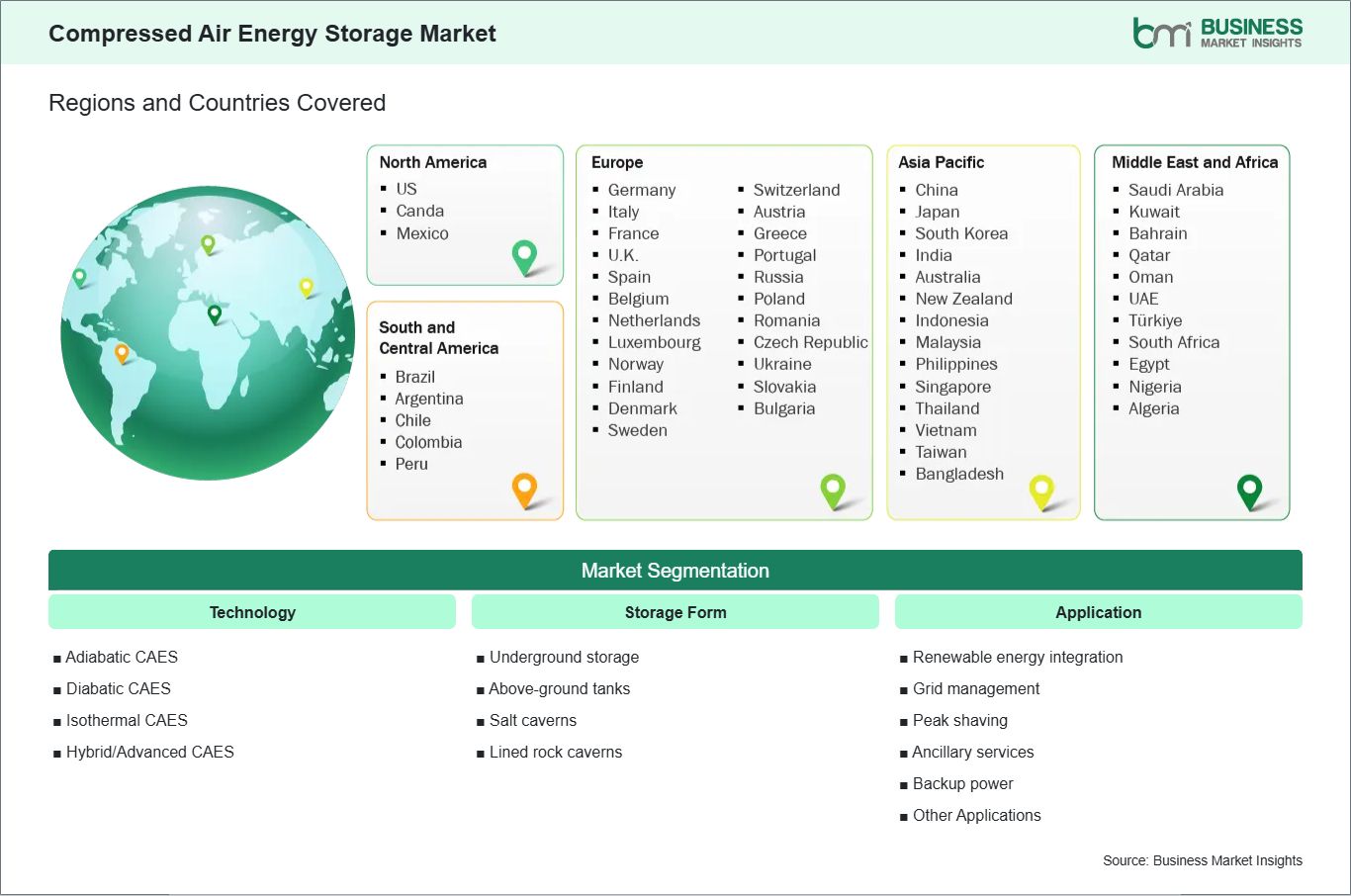
Compressed Air Energy Storage Market Segmentation
The compressed air energy storage market demonstrates diversified deployment patterns across storage technologies, containment structures, and utility-scale operational requirements.
By Technology
- Adiabatic CAES: Improves thermal recovery efficiency and cuts down on external fuel reliance
- Diabatic CAES: Supports large-scale storage operations that use combustion-assisted reheating
- Isothermal CAES: Reduces compression heat losses by using controlled temperature stabilization techniques
- Hybrid/Advanced CAES: Combines flexible thermal management with better operational responsiveness
By Storage Form
- Underground storage: Uses geological formations for large-capacity energy retention
- Above-ground tanks: Allow modular deployment in areas with limited infrastructure
- Salt Caverns: Offer stable pressure containment and good long-duration storage conditions
- Lined Rock Caverns: Expands deployment options in areas without natural cavern formations.
By Application
- Renewable Energy Integration: Stabilizes inconsistent renewable generation during varying supply periods
- Grid management: Helps with frequency regulation and operational balancing across transmission networks. Peak shaving: Eases stress on power infrastructure during high consumption times.
- Ancillary services: Supports utilities in keeping the grid reliable and maintaining reserve capacity.
- Backup power: Provides emergency electricity during outages and disruptions.
- Other Applications: Meets specific industrial and remote energy storage needs.
Market Forces
Compressed Air Energy Storage Market Drivers and Opportunities
Expansion of Long-Duration Energy Storage Requirements
Power systems that include more renewable electricity need storage technologies that can provide extended discharge performance. Traditional short-duration storage solutions often struggle during long grid fluctuations and seasonal changes in demand. Compressed air energy storage systems tackle this issue with infrastructure that can support long-duration discharge cycles for utilities and transmission operators.
The importance of these systems has increased as grid operators focus on resilience and flexible reserve management. Utilities are looking at technologies that can stabilize variable renewable generation without depending entirely on fossil-based peaking resources. This shift has led to more investment in storage systems that improve energy balancing and decrease curtailment in electricity networks with high renewable integration.
Integration of Thermal Management Technologies
New improvements in thermal energy recovery systems are changing how compressed air energy storage facilities perform. Emerging adiabatic and hybrid setups capture heat generated from compression more effectively. This reduces operational losses and boosts discharge effectiveness. These changes open up more opportunities for renewable integration projects and large-scale storage facilities.
Future development paths include connecting with digital monitoring platforms, modular compressor systems, and improved geological storage engineering. Expanding use across industrial clusters and renewable generation areas may enhance commercial viability and operational scalability. As infrastructure modernization programs grow, improved compressed air storage systems could attract more participation in long-duration energy storage portfolios.
Size and Share Analysis
Compressed Air Energy Storage Market Size and Share Analysis
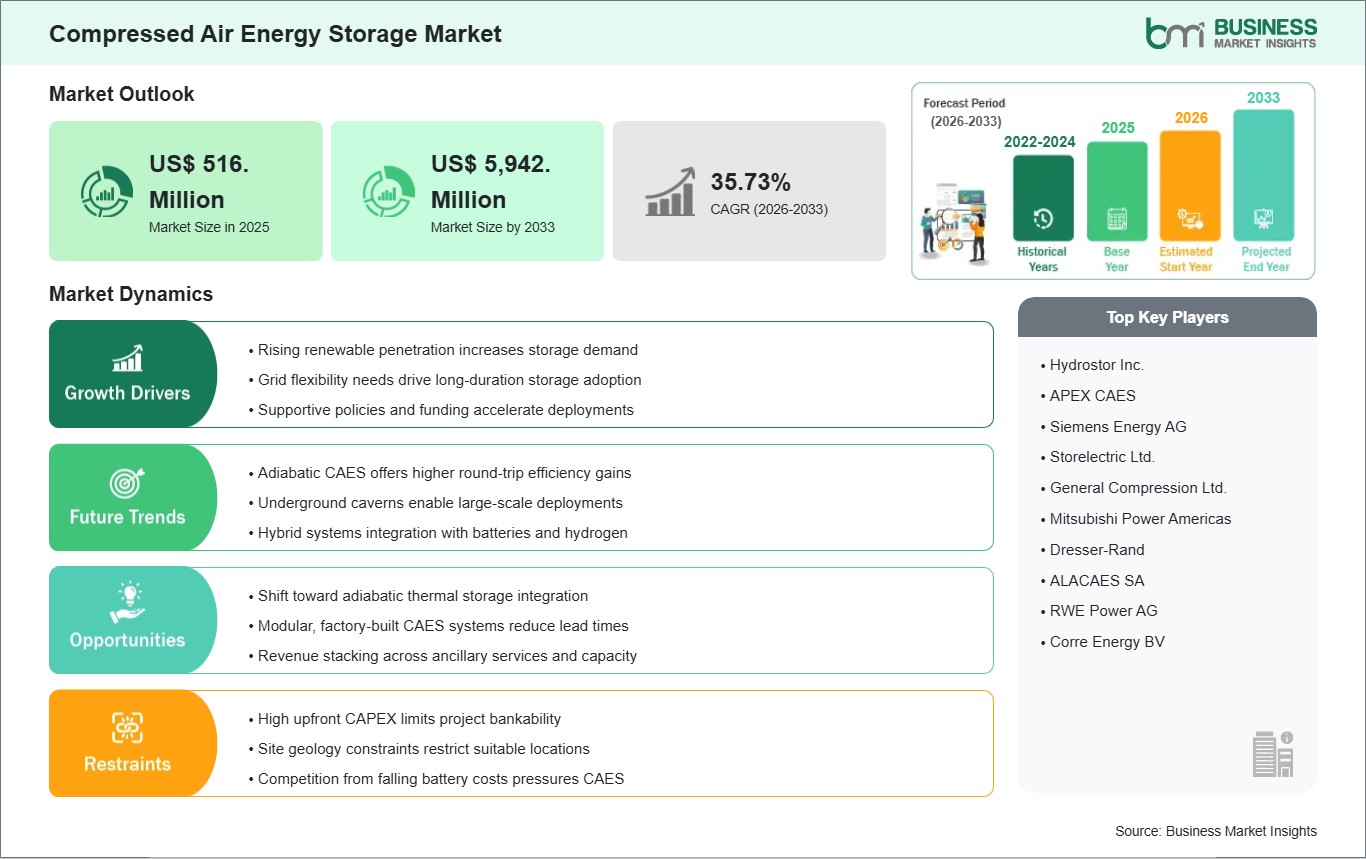
The Compressed Air Energy Storage Market is projected to grow from US$ 516.0 Million in 2025 to US$ 5,942.0 Million by 2033 , registering a CAGR of 35.73% from 2026 to 2033.
Industry growth shows that utilities are increasingly interested in long-duration storage systems. These systems can support renewable energy integration and improve grid flexibility. Ongoing infrastructure modernization programs and electricity transition initiatives encourage deployment in large-scale power networks and industrial energy applications. Hybrid and advanced CAES technologies have significant visibility in the market because of their improved thermal efficiency and operational flexibility. Underground storage and salt cavern setups are still preferred for deployment due to their large capacity and long operational life. The choice of technology is heavily influenced by regional geological conditions and grid infrastructure needs. Integrating renewable energy is a key application area. Utilities are looking for reliable balancing mechanisms for intermittent generation assets. Grid management and supplementary services remain important, especially in areas with increased renewable electricity use and changing transmission reliability standards.
Report Coverage
Compressed Air Energy Storage Market Report Coverage and Deliverables
The "Compressed Air Energy Storage Market Size and Forecast (2022-2033)" report provides a detailed analysis of the market covering below areas:
- Market size and forecast at global, regional, and country levels for all market segments covered under the scope
- Market trends, as well as drivers, restraints, and opportunities
- Market analysis covering key trends, global and regional framework, major players, regulations, and recent developments
- Industry landscape and competition analysis covering market concentration, heat map analysis, prominent players, and recent developments for the compressed air energy storage market
- Detailed company profiles, including SWOT analysis
Geographic Insights
Compressed Air Energy Storage Market Geographic Insights
The compressed air energy storage market shows different patterns of regional adoption influenced by priorities for renewable integration, grid modernization efforts, geological fit, and plans for long-duration storage infrastructure. Utility operators in various regions are looking into compressed air storage technologies as part of wider energy transition frameworks focused on stability in transmission and operational strength. North America has significant activity in the industry due to investments in utility-scale storage and support for clean energy initiatives. Project development in the US and Canada continues to focus on improved compressed air storage systems linked with renewable generation infrastructure.
Favorable geological conditions, especially for underground and salt cavern storage, have made deployment more feasible in certain areas. Asia Pacific is seeing growing interest in deployment, driven by rapid renewable capacity additions and large-scale electricity infrastructure development. China is active in utility-scale storage projects, while Australia is assessing compressed air systems for long-duration balancing needs.
Regional governments are increasingly focusing on diversifying storage to improve grid reliability as electricity consumption and renewable integration targets rise. Europe is making progress in long-duration storage planning through decarbonization initiatives and requirements for balancing electricity across borders. Programs aimed at industrial decarbonization and expanding renewable energy are promoting the evaluation of flexible storage technologies in several European countries. Emerging markets in the Middle East, Africa, and South and Central America are also looking into opportunities for deploying compressed air energy storage linked to renewable integration and modernizing transmission infrastructure.
Industry Activity
Recent Developments
The compressed air energy storage market is evaluated by gathering qualitative and quantitative data post primary and secondary research, which includes important corporate publications, association data, and databases. A few of the key developments in the compressed air energy storage market are:
- In May 2026, Hydrostor announced plans to develop the Quinte Energy Storage Center in Ontario. This project will include a 4 GWh compressed air energy storage system. This will enable the company to establish a strong position in the global market.
- In February 2025, Hydrostor secured US$ 200 million in funding to speed up the deployment of compressed air energy storage projects in several regions, supporting infrastructure expansion, grid modernization initiatives, and long-duration renewable energy integration capabilities.
Trust & Transparency
Research Methodology
The market analysis combines proprietary research with secondary data from government agencies, company disclosures, regulatory filings, industry databases and expert interviews. Market estimates are validated through data triangulation, cross-market benchmarking and analyst
review.
View Full Research Methodology
Key Sources Referred:
Long Duration Energy Storage Council Compressed Air and Gas Institute Energy Storage Association International Energy Agency Company Websites Company Annual Reports Company Investor Presentations