
Flywheel Energy Storage Market Outlook: Size, Share, Trends, Growth Analysis, Competitive Landscape & Forecast, 2022-2033

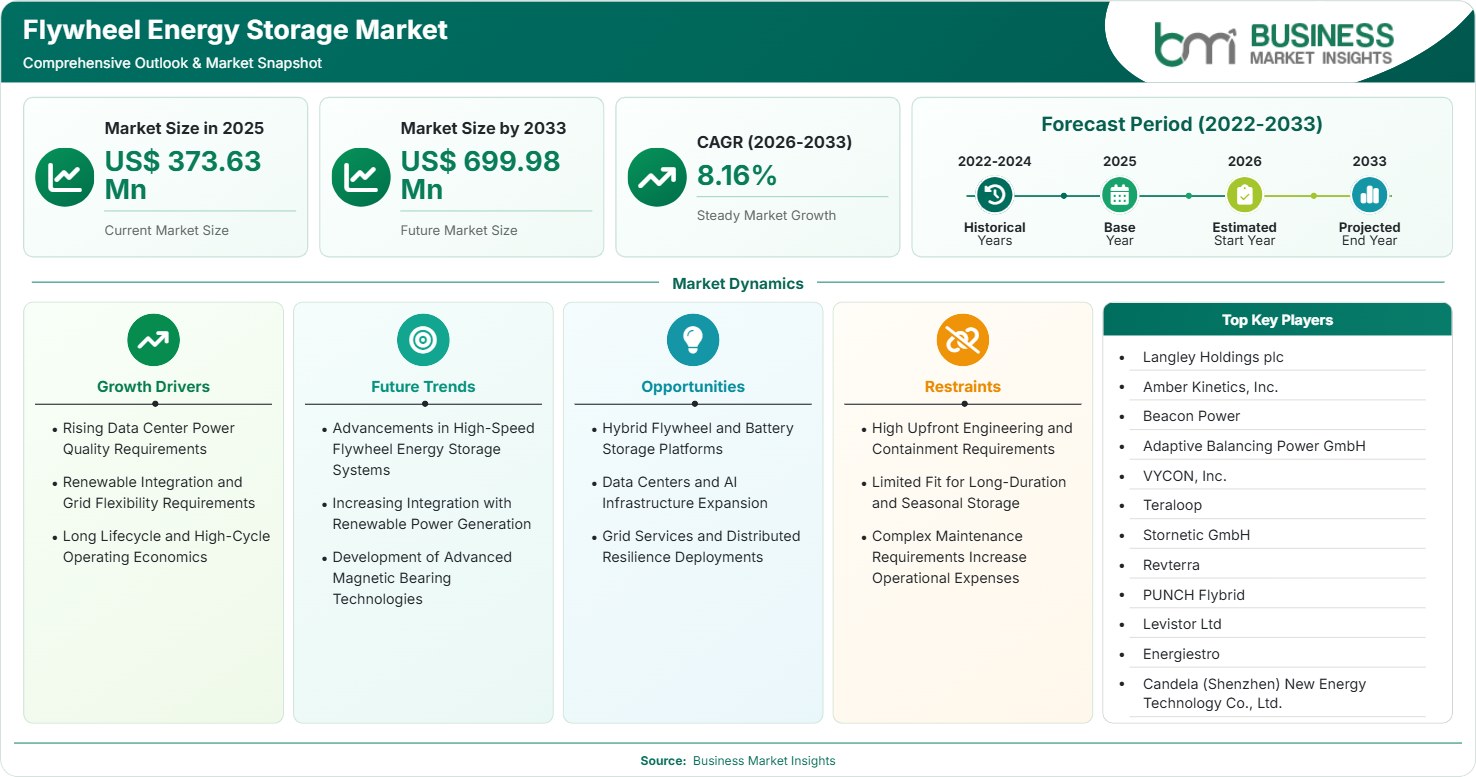
The Flywheel Energy Storage Market size was valued at US$ 373.63 Million in 2025 and is projected to reach US$ 699.98 Million by 2033, growing at a CAGR of 8.16% during 2026–2033, driven by grid stability, UPS demand, renewable integration, data centers, transport electrification, and high-cycle storage needs.

Report Coverage
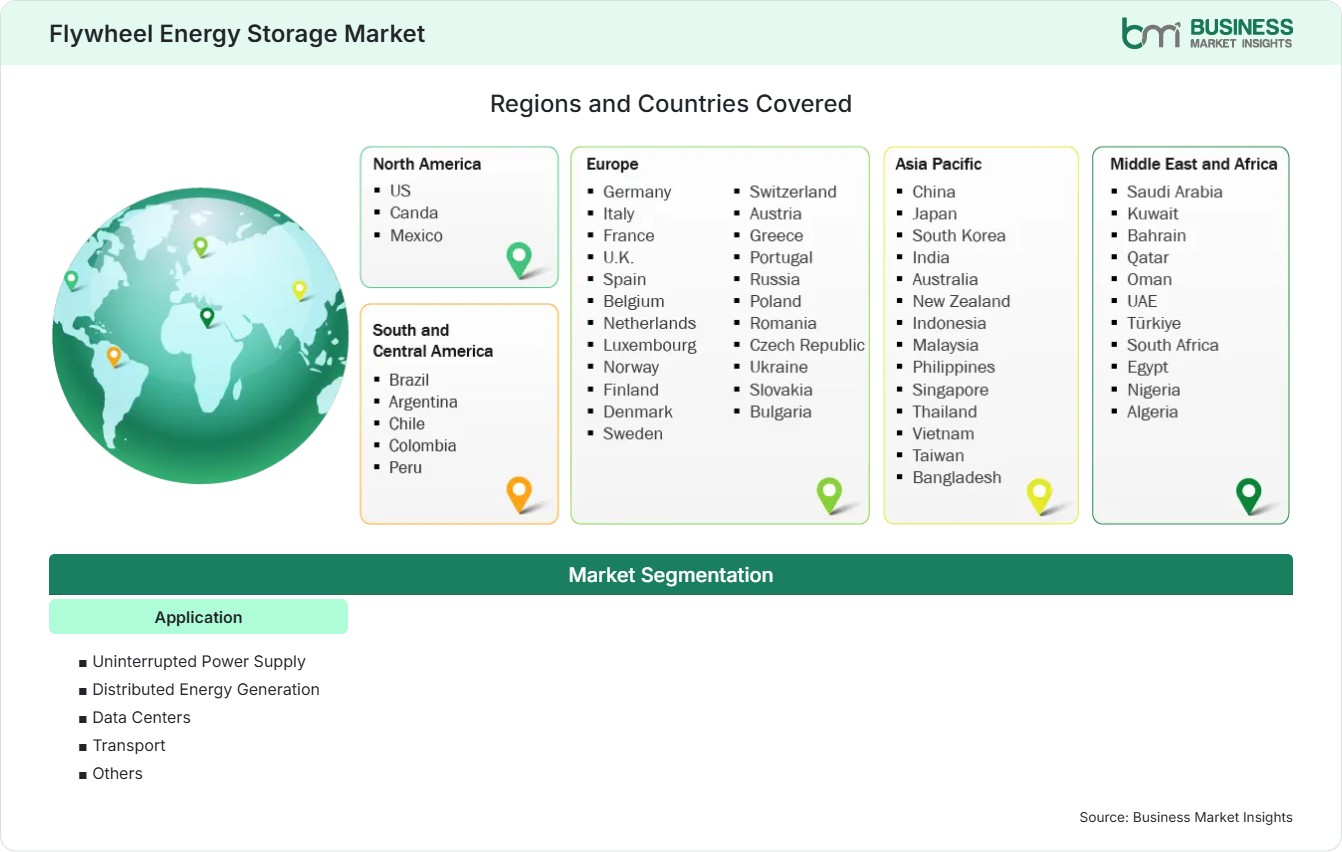
  • Application: Uninterrupted Power Supply, Distributed Energy Generation, Data Centers, Transport, Others
US$ 373.63 Mn Market size in 2025
US$ 699.98 Mn Market Size by 2033
8.16% CAGR, 2026 - 2033
2026-2033 Forecast Period

01 AI Overview

Flywheel Energy Storage Market Summary

  • North America Region: North America holds a 35%–39% share in 2025, growing at a CAGR of 8.0%–8.6%, driven by data centers, grid balancing, UPS modernization, renewable integration, and resilient distributed power infrastructure. The U.S. market is expanding at a 8.1%–8.7% CAGR during 2026–2033, supported by hyperscale data centers, utility frequency regulation, microgrids, and critical infrastructure resilience.
  • Fastest Growing Region: Asia Pacific holds a 29%–33% share in 2025, advancing at a CAGR of 9.0%–10.0%, supported by rapid industrial electrification, renewable integration, data-center construction, rail modernization, microgrid deployment, and increasing demand for high-cycle power-quality solutions.
  • Leading Segment: Uninterrupted Power Supply holds a 45%–50% share in 2025, expanding at a CAGR of 7.8%–8.5%, supported by critical loads, data centers, semiconductor facilities, healthcare infrastructure, telecom networks, and demand for immediate ride-through during grid disturbances.
  • High Growth Segment: Distributed Energy Generation holds a 16%–20% share in 2025, expanding at a CAGR of 9.0%–10.0%, driven by renewable intermittency, microgrid resilience, remote infrastructure, disaster preparedness, distributed generation, and fast-response balancing requirements.
  • Key Market Opportunity: Hybrid flywheel-battery systems can combine millisecond response with longer-duration storage, reducing battery cycling, improving asset life, strengthening microgrid resilience, and creating differentiated revenue streams across grid services and critical infrastructure.
  • Major Market Players: Langley Holdings plc, Amber Kinetics, Inc., Beacon Power, Adaptive Balancing Power GmbH, VYCON, Inc., Teraloop, Stornetic GmbH, Revterra, PUNCH Flybrid, Levistor Ltd, Energiestro, and Candela (Shenzhen) New Energy Technology Co., Ltd.
02 Strategic Insights

Flywheel Energy Storage Market: Strategic Insights

Flywheel Energy Storage Market Strategic Framework
FREE PDF
Request your free sample
Request free sample
03 Stakeholder View

Key Takeaways

  • The supply chain is becoming more specialized, with value concentrated across rotor materials, containment systems, bearings, motor-generators, converters, controls, integration, and long-term service.
  • The strongest upside lies in applications demanding frequent cycling and instantaneous response. UPS systems, data centers, distributed generation, microgrids, transport infrastructure, and grid ancillary services offer better technology fit than applications requiring inexpensive multi-day energy storage.
  • Innovation is moving toward higher energy density, improved containment, friction reduction, advanced bearing systems, and lower-cost structural materials. Prestressed concrete concepts and hubless rotor architectures demonstrate how developers are attempting to reduce capital intensity without sacrificing cycle durability.
  • Asia Pacific presents an attractive investment case because industrial expansion and renewable integration are occurring alongside infrastructure modernization.
  • Investment is increasingly oriented toward technology validation, commercialization partnerships, and deployment-specific collaborations rather than broad capacity expansion.
  • Buyers are likely to evaluate total lifecycle economics more closely, including cycle frequency, maintenance, replacement intervals, response time, and operational availability.
04 Geographic Outlook

Flywheel Energy Storage Market Regional Highlights

North America Flywheel Energy Storage Market

North America accounts for a 35%–39% share in 2025 and is projected to expand at a CAGR of 8.0%–8.6% during 2026–2033. The United States remains the principal contributor, while Canada and Mexico offer smaller opportunities through industrial facilities, renewable integration, and distributed power. The regional Flywheel Energy Storage Market share reflects strong technology adoption in high-value applications where rapid response, repeat cycling, and power-quality management justify specialized equipment.

  • Data-center expansion is increasing demand for high-power ride-through systems that protect computing loads against voltage disturbances and short-duration outages.
  • Utility-scale frequency regulation remains a specialized application where rapid response and repeated cycling can provide differentiated operational value compared with slower storage technologies.
  • Industrial users are increasingly evaluating flywheels for power-quality protection, especially where voltage sags, frequency deviations, and equipment interruptions create disproportionate economic losses.
  • Hybrid configurations pairing flywheels with batteries are gaining strategic relevance because fast-response systems can reduce high-frequency cycling imposed on longer-duration storage assets.
  • Grid modernization programs create opportunities for distributed installations near constrained nodes, renewable assets, and critical facilities requiring rapid stabilization.

US Flywheel Energy Storage Market

The U.S. represents 86%–90% of North America's 2025 demand and is projected to grow at a CAGR of 8.1%–8.7% through 2033. Its position is supported by established flywheel deployments, data-center electricity demand, grid balancing requirements, defense infrastructure, and microgrid resilience initiatives.

  • Data-center investment is creating a premium application environment because high-density computing requires uninterrupted power and rapid transition capabilities.
  • Tribal, defense, and remote-community microgrids represent emerging opportunities for containerized systems designed to improve energy independence and resilience.
  • Grid operators can provide an addressable opportunity where ancillary-service structures compensate resources for rapid frequency response and flexibility.
  • U.S. developers increasingly emphasize certification, above-ground installation, and modular deployment to broaden adoption beyond traditional utility-scale projects.

Europe Flywheel Energy Storage Market

Europe holds a 19%–23% share in 2025 and is expected to advance at a CAGR of 7.8%–8.6% during 2026–2033. Germany leads regional adoption, while the U.K., France, Italy, and Nordic countries provide specialized opportunities. The U.K. and Nordic markets benefit from renewable integration and balancing requirements. Europe’s Flywheel Energy Storage Market growth increasingly reflects resilience, electrification, and high-cycle flexibility needs.

  • Germany combines industrial electricity demand with advanced engineering capabilities, creating opportunities for grid stabilization, manufacturing facilities, and high-power applications.
  • The U.K. offers opportunities in flexible power systems where fast-response resources can complement renewable generation and support balancing requirements.
  • Nordic countries provide attractive demonstration environments because renewable penetration, grid flexibility, and advanced electricity systems support specialized storage applications.
  • France and Italy offer potential in distributed generation, transportation, industrial power quality, and renewable integration projects requiring rapid response.
  • European developers increasingly position flywheels as complementary assets within multi-technology storage portfolios rather than standalone replacements for batteries.

Asia Pacific Flywheel Energy Storage Market

Asia Pacific represents a 29%–33% share in 2025 and is forecast to register the fastest regional CAGR of 9.0%–10.0% through 2033. China remains the largest contributor, while Japan and South Korea provide technologically advanced applications. The region's Flywheel Energy Storage Market share is strengthened by industrial expansion and renewable integration.

  • China offers opportunities across industrial facilities, grid flexibility, renewable integration, and transportation infrastructure as electricity demand and power-quality requirements increase.
  • Japan's mature energy infrastructure supports specialized applications where resilience, compact installations, and high cycling are valued.
  • India presents a high-growth opportunity through distributed generation, microgrids, industrial electrification, and data-center expansion across rapidly developing urban centers.
  • South Korea provides opportunities connected with advanced manufacturing, semiconductor facilities, and high-reliability power systems requiring precise voltage and frequency control.
  • Regional manufacturers and technology partners can benefit from localization strategies that reduce installation complexity and improve service responsiveness.

Rest of World Flywheel Energy Storage Market

South and Central America account for approximately 7%–10% of 2025 demand, with growth estimated at a CAGR of 8.5%–9.5%. Brazil leads regional opportunity, while Chile and Mexico offer renewable and distributed-generation applications. Renewable resources, grid constraints, and remote power requirements create demand for fast-response storage.

The Middle East and Africa represent approximately 10%–13% of 2025 demand and are projected to grow at a CAGR of 9.0%–10.0%. The UAE, Saudi Arabia, and South Africa provide leading opportunities, while renewable projects and microgrids support expansion. The regional Flywheel Energy Storage Market share is supported by resilience and power-quality needs.

  • Brazil can benefit from distributed generation and industrial applications where rapid balancing complements variable renewable resources.
  • Chile offers opportunities around renewable-heavy electricity systems, mining operations, and remote industrial loads requiring dependable power quality.
  • Gulf countries provide potential in data centers, smart infrastructure, and renewable projects where resilience and high-power response are strategically important.
  • South Africa presents opportunities for microgrids and critical infrastructure because grid reliability requirements increase demand for dependable backup and power-quality solutions.
  • Remote and islanded systems across emerging economies can use flywheels as fast-response components within hybrid renewable-storage architectures.
Global Market Geography
FREE PDF
Request your free sample
Request free sample
05 Segment Analysis

Flywheel Energy Storage Market Segmentation

Application

Application demand is led by uninterrupted power supply, representing a 45%–50% share in 2025 and growing at a CAGR of 7.8%–8.5% during 2026–2034. Adoption benefits from data centers, healthcare, telecom, industrial automation, and critical infrastructure requiring immediate ride-through, high cycling capability, and reduced battery replacement exposure.

  • Uninterrupted Power Supply: Critical facilities use flywheels for immediate backup during short outages, reducing reliance on battery cycling and supporting seamless generator transition.
  • Distributed Energy Generation: Distributed systems use fast-response storage to stabilize renewable output, support microgrids, and improve resilience during grid disruptions and localized supply constraints.
  • Data Centers: High-density computing facilities require reliable power-quality management, rapid ride-through, and frequent cycling, creating strong demand for compact, high-availability storage architectures.
  • Transport: Rail, electric mobility, and transportation infrastructure can recover braking energy and manage high-power bursts, improving energy efficiency while reducing peak electrical demand.
  • Others: Specialized industrial, defense, marine, and remote applications use flywheels where rapid response, repeat cycling, and operational reliability outweigh conventional storage economics.
06 Market Forces

Flywheel Energy Storage Market Dynamics

Key Market Drivers

Rising Data Center Power Quality Requirements

The need for electricity in data centers provides a solid reason for implementing fast-acting storage technologies since digital applications cannot handle any voltage fluctuations or brief outages. The Flywheel Energy Storage Market growth is due to technologies that can provide instant power in times when auxiliary power sources have to be engaged or while waiting for stabilization of the grid. In contrast to regular batteries, flywheels can withstand many charge-discharge cycles without chemical damage and are thus useful for facilities that encounter many power events.

Renewable Integration and Grid Flexibility Requirements

Greater use of renewables means that there are demands on the systems to balance, provide voltage regulation, and maintain frequency. The Flywheel Energy Storage Market trends align more closely with the need for solutions that can react within milliseconds and cycle over and over again without degradation in performance. The wind and solar systems may provide fluctuations in short bursts that require flexible technologies that can react more quickly than traditional generation assets. Flywheels play an important part in scenarios where storage is needed for power quality.

Long Lifecycle and High-Cycle Operating Economics

The flywheel system has the potential to deliver high cycle reliability since the storage of energy is done using a mechanical means of operation and not from electrochemical reactions taking place. Such an attribute facilitates growth in the Flywheel Energy Storage Market due to its use in applications where there are many discharges, especially frequency regulation, power quality management, transportation, and industrial load peak control. They are becoming more economical in their lifecycle through such attributes as advanced materials, bearings, vacuum systems, electronics, and modular designs.

Key Market Opportunities

Hybrid Flywheel and Battery Storage Platforms

The hybrid storage approach offers an attractive business proposition as flywheels and batteries are designed for separate operating regimes. Flywheels are capable of coping with fast changes and high-frequency activities, while the battery will be responsible for discharging energy for a longer period of time. In this way, it is possible to protect the battery from being damaged by high-frequency cycles, which may help to increase the life span of this equipment and reduce its maintenance needs. Another aspect of this approach is the optimal dispatching of these technologies.

Data Centers and AI Infrastructure Expansion

Advances in AI computing are opening up new possibilities in high-performance, highly reliable storage solutions. Big computing centers need a dependable source of electricity; they also need increasing sophistication of their power system, due to the increased likelihood of problems arising from power disturbances in a concentrated load center. The flywheels can act as an intermediate power source between the power source provided by the utilities and other forms of longer-term backup sources like generators or batteries. The solution has possibilities not only in UPS but in other power quality-related applications.

Grid Services and Distributed Resilience Deployments

The Flywheel Energy Storage Market Forecasts suggest the potential for growth in distributed grid flexibility because of the decentralization of energy production. Fast response storage could be useful in terms of providing frequency regulation, voltage control, smoothing renewables, and increased resiliency at a local level. Smaller flywheels close to industrial consumers or network bottlenecks could create value that would not be available from larger, centralized energy storage technologies. Microgrid projects can create demand for flywheel energy storage technology in defense sites, remote areas, tribal lands, port facilities, airport locations, and essential services.

Market Restraints and Challenges

High Upfront Engineering and Containment Requirements

Factor: Flywheel systems require precision manufacturing, rotor balancing, containment vessels, vacuum systems, bearings, power electronics, and sophisticated control systems, resulting in a relatively complex bill of materials from an engineering perspective. Impact: Such requirements could lead to increased costs and extended qualification periods, especially for first-time buyers who may not be aware of mechanical storage technologies. High-speed rotating systems also require robust safety engineering and certification, thus leading to higher development costs. Suppliers need to prove their systems' reliability in tough operating conditions before customers will consider large-scale implementation. This problem could delay the adoption of flywheels in cost-sensitive applications where lithium-ion batteries already have procurement precedents.

Limited Fit for Long-Duration and Seasonal Storage

Factor: While flywheels tend to perform exceptionally well in applications where high power is needed for short durations, their use becomes problematic if the clients want a relatively cheap solution for storing energy over several hours or even days. Effect: Consequently, their market potential becomes constrained in cases where long-duration energy arbitrage or balancing is key, as well as where renewable energy storage is required over several days. Other technologies, such as batteries, have a greater capacity to store energy in such instances, making flywheels more suitable in cases that require rapid cycling and high responsiveness.

07 Company Analysis

Competitive Landscape

Competitive positioning is shaped by technology differentiation, system integration expertise, application specialization, geographic reach, and the ability to validate long-term reliability. Flywheel Energy Storage Market analysis indicates that established UPS suppliers compete alongside specialized storage developers, transportation technology companies, and emerging innovators.

Company Name

Overview

Products and Services relevant to this market

Langley Holdings plc

U.K.-based industrial group with energy infrastructure capabilities and a strong presence through its Piller business in critical power.

Flywheel-based UPS systems, critical power protection, energy storage integration, power conditioning, and infrastructure support services.

Amber Kinetics, Inc.

U.S. technology company focused on long-duration flywheel energy storage and scalable systems for resilient power applications.

Long-duration flywheel systems, containerized installations, microgrid solutions, renewable integration, and distributed energy storage.

Beacon Power

U.S. specialist known for utility-scale flywheel deployments and grid frequency regulation applications.

Grid-scale flywheel plants, frequency regulation systems, grid balancing, energy storage controls, and operational services.

Adaptive Balancing Power GmbH

German technology developer focused on high-performance flywheel systems for power quality and industrial applications.

Flywheel energy storage, power-quality solutions, high-power systems, control technologies, and industrial integration.

VYCON, Inc.

U.S. flywheel specialist providing high-performance energy storage solutions for critical power and industrial applications.

UPS flywheels, regenerative energy systems, power quality equipment, and high-cycle energy storage solutions.

Teraloop

Finnish technology company developing scalable hubless flywheel systems for grid, industrial, and renewable applications.

PowerLoop flywheel systems, grid stabilization, microgrid support, renewable balancing, industrial peak management, and energy resilience.

Stornetic GmbH

German specialist associated with high-power flywheel technology designed for rapid cycling and grid-support applications.

Flywheel energy storage systems, high-power energy buffering, renewable integration, grid services, and industrial applications.

Revterra

U.S. developer focused on advanced flywheel energy storage technology and long-duration power applications.

Flywheel energy storage platforms, grid-scale systems, renewable integration, and high-performance storage solutions.

PUNCH Flybrid

U.K. technology company specializing in high-power kinetic energy recovery and storage for transportation and industrial applications.

Flywheel energy recovery, kinetic storage, hybrid power systems, transportation solutions, and high-cycle energy management.

Levistor Ltd

U.K. developer of high-cycle flywheel systems designed for rapid response and demanding power applications.

High-cycle flywheel storage, peak shaving, grid stabilization, energy recovery, and high-power industrial solutions.

Energiestro

Technology developer focused on lower-cost flywheel storage using prestressed concrete rotor technology and long-life operation.

VOSS flywheel systems, renewable energy storage, distributed storage, solar integration, and long-life kinetic energy systems.

Candela (Shenzhen) New Energy Technology Co., Ltd.

China-based new-energy technology participant associated with energy storage and power-management solutions.

Energy storage technologies, power-management systems, renewable integration solutions, and related new-energy applications.

10 Trust & Transparency

Research Methodology

The market analysis combines proprietary research with secondary data from government agencies, company disclosures, regulatory filings, industry databases and expert interviews. Market estimates are validated through data triangulation, cross-market benchmarking and analyst review.

View Full Research Methodology

11 Questions Answered

Frequently Asked Questions

What should buyers evaluate before selecting a system?

Buyers should assess response time, usable energy duration, cycling requirements, efficiency, containment, maintenance, certification, integration capability, lifecycle cost, and service support. The right technology depends on whether the project prioritizes power quality, resilience, frequency regulation, energy shifting, or transportation recovery.

How important are materials to future flywheel economics?

Materials influence rotor strength, energy density, safety, and cost. Advanced composites provide high performance but can be expensive, while innovations such as prestressed concrete seek to reduce material costs and broaden applications. Material engineering remains central to commercial scalability.

Why are hybrid storage systems gaining attention?

Hybrid systems allocate rapid fluctuations to flywheels and longer-duration requirements to batteries. This operating strategy can reduce high-frequency battery cycling, improve response performance, and potentially extend battery service life while providing a broader range of grid and customer services.

What makes flywheels different from battery storage?

According to Flywheel Energy Storage Market report, flywheels store energy mechanically through rotational motion, avoiding electrochemical degradation. Their principal advantages include rapid response and high cycle capability. Batteries generally offer greater energy capacity for longer-duration applications, making the two technologies complementary rather than universally interchangeable.

What applications are best suited to flywheel storage?

Flywheels are best suited to applications requiring rapid response and frequent cycling, including UPS, data centers, frequency regulation, power-quality management, transportation energy recovery, microgrids, and industrial peak control. They are less suited to low-cost multi-day or seasonal storage.

Access the Full Flywheel Energy Storage Market Report

Get segment-level forecasts, regional estimates, competitive benchmarking, company profiles and downloadable Excel datasets.

Access the full Flywheel Energy Storage Market Report
350 pages PDF & Excel | 2026-08-17