
Battery Energy Storage Market Outlook: Size, Share, Trends, Growth Analysis, Competitive Landscape & Forecast, 2026-2033

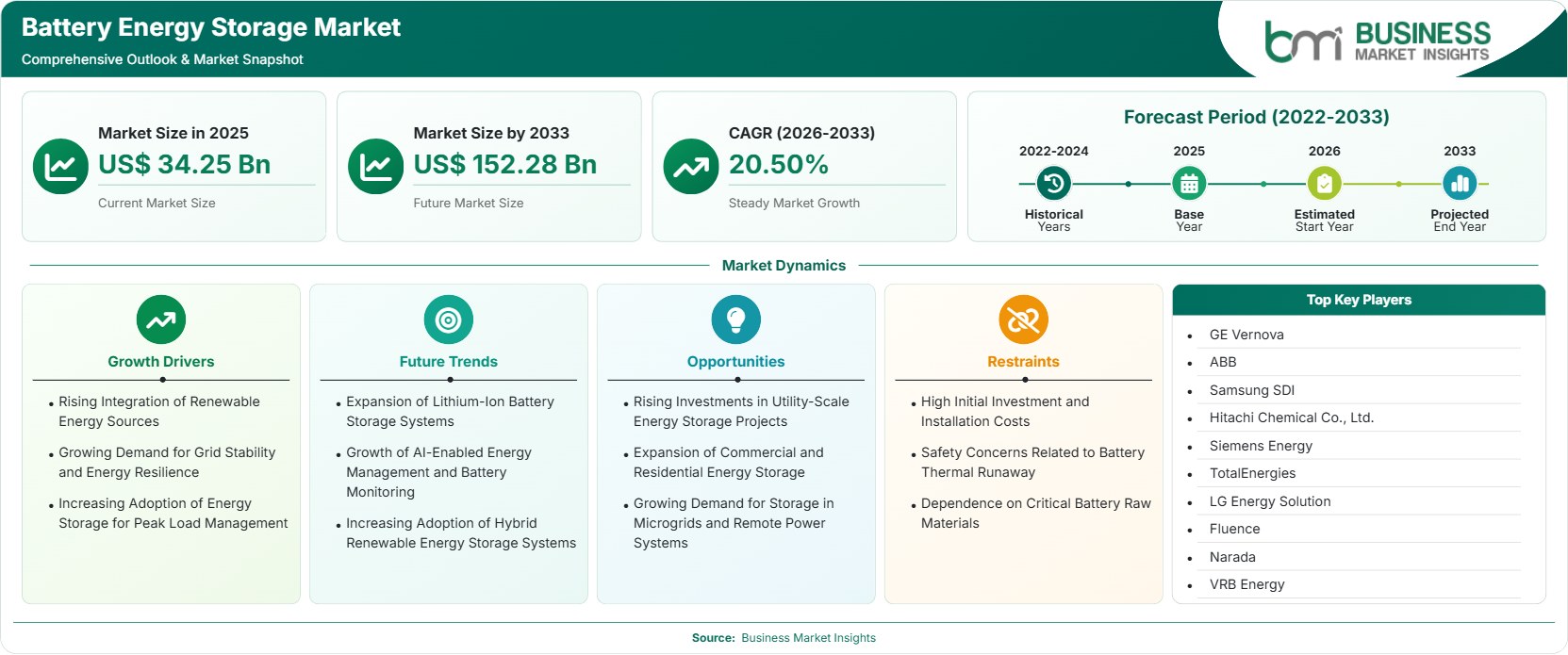
The Battery Energy Storage Market Size was valued at US$ 34.25 Billion in 2025 and is projected to reach US$ 152.28 Billion by 2033, expanding at a CAGR of 20.50% during the forecast period. Increasing renewable energy deployment, rising electricity demand, grid modernization, and the need for reliable power balancing are accelerating investments in battery-based storage systems. Utilities, commercial facilities, households, and industrial users are increasingly deploying storage solutions to manage peak demand, improve grid flexibility, integrate intermittent renewable generation, and enhance energy reliability.

Report Coverage
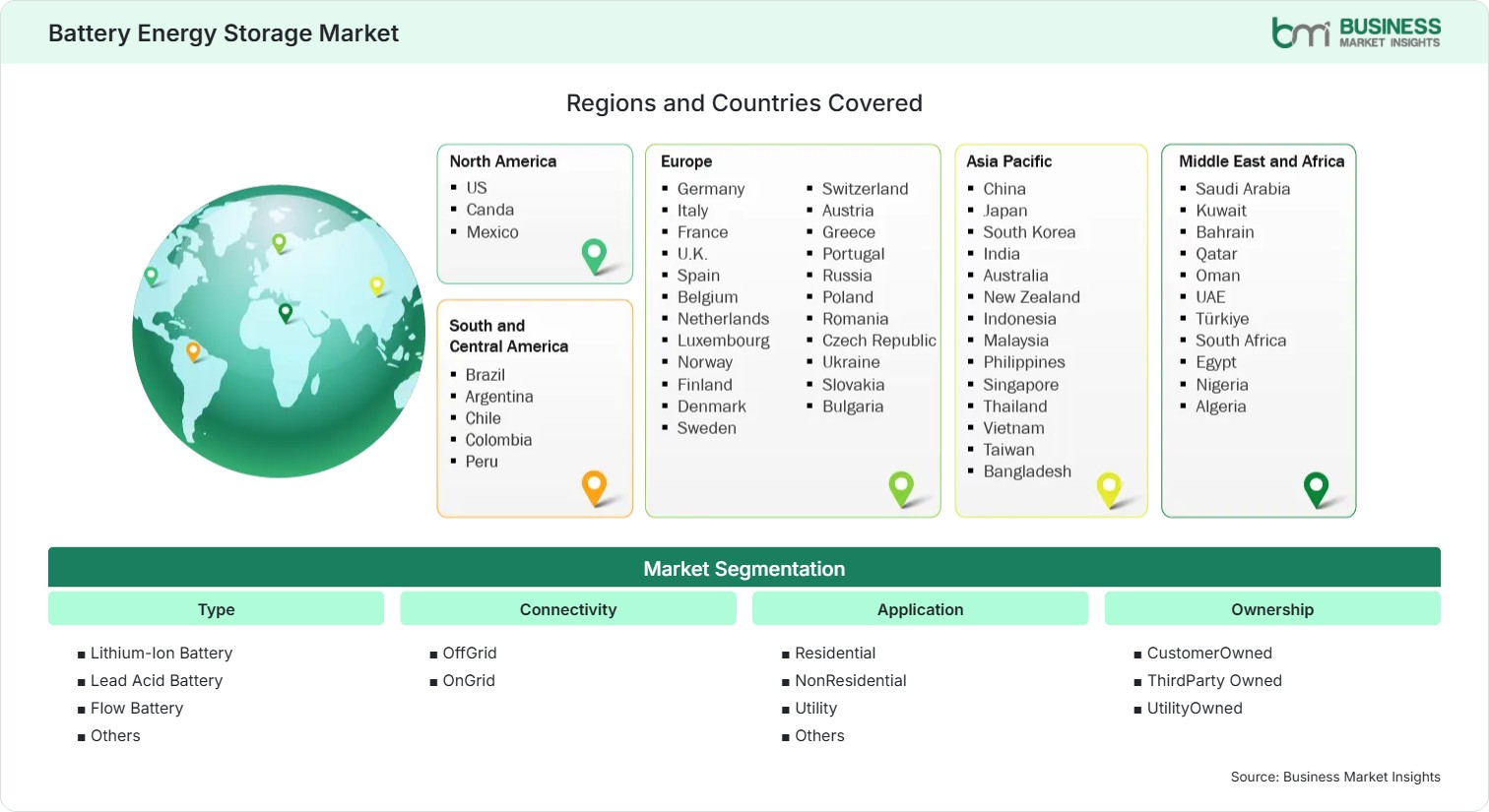
  • Type: Lithium-Ion Battery, Lead Acid Battery, Flow Battery, Others
  • Connectivity: OffGrid, OnGrid
  • Application: Residential, NonResidential, Utility, Others
  • Ownership: CustomerOwned, ThirdParty Owned, UtilityOwned
  • Capacity: Small Scale, Large Scale
US$ 34.25 Bn Market size in 2025
US$ 152.28 Bn Market Size by 2033
20.50% CAGR, 2026 - 2033
2026-2033 Forecast Period

01 AI Overview

Battery Energy Storage Market Summary

  • North America Region: North America accounted for approximately 29%–32% of global revenue in 2025 and is projected to register a CAGR of 20.0%–20.6% through 2033. Rapid renewable energy integration, grid modernization, supportive energy policies, and increasing utility-scale storage deployment continue supporting regional expansion. The Battery Energy Storage Market Share remains significant due to large-scale investments in grid-connected storage projects.
  • Fastest Growing Region: Asia Pacific represented approximately 42%–45% of global revenue in 2025 and is expected to witness a CAGR of 21.2%–21.8% during the forecast period. Expanding renewable energy capacity, battery manufacturing capabilities, electrification, and grid infrastructure investments continue driving regional growth.
  • Leading Segment: Lithium-Ion Battery accounted for approximately 78%–82% of global revenue in 2025 and is projected to expand at a CAGR of 20.5%–21.1% owing to high energy density, declining technology costs, established manufacturing capacity, and widespread deployment.
  • High Growth Segment: Large Scale storage systems are anticipated to register a CAGR of 21.5%–22.1%, supported by growing utility-scale renewable integration and increasing demand for grid balancing capacity.
  • Key Opportunity: Expansion of renewable power generation and growing deployment of utility-scale energy storage systems continue creating substantial opportunities for battery manufacturers, system integrators, utilities, and project developers.
  • Major Market Players: GE, ABB, Samsung SDI, Hitachi Chemical Co., Ltd., Siemens Energy, Total, LG Energy Solution, Fluence, Narada, and VRB Energy.
02 Strategic Insights

Battery Energy Storage Market: Strategic Insights

Battery Energy Storage Market Strategic Framework
FREE PDF
Request your free sample
Request free sample
03 Stakeholder View

Key Takeaways

  • Lithium-ion batteries continue dominating deployment because of their high energy density, established manufacturing ecosystem, and broad commercial availability.
  • Utility-scale storage represents a major growth opportunity as power producers increasingly use batteries to support renewable integration and grid flexibility.
  • On-grid systems account for substantial demand because utilities and grid operators require flexible storage resources for balancing electricity supply and demand.
  • Asia Pacific remains a major regional market because of expanding renewable generation, battery manufacturing, and electricity infrastructure investments.
  • Large-scale systems are gaining importance as renewable energy projects increasingly incorporate dedicated storage capacity.
  • The Battery Energy Storage Market Trend reflects growing adoption of grid-scale storage, renewable-plus-storage projects, distributed energy storage, and longer-duration battery technologies.
04 Geographic Outlook

Battery Energy Storage Market Regional Highlights

North America Battery Energy Storage Market

North America accounted for approximately 29%–32% of global battery energy storage market revenue in 2025 and is projected to expand at a CAGR of 20.0%–20.6% through 2033. Increasing renewable energy deployment, grid modernization, and growing demand for flexible electricity resources continue supporting regional expansion. Utilities and independent power producers are increasingly incorporating battery storage into renewable energy projects to manage intermittency and improve grid reliability. Commercial and residential users are also deploying storage systems to manage electricity costs and maintain backup power availability.

  • Utility-scale battery projects continue expanding as grid operators seek additional flexibility for renewable integration.
  • Increasing solar and wind deployment is creating demand for storage systems capable of balancing variable electricity generation.
  • Residential energy storage adoption is supported by growing rooftop solar installations and increasing interest in backup power.
  • Commercial facilities are deploying batteries for peak demand management and improved energy cost optimization.
  • Grid modernization programs continue encouraging investments in advanced storage technologies and energy management systems.

U.S. Battery Energy Storage Market

The United States represents approximately 88%–91% of North American demand and is projected to register a CAGR of 20.2%–20.8% during the forecast period. Strong renewable energy deployment, increasing utility-scale storage investments, grid reliability requirements, and supportive clean energy policies continue driving demand. Developers are increasingly combining solar and wind projects with battery storage to improve dispatchability and optimize electricity generation. The Battery Energy Storage Market Forecast remains positive as utilities, independent power producers, and commercial customers continue expanding storage capacity.

  • Large-scale battery installations are increasing alongside utility solar and wind projects.
  • Growing electricity demand is encouraging utilities to invest in flexible generation and storage resources.
  • Residential customers are increasingly pairing battery systems with rooftop solar installations.
  • Data centers and other critical facilities are adopting energy storage for backup power and power quality management.
  • Continued investment in transmission and distribution modernization supports additional deployment opportunities.

Europe Battery Energy Storage Market

Europe accounted for approximately 21%–24% of global revenue in 2025 and is projected to expand at a CAGR of 19.7%–20.3% through 2033. Increasing renewable energy generation, grid flexibility requirements, energy security priorities, and the modernization of electricity infrastructure continue supporting regional demand. Battery storage is increasingly deployed alongside solar and wind projects to manage intermittency and improve electricity system stability.

  • Germany continues leading regional demand through strong renewable energy deployment and increasing investment in grid-scale storage projects.
  • The United Kingdom supports battery energy storage market expansion through growing deployment of utility-scale batteries for grid balancing and renewable integration.
  • France continues increasing storage deployment as renewable power generation expands and electricity system flexibility becomes more important.
  • Italy records rising demand as solar generation expands and energy users seek solutions for managing variable electricity supply.
  • Nordic countries continue adopting battery storage to support renewable integration, grid stability, and distributed energy systems.

Asia Pacific Battery Energy Storage Market

Asia Pacific represented approximately 42%–45% of global revenue in 2025 and is expected to register the fastest CAGR of 21.2%–21.8% through 2033. Rapid renewable energy expansion, large-scale battery manufacturing capacity, increasing electricity demand, and grid modernization initiatives continue strengthening regional growth. China, Japan, South Korea, India, and Australia are investing heavily in energy storage systems to improve grid flexibility and integrate growing volumes of renewable electricity. The Battery Energy Storage Market Scope continues expanding as utilities, commercial facilities, and households increasingly adopt storage solutions.

  • China remains the largest regional market owing to extensive battery manufacturing capacity and large-scale renewable energy deployment.
  • India is witnessing strong growth as solar and wind capacity expands and utilities invest in grid-scale energy storage.
  • Japan continues adopting storage systems for grid resilience, renewable integration, and distributed energy applications.
  • South Korea supports regional growth through advanced battery manufacturing capabilities and increasing investments in energy storage projects.

Rest of World Battery Energy Storage Market

The Rest of World accounted for approximately 7%–9% of global revenue in 2025 and is projected to expand at a CAGR of 19.5%–20.2% through 2033. Increasing renewable energy investments, grid modernization initiatives, and growing electricity access requirements are supporting storage deployment across Latin America, the Middle East, and Africa. Energy storage is becoming increasingly important for managing intermittent renewable generation and improving electricity reliability in regions with constrained grid infrastructure.

  • Brazil continues leading Latin American demand through expanding solar and wind generation and increasing grid-scale storage interest.
  • Mexico supports battery energy storage market development through renewable energy deployment and growing demand for reliable electricity infrastructure.
  • Saudi Arabia is investing in large-scale renewable energy projects that create opportunities for integrated battery storage systems.
  • The United Arab Emirates continues strengthening storage adoption through investments in renewable energy and advanced electricity infrastructure.
  • South Africa records increasing demand for energy storage as utilities address grid reliability challenges and integrate additional renewable generation.
Global Market Geography
FREE PDF
Request your free sample
Request free sample
05 Segment Analysis

Battery Energy Storage Market Segmentation

Type

The Type segment is central to the development of battery-based energy storage systems because different technologies provide varying combinations of energy density, duration, cycle life, response time, and cost. Flow batteries are gaining attention for longer-duration applications, while lead acid batteries continue serving selected backup and off-grid applications. The Battery Energy Storage Market Analysis indicates that technology selection will increasingly depend on application-specific requirements, operating conditions, safety considerations, and desired storage duration.

  • Lithium-Ion Battery: Dominates deployment because of high energy density, rapid response, established supply chains, and broad suitability across residential, commercial, and utility applications.
  • Lead Acid Battery: Maintains demand in backup power and selected off-grid applications because of established technology, relatively simple maintenance, and availability.
  • Flow Battery: Gains adoption in long-duration storage applications where extended discharge duration and high cycle life are important requirements.
  • Others: Includes emerging battery technologies and alternative chemistries being developed to improve storage duration, safety, sustainability, and resource availability.

Connectivity

Connectivity determines how storage systems interact with electricity networks and individual energy users. On-grid systems are increasingly deployed to provide grid balancing, frequency regulation, renewable energy integration, and peak load management. Off-grid systems are particularly valuable in remote locations, islands, rural communities, and facilities where reliable grid access is limited. Advancements in energy management systems are improving the ability of storage assets to coordinate with renewable generation and electricity networks.

  • Off-Grid: Increasingly deployed in remote areas, isolated communities, telecommunications infrastructure, and locations requiring independent electricity supply.
  • On-Grid: Represents the leading connectivity segment due to increasing utility-scale deployment and growing requirements for grid flexibility and renewable integration.

Application

Battery storage is being deployed across residential, commercial, industrial, and utility environments to improve energy reliability and optimize electricity consumption. The application landscape is expanding as storage systems become increasingly integrated with solar generation, smart energy management platforms, and distributed energy resources.

  • Residential: Growing adoption is supported by increasing rooftop solar installations, backup power requirements, and consumer interest in greater energy independence.
  • Non-Residential: Commercial and industrial facilities deploy storage to manage electricity demand, improve power quality, reduce operational disruptions, and optimize energy consumption.
  • Utility: Represents the largest application segment as utilities and independent power producers deploy large storage systems for renewable integration, grid balancing, capacity support, and energy arbitrage.
  • Others: Includes specialized applications such as telecommunications, transportation infrastructure, military facilities, and remote energy systems.

Ownership

Ownership models are evolving as the economics of battery storage improve and different customers seek flexible financing and operating arrangements. Customer-owned systems provide direct control over energy assets, while third-party models allow users to access storage without bearing the full upfront investment. Utility-owned systems remain important for grid-scale projects where utilities require direct control over storage capacity and grid services.

  • Customer-Owned: Widely used in residential and commercial installations where customers seek direct control over energy storage and electricity management.
  • Third-Party Owned: Expanding through energy-as-a-service and financing models that reduce upfront costs for commercial and residential users.
  • Utility-Owned: Increasingly adopted for large-scale grid applications where utilities require direct control over storage resources and grid support functions.

Capacity

Capacity segmentation reflects the diverse requirements of energy storage users, ranging from household backup systems to large utility installations. Increasing renewable energy deployment is creating demand across both small and large storage systems. Small-scale installations are benefiting from distributed energy adoption, while large-scale projects are being developed to support grid stability and renewable power integration.

  • Small Scale: Increasingly deployed in residential properties, small businesses, telecommunications facilities, and remote locations requiring localized energy resilience.
  • Large Scale: Represents the fastest-growing capacity segment as utilities and renewable energy developers deploy high-capacity systems for grid balancing and renewable integration.
06 Market Forces

Battery Energy Storage Market Dynamics

Key Market Drivers

Rising Integration of Renewable Energy Sources

Solar and wind generation are expanding rapidly across electricity markets, creating greater requirements for flexible resources capable of balancing variable power generation. Battery storage enables excess renewable electricity to be captured and dispatched when generation falls or demand increases. Utilities and renewable energy developers are increasingly incorporating storage into new projects to improve power dispatchability and reduce curtailment. The growing combination of renewable generation and storage is therefore creating sustained demand for advanced battery systems across grid-connected and distributed applications.

Growing Demand for Grid Stability and Energy Resilience

Electricity grids are facing increasing pressure from rising electricity consumption, distributed generation, extreme weather events, aging infrastructure, and changing generation patterns. Battery storage can respond rapidly to fluctuations in electricity supply and demand, supporting frequency regulation, voltage management, backup capacity, and other grid services. Utilities are increasingly evaluating storage as a flexible resource that can complement conventional generation while strengthening resilience. The Battery Energy Storage Market Growth is therefore closely associated with the modernization of electricity networks and the need for more responsive grid infrastructure.

Increasing Adoption of Energy Storage for Peak Load Management

Electricity demand frequently rises during specific periods of the day, creating peak load conditions that increase pressure on generation and distribution infrastructure. Battery systems can charge during periods of lower electricity demand and discharge when consumption increases, helping users reduce peak demand and improve energy utilization. Commercial facilities, industrial operations, and utilities are increasingly adopting storage for demand management, particularly where electricity pricing varies according to consumption periods. This application is supporting broader deployment of batteries beyond traditional backup power requirements.

Key Market Opportunities

Rising Investments in Utility-Scale Energy Storage Projects

Utilities and independent power producers are increasingly investing in large-scale storage projects to support renewable energy integration, improve grid flexibility, and provide capacity during periods of high demand. Utility-scale batteries can deliver multiple grid services from a single installation, improving the economics of storage deployment. Expansion of solar and wind generation is further encouraging developers to combine renewable assets with dedicated storage capacity. The Battery Energy Storage Market Scope is consequently widening across utility infrastructure and large renewable energy projects.

Expansion of Commercial and Residential Energy Storage

Commercial and residential users are increasingly deploying battery systems to improve energy resilience, manage electricity consumption, and maximize the value of distributed renewable generation. Rooftop solar installations are frequently paired with batteries to store excess generation for later use. Commercial facilities are also using storage for demand management and backup power. Declining technology costs, improved system performance, and expanding financing models are creating opportunities for broader distributed storage adoption across developed and emerging markets.

Growing Demand for Storage in Microgrids and Remote Power Systems

Microgrids are increasingly being deployed to provide reliable electricity to industrial facilities, campuses, communities, military installations, remote infrastructure, and critical facilities. Battery storage can balance renewable generation within these systems and provide backup capacity when the primary grid is unavailable. Remote areas with limited grid connectivity can also use batteries alongside solar and other renewable sources to improve electricity reliability. This application creates opportunities for modular storage solutions designed for decentralized and independent power systems.

Market Restraints and Challenges

High Initial Investment and Installation Costs

Factor: Battery energy storage projects require substantial upfront expenditure for battery modules, power conversion equipment, thermal management systems, energy management software, installation, safety equipment, and grid integration.

Impact: High initial costs can delay investment decisions among residential users, commercial facilities, and smaller project developers, particularly in markets where financing mechanisms remain limited. Manufacturers and system integrators are focusing on modular architectures, manufacturing scale, and improved system efficiency to reduce overall project costs.

Safety Concerns Related to Battery Thermal Runaway

Factor: Certain battery chemistries can experience thermal runaway when cells are exposed to excessive heat, physical damage, manufacturing defects, or improper charging conditions. Such events can create fire and safety risks if appropriate monitoring and protection systems are not implemented.

Impact: Safety concerns can increase project design requirements, insurance costs, regulatory scrutiny, and installation complexity. Battery manufacturers are therefore improving cell chemistry, thermal management, monitoring systems, fire protection, and battery management technologies to strengthen operational safety.

07 Company Analysis

Competitive Landscape

The market is highly competitive, with battery manufacturers, energy technology companies, power equipment providers, and storage system developers competing through technology development, project deployment, manufacturing expansion, and integrated energy solutions. Companies are focusing on lithium-ion systems, grid-scale storage, renewable energy integration, battery management technologies, and long-duration storage solutions. The Battery Energy Storage Market Report indicates that increasing utility-scale deployments, distributed storage adoption, and renewable-plus-storage projects will continue shaping the competitive environment.

Company Name

Overview

Products and Services Relevant to this Market

GE

Global technology and infrastructure company providing energy generation, grid, and storage-related solutions.

Battery energy storage systems, grid integration solutions, energy management technologies, and utility-scale storage solutions.

ABB

Global electrification and automation technology company serving utilities, commercial facilities, and industrial customers.

Battery energy storage systems, power conversion systems, grid integration, energy management, and microgrid solutions.

Samsung SDI

Battery manufacturer developing energy storage technologies for utility, commercial, and industrial applications.

Lithium-ion batteries, energy storage systems, battery modules, battery cells, and large-scale storage solutions.

Hitachi Chemical Co., Ltd.

Materials and energy technology company with capabilities across battery materials and energy storage technologies.

Lithium-ion battery materials, energy storage batteries, battery components, and energy storage technologies.

Siemens Energy

Energy technology company providing solutions for power generation, transmission, grid modernization, and energy storage.

Battery energy storage systems, grid stabilization solutions, energy management, and renewable energy integration.

Total

Integrated energy company investing in renewable energy, electricity infrastructure, and energy storage solutions.

Battery storage projects, renewable-plus-storage systems, energy management, and integrated electricity solutions.

LG Energy Solution

Global battery manufacturer supplying advanced battery technologies for energy storage and mobility applications.

Lithium-ion batteries, battery cells, energy storage systems, grid-scale storage, and residential storage solutions.

Fluence

Energy storage and digital technology company focused on grid-scale energy storage and optimization.

Utility-scale battery storage systems, energy storage platforms, digital optimization software, and grid services.

Narada

Energy storage technology company providing battery and energy storage solutions across power and industrial applications.

Lead acid batteries, lithium-ion batteries, energy storage systems, backup power solutions, and grid storage technologies.

VRB Energy

Energy storage technology company specializing in vanadium redox flow battery systems.

Vanadium flow batteries, long-duration energy storage systems, utility-scale storage, and renewable integration solutions.

10 Trust & Transparency

Research Methodology

The market analysis combines proprietary research with secondary data from government agencies, company disclosures, regulatory filings, industry databases and expert interviews. Market estimates are validated through data triangulation, cross-market benchmarking and analyst review.

View Full Research Methodology

11 Questions Answered

Frequently Asked Questions

What does the Battery Energy Storage Market Forecast indicate?

The market forecast indicates strong expansion through 2033, supported by utility-scale deployments, renewable-plus-storage projects, distributed energy systems, and increasing demand for grid flexibility.

Which region is expected to witness the fastest growth?

Asia Pacific is projected to register the fastest growth because of expanding renewable energy capacity, battery manufacturing capabilities, electrification, and grid modernization investments.

Why are utility-scale storage projects gaining importance?

Utility-scale systems help manage renewable energy intermittency, provide grid balancing services, support peak demand, and improve electricity system flexibility.

Which battery technology accounts for the largest market share?

Lithium-ion batteries account for the largest share because of their high energy density, rapid response capabilities, established manufacturing infrastructure, and broad application suitability.

What factors are driving the Battery Energy Storage Market?

The market is driven by rising renewable energy integration, growing demand for grid stability and energy resilience, and increasing adoption of storage systems for peak load management.

Access the Full Battery Energy Storage Market Report

Get segment-level forecasts, regional estimates, competitive benchmarking, company profiles and downloadable Excel datasets.

Access the full Battery Energy Storage Market Report
350 pages PDF & Excel | 2026-08-20