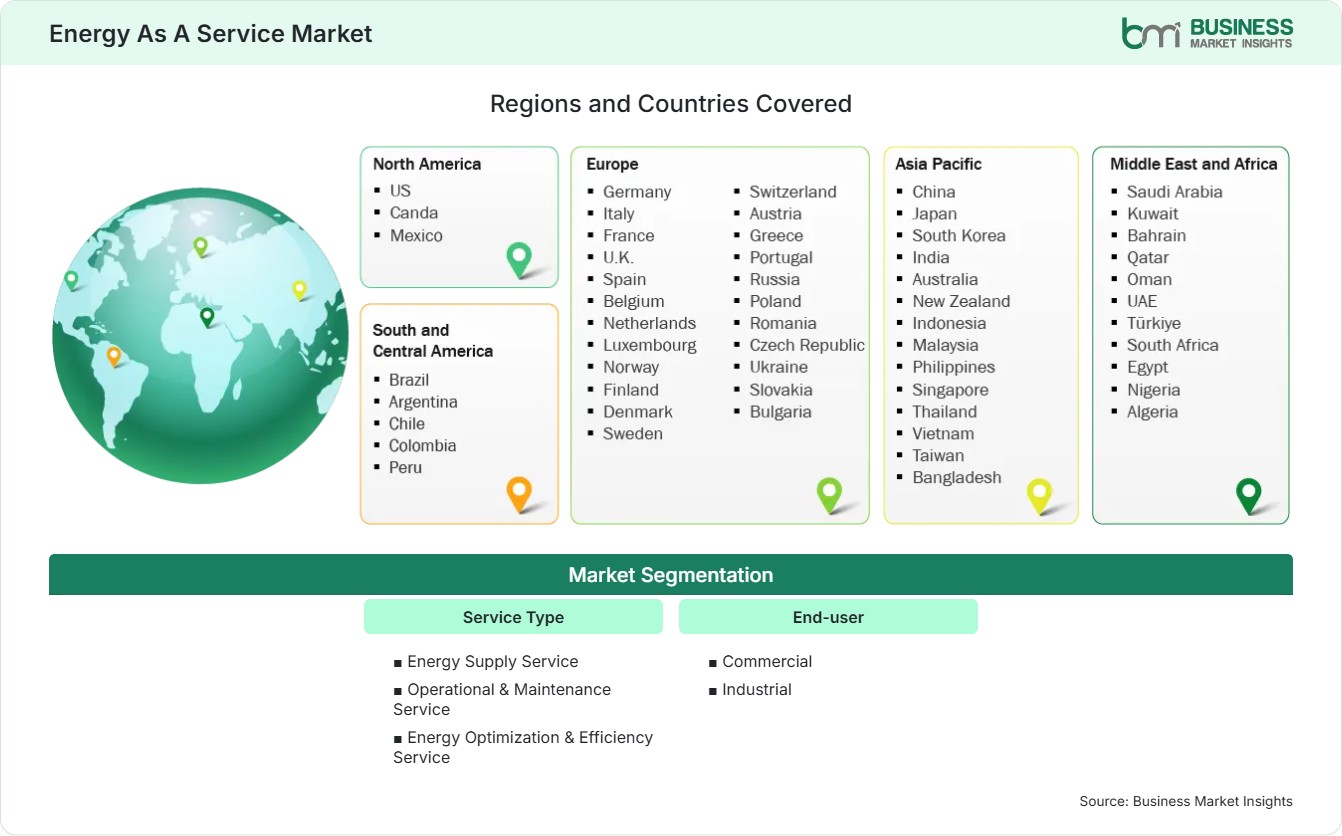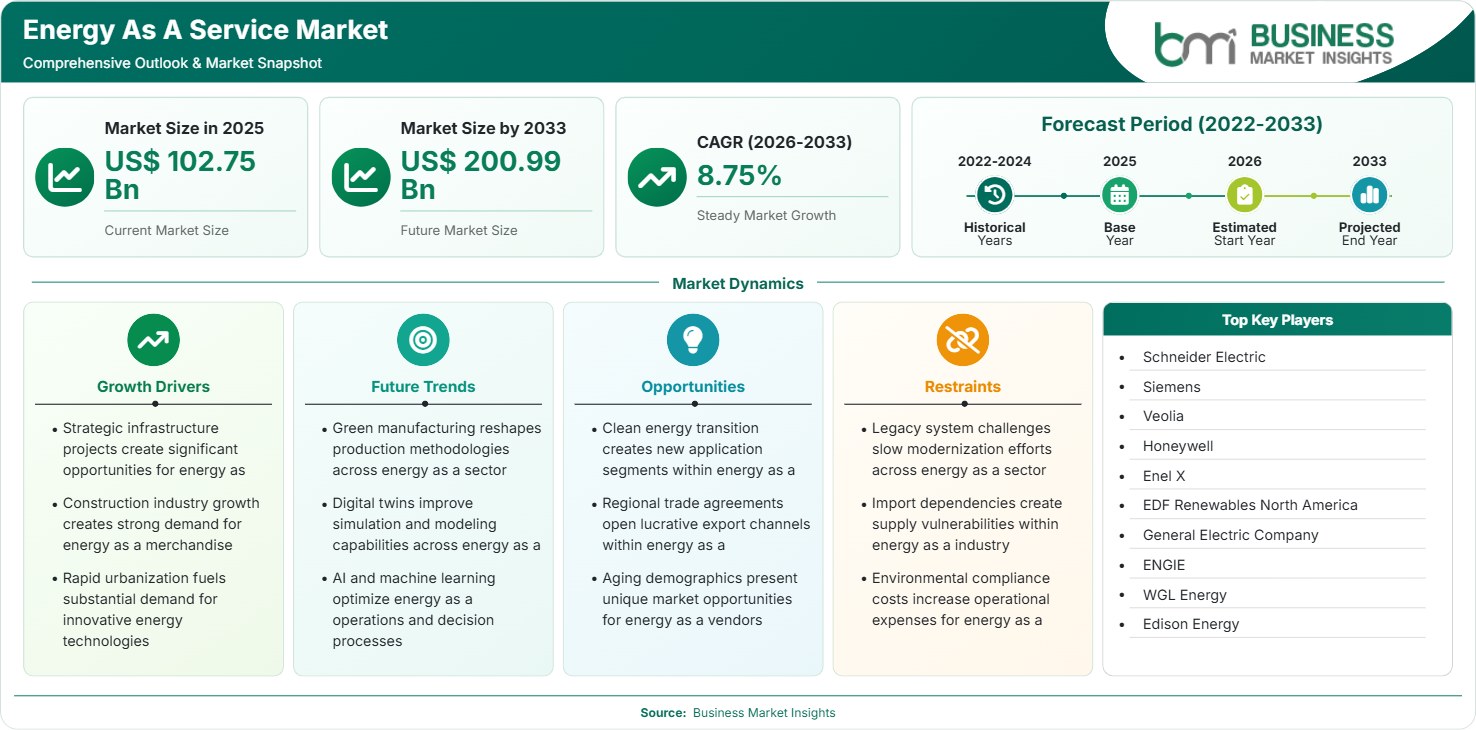
Energy As A Service Market Regional Highlights
North America Energy as a Service Market
North America accounted for 38%–41% Energy as a Service Market share in 2025 and is expected to register a CAGR of 8.2%–8.8% during 2026–2033. Corporate net-zero strategies, modernization of commercial buildings, distributed energy resources, and resilient power systems continue supporting demand. Energy-service providers benefit from mature financing structures and widespread adoption of digital energy management solutions. Utilities and private-sector organizations increasingly deploy integrated efficiency and renewable-energy programs, strengthening long-term service contract opportunities across industrial and commercial applications.
- Commercial building owners increasingly deploy AI-driven energy-management platforms to optimize electricity consumption, reduce operational expenses, and support sustainability reporting requirements across multi-site portfolios.
- Growing microgrid investments enhance resilience against grid disruptions, particularly for healthcare facilities, data centers, government buildings, and critical infrastructure applications.
- Demand-response participation programs create recurring value streams for customers while enabling grid operators to manage peak electricity loads more effectively.
- Corporate renewable-energy procurement strategies continue encouraging adoption of bundled service offerings combining financing, operation, maintenance, and energy optimization capabilities.
- Advanced metering infrastructure and building automation technologies support measurable efficiency gains and improved visibility into energy performance outcomes.
US Energy as a Service Market
The United States represented approximately 76%–80% of regional Energy as a Service Market revenue in 2025 and is projected to expand at a CAGR of 8.4%–9.0% through 2033. Strong commercial infrastructure investment, federal efficiency initiatives, and growing renewable-energy procurement support sustained demand. Increasing deployment of distributed energy systems, battery storage, and performance contracting solutions enhances market expansion opportunities across institutional and industrial sectors.
- Federal and state-level clean-energy policies continue supporting implementation of energy-performance contracts and distributed energy projects across public-sector facilities.
- Data center expansion is increasing demand for resilient, optimized, and sustainable energy-management solutions capable of supporting continuous operations.
- Corporate decarbonization programs encourage investment in integrated service agreements delivering measurable emissions reductions and operational savings.
- Electrification initiatives across transportation and buildings create additional demand for energy optimization and infrastructure management services.
Europe Energy as a Service Market
Europe held 28%–31% share in 2025, and the Energy as a Service Market is forecast to grow at a CAGR of 8.5%–9.1% during 2026–2033. Energy security concerns, decarbonization targets, and strong regulatory frameworks continue encouraging adoption. Germany remains the leading regional market with growth around 8.3%–8.8%, while Southern European countries demonstrate accelerating adoption supported by renewable integration initiatives. Service providers increasingly focus on efficiency upgrades, district energy systems, and digital energy optimization platforms to improve operational performance.
- The European Green Deal continues stimulating investment in building efficiency upgrades and renewable-energy deployment programs.
- Industrial organizations increasingly adopt outsourced energy-management models to improve competitiveness and reduce energy-related operating costs.
- District heating modernization projects support expansion of integrated service offerings across municipalities and urban infrastructure networks.
- Smart-building technologies and advanced analytics improve monitoring capabilities while supporting energy-efficiency compliance requirements.
- Renewable-energy procurement agreements create long-term opportunities for providers offering integrated optimization and management services.
Regional Trends and Share Analysis (Continued)
Asia Pacific Energy as a Service Market
Asia Pacific accounted for 24%–27% Energy as a Service Market share in 2025 and is projected to register the fastest CAGR of 10.1%–10.8% during 2026–2033. Rapid industrialization, urban infrastructure expansion, increasing electricity demand, and renewable-energy investments are supporting market development. China remains the largest regional contributor with growth around 10.0%–10.5%, while India demonstrates one of the fastest adoption rates at 10.8%–11.4%. Digital transformation initiatives and smart-city projects continue strengthening demand for integrated energy management and optimization services across commercial and industrial sectors.
- Smart-city initiatives are creating opportunities for integrated energy management platforms, distributed energy systems, and performance-based service agreements across large urban developments.
- Industrial energy-efficiency programs are driving adoption of analytics-enabled optimization services that improve productivity while reducing electricity consumption and carbon emissions.
- Rapid deployment of solar and storage projects supports bundled service offerings integrating monitoring, maintenance, financing, and operational management capabilities.
- Commercial real-estate developers increasingly implement smart-building technologies to enhance sustainability performance and operational efficiency.
- Government-backed decarbonization initiatives continue encouraging adoption of energy-service models across manufacturing, transportation, and public infrastructure sectors.
Rest of World Energy as a Service Market
The Rest of World region accounted for 7%–10% Energy as a Service Market share in 2025 and is expected to grow at a CAGR of 8.7%–9.4% during 2026–2033. South & Central America benefit from expanding renewable-energy investments and industrial modernization initiatives. Brazil remains the leading regional market with growth of 8.5%–9.1%.
The Middle East & Africa are witnessing increasing deployment of distributed energy systems, energy-efficiency programs, and commercial infrastructure projects. Saudi Arabia and the UAE continue attracting investment, while South Africa demonstrates growing adoption supported by energy-resilience requirements and grid modernization efforts.
- Renewable-energy development programs across Latin America are supporting demand for integrated energy procurement and optimization services.
- Industrial facilities increasingly pursue outsourced energy-management strategies to improve efficiency and reduce exposure to volatile electricity costs.
- Middle Eastern smart-city developments are creating opportunities for advanced building-energy management and microgrid service providers.
- Energy-security concerns in several African economies are encouraging investment in distributed generation and energy-efficiency solutions.
- Public-private partnerships continue supporting infrastructure modernization and long-term service contract opportunities throughout the region.