
Waste To Energy Market Outlook: Size, Share, Trends, Growth Analysis, Competitive Landscape & Forecast, 2026-2033

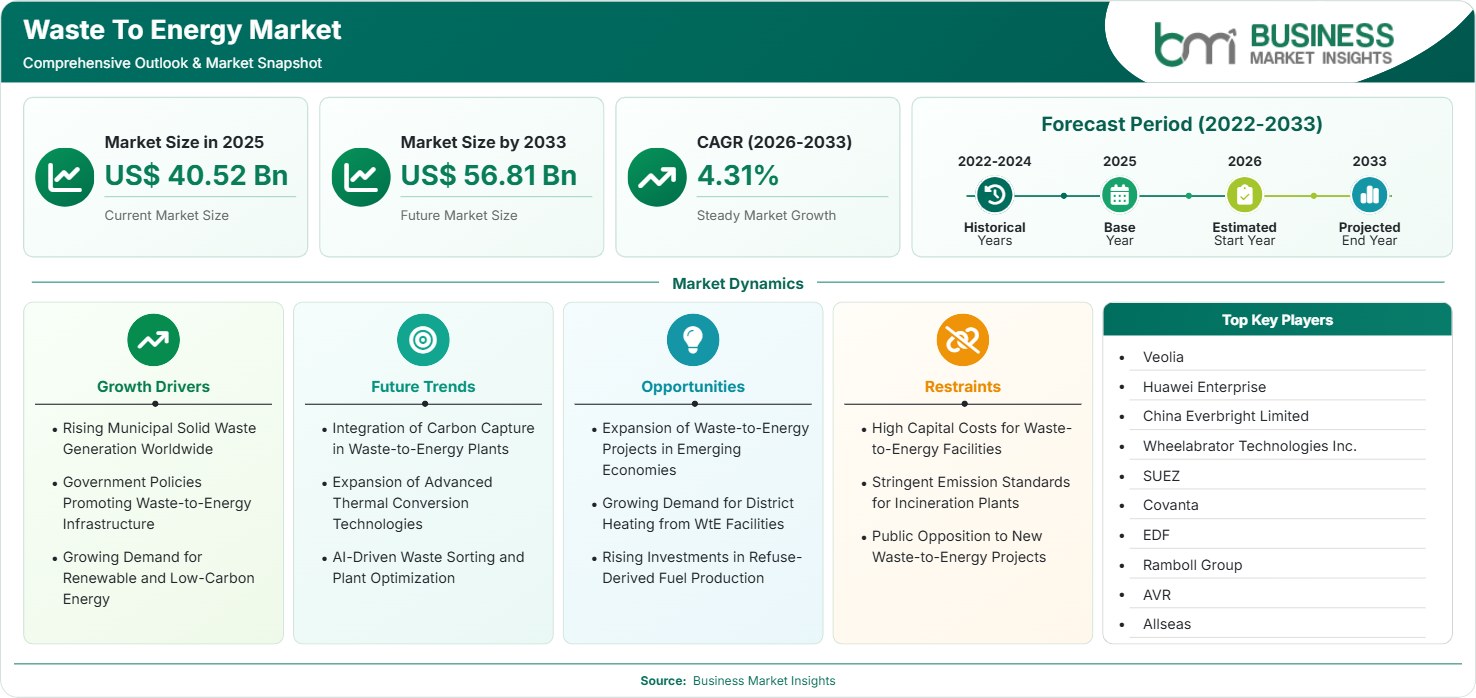
The Waste to Energy Market size was valued at US$ 40.52 Billion in 2025 and is projected to reach US$ 56.81 Billion by 2033, growing at a CAGR of 4.31% during 2026–2033. Growing waste generation, increasing focus on sustainable waste management, rising renewable energy demand, and government initiatives promoting circular economy practices are supporting market growth. Opportunities are emerging from advanced energy recovery technologies, landfill diversion programs, and increasing investments in waste treatment infrastructure.

Report Coverage
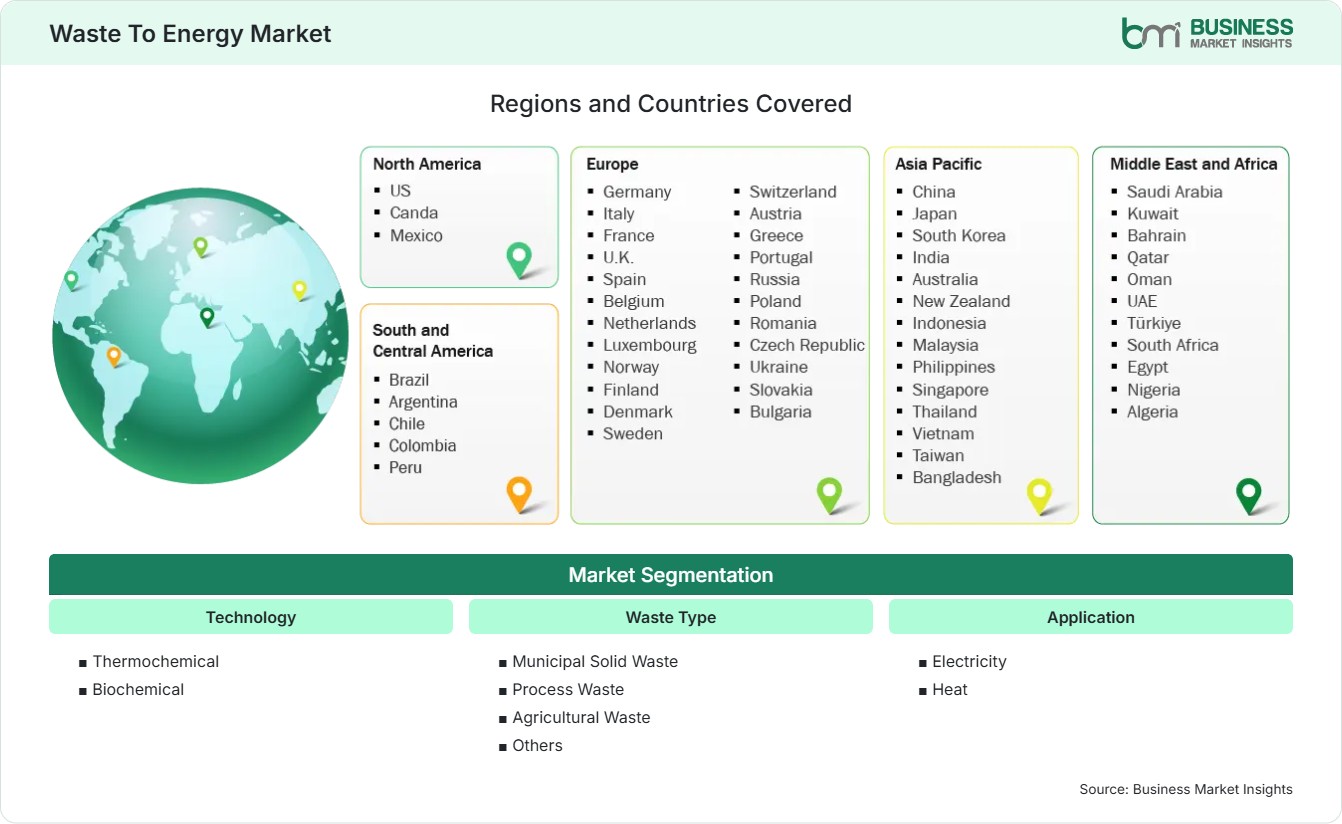
  • Technology: Thermochemical, Biochemical
  • Waste Type: Municipal Solid Waste, Process Waste, Agricultural Waste, Others
  • Application: Electricity, Heat
US$ 40.52 Bn Market size in 2025
US$ 56.81 Bn Market Size by 2033
4.31% CAGR, 2026 - 2033
2026-2033 Forecast Period

01 AI Overview

Waste To Energy Market Summary

  • North America Region: North America holds a waste to energy market share of 23%–26% in 2025 and is projected to grow at a CAGR of 3.8%–4.8% during 2026–2033. Strong municipal waste management systems, environmental regulations, and increasing focus on alternative energy generation continue supporting regional demand. The US market is projected to grow at a CAGR of 4.0%–5.0% through 2033.
  • Fastest Growing Region: Asia Pacific accounts for 36%–39% share in 2025 and is expected to grow at a CAGR of 5.0%–6.0% during the forecast period. Rapid urbanization, growing waste volumes, and increasing investments in energy recovery infrastructure are driving regional growth.
  • Leading Segment: Thermochemical Technology represents 72%–75% share in 2025 and is projected to grow at a CAGR of 4.2%–5.2% through 2033. Extensive deployment of incineration and thermal conversion facilities continues supporting segment leadership.
  • High Growth Segment: Municipal Solid Waste holds 52%–55% share in 2025 and is projected to grow at a CAGR of 4.8%–5.8% during 2026–2033 due to rising urban waste generation and increasing waste diversion initiatives.
  • Key Market Opportunity: Growing investment in advanced waste processing technologies, decentralized energy generation, and circular economy projects is creating significant opportunities across global markets.
  • Major Market Players: Veolia, Huawei Enterprise, China Everbright Limited, Wheelabrator Technologies Inc., SUEZ, Covanta, EDF, Ramboll Group, AVR, and Allseas.
02 Strategic Insights

Waste To Energy Market: Strategic Insights

waste-to-energy-market-market-strategic-framework
FREE PDF
Request your free sample
Request free sample
03 Stakeholder View

Key Takeaways

  • Waste-to-energy technologies convert municipal, industrial, and other non-recyclable waste into electricity, heat, or fuel, helping reduce landfill volumes while supporting sustainable waste management and renewable energy generation.
  • Thermochemical technologies dominate the market due to their proven efficiency, large-scale commercial deployment, and ability to recover energy from diverse waste streams through processes such as incineration, gasification, and pyrolysis.
  • Municipal solid waste remains the largest feedstock segment, driven by rapid urbanization, growing population, and increasing waste generation across developed and emerging economies.
  • Asia Pacific is the fastest-growing regional market, supported by rising waste volumes, expanding urban infrastructure, favorable government policies, and increasing investments in waste management facilities.
  • Governments are increasingly promoting landfill diversion, resource recovery, and renewable energy generation through stricter environmental regulations, financial incentives, and public-private partnerships.
  • Growing investments in advanced emission control systems are improving environmental performance, enhancing regulatory compliance, and increasing public acceptance of waste-to-energy projects.
  • Waste to energy market trend suggest that the integration of AI-enabled waste sorting, automation, smart monitoring, and advanced energy recovery technologies is improving operational efficiency, maximizing resource utilization, and accelerating the transition toward a circular economy.
04 Geographic Outlook

Waste To Energy Market Regional Highlights

North America Waste to Energy Market

North America accounted for a 23%–26% share in 2025 and is projected to expand at a CAGR of 3.8%–4.8% during 2026–2033. The waste to energy market forecast suggest that the region benefits from established waste management infrastructure, strong environmental regulations, and growing interest in renewable energy generation from municipal waste streams. Investments in modern energy recovery facilities and landfill diversion strategies continue supporting industry development.

  • Municipal authorities are increasingly focusing on reducing landfill dependency through advanced waste treatment solutions.
  • Energy recovery projects are gaining support as part of broader sustainability and carbon reduction initiatives.
  • Operators are investing in emissions control technologies to improve facility performance and regulatory compliance.
  • Growing waste volumes continue creating demand for efficient waste processing infrastructure.
  • Public-private partnerships are supporting the development and modernization of energy recovery facilities.

US Waste to Energy Market

The US represented a 19%–22% share in 2025 and is estimated to grow at a CAGR of 4.0%–5.0% through 2033. Strong waste generation volumes, increasing focus on renewable energy, and ongoing investments in sustainable waste management support waste to energy market expansion.

  • Municipal waste remains a major feedstock source for energy generation projects.
  • State and local governments are increasingly encouraging resource recovery and landfill diversion programs.
  • Facility upgrades are helping improve energy recovery efficiency and environmental performance.
  • Demand for reliable baseload renewable energy continues supporting project development.

Europe Waste to Energy Market

Europe held a 28%–31% share in 2025 and is expected to grow at a CAGR of 4.0%–5.0% from 2026–2033. Germany, France, Denmark, and the Netherlands represent major markets due to strong environmental policies, landfill restrictions, and advanced waste management systems. Germany is estimated to expand at 4.3%–5.3% CAGR.

  • Stringent waste disposal regulations continue encouraging adoption of energy recovery technologies.
  • European countries are emphasizing circular economy practices and sustainable resource utilization.
  • District heating networks are supporting demand for thermal energy generated from waste processing facilities.
  • Investments in efficient combustion and emissions management systems continue improving operational performance.
  • Governments remain committed to reducing landfill waste and increasing energy recovery rates.

Asia Pacific Waste to Energy Market

Asia Pacific accounted for a 36%–39% share in 2025 and is projected to register a CAGR of 5.0%–6.0% during 2026–2033. China, India, Japan, and South Korea are leading markets due to rapid urbanization, growing municipal waste generation, and increasing investments in waste treatment infrastructure. China is expected to grow at 5.5%–6.5% CAGR, while India demonstrates strong growth potential with a CAGR of 5.8%–6.8% during the forecast period.

  • Rapid population growth and urbanization are significantly increasing waste generation volumes.
  • China continues expanding waste processing capacity to address environmental and waste management challenges.
  • India is investing in modern waste treatment and energy recovery facilities across major cities.
  • Governments are promoting waste-to-energy projects to improve waste management and diversify energy sources.
  • Infrastructure modernization programs are creating opportunities for technology providers and facility operators.

Rest of World Waste to Energy Market

Rest of World accounted for a 10%–13% share in 2025 and is expected to grow at a CAGR of 4.2%–5.2% through 2033. The Middle East, Latin America, and Africa are increasingly investing in sustainable waste management infrastructure and alternative energy generation solutions.

  • Governments are seeking to reduce landfill usage while improving waste handling efficiency.
  • Growing urban populations are increasing demand for modern waste treatment facilities.
  • Energy recovery projects are supporting broader sustainability and energy diversification objectives.
  • Investment in municipal infrastructure is encouraging adoption of advanced waste processing technologies.
  • Emerging economies are increasingly exploring waste-to-energy facilities as part of integrated waste management strategies.
global-market-geography
FREE PDF
Request your free sample
Request free sample
05 Segment Analysis

Waste To Energy Market Segmentation

Technology

Technology adoption is influenced by waste composition, energy recovery efficiency, environmental regulations, and project economics. Thermochemical Technology accounted for 72%–75% share in 2025 and is projected to grow at a CAGR of 4.2%–5.2% through 2033 due to its ability to process large volumes of waste while generating electricity and heat efficiently.

  • Thermochemical: The dominant segment supported by extensive deployment of incineration, gasification, and pyrolysis technologies across municipal and industrial waste treatment facilities.
  • Biochemical: Experiencing steady growth due to increasing adoption of anaerobic digestion and biological conversion processes for organic and biodegradable waste streams.

Waste Type

Waste type plays a critical role in determining treatment technologies, energy output, and project viability. Municipal Solid Waste accounted for 52%–55% share in 2025 and is projected to grow at a CAGR of 4.8%–5.8% through 2033 due to increasing urbanization and rising waste generation volumes worldwide.

  • Municipal Solid Waste: The leading segment driven by growing urban populations, landfill diversion initiatives, and investments in integrated waste management systems.
  • Process Waste: Generated from industrial and manufacturing operations, providing a stable feedstock source for energy recovery projects.
  • Agricultural Waste: Adoption is increasing as governments and agricultural producers seek sustainable utilization of crop residues and organic waste materials.
  • Others: Includes commercial, institutional, construction, and mixed waste streams processed through specialized energy recovery facilities.

Application

Application demand is driven by energy requirements, infrastructure availability, and regional waste management strategies. Electricity accounted for 63%–66% share in 2025 and is projected to grow at a CAGR of 4.4%–5.4% through 2033 owing to increasing demand for renewable power generation and grid-connected energy recovery projects.

  • Electricity: The dominant segment supported by growing renewable energy requirements, grid integration initiatives, and expansion of waste-based power generation facilities.
  • Heat: Demand is increasing through district heating systems, industrial energy applications, and combined heat and power projects that improve overall energy recovery efficiency.
06 Market Forces

Waste To Energy Market Dynamics

Rising Municipal Solid Waste Generation Worldwide

Rapid urbanization, population growth, changing consumption patterns, and industrial expansion are significantly increasing municipal solid waste generation worldwide. Traditional landfill disposal methods are becoming increasingly unsustainable due to limited land availability, rising environmental concerns, and stricter waste management regulations. Waste-to-energy facilities offer an effective solution by reducing waste volumes while generating electricity, heat, or fuel from non-recyclable waste. Governments and municipalities are investing in integrated waste management strategies that prioritize energy recovery, landfill diversion, and resource efficiency. Increasing waste generation, coupled with the need for sustainable disposal methods, is expected to drive long-term demand for waste to energy market.

Government Policies Promoting Waste-to-Energy Infrastructure

Many governments are implementing policies to reduce landfill dependence, increase renewable energy generation, and advance circular economy objectives through sustainable waste management practices. Financial incentives, supportive regulatory frameworks, renewable energy targets, carbon reduction initiatives, and waste diversion mandates are encouraging investments in waste-to-energy facilities. Public authorities increasingly recognize these projects as essential for improving waste management efficiency while generating clean energy and reducing greenhouse gas emissions. Continued government support through funding programs, public-private partnerships, and infrastructure development initiatives is accelerating project deployment, technology adoption, and modernization of waste treatment systems across developed and emerging economies.

Growing Demand for Renewable and Low-Carbon Energy

The global transition toward sustainable energy systems is increasing demand for renewable and low-carbon energy sources capable of reducing greenhouse gas emissions and improving energy security. Waste-to-energy facilities contribute by converting non-recyclable waste into electricity, heat, or alternative fuels while simultaneously addressing waste disposal challenges. Utilities, municipalities, and industrial operators are increasingly incorporating energy recovery technologies into diversified energy portfolios to reduce reliance on fossil fuels. Rising investments in renewable energy infrastructure, stricter environmental regulations, and growing emphasis on carbon neutrality are supporting the expansion of waste-to-energy projects, creating significant opportunities for technology providers and infrastructure developers worldwide.

Key Market Opportunities

Expansion of Waste-to-Energy Projects in Emerging Economies

Emerging economies are experiencing rapid urbanization, industrialization, and population growth, resulting in rising waste generation and increasing demand for modern waste management infrastructure. Many cities are seeking sustainable alternatives to landfill disposal while improving environmental performance, public health, and energy security. Governments are introducing supportive policies and encouraging public-private partnerships to accelerate investments in waste-to-energy facilities. International funding agencies and private investors are also supporting infrastructure development across these regions. As waste volumes continue to rise and environmental regulations become stricter, technology providers, engineering firms, and facility operators are well positioned to benefit from expanding project pipelines and long-term infrastructure investments.

Growing Demand for District Heating from WtE Facilities

District heating networks are increasingly utilizing thermal energy generated from waste-to-energy facilities to improve energy efficiency and reduce dependence on fossil fuels. Combined heat and power (CHP) systems maximize energy recovery by producing both electricity and usable heat from the same waste stream, significantly improving overall plant efficiency. Urban regions with established district heating infrastructure are witnessing greater adoption of waste-derived thermal energy to supply residential, commercial, and industrial buildings. Rising emphasis on carbon reduction, energy efficiency, and sustainable urban development is expected to expand district heating networks, creating attractive opportunities for waste-to-energy facility operators and energy service providers.

Rising Investments in Refuse-Derived Fuel Production

Refuse-derived fuel (RDF) is gaining significant attention as an effective solution for converting non-recyclable waste into an alternative fuel for industrial processes and energy generation. Investments in waste processing facilities, advanced sorting technologies, and fuel production plants are increasing as industries seek cost-effective and sustainable alternatives to conventional fossil fuels. Cement manufacturers, power plants, and other energy-intensive industries are driving demand for RDF to reduce fuel costs and lower carbon emissions. Waste to energy market growth is supported by the growing government support for resource recovery, circular economy initiatives, and landfill diversion is further encouraging RDF production, and creating substantial opportunities for technology developers, equipment manufacturers, and waste management companies.

Market Restraints and Challenges

High Capital Costs for Waste-to-Energy Facilities

Factor: Development of waste-to-energy facilities requires substantial investment in waste processing equipment, energy recovery systems, emissions control technologies, grid connectivity, and supporting infrastructure. Project development timelines can also be lengthy due to permitting and regulatory requirements.

Impact: High upfront investment requirements can limit project development, particularly in regions with funding constraints or uncertain regulatory environments. Financing challenges may delay construction schedules and affect overall project viability. Stakeholders must often rely on long-term contracts and policy support to ensure economic sustainability.

Stringent Emission Standards for Incineration Plants

Factor: Waste-to-energy facilities are subject to strict environmental regulations governing emissions, air quality, and operational performance. Compliance often requires advanced pollution control systems and continuous environmental monitoring.

Impact: Regulatory compliance can increase operating costs and add complexity to project development and facility management. Operators must invest in modern emissions-control technologies and maintenance programs to meet environmental requirements. While these measures improve sustainability, they can also affect project economics and investment decisions.

07 Company Analysis

Competitive Landscape

The waste to energy market analysis suggest strong competition among waste management companies, energy recovery operators, environmental engineering firms, technology providers, and infrastructure developers. Companies are focusing on advanced thermal conversion technologies, efficient emissions control systems, automation, and energy recovery solutions to enhance operational performance and regulatory compliance. Strategic initiatives such as partnerships with municipalities, acquisitions, capacity expansion, and investments in circular economy projects are strengthening competitive positions. Market participants are also prioritizing research and development to improve plant efficiency, reduce environmental impact, and maximize resource recovery. Expansion into emerging economies and modernization of existing waste processing facilities continue to support long-term market growth and competitiveness.

Company Name

Overview

Products and Services Relevant to this Market

Veolia

Global environmental services company specializing in resource management.

Waste-to-energy operations, waste treatment services, energy recovery solutions, and environmental management systems.

Huawei Enterprise

Technology provider supporting smart infrastructure and digital solutions.

Digital monitoring systems, smart facility management technologies, and industrial automation platforms.

China Everbright Limited

Major investor and operator in environmental protection projects.

Waste-to-energy facilities, municipal waste processing, and renewable energy generation solutions.

Wheelabrator Technologies Inc.

Waste management and energy recovery company.

Waste combustion facilities, electricity generation, and environmental waste treatment services.

SUEZ

Global environmental services and resource management company.

Waste treatment solutions, recycling operations, energy recovery systems, and infrastructure services.

Covanta

Leading provider of sustainable waste and energy solutions.

Waste-to-energy facilities, energy recovery operations, metals recycling, and waste management services.

EDF

International energy company with renewable and sustainable energy interests.

Energy generation, waste-to-energy projects, district heating solutions, and power infrastructure.

Ramboll Group

Engineering and consulting company serving environmental and energy sectors.

Waste-to-energy engineering, project consulting, facility design, and sustainability solutions.

AVR

Dutch waste processing and energy recovery company.

Municipal waste treatment, renewable energy generation, and district heating services.

Allseas

Infrastructure and industrial services company.

Energy infrastructure support, engineering services, and industrial project development solutions.

10 Trust & Transparency

Research Methodology

The market analysis combines proprietary research with secondary data from government agencies, company disclosures, regulatory filings, industry databases and expert interviews. Market estimates are validated through data triangulation, cross-market benchmarking and analyst review.

View Full Research Methodology

11 Questions Answered

Frequently Asked Questions

What opportunities exist for waste-to-energy project developers?

Major opportunities include emerging market infrastructure projects, district heating expansion, refuse-derived fuel production, advanced waste conversion technologies, and circular economy initiatives.

Why does Asia Pacific lead market growth?

Asia Pacific leads growth because of rapid urbanization, increasing waste generation, expanding energy demand, and substantial investments in modern waste treatment infrastructure.

Which waste type segment is growing the fastest?

Municipal Solid Waste is the fastest-growing segment due to increasing urbanization, population growth, and investments in integrated municipal waste management programs.

Which technology segment dominates the market?

Thermochemical technology dominates the market due to extensive deployment of incineration, gasification, and pyrolysis systems capable of processing large waste volumes while generating energy efficiently.

What is driving growth in the waste to energy market report?

Growth is driven by rising municipal solid waste generation, government support for sustainable waste management infrastructure, increasing renewable energy demand, and growing landfill diversion initiatives.

Access the Full Waste To Energy Market Report

Get segment-level forecasts, regional estimates, competitive benchmarking, company profiles and downloadable Excel datasets.

Access the full Waste To Energy Market Report
350 pages PDF & Excel | 2026-08-05