
Waste Derived Biogas Market Outlook: Size, Share, Trends, Growth Analysis, Competitive Landscape & Forecast, 2026-2033

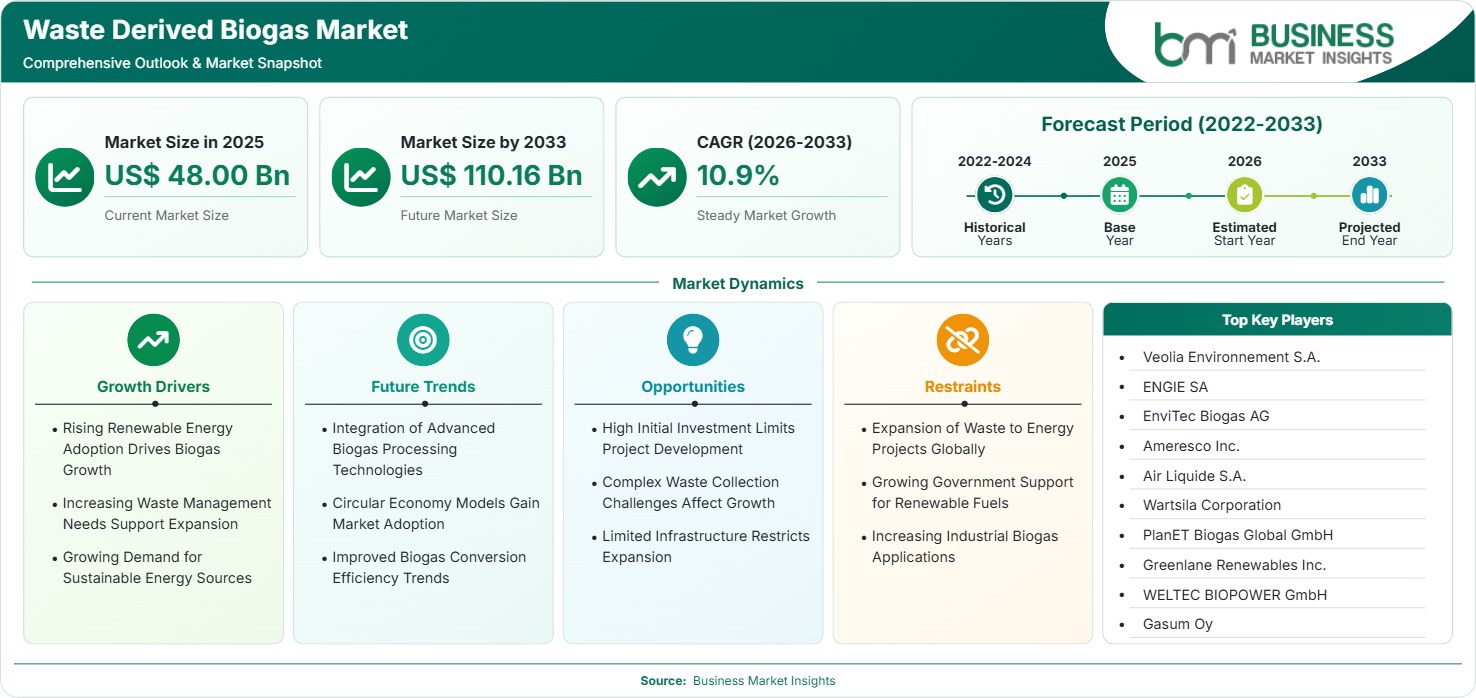
The Waste Derived Biogas market size was valued at US$ 48.00 billion in 2025 and is projected to reach US$ 110.16 billion by 2033, growing at a CAGR of 10.9% during 2026–2033, driven by renewable energy adoption, waste management modernization, decarbonization initiatives, and increasing demand for sustainable fuel alternatives.

Report Coverage
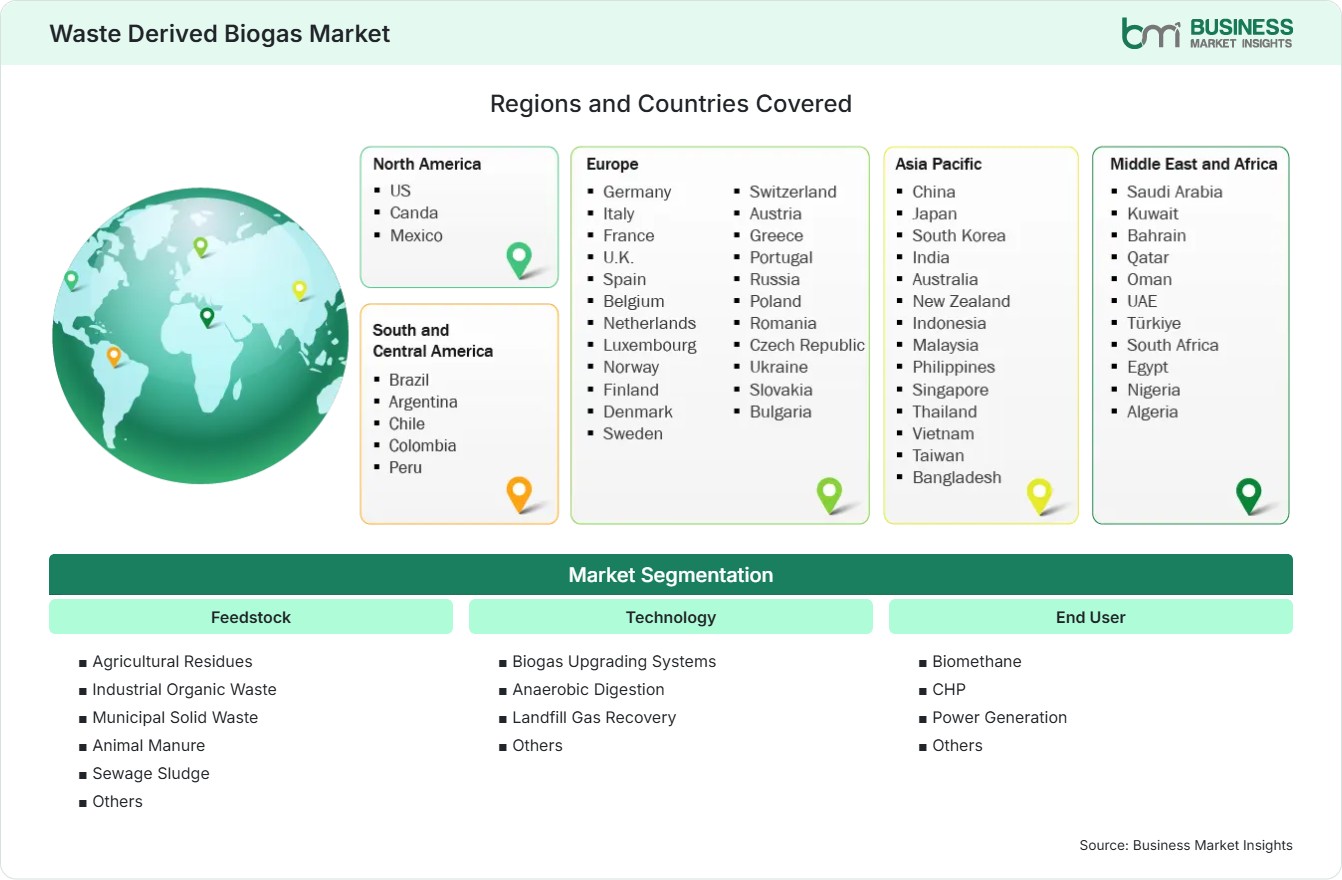
  • Feedstock: Agricultural Residues, Industrial Organic Waste, Municipal Solid Waste, Animal Manure, Sewage Sludge, Others
  • Technology: Biogas Upgrading Systems, Anaerobic Digestion, Landfill Gas Recovery, Others
  • End User: Biomethane, CHP, Power Generation, Others
US$ 48.00 Bn Market size in 2025
US$ 110.16 Bn Market Size by 2033
10.9% CAGR, 2026 - 2033
2026-2033 Forecast Period

01 AI Overview

Waste Derived Biogas Market Summary

  • North America Region: North America holds market share of 31%–34% in 2025, growing with a CAGR of 9%–11% influenced by renewable energy policies, landfill gas utilization, and investments in waste-to-energy infrastructure. The US market demonstrates strong adoption through biogas recovery projects and clean energy programs, registering a CAGR of 9%–11% between 2026–2033.
  • Fastest Growing Region: Asia Pacific accounts for a share of 27%–30% in 2025, expanding with a CAGR of 12%–14% supported by increasing waste generation, government sustainability initiatives, and rising investments in renewable natural gas infrastructure.
  • Leading Segment: Anaerobic Digestion represents the leading technology segment with a share of 42%–45% in 2025, expanding at a CAGR of 10%–12% due to proven efficiency, widespread feedstock compatibility, and growing adoption across municipal and agricultural waste applications.
  • High Growth Segment: Biogas Upgrading Systems represent a high growth technology segment with a share of 18%–21% in 2025, achieving a CAGR of 13%–15% driven by rising biomethane demand, grid injection projects, and transportation fuel applications.
  • Key Market Opportunity: Increasing renewable gas demand, carbon reduction targets, and circular economy initiatives are creating opportunities for waste-derived biogas producers to expand infrastructure, improve resource recovery, and develop low-carbon energy solutions.
  • Major Market Players: Veolia Environnement S.A., ENGIE SA, EnviTec Biogas AG, Ameresco Inc., Air Liquide S.A., Wartsila Corporation, PlanET Biogas Global GmbH, Greenlane Renewables Inc., WELTEC BIOPOWER GmbH, and Gasum Oy.
02 Strategic Insights

Waste Derived Biogas Market: Strategic Insights

waste-derived-biogas-market-market-strategic-framework
FREE PDF
Request your free sample
Request free sample
03 Stakeholder View

Key Takeaways

  • The waste derived biogas market ecosystem is evolving from conventional waste disposal models toward integrated resource recovery systems involving waste operators, technology providers, utilities, and renewable energy companies.
  • Agricultural residues, municipal organic waste, and industrial waste streams offer strong growth opportunities as stakeholders seek reliable feedstock sources for renewable gas production and energy generation.
  • Technological innovation is shifting toward advanced biogas upgrading, methane purification, digital monitoring systems, and improved anaerobic digestion efficiency to maximize energy recovery.
  • Asia Pacific presents a strategic investment opportunity due to rising urban waste volumes, government renewable energy programs, and increasing demand for sustainable waste management infrastructure.
  • Investment activity is increasing through partnerships, infrastructure expansion, and acquisitions as energy companies and waste management firms strengthen renewable gas portfolios.
  • Integration with existing natural gas networks and transportation fuel systems is becoming an important strategic pathway for expanding biomethane adoption.
04 Geographic Outlook

Waste Derived Biogas Market Regional Highlights

North America Waste Derived Biogas Market

North America represents a major regional market with a share of 31%–34% in 2025 and is projected to grow at a CAGR of 9%–11% during 2026–2033. Strong waste management infrastructure, renewable energy incentives, and landfill gas recovery initiatives support regional expansion. Waste Derived Biogas market share remains concentrated in the United States and Canada due to established clean energy frameworks and investment activity.

  • Renewable natural gas programs are increasing demand for waste conversion facilities across municipal and industrial applications.
  • The United States is expanding biogas projects through decarbonization policies and landfill methane reduction initiatives.
  • Canada is supporting renewable gas development through clean energy investments and agricultural waste utilization programs.
  • Technology providers are improving upgrading efficiency to increase biomethane quality and grid integration capabilities.

US Waste Derived Biogas Market

The US market holds a share of 28%–31% in 2025 and is estimated to register a CAGR of 9%–11% from 2026–2033. The country remains a leading market due to extensive landfill infrastructure, renewable fuel policies, and strong participation from energy and waste management companies. Increasing investment in renewable natural gas projects continues supporting market development.

  • Federal and state sustainability programs are encouraging methane capture and renewable fuel production initiatives.
  • Agricultural regions are adopting anaerobic digestion systems to convert manure and organic waste into energy.
  • Utilities are exploring renewable natural gas integration to reduce carbon intensity across energy networks.
  • Private investments are supporting expansion of large-scale waste-to-energy infrastructure projects.

Europe Waste Derived Biogas Market

Europe accounts for a share of 26%–29% in 2025 and is expected to expand at a CAGR of 10%–12% during 2026–2033. The region benefits from strong climate policies, renewable energy targets, and established waste processing infrastructure. Germany, France, and the United Kingdom represent leading markets, while Italy and Sweden demonstrate increasing renewable gas adoption.

  • Germany maintains strong market development through extensive anaerobic digestion facilities and agricultural waste utilization.
  • France is expanding renewable gas production through government-supported biomethane development programs.
  • The United Kingdom is investing in landfill gas recovery and renewable natural gas infrastructure.
  • Sweden continues advancing biogas adoption through transportation fuel applications and circular economy initiatives.

Asia Pacific Waste Derived Biogas Market

Asia Pacific represents the fastest-growing regional market with a share of 27%–30% in 2025 and a projected CAGR of 12%–14% during 2026–2033. Waste Derived Biogas Market growth is supported by rapid urbanization, increasing waste volumes, and government-backed renewable energy initiatives. China, India, Japan, and South Korea represent key markets, with India and China showing significant expansion potential.

  • China is increasing investment in organic waste processing and renewable energy infrastructure development.
  • India is promoting biogas adoption through agricultural waste management and rural energy programs.
  • Japan is focusing on efficient waste conversion technologies and sustainable energy systems.
  • Southeast Asian countries are expanding projects due to rising waste generation and energy demand.

Rest of World Waste Derived Biogas Market

Rest of World Waste Derived Biogas Markets represent a share of 10%–13% in 2025 and are projected to grow at a CAGR of 10%–12% during 2026–2033. Latin America, Middle East, and Africa are gradually expanding through renewable energy initiatives, waste management improvements, and sustainability investments. Brazil, Mexico, UAE, and South Africa represent important growth contributors.

  • Brazil is developing renewable gas projects through agricultural waste utilization and energy diversification strategies.
  • Mexico is improving waste management infrastructure to support renewable energy production opportunities.
  • Middle Eastern countries are investing in sustainable waste solutions aligned with environmental objectives.
  • South Africa is exploring biogas applications to improve waste treatment and energy accessibility.
global-market-geography
FREE PDF
Request your free sample
Request free sample
05 Segment Analysis

Waste Derived Biogas Market Segmentation

Feedstock

The feedstock segment defines the availability and efficiency of waste-derived biogas production through diverse organic waste sources. The segment accounted for a share of 100% in 2025 and is projected to expand at a CAGR of 10%–12% between 2026–2034. Waste Derived Biogas Market scope continues expanding as industries and municipalities prioritize resource recovery, methane reduction, and renewable energy generation from organic waste streams.

  • Agricultural Residues: Agricultural residues support biogas production through crop waste and organic by-products. Increasing farming activity and sustainability initiatives are encouraging conversion of agricultural waste into renewable energy resources.
  • Industrial Organic Waste: Industrial organic waste provides consistent feedstock from food processing and manufacturing operations. Companies are adopting biogas solutions to reduce disposal costs and improve environmental performance.
  • Municipal Solid Waste: Municipal solid waste offers significant biogas potential due to increasing urban waste generation. Waste processing facilities are adopting advanced systems to recover energy and reduce landfill dependency.
  • Animal Manure: Animal manure represents a valuable feedstock source for agricultural biogas facilities. Livestock operations are implementing anaerobic digestion systems to manage waste while generating renewable energy.
  • Sewage Sludge: Sewage sludge supports biogas generation through wastewater treatment infrastructure. Municipal authorities are utilizing digestion technologies to improve waste management efficiency and recover energy resources.

Technology

The technology segment is influenced by advancements in digestion efficiency, gas purification, and renewable fuel integration capabilities. The segment represented a share of 100% in 2025 and is expected to grow at a CAGR of 10%–12% during 2026–2034. Increasing focus on methane capture and clean energy production is accelerating technology adoption.

  • Biogas Upgrading Systems: Biogas upgrading systems improve methane concentration and enable biomethane production. Growing demand for renewable natural gas and transportation fuels is increasing adoption of advanced purification technologies.
  • Anaerobic Digestion: Anaerobic digestion remains widely adopted due to its ability to process multiple organic waste streams. Improved efficiency and operational flexibility support expansion across agricultural and municipal applications.
  • Landfill Gas Recovery: Landfill gas recovery technologies capture methane emissions from waste disposal sites. Increasing environmental regulations and emission reduction targets are supporting project development worldwide.

End User

The end user segment reflects diverse applications of waste-derived biogas across energy generation, transportation, and industrial sectors. The segment accounted for a share of 100% in 2025 and is forecast to grow at a CAGR of 10%–12% from 2026–2034. Rising demand for low-carbon energy solutions is increasing adoption across multiple applications.

  • Biomethane: Biomethane applications are expanding due to compatibility with existing natural gas infrastructure. Increasing renewable fuel demand is encouraging investment in upgrading facilities and distribution networks.
  • CHP: Combined heat and power systems utilize biogas for efficient electricity and heat generation. Industrial facilities and municipalities are adopting CHP solutions to improve energy efficiency and reduce emissions.
  • Power Generation: Power generation applications use biogas as a renewable electricity source. Growing clean energy initiatives are supporting deployment of decentralized power generation systems using organic waste resources.
06 Market Forces

Waste Derived Biogas Market Dynamics

Key Market Drivers

Rising Renewable Energy Adoption Drives Biogas Growth

The shift to renewable energy systems has resulted in higher demand for biogas derived from waste due to the fact that there is an increased need for alternative energy sources apart from those derived from fossil fuels. Due to rising attention to carbon reduction goals and energy diversification, investments have been made in facilities that produce biogas. Market growth is facilitated by the policies on renewable fuels, initiatives on reducing methane emissions, and interests in the circular economy. The Waste Derived Biogas market trends reveal that there will be more use of biomethane in transportation, industrial, and energy sectors.

Increasing Waste Management Needs Support Expansion

The increase in urbanization, industrialization, and population in the world has led to an increase in the amount of waste being produced, creating a need for modern techniques of waste treatment. The application of biogas technology in waste treatment has been embraced in municipalities and industries to enable them to deal with their organic waste without relying on landfills. Biogas technology in waste treatment offers two advantages: not only does it make waste treatment easier, but it also provides a renewable resource. There is increasing pressure to curb emissions from landfills.

Growing Demand for Sustainable Energy Sources

More corporations are making sustainability pledges, and governments are making efforts to decarbonize. Businesses are looking for alternative fuel sources that would help them achieve their environmental goals and conserve natural resources. Biogas gives businesses a chance to turn their waste materials into energy while minimizing their methane emissions caused by decay processes. Energy companies are working on developing renewable gas networks that would serve industrial and transportation companies that want to switch to cleaner fuels. The rising interest of consumers and investors in the environmental performance of companies is also driving sustainable energy initiatives. These trends help shape the waste derived biogas market forecast through increased demand for sustainable fuels.

Key Market Opportunities

Expansion of Waste to Energy Projects Globally

The increase in the implementation of waste-to-energy projects in developed and developing countries is opening up many chances for biogas companies and technological firms. There is a lot of investment being made by governments and municipalities in plants that provide energy as well as sustainable waste treatment. With increased landfill diversion targets and municipal solid waste challenges, there will be greater establishment of such infrastructure for waste treatment. The rise in energy needs is another opportunity in developing countries. It is envisaged that a strategic partnership between the public sector and private firms will lead to the realization of waste-to-biogas projects.

Growing Government Support for Renewable Fuels

Governmental policy incentives that favor renewable fuels and carbon reductions are contributing to the development of biogas from waste. Government incentives, renewable energy mandates, and emissions reduction programs are driving investments into the infrastructure required for the generation and supply of biomethane. Government policy incentives that favor landfill diversion and renewable fuels are contributing to rising demand for renewable gases. Corporations are taking advantage of government incentives that favor renewable fuels to enhance the economics of their projects. The synergy between governmental policy and sustainability objectives is boosting investor confidence in the energy industry. Areas implementing renewable fuels policy are likely to witness growth in the waste derived biogas market

Increasing Industrial Biogas Applications

The industrial sector is increasingly using biogas technology for the treatment of organic waste streams as well as lessening its reliance on fossil fuels. The food industry, manufacturing industries, and agriculture are considering the possibility of harnessing biogas as part of their efforts at sustainable and efficient operations. Industrial plants may take advantage of the biogas produced for purposes of heating, power generation, and renewable fuel, among others. Increasing requirements for corporate social responsibility reports have encouraged corporations to look towards clean energy alternatives. Suppliers of technology are developing tailor-made technology that can handle the needs of industrial waste streams.

Market Restraints and Challenges

High Initial Investment Limits Project Development

Factor: High capital requirements associated with facility construction, equipment installation, and infrastructure development create financial barriers for waste-derived biogas projects.

Impact: The initial cost could make project development take longer, especially when considering areas that do not have sufficient access to funds. There is a need to have the proper digesters, upgrading equipment, storage facilities, and the ability to connect to the grid. It would be harder for small firms to access the necessary funding compared to the big energy firms. While there might be some operational advantages, the initial funding will still pose some problems.

Complex Waste Collection Challenges Affect Growth

Factor: Inconsistent waste collection systems, feedstock quality variations, and logistical limitations can affect biogas production efficiency.

Impact: The process of collecting can raise expenses and hinder the effective use of facilities, as well as the ability to expand to new locations. The dependable supply of feedstock is necessary to ensure the sustainable production of biogas and make the project profitable. Waste streams from municipalities and industries usually need to be separated and transported to be further processed. There can be even more obstacles in underdeveloped regions because of insufficient waste management systems.

07 Company Analysis

Competitive Landscape

The Waste Derived Biogas Market analysis highlights a competitive ecosystem consisting of renewable energy companies, waste management providers, biogas technology developers, and infrastructure specialists. Market participants are focusing on anaerobic digestion efficiency, biomethane upgrading capabilities, project development expertise, and strategic partnerships to expand renewable gas production. Companies are strengthening their positions through technology innovation, international expansion, and investments in sustainable energy infrastructure.

Company Name

Overview

Products and Services relevant to this market

Veolia Environnement S.A.

Global environmental services company providing waste management and resource recovery solutions.

Waste treatment, anaerobic digestion, biogas recovery, renewable energy generation, and environmental services.

ENGIE SA

Energy company developing renewable energy solutions and sustainable infrastructure projects globally.

Renewable gas production, biomethane solutions, energy transition services, and biogas infrastructure.

EnviTec Biogas AG

German biogas specialist providing project development and operational expertise.

Biogas plants, biomethane upgrading, plant operation, and renewable gas solutions.

Ameresco Inc.

Energy efficiency and renewable energy company serving public and private sectors.

Renewable energy projects, biogas systems, landfill gas recovery, and energy management solutions.

Air Liquide S.A.

Industrial gases company developing clean energy and gas processing technologies.

Biogas purification, biomethane upgrading, gas processing solutions, and renewable energy applications.

Wartsila Corporation

Technology company providing energy systems and sustainable infrastructure solutions.

Biogas engines, energy conversion systems, upgrading technologies, and power generation solutions.

PlanET Biogas Global GmbH

Biogas technology provider specializing in customized renewable energy systems.

Anaerobic digestion plants, biogas engineering, feedstock solutions, and plant optimization services.

Greenlane Renewables Inc.

Renewable natural gas technology company focused on biogas upgrading solutions.

Biogas upgrading systems, renewable natural gas projects, gas purification technologies.

WELTEC BIOPOWER GmbH

Biogas plant manufacturer providing sustainable energy production solutions.

Anaerobic digestion facilities, biogas plants, engineering services, and operational support.

Gasum Oy

Nordic energy company producing renewable gases and circular energy solutions.

Biomethane production, biogas plants, renewable fuel distribution, and waste-based energy solutions.

08 Industry Activity

Recent Developments

March 2026

Gasum Oy announced investment decisions for two additional large-scale biogas plants in Sweden, supporting expansion of renewable gas availability from organic waste streams. The projects are part of Gasum’s strategy to increase Nordic biogas production capacity and supply renewable gas to transport and industrial customers.

May 2025

Gasum Oy strengthened its waste-derived biogas production value chain by acquiring full ownership of NSR Biogas AB and related upgrading operations in Helsingborg, Sweden. The acquisition expanded Gasum’s control over biogas production and biomethane upgrading infrastructure using household waste, industrial waste, and manure feedstocks.

April 2025

Wartsila Corporation secured orders to supply bioLNG production solutions for two large-scale biogas projects in Finland. The facilities will use manure and food processing waste as feedstock to produce renewable fuel and recycled biofertilizer.

February 2025

ENGIE SA expanded its biomethane activities through a long-term Biomethane Purchase Agreement with Sanofi in France. The agreement supports the supply of renewable gas produced from biomethane facilities, strengthening ENGIE’s waste-derived renewable gas portfolio and industrial decarbonization initiatives.

10 Trust & Transparency

Research Methodology

The market analysis combines proprietary research with secondary data from government agencies, company disclosures, regulatory filings, industry databases and expert interviews. Market estimates are validated through data triangulation, cross-market benchmarking and analyst review.

View Full Research Methodology

11 Questions Answered

Frequently Asked Questions

What insights does the Waste Derived Biogas Market Report provide?

The report provides analysis of market size, regional opportunities, technology trends, competitive developments, feedstock dynamics, and factors influencing renewable gas industry expansion.

What challenges affect waste-derived biogas project development?

High capital investment requirements, complex feedstock collection systems, infrastructure limitations, and operational challenges can affect project development timelines and economic feasibility.

How does waste-derived biogas support sustainability goals?

Waste-derived biogas reduces methane emissions, improves waste management efficiency, supports circular economy practices, and provides renewable energy alternatives that help organizations reduce carbon footprints.

Which feedstock sources are commonly used for waste-derived biogas production?

Agricultural residues, industrial organic waste, municipal solid waste, animal manure, and sewage sludge are major feedstock sources used to generate biogas through anaerobic digestion and related technologies.

What factors are driving the Waste Derived Biogas Market growth?

The market is driven by renewable energy adoption, increasing waste generation, methane emission reduction initiatives, government sustainability policies, and growing demand for renewable natural gas solutions across industrial and transportation sectors.

Access the Full Waste Derived Biogas Market Report

Get segment-level forecasts, regional estimates, competitive benchmarking, company profiles and downloadable Excel datasets.

Access the full Waste Derived Biogas Market Report
350 pages PDF & Excel | 2026-07-31