
Microturbine Market Outlook: Size, Share, Trends, Growth Analysis, Competitive Landscape & Forecast, 2026-2033

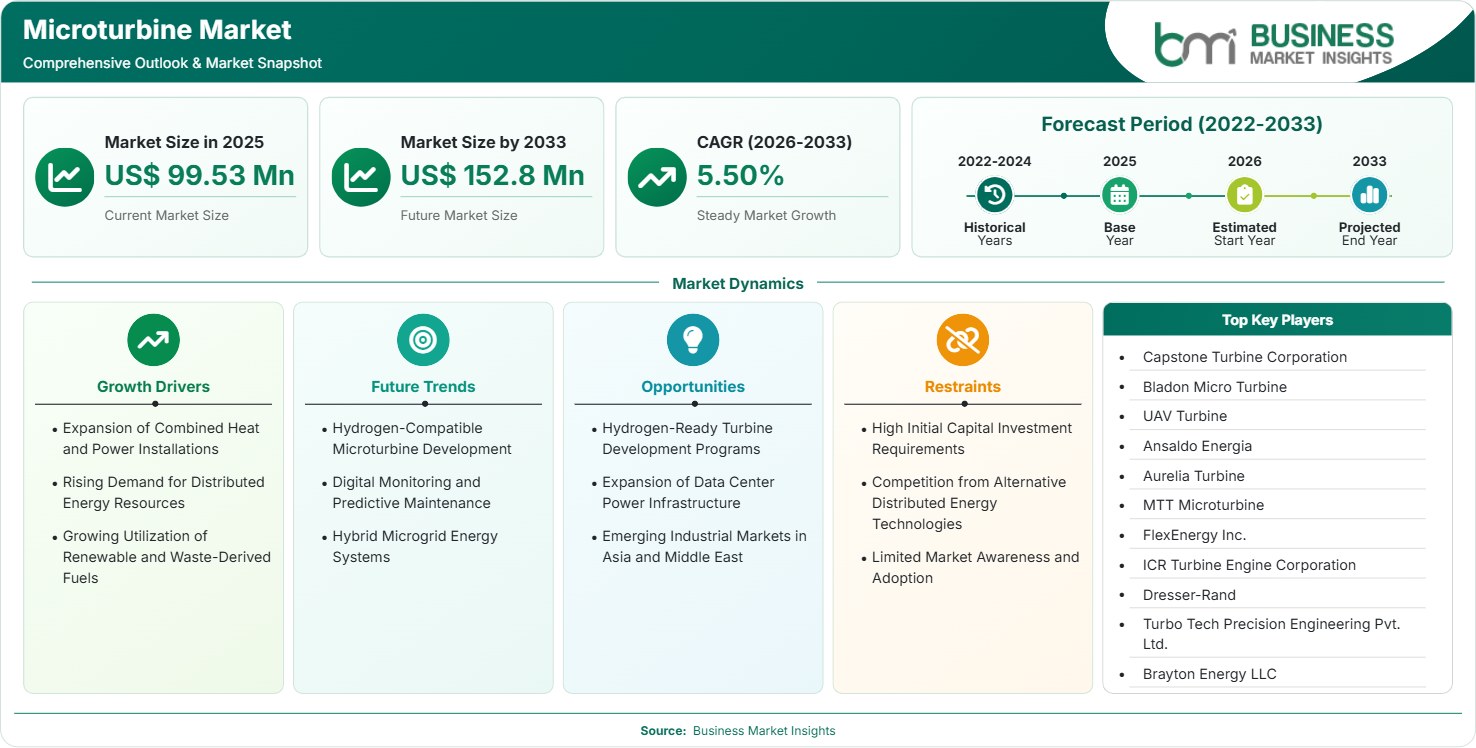
The Microturbine Market size was valued at US$ 99.53 Million in 2025 and is projected to reach US$ 152.8 Million by 2033, growing at a CAGR of 5.50% during 2026–2033. Rising demand for distributed energy systems, increasing CHP adoption, decarbonization initiatives, waste-gas utilization projects, and resilient backup power infrastructure create substantial growth opportunities across industrial and commercial sectors.

Report Coverage
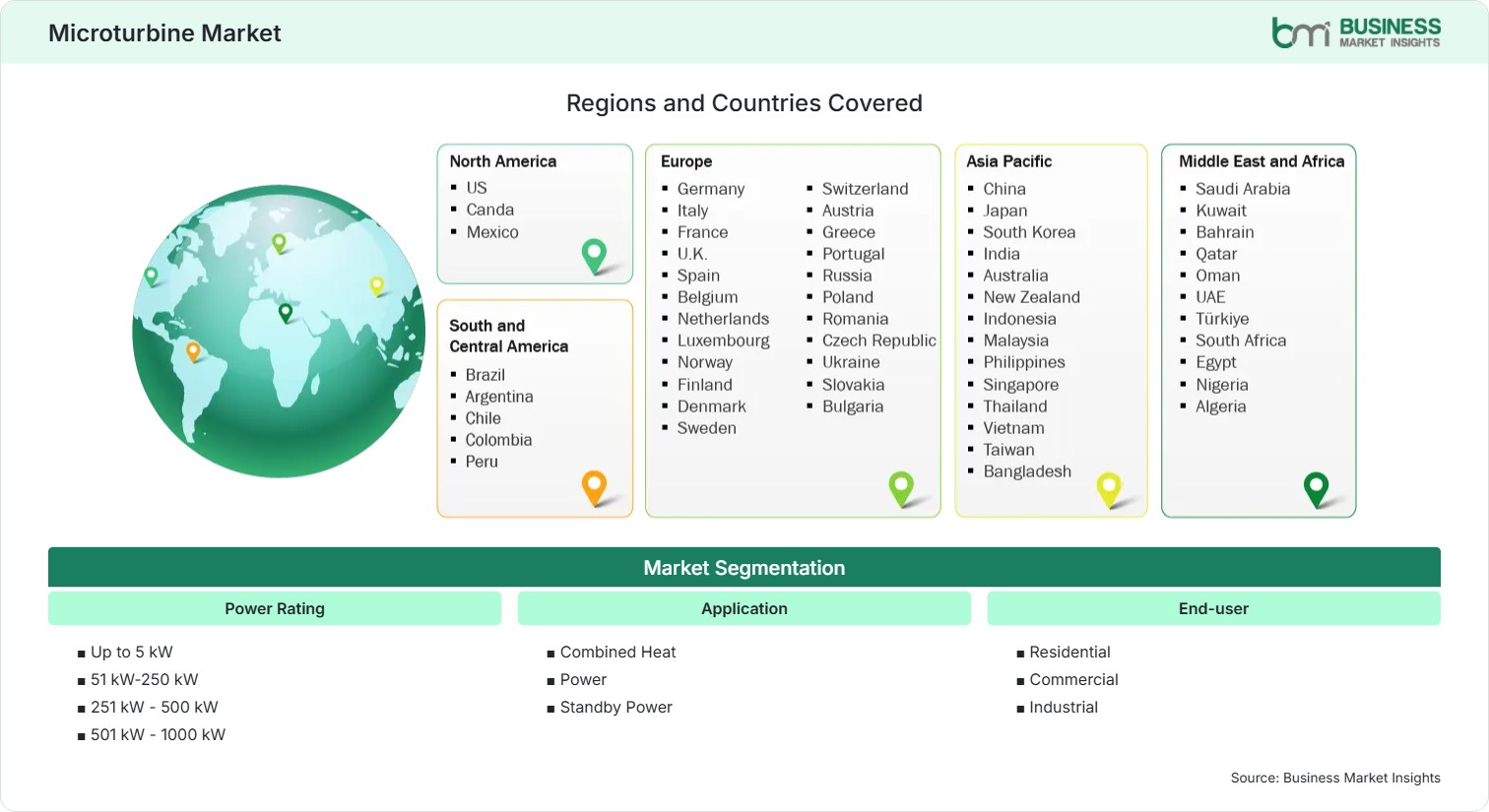
  • Power Rating: Up to 5 kW, 51 kW-250 kW, 251 kW - 500 kW, 501 kW - 1000 kW
  • Application: Combined Heat, Power, Standby Power
  • End-user: Residential, Commercial, Industrial
US$ 99.53 Mn Market size in 2025
US$ 152.8 Mn Market Size by 2033
5.50% CAGR, 2026 - 2033
2026-2033 Forecast Period

AI Overview

Microturbine Market Summary

  • North America Region: North America holds a market share of 36%–39% in 2025, growing at a CAGR of 5.2%–5.8% during 2026–2033. Growth is supported by distributed generation deployment, CHP investments, landfill gas utilization, energy resilience requirements, and industrial decarbonization strategies across commercial and municipal facilities. The U.S. accounts for most regional demand and is projected to expand at a CAGR of 5.3%–5.9% through 2033.
  • Fastest Growing Region: Asia Pacific holds a market share of 25%–28% in 2025, growing at a CAGR of 6.2%–6.9% during 2026–2033. Industrial expansion, grid reliability concerns, smart manufacturing investments, and increasing adoption of decentralized energy systems are accelerating deployment across emerging economies and industrial clusters.
  • Leading Segment: Combined Heat & Power (CHP) holds a market share of 63%–66% in 2025, growing at a CAGR of 5.4%–6.0% during 2026–2033. Superior fuel efficiency, continuous power generation capabilities, lower emissions, and favorable lifecycle economics support strong adoption across industrial and commercial facilities.
  • High Growth Segment: Industrial end-user holds a market share of 46%–49% in 2025, growing at a CAGR of 5.8%–6.4% during 2026–2033. Manufacturers increasingly utilize onsite generation systems to improve energy security, reduce operating costs, and support sustainability objectives amid volatile electricity markets.
  • Key Market Opportunity: Growing deployment of renewable natural gas, biogas, flare gas recovery, and hydrogen-ready turbine technologies presents significant opportunities for manufacturers targeting low-carbon distributed power generation applications globally.
  • Major Market Players: Capstone Turbine Corporation, Bladon Micro Turbine, UAV Turbine, Ansaldo Energia, Aurelia Turbine, MTT Microturbine, FlexEnergy Inc., ICR Turbine Engine Corporation, Dresser-Rand, Turbo Tech Precision Engineering Pvt. Ltd., and Brayton Energy LLC.
Strategic Insights

Microturbine Market: Strategic Insights

Microturbine Market Strategic Framework
FREE PDF
Request your free sample
Request free sample
Stakeholder View

Key Takeaways

  • The value chain has been increasingly integrating turbine suppliers, digital control system suppliers, fuel infrastructure suppliers, and EPC firms in order to enhance efficiency and performance.
  • CHP technologies continue presenting the greatest commercial potential due to the fact that users emphasize fuel efficiency, energy recovery and reduction of operating costs.
  • Research is conducted in the area of hydrogen combustion technologies, advanced ceramics, and AI-based diagnostic systems.
  • The Asia Pacific region is a lucrative investment opportunity due to the presence of industrial growth, energy security needs, and growing use of decentralized energy systems.
  • Strategic collaborations between turbine companies and industrial energy-service companies facilitate commercialization and increase access to new markets.
  • Waste-gas recovery in oil and gas industries is becoming a lucrative niche application.
Geographic Outlook

Microturbine Market Regional Highlights

North America Microturbine Market

North America accounts for 36%–39% of revenue in 2025 and is projected to register a CAGR of 5.2%–5.8% through 2033. The region benefits from mature distributed generation infrastructure, extensive CHP deployment, and strong industrial demand. The Microturbine Market share remains concentrated in the United States and Canada, where energy resilience and emissions reduction initiatives continue supporting adoption. Municipal facilities, hospitals, universities, and industrial sites increasingly deploy microturbines to improve operational continuity and energy efficiency.

  • The Industrial CHP facilities are growing as companies search for reliable sources of power and reduced costs in an ever-changing energy environment.
  • Landfill gas and wastewater treatment systems are providing revenue from the use of waste to produce energy in an efficient way.
  • Firms’ decarbonization goals facilitate the installation of less emission-producing onsite power generation resources.
  • Growing use of asset management software increases the reliability and visibility of the turbine operations.

US Microturbine Market

The United States represents 74%–77% of regional revenue and is expected to grow at a CAGR of 5.3%–5.9% during the forecast period. Federal energy-efficiency programs, industrial modernization initiatives, and strong CHP deployment support market development. Manufacturing facilities, healthcare institutions, and commercial buildings increasingly adopt decentralized generation systems to enhance resilience. Continued investment in renewable natural gas infrastructure further strengthens long-term demand for advanced microturbine solutions.

  • CHP energy systems are being used by hospitals to ensure constant supply of electricity and cut down energy costs.
  • The use of renewable natural gas has increased the feasibility of installing fuel flexible microturbines in city infrastructure projects.
  • Data centers are looking into distributed energy systems in order to enhance their reliability and backup system capability.
  • Greater focus on grid resiliency has resulted in investments in on-site generation systems.

Europe Microturbine Market

Europe holds 27%–30% of market revenue in 2025 and is forecast to grow at a CAGR of 5.1%–5.7% through 2033. Stringent emissions regulations, energy-efficiency targets, and industrial decarbonization policies drive adoption. Germany remains the leading market, while Italy and the Netherlands demonstrate notable deployment activity. The United Kingdom and Nordic countries are expanding distributed energy projects that utilize CHP and renewable gas applications to improve sustainability and energy security.

  • Decarbonization policies related to industries facilitate investment in distributed high-efficiency power generation technology.
  • Germany is leading the demand due to sophisticated manufacturing infrastructure and energy efficiency programs.
  • Integration of renewable gas policies encourages adoption of renewable gases in municipal and industrial energy projects.
  • Energy independence drives the growth of decentralized power technology demand.

Asia Pacific Microturbine Market

Asia Pacific accounts for 25%–28% of revenue in 2025 and is projected to record the fastest CAGR of 6.2%–6.9% through 2033. Industrial expansion, urbanization, and growing electricity demand support deployment across the region. China leads adoption volumes, while India and Southeast Asian countries emerge as high-growth markets. Microturbine Market growth in the region is supported by manufacturing investments, energy diversification initiatives, and increasing focus on efficient distributed generation infrastructure.

  • China remains active in industrial energy efficiency projects that need secure and reliable on-site power generation.
  • India is a promising market for its potential for manufacturing growth and energy security considerations.
  • The countries of Southeast Asia are implementing distributed energy systems to facilitate industrialization.
  • "Smart factories" present new opportunities for sophisticated electrical systems with control systems integration.

Rest of World Microturbine Market

Rest of World represents 7%–10% of global revenue and is anticipated to expand at a CAGR of 5.0%–5.6% through 2033. The Middle East benefits from oil and gas applications and industrial diversification strategies. South & Central America increasingly adopts distributed energy technologies to improve power reliability and operational efficiency. Countries including Saudi Arabia, the UAE, Brazil, and Chile continue investing in resilient energy infrastructure supporting decentralized generation deployment.

  • Oil and gas operators utilize microturbines for flare gas recovery and remote power applications.
  • Industrial diversification programs in Gulf countries support adoption of advanced energy technologies.
  • Mining and resource-processing sectors increasingly deploy distributed generation systems in remote locations.
  • Latin American infrastructure modernization initiatives improve opportunities for CHP and standby power applications.
Global Market Geography
FREE PDF
Request your free sample
Request free sample
Segment Analysis

Microturbine Market Segmentation

Power Rating

The 51 kW–250 kW category accounts for the largest share of approximately 38%–41% in 2025 and is projected to grow at a CAGR of 5.5%–6.1% through 2033. This range offers an optimal balance between efficiency, installation flexibility, and cost-effectiveness. The Microturbine Market scope continues expanding in commercial buildings, hospitals, and industrial facilities where medium-capacity distributed generation solutions support both operational resilience and energy-efficiency objectives.

  • Up to 50 kW: Often found in smaller commercial buildings, telecom applications, off-grid areas, and distributed energy applications where size, maintenance, and reliability continue to be key considerations.
  • 51 kW to 250 kW: Used extensively in hospitals, schools, office buildings, and factories needing energy production coupled with energy recovery capabilities and flexibility.
  • 251–500 kW: Found increasingly in medium-sized manufacturing plants, district energy projects, and factory campuses that are focused on energy efficiency and independence from the grid.
  • 501–1000 kW: Applicable to larger industrial operations and utility back-up systems that require consistent power generation and strong economics.

Application

Combined Heat & Power (CHP) represents the dominant segment with a 63%–66% market share in 2025 and an expected CAGR of 5.4%–6.0% through 2033. Strong economics associated with simultaneous electricity and thermal energy generation continue supporting adoption. Rising energy costs and sustainability requirements further accelerate CHP deployment across industrial, healthcare, and commercial environments.

  • Combined Heat & Power (CHP): Organizations deploy CHP systems to maximize fuel utilization, improve efficiency, lower emissions, and achieve meaningful operating cost reductions through recovered thermal energy.
  • Standby Power: Growing demand for uninterrupted electricity supply across healthcare, commercial, industrial, and telecommunications facilities continues supporting adoption of advanced backup power systems.

End-user

The industrial segment commands 46%–49% of revenue in 2025 and is expected to achieve the highest CAGR of 5.8%–6.4% through 2033. Increasing energy consumption, sustainability objectives, and demand for reliable onsite generation support deployment. Microturbine Market trends indicate that industrial users increasingly prioritize distributed energy assets capable of enhancing operational resilience while reducing long-term energy costs.

  • Residential: Installation continues to be prevalent in top-end residential communities, remote housing projects, and distributed energy installations that require consistent and easy-to-maintain energy production systems.
  • Commercial: Increasingly, commercial buildings, educational institutions, health care facilities, and hospitality sites are using microturbines to enhance efficiency, reliability, and sustainable performance.
  • Industrial: Factories, refineries, chemical plants, and other industries make use of microturbines for their uninterrupted operations and cost-cutting programs.
Market Forces

Microturbine Market Dynamics

Key Market Drivers

Expansion of Combined Heat and Power Installations

Combined Heat and Power (CHP) systems continue to be one of the most significant implementation approaches for microturbines. Based on the efficiency analyses conducted by such organizations as the International Energy Agency, CHP systems have the ability to obtain higher efficiencies than those of regular power systems due to the use of the wasted heat. Industrial plants, hospitals, colleges, and office buildings have started to implement CHP systems in order to cut down their fuel usage and costs. The small size, low emissions, and continuous operation with minimum maintenance are among the most attractive features of microturbines.

Rising Demand for Distributed Energy Resources

Power reliability concerns, grid congestion, and increasing electricity demand are driving adoption of distributed energy resources globally. Businesses increasingly seek onsite generation systems capable of supporting operations during outages and reducing dependence on centralized grids. Microturbines provide operational flexibility while enabling integration with renewable fuels and energy-management platforms. The Microturbine Market growth trajectory is closely linked to industrial modernization and resilience-focused infrastructure investments. Growth is particularly evident among facilities operating in regions with unstable grid conditions or high electricity costs. The ability to deliver continuous power and support critical operations strengthens the value proposition for end users.

Growing Utilization of Renewable and Waste-Derived Fuels

The growing availability of biogas, renewable natural gas, landfill gas, and flare gas provides the opportunity to deploy microturbines. The majority of industries are trying to find less environmentally damaging fuel sources but without sacrificing production efficiency. Fuel flexible turbines allow using alternative sources of energy and at the same time reducing emissions of greenhouse gases. The legislative programs aimed at the reduction of methane and waste-to-energy projects promote investments into microturbines. The microturbine market trends clearly indicate that companies move towards the development of circular-energy models.

Key Market Opportunities

Hydrogen-Ready Turbine Development Programs

Manufacturers are accelerating research into hydrogen-compatible combustion systems to align with emerging low-carbon energy ecosystems. Governments across Europe, Asia Pacific, and North America continue investing in hydrogen infrastructure, creating future demand for distributed generation technologies capable of operating with hydrogen blends. Microturbine Market Forecasts increasingly incorporate opportunities associated with hydrogen-ready systems because industrial customers seek flexible assets that can adapt to future fuel transitions. Companies developing advanced combustion technologies, materials, and controls are expected to gain competitive advantages. Successful commercialization of hydrogen-capable microturbines could unlock substantial deployment opportunities across industrial and commercial applications.

Expansion of Data Center Power Infrastructure

Fast growth in the domains of cloud computing, artificial intelligence, and digital services is driving the need for dependable solutions for energy distribution. Operators of data centers need robust power systems that will be able to support their operations without causing any downtimes. Microturbines present a viable choice for supplementary generation because of their high reliability, scalable architecture, and low maintenance needs. The expansion of edge computing systems and data centers across regions creates more possibilities for installation. The integration of CHP systems makes microturbines even more relevant to the digital environment.

Emerging Industrial Markets in Asia and Middle East

The development of industrial programs in India, Southeast Asia, Saudi Arabia, and the United Arab Emirates is increasing the need for decentralized electricity generation equipment. The need arises due to the need for electricity supply systems that will guarantee uninterrupted functioning of industries, industrial complexes, and processing plants. Microturbines are flexible and fuel adaptive solutions that suit regional energy policies. Rising investment in the diversification of industry and infrastructure development opens new market possibilities for the future. Companies forming regional alliances and manufacturing and service centers will gain from the increased demand.

Market Restraints and Challenges

High Initial Capital Investment Requirements

Factor: Microturbine systems typically require higher upfront investment compared with conventional diesel generators and certain alternative distributed generation technologies. Impact: Budget-sensitive customers may delay or reduce adoption despite long-term operational benefits. Installation costs, engineering requirements, and integration expenses can create financial barriers, particularly for small and medium-sized enterprises. While lifecycle economics often justify deployment through fuel savings and lower maintenance costs, purchasing decisions remain heavily influenced by capital expenditure constraints. This challenge is particularly relevant in developing markets where access to financing and energy-efficiency incentives remains limited.

Competition from Alternative Distributed Energy Technologies

Factor: Fuel cells, reciprocating engines, battery energy storage systems, and renewable energy technologies continue advancing rapidly in performance and cost competitiveness. Impact: Customers evaluating distributed energy solutions often compare multiple technologies based on efficiency, economics, emissions, and operational requirements. In some applications, alternative technologies may offer stronger short-term economic advantages or policy support. Manufacturers must therefore continue improving efficiency, fuel flexibility, and digital capabilities to maintain competitiveness. Intensifying technology competition may place pressure on pricing strategies and potentially slow adoption in selected end-use sectors.

Company Analysis

Competitive Landscape

The competitive environment remains moderately consolidated, with companies focusing on fuel-flexible technologies, CHP optimization, emissions reduction, and digital monitoring capabilities. The Microturbine Market analysis highlights increasing investment in distributed energy innovation, renewable gas compatibility, and advanced turbine engineering to improve lifecycle performance and operational efficiency.

Company Name

Overview

Products and Services Relevant to this Market

Capstone Turbine Corporation

Leading developer of low-emission microturbine systems serving commercial, industrial, energy, and transportation sectors globally.

Microturbine generators, CHP systems, distributed energy solutions, digital monitoring services, and renewable fuel-compatible power generation technologies.

Bladon Micro Turbine

U.K.-based turbine technology company focused on compact and efficient microturbine power systems.

Lightweight microturbines, energy generation systems, engineering services, and advanced turbine technology solutions.

UAV Turbine

U.S. manufacturer specializing in turbine propulsion and compact power generation technologies.

Small turbine engines, distributed power systems, aerospace turbine technologies, and engineering services.

Ansaldo Energia

Global energy technology company offering advanced power generation equipment and engineering solutions.

Gas turbines, distributed generation technologies, energy infrastructure solutions, and industrial power systems.

Aurelia Turbine

Finnish company focused on high-efficiency microturbines for industrial and distributed energy applications.

Microturbine generators, CHP systems, waste heat utilization solutions, and industrial energy technologies.

MTT Microturbine

Netherlands-based innovator developing advanced microturbine technologies for sustainable energy applications.

High-efficiency microturbines, energy recovery systems, distributed power generation, and engineering support services.

FlexEnergy Inc.

U.S. provider of clean energy systems utilizing waste gases and renewable fuel resources.

Microturbines, waste-gas recovery technologies, flare gas utilization systems, and industrial energy solutions.

ICR Turbine Engine Corporation

U.S. engineering company specializing in compact turbine engine technologies.

Turbine engines, power generation systems, engineering development, and specialized turbine applications.

Dresser-Rand

Established energy equipment manufacturer operating across industrial power and energy infrastructure markets.

Turbomachinery solutions, distributed generation equipment, energy infrastructure products, and engineering services.

Turbo Tech Precision Engineering Pvt., Ltd.

Indian engineering company engaged in turbine manufacturing and precision industrial solutions.

Turbine components, power generation equipment, engineering services, and precision manufacturing capabilities.

Brayton Energy, LLC.

U.S.-based technology developer focused on advanced energy conversion and turbine technologies.

Microturbine technologies, clean energy systems, advanced power conversion equipment, and research-driven engineering solutions.

Trust & Transparency

Research Methodology

The market analysis combines proprietary research with secondary data from government agencies, company disclosures, regulatory filings, industry databases and expert interviews. Market estimates are validated through data triangulation, cross-market benchmarking and analyst review.

View Full Research Methodology

Questions Answered

Frequently Asked Questions

How does a Microturbine Market Report support strategic planning?

A comprehensive report helps stakeholders assess technology trends, competitive positioning, investment opportunities, regional demand patterns, fuel-transition developments, and emerging application areas influencing future growth.

What end-user segment offers the strongest growth potential?

Industrial facilities represent the strongest growth segment due to rising energy consumption, operational resilience requirements, sustainability initiatives, and increasing deployment of distributed energy infrastructure.

Why are CHP applications important for this industry?

CHP systems maximize fuel utilization by simultaneously generating electricity and thermal energy. This improves overall efficiency, lowers operating costs, and supports sustainability goals across energy-intensive facilities.

Which fuel sources can microturbines utilize?

Modern microturbines can operate using natural gas, biogas, renewable natural gas, landfill gas, flare gas, and selected hydrogen blends, depending on system design and combustion technology specifications.

What factors are driving adoption of microturbine technology?

Demand is primarily driven by growing CHP installations, increasing focus on energy efficiency, distributed generation investments, renewable fuel utilization, and the need for resilient onsite power generation across commercial and industrial facilities.

Access the Full Microturbine Market Report

Get segment-level forecasts, regional estimates, competitive benchmarking, company profiles and downloadable Excel datasets.

Access the full Microturbine Market Report
350 pages PDF & Excel | 2026-08-18
Similar Research

Related Market Reports